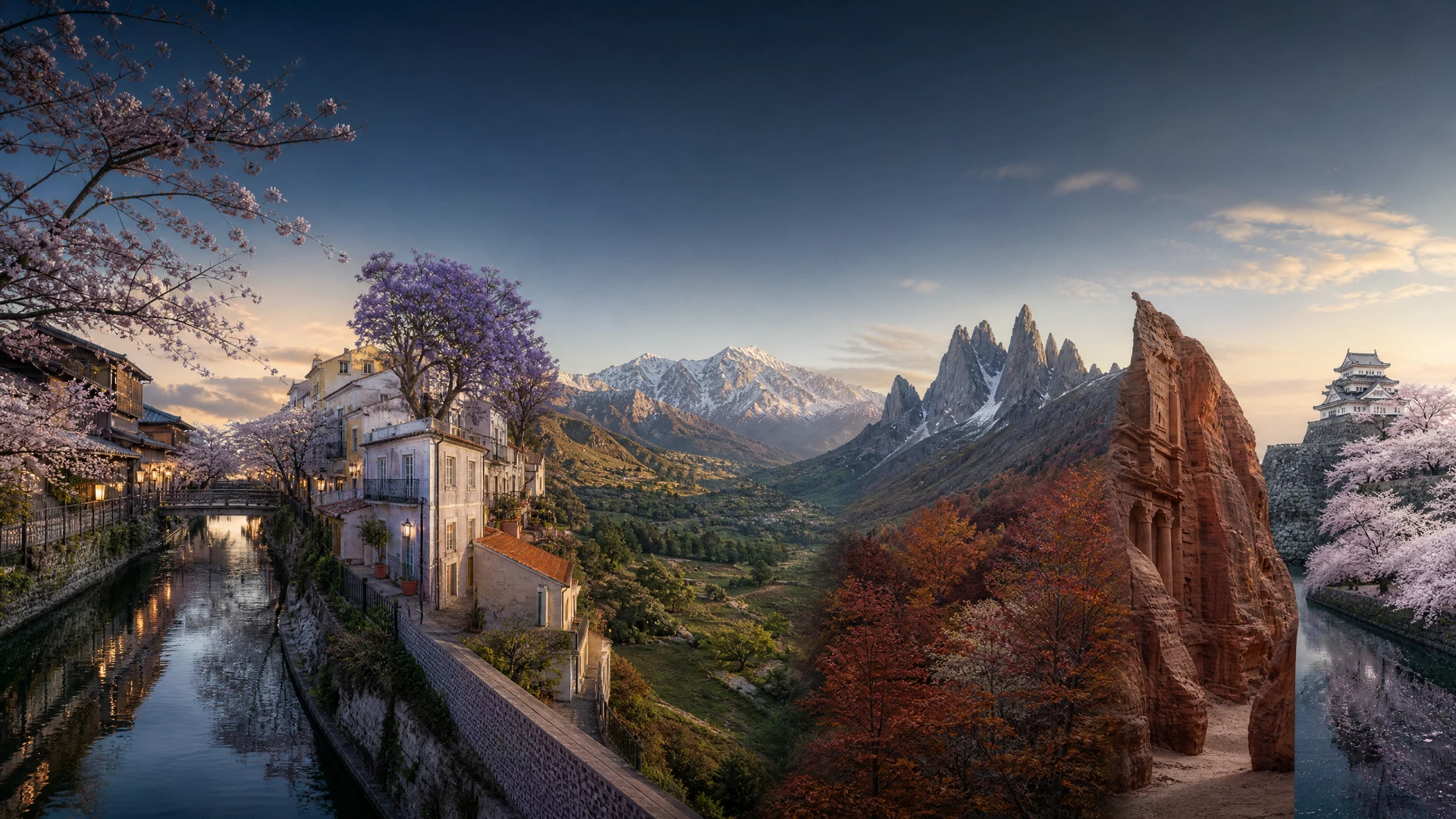
The Six Places Where April Is the Only Correct Answer.
Destination: Global
Category: comparison
At 6:12 in the morning, the canal beside Kyoto's Philosopher's Path is still carrying last year's leaves beneath the first layer of pink. The person who arrives then has not beaten the crowds in the usual travel-guide sense. They have caught a country in the short interval between its ordinary morning and its annual act of collective attention. By ten, the path will be a procession. By noon, every convenience-store shelf will be missing the pink packaging that exists for two weeks and then vanishes. In April, Japan does not decorate itself with cherry blossoms. It organizes itself around their disappearance.
That is what makes April difficult to describe and easy to misunderstand. It is not spring everywhere. It is late-season snow above the Atlas valleys and new green below them. It is autumn closing the trekking season in Patagonia while Jordan's highlands are flowering. It is Lisbon before the summer crowds claim the hills and northern Japan after the obvious blossom cities have exhausted the attention of the world. Every other month has a dominant travel logic. December is a decision about winter. July is a decision about summer. April asks a harder question: which version of the planet do you want to encounter while the others are happening at the same time?
This is an argument about where to go in April, not a list of places where the temperature happens to be agreeable. These six places belong here because April changes the experience at its core. Japan makes a flower into a national calendar. Lisbon enters the brief interval when its light, civic memory, and streets align. Morocco turns the country between desert and snowmelt. Patagonia takes on its deepest color before the trails close. Jordan becomes walkable and briefly green. Tohoku offers the same Japanese bloom front after the rest of the world has already crowded south. None is interchangeable. Each is a reason to look at April as a collection of exact windows rather than a generic shoulder season.
Japan: The Country That Built a National Identity Around a Two-Week Flower
Japan belongs on this list first because April is the month when a natural event becomes a social fact. The Somei Yoshino cherry is not rare; it is planted so widely that its bloom functions as a national clock. The blossom front, or sakura zensen, moves north through the archipelago each spring, followed by forecasts, office hanami plans, limited seasonal food, weather anxiety, and the brief knowledge that whatever looks full today will be gone by the weekend. The flower is beautiful, but beauty is not the real argument. The argument is that Japan has spent centuries treating impermanence as a reason to gather rather than a reason to mourn alone.
In Kyoto, the most useful way to understand this is not to join the largest crowd immediately. Start at the northern end of the Philosopher's Path near Ginkaku-ji while the canal is still reflecting houses instead of phones. The walk is two kilometers, and the cherry trees along it were planted in the early twentieth century as part of the canal landscape. At daybreak, the petals on the water are not yet trampled into the edges of the path. The city is still a place with school routes, bicycles, and residents buying breakfast. By late morning, it has become the Kyoto in which every visitor wants proof they were there.
Then go to Maruyama Park after dark, when the old shidarezakura—the weeping cherry illuminated during the season—turns hanami from a photograph into a public ritual. The trade is obvious: night viewing is more crowded. But it also explains something daylight cannot. Salarymen, students, families, and friends sit under trees with blue tarps, canned highballs, bento boxes, and the particular good humor of people who know they have negotiated an annual inconvenience together. It is not a private encounter with nature. It is a mass agreement that the flower deserves attention while it is here.
April changes the food calendar as decisively as it changes the parks. Sakuramochi appears with the leaf still around it; bakeries sell pink bread and convenience stores turn their packaging into a temporary field guide to national sentiment. The important detail is not that these items are refined. It is that the entire food system accepts their short life. A traveler can eat a sakura rice cracker in a Tokyo station on Tuesday, return the following month, and find the season has been packed away without apology.
That ephemerality makes planning important. A Tokyo food itinerary that begins at Tsukiji before the market crowds consolidate gives the trip an urban counterweight to the blossom parks, while a Kyoto route built around dawn walks and the quieter edges of the city is the better structure for a bloom-week base. If you have time to extend south, the Hiroshima and Miyajima cultural guide adds a later or earlier stop depending on how the front is moving that year.
Japan is the April argument for ritual. Lisbon is the argument for an entirely different kind of timing: the moment a European capital is about to become summer, but has not yet surrendered its streets to it.
Lisbon: The City Before Summer Arrives—and Before It Turns Purple
Where Japan makes April visible through the fleeting pink of a national ritual, Lisbon lets April arrive as a release of pressure. The city has not yet hit the long, dry summer rhythm that concentrates visitors in Alfama, Baixa, and the tram corridors. Easter has passed. The air is often warm enough for late lunches outside but cool enough to walk from the river to the higher neighborhoods without making each climb into an endurance event. This is not the generic claim that spring is pleasant. It is the particular point in Lisbon's year when the city can still be used at walking speed.
Late April has a second, more visual argument. Jacarandas are not at their broad May peak yet, but the first purple begins to appear in the places that reward looking up rather than following the tram line. Around Rua Castilho above Marquês de Pombal, the canopy starts to announce itself. At Largo do Carmo, the earliest color changes the small square's relationship to the ruins of the Carmo Convent. The April traveler catches Lisbon in the first act rather than the full display: low sun through a few violet clusters, cream façades still holding the evening warmth, tables outside before dinner service begins.
The more consequential color on the calendar is red. April 25 is Dia da Liberdade, the anniversary of the 1974 Carnation Revolution. The date commemorates the overthrow of the Estado Novo dictatorship, and the symbol is not a piece of visitor theatre: carnations were placed in the muzzles of soldiers' rifles as Lisbon's political order changed. On that day, the city has concerts, public gatherings, and the feeling of a civic holiday that belongs to people who live there. A traveler can be present without pretending to possess its memory. That distinction is why April 25 matters more than an abstract promise of good weather.
Make room for the city's ordinary food infrastructure, not only the food halls built for first contact. Mercado de Arroios and neighborhood counters around Intendente remain useful because lunch is still organized around local routines. Order ameijoas à Bulhão Pato when clams are available, stand at a counter for a bifana, and save the polished pastry pilgrimage for a moment when you actually want it. Lisbon is generous in April because you are not forced to treat every meal as an appointment with a queue.
For the edible Lisbon that exists beyond a highlight reel, the four-day food route through petiscos, markets, and local wine is the right companion. The five-day Lisbon guide that links Alfama, Belém, and Sintra without reducing the city to a tram ride makes more sense if April 25 turns your stay into a longer trip.
Lisbon is April's urban sweet spot: the city is open but not yet consumed by the season. Morocco follows as a larger transformation. There, April does not simply make the streets more comfortable. It reveals green in places travelers expect to remember as brown.
Morocco: The Desert After the Winter Rains
If Lisbon in April is about a city breathing before summer, Morocco is about a country showing the work winter has done. The travel version of Morocco that dominates the imagination is ochre: dust, desert, sun-baked walls, heat rising off the road between Marrakech and the south. It is accurate, but it is incomplete. After the rains and Atlas snowmelt, April has another palette. Valleys carry more water. Hillsides hold green longer. The Draa Valley's palm corridor has its most persuasive contrast with the dry land around it. The country is still Morocco; it is simply visible in a form that the high-summer itinerary cannot produce.
Drive south from Marrakech and the sequence begins to make sense. The High Atlas may retain snow at the upper elevations while lower slopes and cultivated valleys start producing wildflowers. In Imlil, the base village used by many Toubkal trekkers, the question is no longer whether winter equipment has ended every possible walk. It is which elevation and weather window make sense that week. April is variable; it rewards travelers who can leave one flexible day for the mountains rather than treating the range as a fixed postcard behind the city.
The second April clock is in the Vallée des Roses around Kelaat M'Gouna. The larger Rose Festival is associated with early May, but late April is when the first harvest activity turns the valley from a name on a map into a working agricultural economy. Damask roses are gathered early, before the day warms, and cooperatives begin turning a brief flowering period into rosewater and oil. The point is not to arrive expecting a commercial festival every afternoon. It is to understand that April is the lead-in to a harvest whose scent, labor, and water use shaped this valley long before it appeared in an itinerary.
Farther south, the Draa Valley makes the strongest visual case. The palm grove running through Agdz and toward Zagora exists because water is managed through a landscape that otherwise gives no one an easy margin for error. Look for the khettara channels and the small decisions—walls, groves, irrigation, shade—that turn a route into a settled corridor. In September, the same road reads as desert overcoming cultivation. In April, cultivation has a visible argument back.
Fes is also kinder to the body in April, though calling that a reason to visit undersells it. The terraces above the Chouara Tannery are still pungent; they should be. The pits use a process involving lime, pigeon droppings, dyes, and work that cannot be deodorized for an outside audience. Clear spring light makes the vats legible before the summer dust and heat turn observation into a test of how long one can stand still. Go early, buy something only if you want it, and do not confuse the balcony you are shown with the entire city.
The ten-day Morocco road trip through Marrakech, the Sahara, Fes, and Chefchaouen is the practical route if the April landscape is the point, because it gives the south and the mountain roads enough room. The Marrakech food guide keeps the city from becoming merely the place where you sleep before leaving it.
Morocco greens in April because water temporarily changes the terms of the landscape. Patagonia takes that seasonal transformation in the opposite direction. It does not wake up. It begins to close, and in doing so becomes more intensely itself.
Patagonia: The Autumn That Turns the World Gold, Then Burgundy
Where Morocco is April at the moment water makes the desert answer back, Patagonia is April at the moment the year begins taking things away. The long summer days are shortening. Some services are preparing to close. The wind can still be serious because this is Patagonia, not because someone chose the wrong month. But that contraction is the argument. The crowds have thinned, the refugios are less dominated by peak-season booking pressure, and the lenga beech is moving beyond March gold into deeper ochre, copper, and burgundy.
Lenga is not decoration on a trek. It changes the scale of the granite. In Torres del Paine, look for it on the approach to the French Valley and in the woods that make the grey rock and glacial water feel less monochrome. In April, a branch of autumn color in the foreground can make a familiar view read as a landscape in motion. On the Argentine side, the road and trails near El Chaltén bring the same contrast around Fitz Roy: dark rock, cold light, and trees that look as if the entire valley is holding the last heat of the season.
The trade-off is real. Daylight is shorter. Weather can close plans. Some campsites, ferries, restaurants, or buses may shift schedules as winter approaches. That is precisely why April is not a casual choice; it belongs to the traveler who wants the trek rather than the guarantee of a full summer operation. The route needs contingency. An extra night in Puerto Natales or El Chaltén is not wasted planning. It is what allows you to wait out a bad forecast and walk when the towers are actually visible.
April also changes the social texture of a refugio. In January, the W Circuit can feel like a reservation system wearing hiking boots. In April, a shared table has more room for people who arrived because they wanted the trail, not because a seasonal photo told them where to stand. That does not mean walk-ins are assured. It means the booking equation is less absurd, particularly outside holiday periods, and that the traveler has a better chance of choosing dates based on weather than on whatever bed remained six months earlier.
Use the Patagonia road trip linking Torres del Paine, El Calafate, and the Carretera Austral when the April case is color plus range. If the goal is to concentrate on the Chilean hiking logic, the Torres del Paine adventure guide lays out the sequencing that makes a variable-weather trip possible.
Patagonia turns in April because the Southern Hemisphere is withdrawing from summer. Jordan provides the reverse image: a desert country briefly made generous by spring, before heat takes the terms away again.
Jordan: The Desert That Flowers Before It Burns
If Patagonia's April is about the closing of a season, Jordan's is about the narrow opening before another one becomes punishing. Petra is always stone. Wadi Rum is always sand and rock. But April changes the distance between them and the person trying to walk through them. Mornings are cool enough to enter the Siq with a jacket in hand. The climb to the Monastery is a physical day rather than a calculation about how much heat you can absorb. Wadi Rum's night can still require a Bedouin blanket rather than an air-conditioned tent pretending to be a desert camp.
Start Petra at opening. The Treasury is the image everyone recognizes, but April gives the day enough usable temperature to keep walking after the first reveal. Continue past the Royal Tombs, find a quieter place for tea, and decide whether the Monastery route is worth the steps based on the actual weather rather than the imagined trip. The value of a 6am entry is not solitude as a trophy. It is that the Siq is still a passage—water-worn stone, echo, shade—before it becomes a corridor of arrivals.
Jordan has a spring argument outside Petra that deserves more attention than it gets. Dana Biosphere Reserve spans dramatic changes in elevation and habitat, moving from Mediterranean-like highlands toward desert. In spring, its hills can hold wildflowers and green that surprise travelers who came expecting only ochre. The black iris, Jordan's national flower, appears in its season across parts of the highlands; do not plan a whole trip around one blossom, but do let the possibility correct the usual mental image of the country. April is when Jordan's ecological range is easiest to grasp on foot.
Wadi Rum works because April nights still ask something of you. A Bedouin camp should not be sold as a costume. Ask who operates it, whether the food is prepared on site, how waste is handled, and whether the program leaves room for the desert rather than filling every hour with vehicles. The best moment is often after dinner, when the group noise thins and the sand has lost the heat it held during the afternoon. This is the month when the desert can be cold enough to feel like a place with a night life of its own.
The five-day Jordan and Petra route that combines the Treasury at dawn, Wadi Rum, the Dead Sea, and Amman is useful regardless of whether the trip is romantic; it has the geographical sequencing right, which is more important than the label.
Jordan flowers in April because the desert has a short period of mercy. Japan's northern Tohoku region takes us back to the flower itself, but only after Tokyo and Kyoto have made it feel almost impossible to see without surrendering the day to crowds.
Tohoku: The Cherry Blossoms That Arrive After the World Has Moved On
Where Jordan offers a spring the standard desert image refuses to predict, Tohoku offers the version of Japan that the standard cherry-blossom itinerary leaves behind. The cultural importance of hanami does not end when the Tokyo and Kyoto headlines have peaked. It moves north. Lower temperatures and latitude delay the blossom front into mid-to-late April and, in some locations, toward early May. This is not an argument for avoiding the famous cities because they are famous. It is an argument for following the season far enough to find the scale that central Japan cannot offer at its busiest.
Hirosaki Park in Aomori is the clearest proof. Around Hirosaki Castle, roughly 2,600 cherry trees create a different relationship between bloom and place: petals gather in the moat, the castle rises beyond the canopy, and mature trees carry the density that makes the park feel less like an avenue of blossoms than a temporary weather system. The key detail is the moat. When petals begin falling, the water collects them into pink surfaces that change hour by hour. A traveler who knows only the tidy image of one branch against one roof has missed the full-scale event.
Kakunodate offers a second form of April. Its samurai district contains old residences, broad streets, and shidarezakura planted in and around the compounds. The weeping forms matter because they hang at human height, creating an intimate counterpoint to Hirosaki's larger canopy. Go before the coach groups arrive, not because early mornings make a traveler morally superior, but because the wood façades and branches can be read together before the street becomes a one-way current of people.
Then there is Kitakami Tenshochi, where thousands of trees line a long stretch of the Kitakami River. The riverbank works as a corrective to the idea that every cherry-blossom experience must happen within a city park. In the right bloom week, the scale comes from repetition: trees, water, distant hills, and the fact that there is room to keep walking. It is possible to spend an afternoon following the blossom line without fighting for a single frame.
Tohoku has no standalone AskLeif guide yet, so it should be planned as a deliberate northern extension, not misrepresented as a plug-in to a Tokyo weekend. The 14-day Japan rail-pass itinerary is the best structure for allowing a northbound detour, and the two-week Japan rail route explains the longer-distance rhythm that makes a two-night Tohoku addition practical. The Hayabusa shinkansen puts northern Honshu within reach of Tokyo, but reachability and adequacy are not the same thing. Give the region enough time to be more than a checkmark.
Where to Go in April: The Calendar Is the Itinerary
The mistake in planning an April trip is choosing the destination first and treating the calendar as an afterthought. In this month, the calendar is the itinerary. The right April trip begins with a window, then finds the place that belongs inside it.
Japan's central bloom is often a late-March to early-April decision, but forecasts vary every year with late-winter temperatures. Book flexible where possible, particularly in Kyoto. Japan's Tohoku bloom follows later, which is why it is the choice for travelers able to go in the second half of the month or willing to plan a northern extension. Do not try to “do all of Japan” during one blossom week. Pick the version of hanami you want: the communal intensity of the central cities or the later, more regional scale of the north.
Lisbon works throughout April, but the final week gives you the chance to be present for Dia da Liberdade on April 25 and perhaps see the first jacaranda color. If political and civic life interests you, build around the date. If the goal is long walking days and more restaurant availability, the middle weeks may offer the cleaner balance.
Morocco rewards an April trip that does not lock every road before arrival. Give the Atlas a weather buffer. Treat the Vallée des Roses as a working landscape with harvest timing, not a promise that a festival will happen on demand. The Draa Valley needs a road-trip structure; it cannot be absorbed into a rushed weekend in Marrakech without losing the water-and-desert argument that makes it matter.
Patagonia is the highest-commitment choice. Plan for seven to ten days at minimum if hiking is the point, carry weather-ready layers, and build an extra day into the route. It is also the April destination where the reward is most tied to accepting uncertainty. You are choosing deeper autumn color, lower crowd pressure, and shorter operational margins in exchange for the stability of peak summer.
Jordan can work in five to seven days: Amman for arrival and food, Petra for two nights if your legs allow it, then Wadi Rum and the Dead Sea depending on priorities. April is popular for good reasons, so Petra accommodation and quality desert camps should be booked early. The temperature advantage disappears quickly as the year moves toward May.
Budget follows the same pattern. Japan during bloom is the expensive outlier, especially in Kyoto. Tohoku can ease the accommodation pressure but will not make a late booking effortless. Lisbon and Morocco are often more manageable if you avoid holiday-week compression. Jordan's costs depend heavily on transport and desert-camp choices. Patagonia requires the largest logistics budget because it layers flights, transfers, refuge or lodging, equipment, and the price of keeping weather flexibility.
Where to Go in April: Why Not Amsterdam, Thailand, or Paris?
Amsterdam has tulips in April and deserves the demand it receives. It is excluded because this is not a list of flowers. Keukenhof is an extraordinary horticultural display, but it is designed for the visitor's gaze. Japan's hanami and Tohoku's delayed bloom are living seasonal practices that change how a country eats, gathers, commutes, and speaks about time. Lisbon's April 25 is a civic act. Morocco's green is a water story. Jordan's bloom changes what the desert allows. The Netherlands gives you flowers arranged for viewing; these places give you a month that alters the life around them.
Thailand gives April one of the year's great public events: Songkran. It is also often the hottest and most chaotic period in the country, with regional heat and holiday movement shaping the trip around a single festival week. Go for Songkran if Songkran is your reason. Do not put it on a list of destinations that remain at their best through the whole month for multiple kinds of traveler. The distinction is an act of curation, not a slight.
Paris in spring needs no rescue from invisibility. The chestnuts, café tables, and river light are already among the most documented April experiences on earth. It does not need this article's argument. The places above do, because the fact that they are excellent in April is not enough. April is the evidence for what they are.
Japan blooms. Lisbon purples. Morocco greens. Patagonia turns. Jordan flowers. Tohoku blooms later.
Six April arguments, each unavailable in quite the same way one month earlier or one month later. The month belongs to no single season. That is not a complication. It is the reason to travel in it.