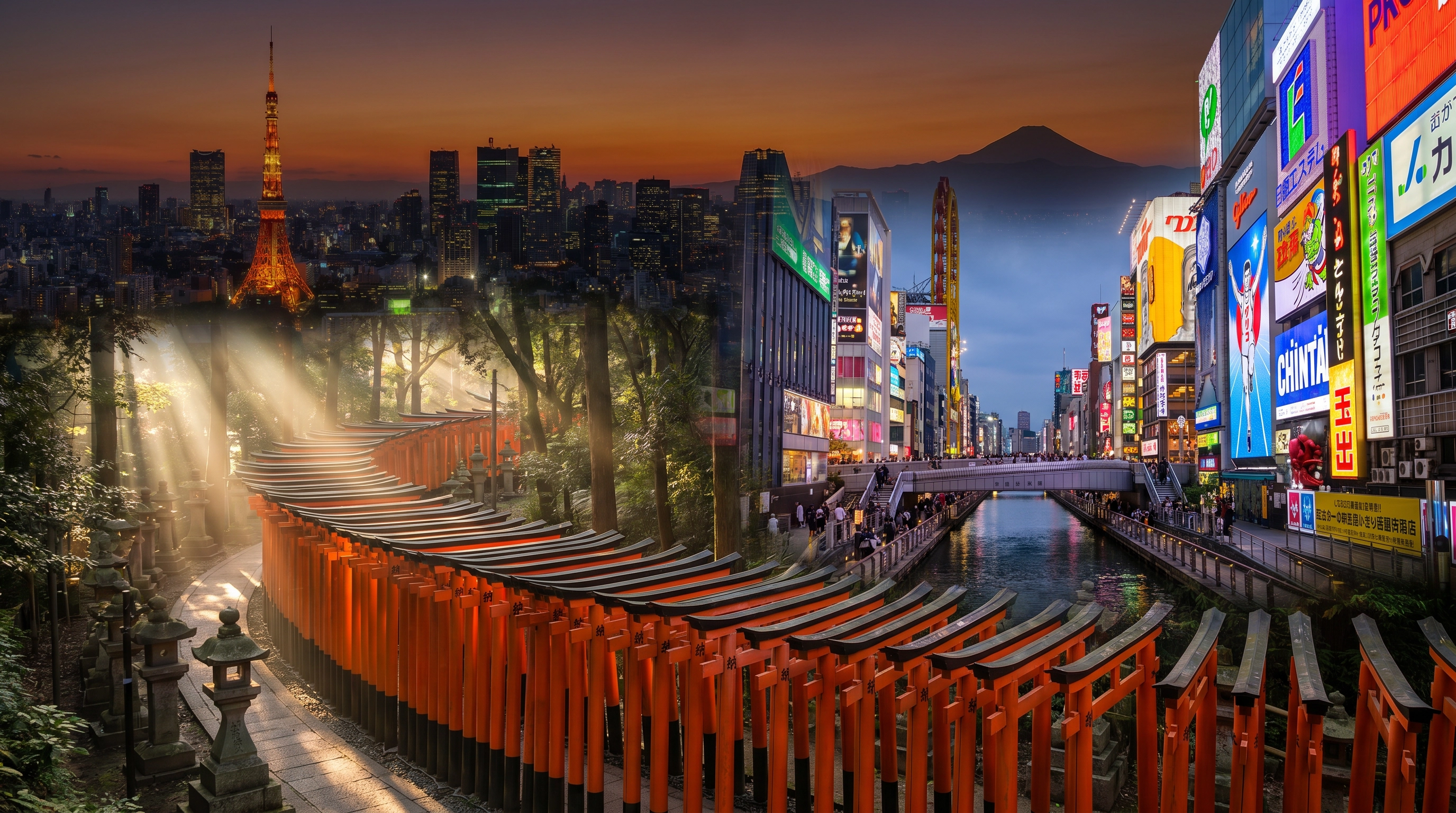
Japan in Two Weeks: The Itinerary That Actually Makes Sense
Destination: Japan
Category: Destination Guides
Japan in Two Weeks: The Itinerary That Actually Makes Sense
There is a moment, somewhere around day three in Japan, when something quietly breaks inside you. Not in a bad way. In the way that happens when a place is so completely unlike anything you've ever experienced that your brain simply stops trying to file it under a familiar category and surrenders. You're standing in a 7-Eleven at midnight eating a warm nikuman pork bun that is, inexplicably, one of the best things you've ever tasted. The streets outside are immaculate. A salaryman in a perfect suit bows slightly as he passes. A vending machine on the corner sells hot coffee in cans. And you think: I have been wildly underprepared for how good this was going to be.
That's Japan. And if you've been putting it off, waiting for the right time, telling yourself you'll go "eventually" — this is your sign. Two weeks is the sweet spot. Long enough to move between cities and feel each one settle into you. Short enough to keep the energy high. And the route that works — the one that flows geographically, builds in intensity, and ends on a note that will make you immediately start planning the return trip — is this one.
Tokyo. Hakone. Kyoto. Nara. Osaka.
This is how you do Japan for the first time. And the second time. And honestly, every time.
Why Two Weeks Is the Right Amount of Time
One week in Japan is a tease. You'll see Tokyo and maybe Kyoto, spend half your time jet-lagged, and leave feeling like you barely scratched the surface. Three weeks risks the fatigue that comes from moving too fast through a country where slowing down is actually the point.
Two weeks — fourteen days — gives you enough time to spend four or five nights in Tokyo without rushing, make the transition to Kyoto and feel the city shift from kinetic to contemplative, detour through Nara for a morning that will permanently alter your understanding of what a "day trip" can be, and end in Osaka with enough energy left to eat your way through Dotonbori like it's your job.
It also gives you one or two buffer days. Japan rewards spontaneity within structure. Leave space for the afternoon you spend down a random alley in Gion because the light was right. Leave space for the extra bowl of ramen you didn't plan for but absolutely needed.
The Route: How It Flows
Tokyo (Days 1–5) → Hakone (Day 6) → Kyoto (Days 7–10) → Nara (Day 11, day trip) → Osaka (Days 12–14)
The Shinkansen bullet train connects these cities in a way that makes the logistics almost embarrassingly easy. Tokyo to Kyoto is 2 hours 15 minutes. Kyoto to Osaka is 15 minutes. The Japan Rail Pass covers all of it and pays for itself within the first few rides if you're doing this route. Buy it before you leave home — it's only available to foreign visitors and must be purchased outside Japan.
Total distance: roughly 500 kilometers. Total travel time between cities: under 5 hours across the entire trip. The rest of your time is spent actually being in Japan, which is the point.
Tokyo: Days 1–5 — The City That Rewrites Your Expectations
Land at Narita or Haneda, take the train directly to your hotel (do not take a taxi from the airport — it will cost you ¥20,000 and you'll feel foolish), and give yourself the rest of day one to walk. Just walk. Pick a neighborhood — Shinjuku, Shibuya, Shimokitazawa, Yanaka — and walk until your legs give out. Tokyo reveals itself on foot in a way it doesn't from any other vantage point.
Tokyo is the largest city on Earth by population, but it doesn't feel that way. It feels like a collection of villages that happen to be adjacent to each other, each with its own personality, its own food culture, its own reason to exist. Shinjuku is neon and noise and the best ramen you'll eat at 2 AM. Yanaka is narrow lanes and old wooden houses and the Tokyo that survived the earthquakes and the bombs. Harajuku is fashion and chaos and the most extraordinary people-watching on the planet. Akihabara is a fever dream of electronics and anime that you either find overwhelming or completely addictive, usually both.
What to prioritize in Tokyo:
The Tsukiji Outer Market for breakfast — the inner market moved to Toyosu, but the outer market still has the best tamagoyaki egg omelets, fresh tuna on rice, and grilled scallops you'll find anywhere in the city. Go before 9 AM. Senso-ji Temple in Asakusa is the oldest temple in Tokyo and the most visited, which means you should arrive at dawn when the lanterns are still lit and the incense smoke hangs in the air before the tour groups arrive. teamLab Borderless (recently reopened in Azabudai Hills) is the digital art installation that every person who visits Tokyo in 2024 and 2025 will tell you about, and they're right — it's genuinely unlike anything else on Earth.
For food: Tokyo has more Michelin stars than any other city in the world. You don't need a reservation at a three-star restaurant to eat extraordinarily well. The standing ramen bars, the basement depachika food halls in department stores, the yakitori alleys under the train tracks in Yurakucho — these are where the real eating happens.
For the full Tokyo breakdown by travel style, our guides cover every angle: the 5-day solo Tokyo itinerary for Shinjuku, Akihabara, and the hidden bar scene; the 5-day couples itinerary for Yanaka walks, Daikanyama, and a Hakone onsen day trip; the 5-day budget guide for doing Tokyo on ¥8,000 a day without missing anything important; and the 5-day luxury guide for omakase counters, Aman Tokyo, and the experiences that require a reservation six months in advance. If you're bringing the family, the 6-day Tokyo family guide covers teamLab, Ueno Zoo, Harajuku crepes, and conveyor belt sushi in the order that makes logistical sense with kids in tow.
Hakone: Day 6 — The Breathing Space Between Cities
Most two-week Japan itineraries skip Hakone or treat it as an afterthought. This is a mistake.
Hakone is a mountain resort town 90 minutes southwest of Tokyo by the Romancecar express train, and it exists for one purpose: to slow you down. It sits in the caldera of a dormant volcano, on the shores of Lake Ashi, with views of Mount Fuji on clear days that will make you understand why the Japanese have been painting that mountain for a thousand years.
The classic Hakone experience is the ryokan — a traditional Japanese inn where you sleep on a futon on tatami floors, wear a yukata robe to dinner, eat a multi-course kaiseki meal that arrives in lacquered boxes, and soak in an outdoor onsen hot spring bath while the steam rises into the mountain air. This is not a luxury experience in the Western sense. It's a cultural one. Every Japanese person you meet will tell you that a night in a ryokan is something you have to do at least once. They're right.
The Hakone Open Air Museum is one of the great surprises of Japan — a sculpture park set against mountain scenery with works by Picasso, Rodin, Henry Moore, and Japanese artists, spread across grounds that are themselves a work of art. The Hakone Ropeway over the volcanic Owakudani valley, where you can see the sulfur vents and buy the famous black eggs boiled in volcanic spring water, is the kind of experience that sounds gimmicky and turns out to be genuinely spectacular.
If you're combining Tokyo with a Hakone day trip, our Tokyo couples guide has the full Hakone onsen itinerary built in.
Kyoto: Days 7–10 — The City That Makes You Believe in Something
The bullet train from Tokyo to Kyoto takes 2 hours and 15 minutes and costs around ¥14,000 one way (covered by the JR Pass). You'll arrive at Kyoto Station, which is itself a remarkable piece of architecture — a vast glass and steel structure that somehow doesn't feel out of place in a city of 1,600 temples and shrines.
Kyoto was the imperial capital of Japan for over a thousand years, and it shows. Not in a museum-piece way, but in the way that a city carries its history in its bones. The streets of Gion still have the wooden machiya townhouses where geiko (the Kyoto term for geisha) have lived and trained for centuries. The Philosopher's Path along the canal is lined with cherry trees that have been there since the Meiji era. The moss gardens of Ryoan-ji and Saihoji have been tended by monks for 600 years.
What to prioritize in Kyoto:
Fushimi Inari Shrine — the one with the thousands of vermillion torii gates winding up the mountain — is the most photographed place in Japan and the most misunderstood. Every photo you've seen was taken in the first 200 meters. Walk past the crowds, past the souvenir stalls, past the first viewpoint, and keep going up the mountain. At the top, 90 minutes from the base, there is almost nobody. The gates continue. The silence is total. This is the real Fushimi Inari, and it's one of the most extraordinary walks in Asia.
Arashiyama — the bamboo grove, Tenryu-ji garden, the monkey park on the hill — is best experienced before 8 AM when the light is green and filtered and the bamboo makes that particular sound in the wind that you won't be able to describe to anyone who hasn't heard it. Nishiki Market, the narrow covered arcade they call "Kyoto's Kitchen," is where you eat your way through pickled vegetables, fresh tofu, grilled mochi, and things you can't identify but should absolutely try.
For the evenings: Gion at dusk, when the lanterns come on and the occasional geiko moves through the streets in full kimono, is one of those travel experiences that feels almost staged but is completely real. Walk slowly. Don't take photos of the geiko without permission — it's considered deeply rude and the neighborhood has signs asking tourists to respect this.
Our Kyoto guides cover every travel style in depth: the 5-day Kyoto solo guide for temple walks, zazen meditation, and machiya guesthouses; the 5-day Kyoto couples guide for the Philosopher's Path at dawn, Nishiyama neighborhood, and the best hidden restaurants; the 5-day Kyoto adventure guide for the Fushimi Inari summit, Kurama Mountain, and Kibune Gorge; and the 5-day Kyoto family guide for Fushimi Inari at dawn with kids, Arashiyama, and a hands-on wagashi sweet-making class. For food obsessives, the 4-day Kyoto food guide covers kaiseki, tofu cuisine, and the culinary traditions that make Kyoto one of the great eating cities of the world.
Nara: Day 11 — The Day Trip That Steals the Show
Nara is 45 minutes from Kyoto by train and is, without question, the most charming day trip in Japan. The city was Japan's first permanent capital, established in 710 AD, and it has a collection of temples and shrines that rival Kyoto's — including Todai-ji, the largest wooden structure in the world, which houses a 15-meter bronze Buddha that you will stand in front of with your mouth open.
But what Nara is actually famous for is the deer.
Roughly 1,200 sika deer roam freely through Nara Park, protected as sacred messengers of the gods since the 8th century. They are completely wild and completely unafraid of humans. They will approach you, bow their heads (they've learned this gets them food), and eat deer crackers directly from your hand. They will also headbutt you gently if you're slow with the crackers. It is one of the most surreal and delightful experiences in all of Japan, and it's free.
Our 2-day Nara guide covers the full Nara experience including the sake breweries in the Naramachi district and the Kasuga Taisha shrine's lantern-lit pathways — worth knowing even if you're only spending a day.
Osaka: Days 12–14 — The City That Feeds You Until You Can't Move
The 15-minute Shinkansen from Kyoto to Osaka is one of the great transitions in travel. You arrive in a city that is everything Kyoto is not: loud, chaotic, neon-lit, and completely obsessed with food. The Osaka saying is kuidaore — "eat until you drop" — and the city takes this as a personal challenge.
Osaka is Japan's second city in every way except attitude, where it considers itself first. The people are warmer and funnier than anywhere else in Japan. The food is cheaper and more abundant. The nightlife is louder. The streets of Dotonbori at night — the giant crab sign, the running man, the canal reflecting a thousand neon signs — are the most visually overwhelming street in Asia, and I mean that as a compliment.
What to eat in Osaka: Takoyaki (octopus balls, best at Aizuya in Dotonbori), okonomiyaki (savory pancake, best at Mizuno), kushikatsu (deep-fried skewers, best in Shinsekai), and ramen at any of the dozens of shops in the underground Shin-Umeda Food Hall. The rule in Osaka is to eat standing up, eat often, and never apologize for ordering a second portion.
What to see: Osaka Castle is more impressive than it has any right to be — the original was destroyed and rebuilt multiple times, but the grounds and the moat and the view from the top justify the visit. Shinsekai is the old working-class neighborhood that time forgot and hipsters recently discovered, with its Tsutenkaku Tower and its kushikatsu shops and its atmosphere of cheerful, slightly rundown authenticity. Namba and Shinsaibashi for shopping, Nakazakicho for coffee and vintage clothing and the Osaka that doesn't appear in guidebooks.
Our Osaka guides go deep on every angle: the 4-day Osaka budget guide for Japan's food capital without the Tokyo price tag; the 4-day Osaka solo guide for solo izakaya dining and the friendliest big city in Japan for traveling alone; the 5-day Osaka food and culture guide for the full culinary deep dive; and the 4-day Osaka family guide for Universal Studios Japan, the aquarium, and street food adventures with kids. For the combined Osaka-Kyoto experience, the 7-day Osaka & Kyoto couples guide is the most efficient way to do both cities justice.
The Practical Details That Will Save You
Getting around: The Shinkansen bullet train is the backbone of this trip. The Japan Rail Pass (7-day or 14-day) covers all JR trains including the Shinkansen and pays for itself quickly on this route. Within cities, the IC card (Suica or Pasmo) is loaded with yen and tapped on every train, subway, and bus — it also works at convenience stores and vending machines. Download Google Maps before you arrive; it has real-time Japanese transit data and is more reliable than any dedicated transit app.
Where to stay: Tokyo has the widest range — from capsule hotels (genuinely fun for one night, genuinely uncomfortable for more) to luxury hotels that rival anything in the world. Budget ¥8,000–¥15,000 per night for a decent business hotel in a central location. In Kyoto, a machiya guesthouse (traditional wooden townhouse) is the experience worth paying for — they book out months in advance. In Osaka, the Namba and Shinsaibashi areas put you within walking distance of everything worth eating.
Money: Japan is still largely cash-based outside of major tourist areas. Carry yen. 7-Eleven ATMs accept foreign cards reliably; most other ATMs do not. Budget ¥5,000–¥8,000 per day for food and incidentals if you're eating well but not extravagantly.
Language: English is less widely spoken than you might expect outside of tourist areas. Download Google Translate with the Japanese language pack for offline use. The camera translation feature — point your phone at any menu or sign and it translates in real time — is one of the most useful pieces of technology ever invented for travelers in Japan.
Best time to go: Cherry blossom season (late March to early April) is the most beautiful time to visit Japan and also the most crowded and expensive. Book accommodation 6 months in advance if you're going during sakura season. Autumn (October to November) is equally spectacular — the maple leaves turn red and gold and the crowds are thinner. Summer (July–August) is hot, humid, and festival season — chaotic and wonderful. Winter is cold but uncrowded, and the onsen experience in Hakone in the snow is something you'll describe to people for the rest of your life.
Etiquette: Remove your shoes when entering homes, ryokans, and many traditional restaurants. Don't eat or drink while walking (except at festivals). Don't tip — it's considered rude. Bow slightly when greeting people. Be quiet on trains. These aren't rules enforced by anyone; they're just the way things work, and following them makes you feel like you're participating in something rather than just observing it.
One Last Thing
Japan will ruin other travel for you. Not in the way that makes you stop traveling — in the way that makes you hold every other destination to a higher standard. The efficiency, the food, the design, the kindness, the sheer density of extraordinary things to see and eat and experience in a relatively small geographic area — it sets a bar that most places can't reach.
Most people who go to Japan for two weeks come home and immediately start planning the next trip. They want to see Hokkaido in winter. They want to do the Nakasendo trail between Kyoto and Tokyo on foot. They want to spend a week in Kanazawa, which is Kyoto before the tourists arrived. They want to go back to that ramen shop in Shinjuku and order the same bowl again.
That's the right response.
Ready to build your Japan itinerary? Leif puts together the full day-by-day plan — trains, accommodation, restaurants, and everything you need to book — in about 60 seconds.