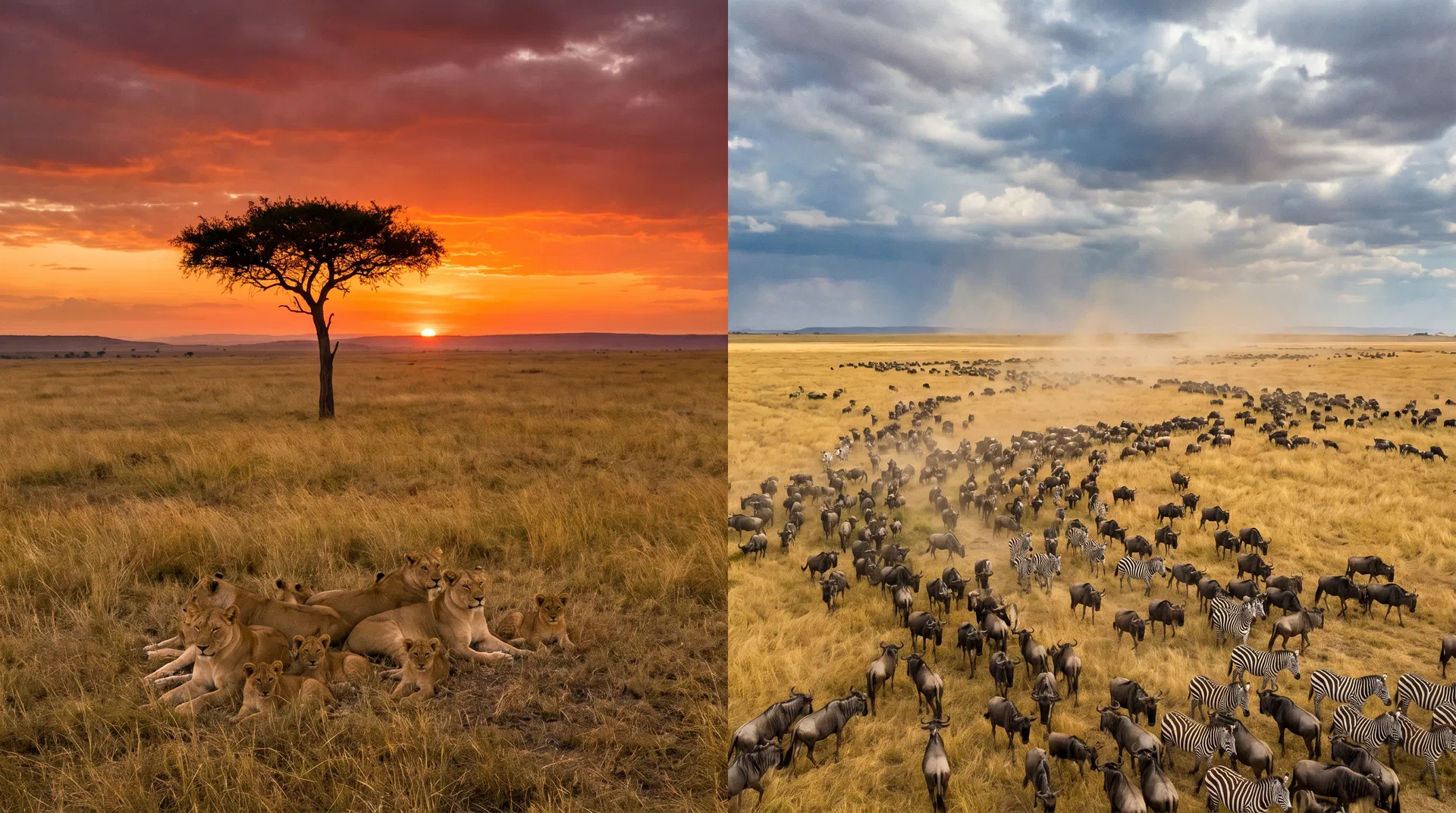
Kenya vs. Tanzania — East Africa's Greatest Safari Debate, Settled
Destination: Africa
Category: Destination Guides
There is a question that haunts every first-time safari planner. You've decided you're going to East Africa. You've accepted that it will cost more than you planned, take longer than you expected, and ruin every other vacation you take for the rest of your life. But you still have to answer the one question that every travel forum, every safari operator, and every well-traveled friend will give you a different answer to: Kenya or Tanzania?
Both countries share the same ecosystem. Both sit on the same ancient savanna. Both are home to the Big Five, the Great Migration, and the kind of landscapes that make you feel genuinely small in the best possible way. On paper, they look almost identical. In practice, they feel completely different — and which one is right for you depends entirely on one thing: what kind of traveler you are.
This isn't a diplomatic "you can't go wrong with either" article. After researching hundreds of firsthand accounts, digging into the data, and drawing on what real guides and real travelers say when they're being honest, here is the actual answer.
Kenya: The Safari That Meets You Where You Are
Kenya has been synonymous with safari for so long that it's easy to forget why. The answer is Nairobi. It is the only capital city in the world with a national park inside its city limits — and within an hour of landing at Jomo Kenyatta International Airport, you can be watching a black rhino move through the bush with a skyline of glass towers behind it. That image alone tells you everything about what Kenya does differently.
Accessibility is Kenya's superpower. Direct flights from London, New York, and Amsterdam land in Nairobi without a layover. You clear customs, clear security, and you're on a game drive before sunset on day one. Tanzania, by contrast, almost always requires a connection through Doha, Istanbul, or Addis Ababa — adding fatigue and half a day to your journey before you've seen a single animal. For first-time safari travelers, or anyone with limited time, that difference is significant.
Kenya is also more affordable. More tourists mean more competition, more accommodation options, and lower prices. A well-run Kenya safari can start at $200–$250 per person per day. Tanzania's premium parks — particularly the Serengeti and Ngorongoro — typically start at $350 and climb quickly from there. That's not a knock on Tanzania; the quality justifies it. But if budget is a factor, Kenya gives you more runway.
The Masai Mara is where Kenya makes its case most forcefully. At just 1,510 square kilometers — roughly 12 times smaller than the Serengeti — the Mara is dense. Animals are concentrated. Guides know exactly where the lion prides sleep, where the cheetahs hunt in the morning light, and which riverbank the leopards favor. A single game drive in the Mara can produce sightings that would take three days in a larger park to replicate. It is, by design, an efficient safari experience — and that efficiency is genuinely valuable when you only have five days.
Kenya also wins on rhinos. Ol Pejeta Conservancy, Lake Nakuru, and Nairobi National Park are among the most reliable rhino-viewing destinations on the continent. In Tanzania, your best shot at a rhino is Ngorongoro Crater — but the sightings are often distant, and they're never guaranteed. If completing the Big Five matters to you, Kenya stacks the odds in your favor.
And then there's Amboseli. It doesn't get the same press as the Mara, but Amboseli National Park may be the single most photogenic place in East Africa. The park sits at the foot of Mount Kilimanjaro, and on a clear morning — which happens more often than you'd expect — you watch herds of "super tusker" elephants, bulls whose tusks literally drag along the ground, move across the open plains with the snow-capped summit of Africa's highest mountain rising 5,895 meters behind them. No photograph does it justice. You just have to be there.
Tanzania: Where the Wilderness Goes Deeper
Tanzania plays a different game entirely. It is bigger, wilder, and in certain ways more demanding — but for the right traveler, it is the most extraordinary safari experience on earth.
The Serengeti is not just a park. It is a statement. At 14,750 square kilometers, it is 12 times the size of the Masai Mara, and it contains approximately 3,500 lions across 300 prides — the largest lion population in Africa. The scale of the Serengeti changes how a safari feels. You can drive for an hour without seeing another vehicle. A lion kill happens and the only witnesses are you, your guide, and the vultures already circling. That sense of genuine wilderness — of being a guest in something vast and indifferent — is harder to find in Kenya's more accessible parks, and it is what Tanzania's most devoted visitors keep coming back for.
The Ngorongoro Crater is unlike anything else on earth. It is the world's largest intact volcanic caldera: a 260-square-kilometer bowl that formed when a massive volcano collapsed on itself roughly three million years ago. Inside it, completely enclosed by 600-meter walls, live approximately 25,000 large mammals — including the highest density of predators found anywhere in Africa. The crater has its own resident lion prides that have never left. It has black rhinos that are genuinely visible, not just theoretically present. It has hippo pools, flamingo-pink soda lakes, and herds of wildebeest that have been circling the same floor since before humans had a word for migration. Descending into the crater at dawn, watching the mist lift off the grasslands as the first light hits the rim, is one of those travel experiences that rewires something in you.
But the real reason to choose Tanzania is the Great Migration — and specifically, the timing. The Migration is a year-round event in Tanzania. The herds spend roughly nine months of the year in the Serengeti, and each season brings a different spectacle. January and February is calving season in the southern Serengeti: up to 8,000 wildebeest calves are born every single day, which triggers a predator frenzy unlike anything else in the natural world. June and July brings the Grumeti River crossing in the western Serengeti, where the herds face a gauntlet of enormous Nile crocodiles that have been waiting, motionless, for months. And then, between late July and mid-October, comes the Mara River crossing — the moment that ends up on every wildlife documentary, every magazine cover, every bucket list. Hundreds of thousands of wildebeest and zebra stand at the riverbank, testing the water, retreating, surging forward again, until something — nobody knows what — triggers the stampede. They launch themselves into a river full of crocodiles. Some make it. Some don't. The ones that do scramble up the far bank and immediately start grazing, as if nothing happened.
You can witness the Mara River crossing from the Kenya side too, during the same July–October window. But Tanzania gives you the full story — the calving, the Grumeti, the Mara — while Kenya only catches the final chapter.
And then there's Zanzibar. Tanzania is the only East African country where you can combine a world-class safari with a genuinely world-class beach in a single trip. Zanzibar is a spice island — cloves, vanilla, cinnamon, nutmeg — with a UNESCO World Heritage old town, white sand beaches that look like they were designed by someone who had never seen anything ugly, and water so clear and warm that the transition from dusty game drives to floating in the Indian Ocean feels almost medically necessary. After a week of 4am wake-up calls, red dust, and the emotional weight of watching predators hunt, Zanzibar is the reset your nervous system needs.
The Decision Matrix
The honest answer to "Kenya or Tanzania?" is a question back: what do you want to feel?
| Choose Kenya if... | Choose Tanzania if... |
|---|---|
| This is your first safari | You've done a safari before and want to go deeper |
| You have 5–7 days | You have 8–14 days |
| Budget is a significant factor | You're willing to pay for the premium experience |
| Seeing rhinos up close matters | Witnessing the full Migration year-round is the priority |
| You want an efficient, high-density wildlife experience | You want scale, wilderness, and fewer vehicles |
| You're combining with Nairobi culture or Amboseli photography | You're combining with Zanzibar beach |
| You're traveling July–October and want the Mara crossing | You're traveling January–February and want calving season |
The "Do Both" Argument
Here is the thing that every experienced East Africa traveler will eventually tell you: the question isn't really Kenya or Tanzania. It's Kenya and Tanzania, and the only question is which one you do first.
A classic 10–12 day East Africa circuit — Masai Mara, Amboseli, Serengeti, Ngorongoro, Zanzibar — is one of the great travel experiences available to any human being alive today. The two countries share a border, share an ecosystem, and complement each other in a way that makes the combined trip feel like a complete story rather than two separate ones. Kenya gives you the accessibility and the density. Tanzania gives you the scale and the depth. Zanzibar gives you the exhale.
The Migration crosses between them. The elephants don't care which side of the border they're on. And neither, once you've been, will you.
Where to Start Planning
We've built dedicated guides for every destination in this cluster — use them as your starting point:
- Kenya Amboseli 4-Day Safari — elephants, Kilimanjaro, and the most photogenic park in Africa
- Kenya 7-Day Safari Circuit — Masai Mara + Amboseli + Lake Nakuru, the complete Kenya loop
- Masai Mara 5-Day Safari — the anchor guide; everything you need to know about Kenya's most iconic park
- Tanzania Budget Safari 7-Day Guide — how to do the Serengeti and Ngorongoro without the luxury price tag
- Tanzania Kilimanjaro 7-Day Trek — the Lemosho Route, the summit push, and what nobody tells you about summit night
- Zanzibar Honeymoon 5-Day Guide — the perfect post-safari beach extension
East Africa is waiting. The only wrong choice is not going.