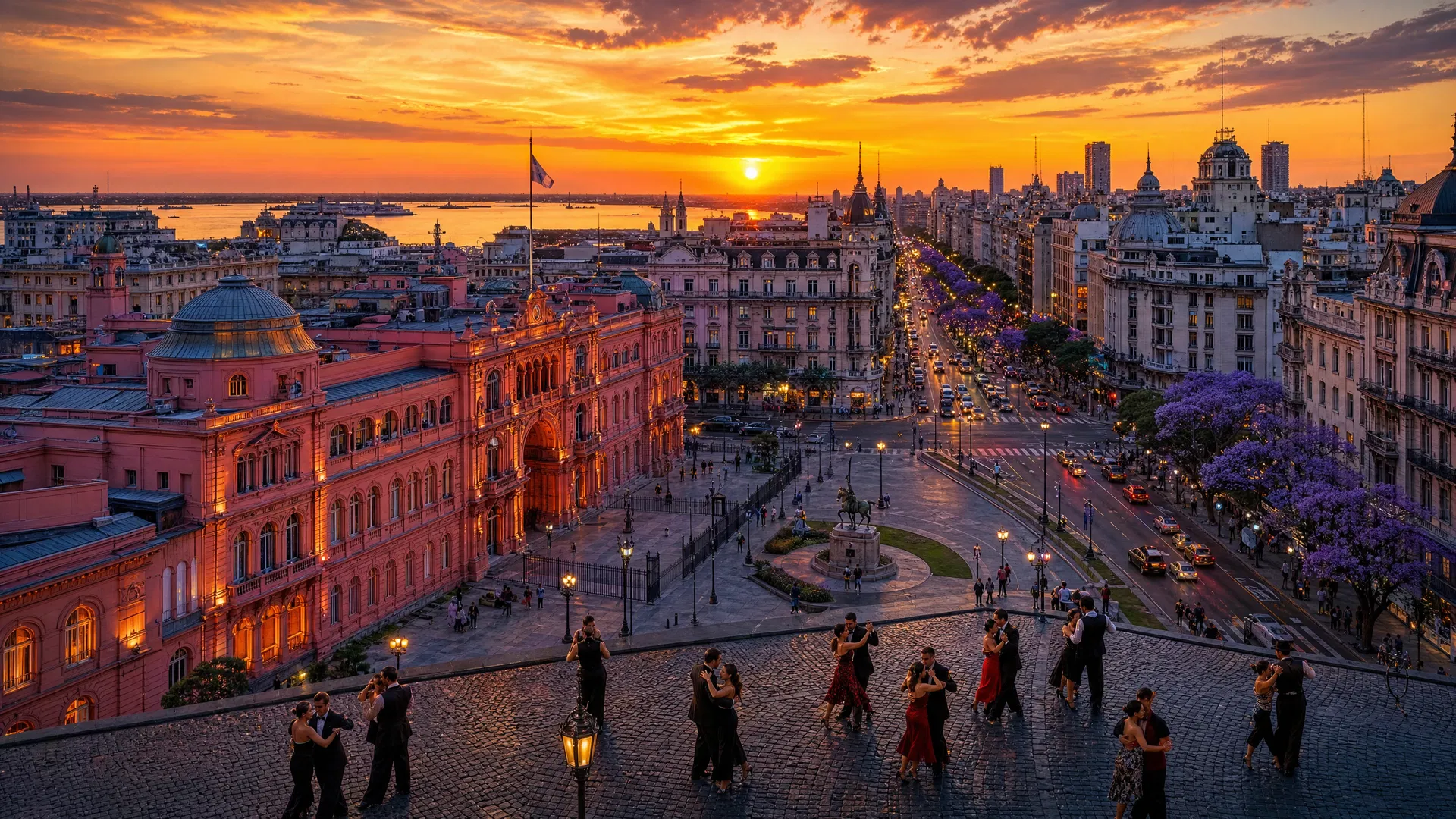
Buenos Aires: The City That Never Agreed to Be Ordinary
Destination: Buenos Aires, Argentina
Category: destination
There is a moment that happens to almost every first-time visitor to Buenos Aires, usually on the second or third day. You are sitting at a sidewalk table somewhere in Palermo or San Telmo, nursing a cortado and watching the city move past you — the women in heels at noon, the men arguing passionately about something that may or may not be football, the jacaranda trees dropping purple petals onto the cobblestones — and you think: I have been here before. Not literally. But the feeling is unmistakable. Buenos Aires is a city that feels familiar before you understand it, and then reveals itself to be something entirely its own the moment you stop trying to compare it to anywhere else.
People call it the Paris of South America, and there is enough truth in that to make the label stick. The wide boulevards, the Haussmann-style architecture, the café culture that treats a single espresso as a two-hour social commitment — yes, fine. But Paris does not have tango. Paris does not have asado. Paris does not have the particular Argentine energy that is equal parts melancholy and exuberance, a city that has survived economic collapses, military dictatorships, and hyperinflation and somehow emerged from each one more alive than before. Buenos Aires is not Paris. It is something harder to name and considerably more interesting.
The City That Built Itself from Everywhere
To understand Buenos Aires, you have to understand where it came from. Argentina received more European immigrants per capita in the late 19th and early 20th centuries than almost any country on earth. Italians came by the hundreds of thousands — which is why Argentine Spanish sounds the way it does, with that distinctive sing-song cadence that is nothing like the Spanish of Madrid or Mexico City. Spanish immigrants followed, then Jewish families fleeing persecution in Eastern Europe, then Arabs from Lebanon and Syria, then Welsh settlers who established their own communities in Patagonia and never quite left. The result is a city of layered identities, where you can eat a medialunas (the Argentine croissant, softer and sweeter than its French cousin) at a café founded by a Basque family in 1858, then walk two blocks to a Jewish deli that has been making knishes since 1930, then end the evening at a restaurant where the chef is cooking Italian-Argentine fusion with produce from a farm in Mendoza.
This immigrant DNA is not just historical flavor. It is the reason Buenos Aires has one of the most sophisticated food cultures in South America, a literary tradition that produced Jorge Luis Borges, and a fashion scene that punches well above its weight. It is also the reason the city feels simultaneously European and distinctly not — the bones are Old World, but the soul is something that only Argentina could have produced.
The Neighborhoods: A City of Distinct Villages
Buenos Aires is enormous — officially 48 neighborhoods — and the mistake most first-time visitors make is trying to see all of it. The smarter approach is to pick two or three neighborhoods and actually inhabit them, because each one operates almost like a separate city.
Palermo is the neighborhood that most visitors end up spending the most time in, and for good reason. It is leafy, walkable, full of excellent restaurants and bars, and subdivided into micro-neighborhoods that each have their own personality. Palermo Soho is the design and boutique shopping district, where independent Argentine designers sell clothes that you will not find anywhere else on earth. Palermo Hollywood, just north of Soho, is where the city's media industry is concentrated and where the restaurant scene has become genuinely world-class — this is the neighborhood where Tegui, one of Argentina's most celebrated restaurants, operates out of a building with no sign on the door. Palermo Chico is quieter and more residential, full of embassies and the kind of old money that does not need to announce itself. And Bosques de Palermo — the city's great park — is where porteños (Buenos Aires residents) go on weekends to cycle, row boats on the lake, and remind themselves that the city has lungs.
Recoleta is where Buenos Aires wears its European aspirations most openly. The neighborhood is elegant in the way that certain old European cities are elegant — not flashy, but assured. The Recoleta Cemetery is here, and it is one of the genuinely unmissable experiences in the city. This is not a cemetery in the way most people think of cemeteries. It is a city of the dead, with streets and avenues and mausoleums that range from neoclassical temples to art nouveau masterpieces, all crammed together in a space that somehow feels both overwhelming and intimate. Evita Perón is buried here, in the Duarte family vault, and the flowers left at her tomb are always fresh. The cemetery is free to enter and you could spend two hours inside it without seeing everything. The surrounding neighborhood — the café terraces, the antique dealers, the Floralis Genérica sculpture that opens its petals at dawn and closes them at dusk — rewards slow walking.
San Telmo is the city's oldest neighborhood and its most atmospheric. The cobblestone streets, the colonial architecture, the Sunday antiques market at Plaza Dorrego that has been running for decades — San Telmo is where Buenos Aires keeps its memory. It is also where tango was born, in the conventillos (tenement houses) where immigrants and working-class porteños lived in the late 19th century, and the neighborhood has never fully let go of that origin. On Sunday afternoons, couples dance in the streets around Plaza Dorrego while tourists and locals watch from café chairs. It is one of those things that sounds like a tourist trap and turns out to be completely genuine. The market itself is worth several hours — antique dealers selling everything from 1940s silverware to vintage Argentine football programmes, leather craftsmen working in real time, food stalls serving choripán and empanadas to the crowd.
La Boca is the neighborhood that appears on every Buenos Aires postcard — the brightly colored houses of Caminito, the Boca Juniors stadium, the working-class port energy that has never been gentrified away. It is also the neighborhood that requires the most honest travel advice: Caminito itself is a single pedestrianized street that is genuinely beautiful and genuinely touristy, and the surrounding neighborhood is not particularly safe for wandering. The smart approach is to visit Caminito, see the stadium (and if you can, attend a match), and then head back to San Telmo or Palermo rather than exploring further on foot. La Boca is worth seeing. It is not worth getting lost in.
Belgrano and Núñez, further north, are where the city becomes more residential and more local. These are the neighborhoods where porteños actually live — the schools, the supermarkets, the Sunday family lunches that go until 5pm. They are not on most tourist itineraries, which is exactly why they are worth visiting if you have more than five days.
Tango: The Real Thing and the Tourist Version
Let's be direct about tango, because there is a lot of confusion about what it actually is and where to find it.
The tourist version of tango — the dinner shows at places like Café de los Angelitos or Esquina Carlos Gardel — is not fake. The dancers are genuinely skilled, the production values are high, and if you want a polished, theatrical introduction to the art form, these shows deliver it. But they are performances, not participations. You watch. You applaud. You go home.
The real tango is the milonga — the social dance halls where porteños go to actually dance. This is where tango lives as a living culture rather than a preserved artifact. La Viruta in Palermo Soho is one of the most accessible milongas for visitors, offering beginner classes before the evening session and welcoming dancers of all levels. La Catedral in Almagro is the bohemian alternative — a converted warehouse with mismatched furniture, murals of Carlos Gardel, and a crowd that skews younger and more experimental. Club Gricel in San Cristóbal is the most traditional, with live orchestras and a wooden dance floor that has been polished by decades of feet. Milonga Parakultural is specifically known as a place where locals come to dance with tourists — an unusually welcoming space for beginners.
The milonga has its own etiquette — the cabeceo (the subtle nod that is how you invite someone to dance), the tandas (sets of three or four songs followed by a cortina that signals the end of the set), the codes around conversation on the dance floor. None of this is as intimidating as it sounds. Porteños are genuinely welcoming to visitors who approach tango with respect rather than irony. Show up, watch for a while, take the beginner class if it's offered, and let the evening unfold.
And then there is the street tango — the couples who dance on Plaza Dorrego on Sunday afternoons, the performers on Florida Street, the occasional spontaneous moment in a San Telmo bar when someone puts on a Piazzolla record and two people who have never met start moving together. This is the tango that Borges wrote about — not a performance but a conversation between two bodies, conducted in a language that has no words.
The Food: More Than Steak (Though the Steak is Extraordinary)
Buenos Aires is one of the great food cities of the world, and it is underrated as such because the conversation about it tends to begin and end with beef. The beef is extraordinary — Argentina's grass-fed cattle produce some of the best meat on earth, and a proper asado (the Argentine barbecue ritual that is as much ceremony as meal) is an experience that will recalibrate your understanding of what grilled meat can be. The parrilla (grill restaurant) is the cornerstone of Buenos Aires dining, and you should eat at one, ideally more than once. Don Julio in Palermo is consistently cited as one of the best in the city, with a wine list that reads like a love letter to Mendoza. La Cabrera, also in Palermo, is famous for its generous side dishes and its tendency to have a line out the door by 8pm.
But to stop at steak is to miss most of what makes Buenos Aires a food city.
Choripán is the street food institution — chorizo in crusty bread, dressed with chimichurri, sold from carts and at parrillas and at football matches and at basically any outdoor event in the city. It is simple, it is perfect, and it costs almost nothing. Chori in Palermo is the most celebrated version, with thoughtful variations on the classic, but the best choripán you will eat in Buenos Aires will probably be from a cart outside La Bombonera before a Boca Juniors match.
Empanadas deserve their own paragraph. These are not the empanadas of other countries — Argentine empanadas are a regional art form, with different provinces producing different styles. The Buenos Aires version tends toward beef with hard-boiled egg and olives, baked rather than fried, with a crimped edge that varies by filling. El Sanjuanino in Recoleta has been making them the same way for decades and the line at lunchtime tells you everything you need to know.
The café culture is one of the great underappreciated pleasures of Buenos Aires. The city has 82 bares notables — historic cafés that are officially protected as cultural heritage sites. These are not tourist attractions. They are working cafés where porteños have been reading newspapers, arguing about politics, and conducting the business of daily life for a century or more. Café Tortoni on Avenida de Mayo is the most famous — founded in 1858, with a tiled floor and dark wood paneling and a back room where tango shows still happen most evenings. La Biela in Recoleta is where the city's intellectual class has always gathered, under the enormous rubber tree that has been growing in the terrace since before anyone can remember. El Federal in San Telmo is the most atmospheric, a corner bar that has barely changed since the 1860s.
The Italian influence on Buenos Aires cuisine is profound and delicious. The city has more pizza and pasta restaurants per capita than almost any city outside Italy, and the Argentine versions have evolved into something distinct. Buenos Aires pizza is thick-crusted, generously topped, and eaten standing at the counter of a pizzería at midnight — Güerrin on Corrientes Avenue is the canonical example, open until 2am and always packed. The pasta at places like El Preferido de Palermo is the kind of cooking that makes you understand why Italian grandmothers are considered national treasures.
Wine is not technically food, but in Buenos Aires it functions as one. Argentina produces some of the world's best Malbec, and the city's wine bars and restaurants treat it with appropriate reverence. Vico Wine Bar in Palermo is a good starting point — a casual, knowledgeable space where the staff will walk you through the difference between a Mendoza Malbec and a Patagonian Pinot Noir without making you feel like a student.
The Football: A Religion, Not a Sport
If you are in Buenos Aires and you have any interest in football whatsoever, you need to attend a match. Not a friendly. A proper league match, preferably involving Boca Juniors or River Plate, the two clubs whose rivalry — the Superclásico — is one of the most intense sporting contests on earth.
La Bombonera, the Boca Juniors stadium in La Boca, is one of the most atmospheric sporting venues in the world. The stadium is small by modern standards — just over 54,000 capacity — but it is built almost vertically, with stands that lean over the pitch at an angle that makes the noise feel physical. When Boca score, the stadium bounces. This is not a metaphor. The structure actually moves. Attending a match here is less like watching football and more like being inside a collective emotional experience that has been building for a hundred years.
Getting tickets requires some advance planning — official tickets sell out quickly, and the away section is not available to foreign visitors for security reasons. Several reputable tour operators in Buenos Aires specialize in match-day experiences that include transport, tickets, and a guide who can explain what is happening in the stands. It is worth the premium.
Day Trips: Beyond the City
Buenos Aires rewards extended stays, but the city is also an excellent base for exploring the surrounding region.
Tigre and the Paraná Delta is the most accessible day trip — just 45 minutes by train from Retiro station. The delta is a labyrinth of waterways, islands, and weekend houses that stretches for hundreds of kilometers north of the city. Taking a boat tour through the smaller channels, stopping at a riverside restaurant for lunch, and watching the city recede into the distance is one of those experiences that reminds you how much of Argentina exists beyond the capital.
Colonia del Sacramento, Uruguay is a 50-minute ferry ride across the Río de la Plata and one of the most charming small cities in South America. The old town — a UNESCO World Heritage Site — is a perfectly preserved colonial settlement with cobblestone streets, Portuguese-era buildings, and a lighthouse that you can climb for views of the river. The pace is completely different from Buenos Aires, which is part of the point.
Mendoza is a full day's journey by plane (90 minutes) or overnight bus, but if you have the time, the wine country around Mendoza is one of the great travel experiences in South America. The Malbec vineyards against the backdrop of the Andes, the bodegas that have been producing wine for generations, the city itself with its wide tree-lined avenues and outdoor café culture — Mendoza deserves more than a day trip, but even a quick visit will change how you think about Argentine wine.
Practical Buenos Aires
When to go: Buenos Aires is a year-round destination, but the shoulder seasons — March to May (autumn) and September to November (spring) — are the most pleasant. Summer (December to February) is hot and humid, and many porteños leave the city in January. Winter (June to August) is mild by most standards but can be grey and rainy.
Getting around: The Subte (subway) is cheap, efficient, and covers most of the central neighborhoods. Taxis and ride-share apps (Uber, Cabify, and the local app InDriver) are widely available and inexpensive by international standards. Walking is the best way to experience the neighborhoods — Buenos Aires is a very walkable city if you are staying in the central areas.
The money situation: Argentina's currency situation has been complex for years, and it is worth understanding before you arrive. The official exchange rate and the informal rate (the "blue dollar") have historically diverged significantly, meaning that visitors who exchange money through official channels may receive considerably less than those who use informal exchange houses (casas de cambio). The situation changes frequently — check current conditions before you travel and ask your accommodation for current advice. This is one of those practical realities of Buenos Aires travel that every honest guide should mention.
Safety: Buenos Aires is generally safe for tourists in the neighborhoods covered in this guide. The usual urban precautions apply — be aware of your surroundings, don't display expensive equipment unnecessarily, and take taxis or ride-shares rather than walking in unfamiliar areas at night. La Boca, as mentioned, requires more caution than other neighborhoods.
Language: Spanish is the language of Buenos Aires, and Argentine Spanish has its own vocabulary and pronunciation that differs from other varieties. Porteños appreciate any attempt to speak Spanish, even imperfect Spanish. The word for "you" in Buenos Aires is "vos" rather than "tú," and the pronunciation of "ll" and "y" sounds like "sh" rather than "y" — so "yo" (I) is pronounced "sho." This takes about a day to get used to.
Your Buenos Aires Guides on Ask Leif
Whether you are planning your first visit or your fifth, Ask Leif has built a comprehensive set of guides to help you make the most of Buenos Aires and Argentina:
- Buenos Aires 5-Day First-Timer's Guide — The essential introduction to the city, covering all the major neighborhoods, must-eat restaurants, and cultural experiences across five days.
- Buenos Aires for Couples: A Romantic 4-Day Itinerary — Tango lessons, rooftop wine bars, candlelit parrillas, and the most romantic corners of Palermo and Recoleta.
- Solo Buenos Aires: 5-Day Itinerary for the Independent Explorer — How to navigate the city on your own terms, from milongas to football matches to the best solo-friendly restaurants.
- Buenos Aires Family Adventure: 5-Day Itinerary for Kids & Parents — The city through the eyes of families, with kid-friendly activities, manageable pacing, and the best family restaurants.
- Buenos Aires on a Budget: Your 4-Day Blue Dollar Adventure — How to experience one of South America's great cities without spending like it.
- Buenos Aires: 4-Day Italian-Argentine Food & Culture Guide — A deep dive into the city's extraordinary food culture, from parrillas to pizzerías to the immigrant kitchens that built it all.
And if Buenos Aires is just the beginning of your Argentina journey:
- Patagonia 10-Day Adventure & Trekking Guide — The other end of Argentina: glaciers, condors, and some of the most dramatic landscapes on earth.
- Patagonia 10-Day Road Trip: Torres del Paine, El Calafate & Carretera Austral — The ultimate South American road trip, crossing between Argentina and Chile through landscapes that will make you question everything you thought you knew about scenery.
- Salta for Couples: A Romantic 3-Day Itinerary in Argentina's Northwest — Argentina's most underrated city, with colonial architecture, extraordinary food, and the wine country of the Calchaquí Valleys on its doorstep.
The Thing About Buenos Aires
Buenos Aires is a city that gets under your skin in a way that is difficult to explain to people who have not been there. It is not the most beautiful city in South America — that argument belongs to somewhere like Cartagena or Valparaíso. It is not the most dramatic — that is Patagonia, unambiguously. It is not the easiest — the currency situation, the late dining hours, the sheer scale of the place can be disorienting.
What it is, is alive. Alive in the way that great cities are alive — with a culture that is still being made, a conversation that is still being had, a sense that the most interesting thing that has ever happened here is probably happening right now, somewhere in a milonga or a parrilla or a café on a cobblestone street in San Telmo. Buenos Aires is the kind of city that makes you want to stay longer than you planned and come back sooner than you expected.
The best way to plan a trip there is to decide what kind of Buenos Aires you want — the food Buenos Aires, the tango Buenos Aires, the literary Buenos Aires, the football Buenos Aires, the romantic Buenos Aires — and then let the city surprise you with everything else. It will. It always does.
Ready to start planning? Let Leif build your personalized Buenos Aires itinerary — your dates, your budget, your travel style. No two itineraries are ever the same.