Prague: The City That Survived Everything — And Wants to Show You Every Inch of It
Destination: Czech Republic
Category: Europe
There is a moment that happens to almost every first-time visitor to Prague, and it usually occurs within the first hour of arriving. You step out of a metro station or round a corner from your hotel, and the city simply unfolds in front of you — a skyline of Gothic spires and Baroque domes and Art Nouveau facades stacked so densely that it looks less like a real city and more like a film set someone forgot to take down. You stop walking. You might say something out loud. You take a photograph that will never do it justice.
Then you go back and take five more.
Prague does this to people. It has been doing it for centuries. The "City of a Hundred Spires" — a nickname that undersells it, because there are closer to five hundred — sits on the banks of the Vltava River in the heart of Bohemia, and it is, by any honest measure, one of the most beautiful cities on Earth. Not in the way that a beach at sunset is beautiful, or a mountain range is beautiful. Prague is beautiful in the way that a very old, very complicated, very alive thing is beautiful: full of contradictions, full of history, full of people who have been here long enough to stop noticing what visitors cannot stop staring at.
What makes Prague genuinely extraordinary is not just the architecture — though the architecture alone would justify the flight. It is the fact that the architecture survived. Prague is the only major Central European capital that escaped the large-scale bombing of the Second World War essentially intact. While Warsaw was razed and rebuilt, while Dresden burned, while Budapest's bridges were blown into the Danube, Prague emerged from the 20th century's worst violence with its medieval core more or less whole. Walk through the Old Town today and you are walking through streets that have looked roughly the same for six hundred years. That is not a reconstruction. That is the real thing.
The City in Layers: Understanding Prague Before You Arrive
Prague is not one city. It is six or seven cities stacked on top of each other, each representing a different era, a different power, a different idea of what this place should be. Understanding those layers makes the experience richer and the navigation considerably less confusing.
Hradčany is the castle district — the hilltop fortress that has dominated the city's skyline since the 9th century and remains, by area, the largest ancient castle complex in the world. Prague Castle is not a single building but an entire walled town: palaces, churches, gardens, galleries, a cathedral that took six centuries to complete. Most visitors spend two or three hours here and leave feeling they've seen it. Most visitors are wrong. The castle rewards a full day, ideally two. Malá Strana — the "Lesser Town" — sits at the foot of the castle hill, a neighborhood of Baroque palaces and hidden gardens and cobblestone lanes that twist in ways that seem designed to make you pleasantly lost. This is where the embassies are, where the most romantic restaurants hide in vaulted cellars, where the light in the late afternoon turns the ochre and terracotta facades into something that looks genuinely painted. Malá Strana is the Prague that appears in dreams. Staré Město — the Old Town — is where most visitors spend most of their time, and for good reason. The Old Town Square is one of the great public spaces in Europe: the twin Gothic towers of the Týn Church rising above the rooftops, the medieval Astronomical Clock performing its hourly mechanical theater, the Jan Hus memorial at the center reminding you that this city has always had opinions. The Jewish Quarter — Josefov — sits within the Old Town, a neighborhood of synagogues and the Old Jewish Cemetery where centuries of burials have stacked the graves twelve layers deep, the headstones tilting at every angle like a forest after a storm. Nové Město — the New Town — is new only by Prague's standards, having been founded in 1348 by Charles IV. Wenceslas Square, the long boulevard that serves as the city's commercial spine, is where history has repeatedly been made: the 1968 Prague Spring, the 1989 Velvet Revolution. It is also where you will find the National Museum, the National Theatre, and some of the finest Art Nouveau architecture in Europe.Then there are the neighborhoods that most tourists never reach, and that locals are quietly grateful for. Vinohrady, just east of the center, is a stately residential district of tree-lined boulevards and Art Nouveau apartment buildings, home to the city's best independent restaurants, wine bars, and coffee shops. Žižkov, immediately adjacent, is rougher, funkier, and home to the Television Tower — a Communist-era structure that looks like a rocket ship and has, improbably, become one of the city's most beloved landmarks, partly because of the ten giant crawling babies that sculptor David Černý attached to its exterior. Karlín, once industrial and now thoroughly gentrified, is where the city's most interesting new restaurants and bars have opened in the last decade.
Charles Bridge: The One Thing You Must Do Twice
Every guidebook tells you to visit Charles Bridge. What most guidebooks fail to tell you is that you need to visit it twice: once at dawn, and once in the middle of the day, because they are completely different experiences.
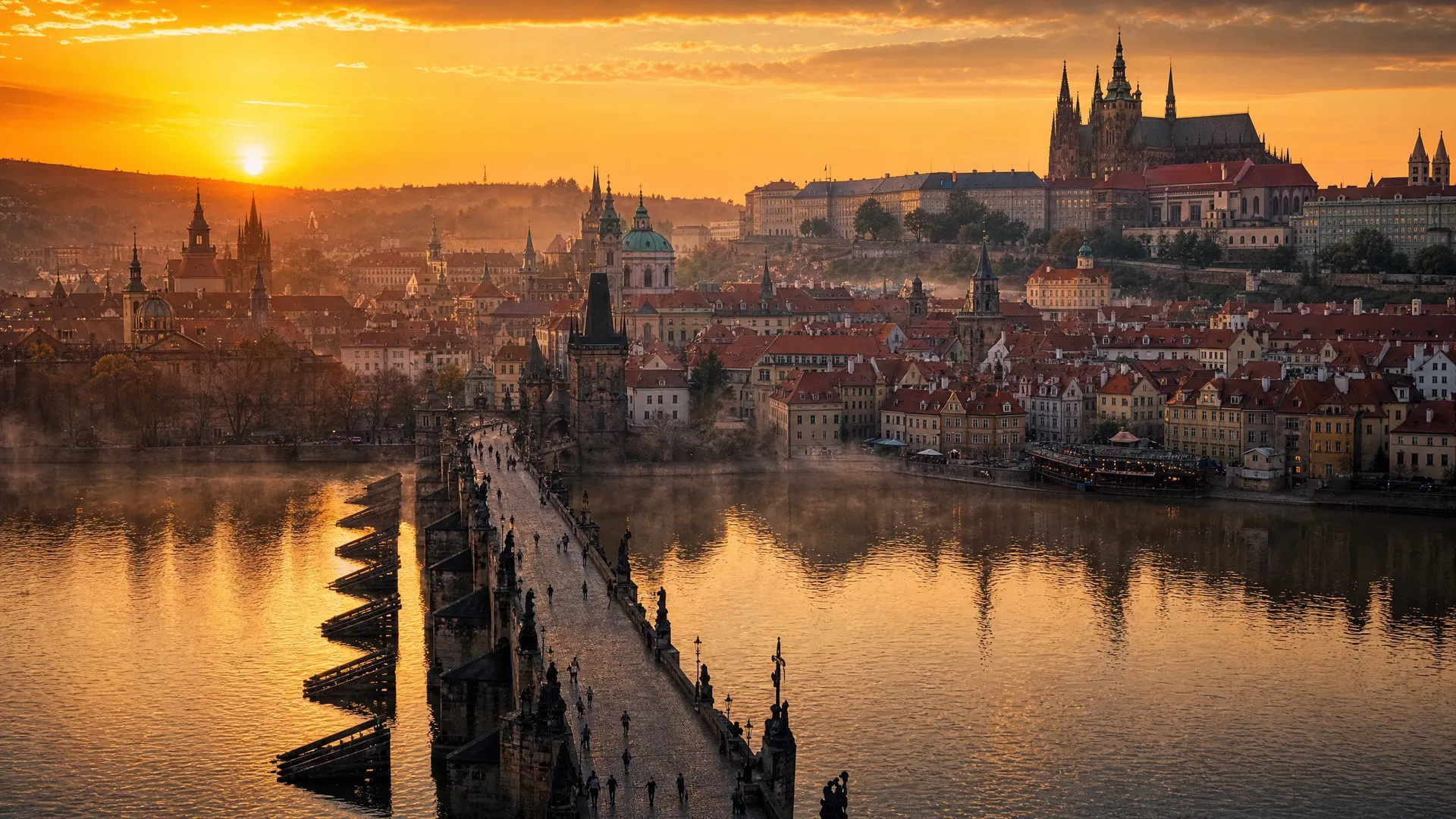
At dawn — and we mean actual dawn, not 8 AM, but the first grey light before the sun clears the hills — Charles Bridge is one of the most peaceful places in Europe. The 30 Baroque statues of saints that line the bridge stand in the mist like silent witnesses. The Vltava moves slowly below. The castle glows on the hill. You might share the bridge with a handful of photographers and a few fishermen on the banks below, and that is all. It is the Prague that existed before tourism, and it is extraordinary.
By noon, the same bridge is a carnival. Street musicians, portrait artists, souvenir sellers, tour groups moving in tight formations, selfie sticks extended at every angle. It is chaotic and alive and genuinely fun in its own way — but it is a completely different experience. Both are worth having. The dawn visit is the one you will remember for the rest of your life.
The bridge itself dates to 1357, commissioned by Charles IV, and connects the Old Town to Malá Strana across the Vltava. The statues were added between 1683 and 1714, and the most famous of them — St. John of Nepomuk, a bronze figure with a golden halo — has been touched by so many hands over the centuries that the bronze has worn smooth and bright at the points of contact. Touching the statue is said to bring good luck and guarantee a return to Prague. Based on the number of people who do return, the legend appears to be working.
Prague Castle: The World's Largest Ancient Castle Complex
Perched on a hill above the city, Prague Castle is not so much a building as an entire walled neighborhood — a complex of palaces, churches, courtyards, gardens, and galleries that covers nearly 70,000 square meters and has served as the seat of Bohemian kings, Holy Roman Emperors, and Czech presidents for more than a thousand years.
The centerpiece is St. Vitus Cathedral, a Gothic masterpiece that was begun in 1344 and not completed until 1929 — nearly six centuries of construction. The stained glass windows inside include one designed by Art Nouveau master Alfons Mucha, a riot of color and symbolism that stops visitors mid-stride. The cathedral also contains the tomb of St. Wenceslas, the patron saint of Bohemia, and the Bohemian Crown Jewels are kept in a chamber here, locked behind seven locks whose keys are held by seven different people.
Beyond the cathedral, the castle complex contains the Old Royal Palace with its magnificent Vladislav Hall — a Gothic space so large that medieval knights held jousting tournaments inside it — the Basilica of St. George, the Golden Lane of tiny colorful houses that once housed castle guards and later, briefly, Franz Kafka, and the Royal Garden with its Renaissance summer palace and singing fountain.
The views from the castle ramparts over the city are the best in Prague. Come in the late afternoon when the light is warm and the spires below catch the gold.
The Jewish Quarter: History That Demands to Be Witnessed
Josefov, Prague's Jewish Quarter, is one of the most important and affecting historical sites in Central Europe. For centuries, Prague's Jewish community — one of the oldest in Europe — lived, worshipped, and was buried within these few blocks. The neighborhood contains six synagogues, the oldest of which, the Old-New Synagogue, dates to around 1270 and is still an active place of worship, making it the oldest functioning synagogue in Europe.
The Old Jewish Cemetery is the site that most visitors find hardest to leave. Because the Jewish community was not permitted to expand the cemetery, burials continued in the same small space for nearly three centuries, with graves stacked as many as twelve layers deep. The result is a dense, tilting forest of headstones — approximately 12,000 visible markers representing perhaps 100,000 burials — that communicates the weight of history more powerfully than any museum exhibit.
The Pinkas Synagogue contains one of the most moving Holocaust memorials in the world: the names of 77,297 Bohemian and Moravian Jewish victims of the Nazi genocide, written by hand on the synagogue walls. The names cover every surface from floor to ceiling. It takes time to read even a fraction of them. It should take time.
Franz Kafka was born in a house on the edge of Josefov in 1883, and the neighborhood's labyrinthine quality — its sense of being simultaneously inside and outside the city, governed by rules that apply nowhere else — is present in his work in ways that become obvious once you have walked these streets.
The Food: Beyond Goulash and Dumplings (Though Also Definitely Goulash and Dumplings)
Czech cuisine has a reputation problem. Mention it to most people and they picture heavy stews, pork knuckle, and dumplings — the kind of food that requires a nap afterward. That reputation is not entirely undeserved, but it is dramatically incomplete.
Svíčková na smetaně — braised beef sirloin in a creamy root vegetable sauce, served with bread dumplings, a dollop of cranberry, and a spoonful of whipped cream — is one of the great dishes of Central European cooking, and the version at Lokál Dlouhá in the Old Town is the benchmark. Lokál is the most reliable Czech pub-restaurant in Prague: genuinely excellent food, tank-conditioned Pilsner Urquell poured to perfection, and an interior that deliberately references 1970s Czech pub culture without being ironic about it. It is where you go on your first night. Guláš — Czech goulash, which differs from its Hungarian cousin in being thicker, darker, and served with bread dumplings rather than egg noodles — is the dish that will follow you through every pub and restaurant in the city. The version at U Modré Kachničky (the Blue Duckling) in Malá Strana is among the finest, served in a romantically lit cellar that feels like it has not changed since the 18th century.For serious meat, Kantýna in Nové Město is part butcher shop, part standing restaurant, and entirely serious about Czech beef. The tartare is outstanding. The burger is widely considered the best in Prague. You order at the counter, find a spot at a communal table, and eat standing up if necessary. No fuss. Extraordinary quality.
The trdelník question will arise within your first hour in the Old Town. Trdelník — a chimney cake of dough wrapped around a spit, grilled over coals, and rolled in cinnamon sugar — is sold from stalls throughout the tourist center, and it smells incredible. Here is the honest truth: it is not a traditional Czech food. It was imported from Slovakia and Hungary and has been enthusiastically marketed to tourists for the last two decades. It is also delicious. Eat one without guilt and move on.
Prague's restaurant scene has transformed dramatically in the past decade. The city now has five Michelin-starred restaurants: La Degustation, Field, Štangl (which also holds a green star for sustainability), Levitate, and Casa de Carli. The Bib Gourmand list — Michelin's recognition for exceptional quality at fair prices — includes Alma, Výčep, U Kalendů, U Matěje, Na Kopci, Dejvická 34, and The Eatery. Výčep in Žižkov, which means "tap room," operates like an unpretentious local pub but makes almost everything — bread, salami, cheese, sauerkraut — in-house and hunts and grows what it can. It is worth every minute of the metro ride.
For the most authentic experience of all: U Kalendů in Žižkov, a pub that dates to the Communist era when it opened at 6 AM for blue-collar workers starting their shifts. No English menu. No concessions to modernity. Prices so low they seem like a misprint. This is what Czech pub culture actually looks like when it is not performing for tourists.
The Beer: A Subject That Deserves Its Own Section
Czech beer is not merely a beverage. It is a cultural institution, a point of national pride, and — by most objective measures — among the finest lager in the world. The Czech Republic consistently leads the world in per-capita beer consumption, and the reason is simple: the beer is genuinely exceptional.
Pilsner Urquell, brewed in Plzeň (Pilsen) since 1842, is the original pilsner — the style that half the world's lagers are descended from. Drinking it tank-conditioned and unfiltered, as it is served at Lokál and a handful of other serious establishments in Prague, is a fundamentally different experience from drinking it from a bottle. The difference is not subtle. Kozel — dark and amber varieties — is the other great Czech lager, brewed in Velké Popovice since 1874. The dark Kozel is a revelation for anyone who thinks dark beer must be heavy: it is smooth, slightly sweet, and goes with roast duck in a way that seems almost designed. Bernard, Únětické pivo, and a growing number of craft breweries have expanded the Prague beer landscape considerably in recent years. The craft beer scene, centered in neighborhoods like Žižkov and Karlín, has produced some genuinely excellent IPAs, stouts, and experimental styles — though the locals will tell you, with some justification, that you came all this way to drink Czech lager, so drink Czech lager.The proper way to order beer in Prague is simply to sit down. In most traditional pubs, a beer will appear in front of you without your having to ask. When you want another, you nod. When you want to stop, you place a coaster on top of your glass. This system has been working for centuries and requires no improvement.
The Neighborhoods Worth Getting Lost In
Vinohrady is the neighborhood that makes Prague residents feel smug about where they live. Tree-lined boulevards of Art Nouveau apartment buildings, the twin towers of the Church of St. Ludmila rising above náměstí Míru (Peace Square), wine bars and coffee shops and restaurants that cater to the people who actually live here rather than the people passing through. The Sunday farmers' market at náměstí Míru is one of the best in the city. The independent bookshops and record stores on the side streets are the kind that make you miss a flight. Žižkov is where Vinohrady's more interesting younger sibling lives. Named after the Hussite general Jan Žižka, whose enormous equestrian statue on Vítkov Hill is the largest bronze equestrian statue in the world, Žižkov has historically been the working-class, slightly rough counterpart to Vinohrady's bourgeois elegance. The neighborhood has gentrified considerably but retains its character: more pubs per capita than anywhere else in Prague, the Television Tower with its crawling baby sculptures, and a general atmosphere of not particularly caring what you think of it. This is where you go for the second and third nights. Karlín was devastated by floods in 2002 and has since been rebuilt into one of the most interesting neighborhoods in Central Europe. The architecture is a mix of pre-flood 19th-century buildings and contemporary design, and the restaurant and bar scene is the most dynamic in the city. The Manifesto Market — a container market of food trucks and bars — operates here seasonally and is worth an evening. Malá Strana rewards the visitor who leaves the main tourist route. The neighborhood's hidden gardens — the Vrtba Garden, the Wallenstein Garden, the Ledebour Garden — are among the most beautiful in Prague and are visited by a fraction of the people who crowd Charles Bridge fifty meters away. The Wallenstein Garden, in particular, with its geometric hedges and artificial stalactite grotto and resident peacocks, is the kind of place that makes you feel you have discovered something that was not meant for you to find.Day Trips: The Czech Republic Beyond Prague
Prague is an exceptional base for exploring Bohemia, and several day trips are worth building into your itinerary.
Český Krumlov, two and a half hours south by bus or train, is a UNESCO World Heritage town built around a dramatic castle on a bend of the Vltava River. It is smaller and quieter than Prague — or at least it is in the early morning and evening, before the day-trippers arrive — and the castle's Baroque theater, with its original stage machinery intact, is one of the most remarkable theatrical spaces in Europe. Kutná Hora, an hour east of Prague, was one of the wealthiest cities in medieval Europe thanks to its silver mines, and its Cathedral of St. Barbara — a Gothic masterpiece built by the miners themselves — is among the finest churches in Central Europe. The town also contains the Sedlec Ossuary, a small chapel decorated with the bones of approximately 40,000 people, arranged into chandeliers, coats of arms, and garlands. It is simultaneously macabre and strangely beautiful, and it is unlike anything else in the world. Karlovy Vary (Karlsbad), two hours west, is a spa town of extraordinary elegance — colonnaded promenades above a river valley, thermal springs that have been drawing European aristocracy since the 14th century, and a film festival that brings the international film world to Bohemia every July. The local specialty is Becherovka, a herbal liqueur that tastes like Christmas and medicine in equal measure and is, once you have acquired the taste, genuinely excellent.Practical Prague: What You Actually Need to Know
Getting there: Prague's Václav Havel Airport is well-connected to most European cities and has direct flights from major North American hubs. The airport bus (line 119) connects to the metro at Nádraží Veleslavín in about 20 minutes for a fraction of the taxi fare. Getting around: Prague's public transport system — tram, metro, and bus — is excellent, cheap, and covers the entire city. A 24-hour pass costs roughly €5 and is valid on all modes. The trams are particularly useful and particularly scenic; tram line 22 passes through Malá Strana and up to the castle and is worth riding for the views alone. Walking is the best way to experience the historic center, but the hills are real — comfortable shoes are not optional. Money: The Czech Republic is in the European Union but uses the Czech koruna (CZK), not the euro. As of 2026, roughly 25 CZK to 1 USD. Prague is significantly cheaper than Western European capitals: a full meal with beer at a local pub will cost 200–350 CZK (€8–14). Even at Michelin-starred restaurants, prices are modest by Paris or London standards. Language: Czech is a Slavic language of considerable complexity, and most visitors make no serious attempt to learn it beyond "prosím" (please) and "děkuji" (thank you), which is perfectly acceptable. English is widely spoken in the tourist center and in restaurants and hotels throughout the city. The effort of attempting even a few words in Czech is invariably appreciated. When to go: Prague is beautiful in every season, but the sweet spots are May–June and September–October — warm enough for outdoor dining and evening walks, cool enough to be comfortable, and less crowded than the peak summer months. December brings the Christmas markets, which are genuinely magical and genuinely crowded. January and February are cold but offer the city at its most local and least touristed. What to avoid: The tourist restaurants immediately surrounding Old Town Square, which are uniformly overpriced and mediocre. The "Prague ham" sold from stalls in the tourist center, which is not a traditional Czech food. Currency exchange offices in the tourist center, which offer rates that are legal but predatory — use an ATM instead.Your Prague Itinerary, Built Around You
No two Prague trips should look the same. A solo traveler chasing jazz bars and craft beer through Žižkov is having a completely different city than a couple lingering over svíčková in a Malá Strana cellar, or a family navigating the castle complex with children who are more interested in the changing of the guard than the Gothic architecture.
That is precisely why we built Ask Leif. Our Prague guides are designed for the specific kind of traveler you are — not a generic tourist, but a person with particular interests, a particular budget, and a particular idea of what a good day looks like.
Whether you are planning your first visit or your fifth, whether you have three days or five, whether you are traveling solo, as a couple, as a family, or on a budget that requires creative thinking, we have built a guide for you:
- Prague in 4 Days: The Ultimate City Break Itinerary — the comprehensive introduction to the city, covering all the essential sights with enough depth to actually understand what you're looking at
- Prague Solo Travel Guide: 3 Days of Jazz, Castles & Budget-Friendly Exploration — built for the traveler who moves at their own pace and wants to find the city's edges as well as its center
- Prague for Couples: A Romantic 4-Day Itinerary Through the Heart of Bohemia — candlelit cellars, dawn on Charles Bridge, the hidden gardens of Malá Strana, and the best table in Vinohrady
- Prague for Two: A 5-Day Romantic Couples Itinerary — for couples who want more time, more depth, and more of the city that most visitors never reach
- Prague Family Adventure: 3-Day Budget-Friendly Exploration of Castles & Clocks — designed around the things that genuinely engage children: the Astronomical Clock mechanism, the castle's Golden Lane, the Television Tower, the toy museums
- Prague on a Budget: 4-Day Guide to Medieval Architecture & Czech Beer for €40/Day — proof that Prague is one of the best-value cities in Europe for travelers who know where to look
- Prague Food Guide: 4 Days of Svíčková, Craft Beer & Czech Wine — for the traveler whose itinerary is organized around meals, with every restaurant, beer hall, and market worth knowing
The Thing About Prague
There is a reason people come back. It is not just the architecture, though the architecture is extraordinary. It is not just the food or the beer or the value, though all of those are genuine. It is something harder to name — a quality of the city itself, a density of history and beauty and contradiction that takes more than one visit to fully absorb.
Prague survived the Hussite Wars, the Thirty Years' War, the Habsburg Empire, the Nazi occupation, forty years of Communist rule, and the Velvet Revolution. It survived all of it with its skyline more or less intact and its character more or less its own. The city has a resilience that you can feel in the streets — not the resilience of a place that has been rebuilt, but the resilience of a place that was never fully broken.
Go at dawn. Cross the bridge before the crowds arrive. Climb to the castle and look back at the city below. Sit in a Žižkov pub and drink tank beer and eat svíčková and watch the locals ignore you completely. Get pleasantly lost in Malá Strana. Find the garden with the peacocks.
Prague will do the rest.
Built by travelers, for travelers — Your Next Adventure Starts Here. Ready to plan your Prague trip? Create your personalized Prague itinerary in 60 seconds →