Marrakech: The City That Rewires Your Senses (And Why You'll Never Stop Thinking About It)
Destination: Marrakech, Morocco
Category: Destination Guides
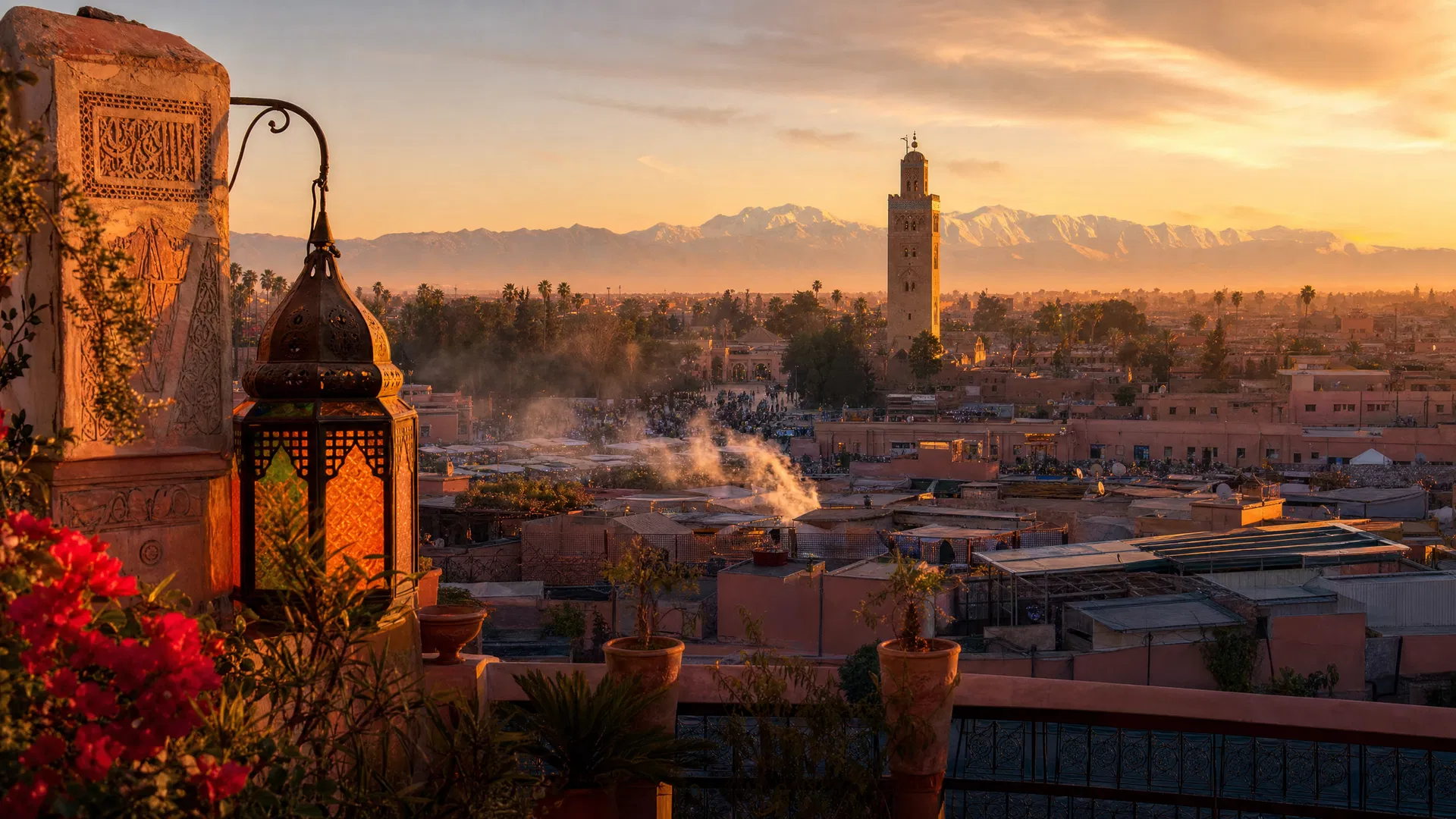
There is a moment that happens to almost everyone who visits Marrakech. It usually occurs on the first evening, somewhere between the medina's labyrinthine alleys and the chaos of Jemaa el-Fna square. The light turns amber. Smoke rises from a hundred charcoal grills. A Gnawa musician strikes the first note on his guembri bass lute. And you stop walking — not because you're lost, though you probably are — but because something in your nervous system simply refuses to process what your eyes and ears and nose are all receiving at once.
Marrakech does that. It overwhelms you, then seduces you, then refuses to let you go.
This is not a city that eases you in gently. It arrives all at once: the ochre-pink walls that give it the nickname "the Red City," the call to prayer echoing across rooftops at dawn, the smell of cumin and cedar and tanned leather drifting through streets so narrow two people can barely pass side by side. It is one of the most disorienting places on earth, and one of the most magnificent. And once you understand how it works — once you stop fighting the chaos and start moving with it — it becomes one of the most rewarding travel experiences you can have anywhere in the world.
This guide is for the traveler who wants to experience Marrakech properly: not as a checklist of sights to photograph, but as a city to inhabit, however briefly. We'll walk you through the medina quarter by quarter, tell you what to eat and where to eat it, explain the day trips that transform a city break into something far more expansive, and point you toward every Ask Leif guide in our Morocco collection so you can build the trip that fits exactly who you are.
The Medina: A Living, Breathing Labyrinth
The medina of Marrakech is a UNESCO World Heritage Site, and it deserves that designation not for any single monument but for what it is as a whole: a 19-kilometer ring of pink-ochre walls enclosing a city that has been continuously inhabited since the 11th century. From above, it looks like a human honeycomb — thousands of square riads packed together, their blank exterior walls concealing interior courtyards of extraordinary beauty, connected by a web of alleys that narrows, branches, dead-ends, and doubles back on itself in ways that defeat every navigation app ever written.
Getting lost here is not a failure. It is the point.
The medina's geography is organized, loosely, around Jemaa el-Fna — the great square at its heart — with the souks radiating northward and the historic monuments scattered through the southern districts. But the real Marrakech exists in the spaces between the landmarks: the bread baker who pulls flatbreads from a wood-fired oven at 7 AM, the elderly man playing chess outside a café that has no sign and no menu, the schoolchildren in white djellabas who treat the ancient alleys as their personal playground.
The Souks are the medina's commercial engine and its most immediately overwhelming feature. They are organized by trade in the traditional manner — the dyers' souk, the spice souk, the leather souk, the carpet souk, the brass souk — though the boundaries have blurred over centuries of commerce. The Souk Semmarine is the main artery, wide enough for a cart and lined with the kind of tourist-facing shops that sell everything from Berber rugs to argan oil to hand-painted ceramic tagines. Venture off it into the smaller lanes and the character changes: the workshops where craftsmen still work by hand, the wholesale stalls where local women buy their fabric, the tiny tea houses where you can sit for twenty minutes and watch the whole city flow past.
Haggling is expected in the souks, and the opening price is rarely the final price. The best advice is to know what you want before you want it — browse without intent first, then return to negotiate when you've calibrated your sense of value. And always remember: the transaction is a social ritual as much as a commercial one. A cup of mint tea offered mid-negotiation is not a distraction tactic; it's an invitation to slow down and do this properly.
The Mellah, the historic Jewish quarter in the southern medina, is one of Marrakech's most undervisited neighborhoods and one of its most atmospheric. The architecture here is distinct — wrought-iron balconies, Star of David motifs carved into doorways, the remnants of a community that once numbered in the tens of thousands before the mid-20th century emigrations to Israel and France. The Mellah sits adjacent to the Bahia Palace and the Saadian Tombs, making it a natural anchor for a half-day exploration of the southern medina.
Bab Doukkala, in the northwest corner of the medina, is where many experienced Marrakech travelers choose to base themselves. It is quieter than the souk district, close enough to the action but removed from the most aggressive tourist commerce. The streets here feel more genuinely residential — laundry strung between windows, neighborhood hammams, the kind of corner grocery that sells everything from phone credit to fresh herbs.
Jemaa el-Fna: The World's Greatest Square
Jemaa el-Fna has been on UNESCO's list of "Masterpieces of Oral and Intangible Heritage of Humanity" since 2001 — the first public space in the world to receive that designation. The name is contested: some translate it as "Assembly of the Dead," a reference to the public executions that once took place here; others say it means "Mosque of the Ruined," referring to a mosque that was never completed. Either way, the name carries weight.
By day, the square is a sun-baked open space where orange juice sellers compete for attention and a handful of snake charmers work the tourist crowd. It is busy but manageable. The juice stalls — rows of them, each identical, each vendor calling out to passing tourists — are a Marrakech institution. The orange juice, freshly squeezed and served in a glass for 4 dirhams, is one of the great travel bargains on earth.
But Jemaa el-Fna at night is something else entirely.
When the sun drops behind the Koutoubia minaret around 6 PM, the square transforms. Smoke rises from nearly a hundred food stalls that materialize from nowhere, erecting tented tables and firing up charcoal grills with practiced efficiency. Circles of spectators form around acrobats, storytellers, Gnawa musicians, and the occasional boxing match. The sound of the guembri bass lute mixes with the clatter of plates and the calls of stallholders competing for your attention in French, English, Spanish, and Arabic simultaneously.
The food stalls of Jemaa el-Fna are not fine dining. They are street food at its most honest, cooked fast over high heat, served on communal tables with bread as your utensil. Some of it will be the most memorable meal of your trip. The lamb brochettes are reliable; the merguez sausages, spicy and snappy, are another safe choice. But the dishes that separate the adventurous from the cautious are the ones worth seeking out: babbouche, a steaming bowl of small snails in a peppery, cumin-laced broth that locals drink like tea; bouzelouf, slow-cooked sheep's head served with cumin and salt, the cheek meat tender and surprisingly delicate; and harira, Morocco's national soup, thick with tomatoes, lentils, chickpeas, and lamb, available for around 10 dirhams a bowl.
The best way to experience the square is to eat early (the stalls are freshest between 7 and 9 PM), then find a rooftop terrace — Café de France, the Terrasse des Épices, or the rooftop at Dada Marrakech — and watch the whole spectacle from above with a mint tea. The view from height reveals what you can't see from the ground: the sheer scale of the thing, the organized chaos of it, the way the smoke and the lights and the crowd form something that has been happening in essentially the same way for a thousand years.
The Monuments: History Written in Plaster and Tile
Marrakech is one of Morocco's four imperial cities, and its historic monuments reflect centuries of dynastic ambition rendered in some of the most intricate decorative work in the Islamic world.
The Koutoubia Mosque is the city's defining silhouette — a 12th-century minaret that rises 70 meters above the medina and can be seen from almost anywhere in the city. Non-Muslims cannot enter, but the gardens surrounding it are open to all and offer one of the city's most peaceful retreats from the souk chaos. The minaret served as the architectural model for the Giralda in Seville and the Hassan Tower in Rabat — evidence of how far the Almohad dynasty's influence reached.
The Bahia Palace was built in the late 19th century for Si Moussa, the Grand Vizier of Morocco, and expanded by his son Ba Ahmed. The name means "brilliance," and the palace earns it: 8 hectares of gardens, courtyards, and reception rooms decorated with hand-painted cedarwood ceilings, zellij tilework, and carved plaster that took hundreds of Moroccan craftsmen years to complete. The palace was designed to be the greatest in the world at the time of its construction. Whether it achieved that ambition is debatable; that it is extraordinary is not.
The Saadian Tombs were sealed by the Alaouite Sultan Moulay Ismail in the 17th century — presumably to erase the memory of the dynasty he had supplanted — and not rediscovered until a French aerial survey in 1917. They contain the remains of the Saadian Sultan Ahmed al-Mansour and his family, housed in a chamber of such refined beauty that the decision to seal it rather than destroy it begins to make a certain kind of sense. The marble columns, the carved cedar ceiling, the intricate tilework: it is one of the finest examples of Moroccan funerary architecture in existence.
The Ben Youssef Madrasa, a 14th-century Koranic school that once housed 900 students, is perhaps the most architecturally overwhelming building in Marrakech. Every surface is decorated: zellij tiles at the base, carved stucco in the middle register, and intricate cedar woodwork at the top, all surrounding a central courtyard with a marble fountain. The student cells that line the upper galleries are tiny — barely large enough for a sleeping mat and a lamp — a reminder that the pursuit of knowledge in medieval Morocco was not a comfortable undertaking.
The El Badi Palace is the ruin that rewards imagination. Built by the Saadian Sultan Ahmed al-Mansour in the 16th century to celebrate his victory over the Portuguese at the Battle of the Three Kings, it was reportedly so magnificent that it drew visitors from across the known world. The Italian marble was imported from Carrara; the gold and onyx came from sub-Saharan Africa. Then Moulay Ismail stripped it bare to build his own palace in Meknes, leaving only the shell: vast sunken gardens, the remains of 360 rooms, and a series of underground passages that hint at what was lost. Storks nest on the ruined walls. The scale of what remains is enough to suggest the scale of what was.
The Gardens: Green Oases in the Red City
The Majorelle Garden is perhaps Marrakech's most photographed attraction, and the crowds it draws are a testament to how genuinely remarkable it is. The garden was created by French painter Jacques Majorelle, who spent forty years developing it from a bare plot into a botanical masterpiece of cacti, bamboo groves, and water features. He also invented the vivid cobalt blue — Majorelle Blue — that covers the studio and pavilions and has become one of the most recognizable colors in travel photography.
Yves Saint Laurent and Pierre Bergé purchased the garden in 1980 when it faced demolition, restored it, and made it their Marrakech home. The Berber Museum within the garden houses Bergé's extraordinary collection of Berber art and jewelry. Saint Laurent's ashes were scattered here after his death in 2008, and a memorial garden was created in his honor. The garden opens at 8 AM; arrive then to beat the worst of the crowds.
The Secret Garden (Jardin Secret) in the heart of the medina is a more recent restoration — a 19th-century riad garden that was derelict for decades before being painstakingly brought back to life. It is smaller and quieter than Majorelle, with two distinct garden styles: an Islamic garden of geometric symmetry and an exotic garden of tropical plants. The rooftop terrace offers one of the best views of the medina's roofscape.
The Agdal Gardens, a 12th-century royal garden south of the medina walls, stretch for over 400 hectares of olive, orange, and pomegranate groves surrounding a series of ancient irrigation pools. They are not always open to the public — access depends on whether the royal family is in residence — but when they are, they offer a completely different experience of Marrakech: vast, quiet, agricultural, a reminder that this city was built in an oasis.
The Hammam: A Ritual, Not a Spa Treatment
The hammam is Morocco's oldest social institution, and experiencing one properly is as essential to understanding Marrakech as visiting any palace or souk. The word comes from the Arabic for "heat," and the experience is exactly that: a sequence of progressively hotter rooms, a full-body scrub with a kessa mitt that removes layers of dead skin you didn't know you had, a black soap (savon beldi) made from olives and eucalyptus, and a final cool-water rinse that leaves you feeling like you've been rebuilt from scratch.
There are two kinds of hammam in Marrakech. The tourist hammams — places like Hammam de la Rose or Les Bains de Marrakech — offer a comfortable, English-speaking, appointment-based experience with private rooms and a menu of treatments. They are excellent, and there is no shame in choosing them. But the neighborhood hammams — Hammam Mouassine, Hammam Bab Doukkala — offer something harder to replicate: the actual social experience of a Moroccan bathhouse, where local families have been coming for generations, where the attendant speaks no English and communicates entirely through hand signals, and where the whole thing costs 50 dirhams rather than 500.
The protocol at a neighborhood hammam is simple once you know it: pay at the entrance, change in the anteroom, follow the attendant's lead through the rooms, and surrender yourself to the process. Bring a change of underwear, a pair of flip-flops, and the willingness to feel briefly bewildered. What you'll leave with — beyond the softest skin of your adult life — is the sense of having participated in something genuinely Moroccan rather than merely observed it.
The Food: Morocco's Most Underrated Cuisine
Moroccan food is one of the great undiscovered cuisines of the world — underrated because it rarely travels well, because the complexity of its spice combinations is difficult to replicate outside the country, and because the best versions are made in home kitchens and small neighborhood restaurants that no food critic has ever reviewed.
Tagine is the dish most visitors know, and for good reason: a slow-cooked stew of meat, vegetables, and preserved lemons or dried fruit, cooked in the conical clay pot that gives it its name, the flavors deepened by ras el hanout (a spice blend that can contain up to 30 different ingredients). But tagine is a category, not a single dish. The lamb tagine with prunes and almonds is different from the chicken tagine with preserved lemon and olives, which is different from the kefta tagine with eggs, which is different from the fish tagine with chermoula. Eating your way through them is a project worth undertaking.
Tangia is the dish that belongs specifically to Marrakech — a slow-cooked lamb or beef stew made in a tall clay urn, traditionally taken to the public baths to cook in the residual heat of the furnaces for eight to ten hours. The result is meat of extraordinary tenderness, perfumed with preserved lemon, cumin, and saffron. It is normally a home dish, but Chez Lamine, a stand in the medina near Jemaa el-Fna, serves it daily. This is a hyper-local experience that most visitors miss entirely.
Pastilla is Marrakech's great showpiece dish: a flaky warqa pastry filled with pigeon (or chicken), almonds, cinnamon, and saffron, dusted with powdered sugar and cinnamon. The combination of sweet and savory, of crispy pastry and tender filling, is one of those flavor experiences that makes you recalibrate your understanding of what food can do. It is traditionally served at celebrations and special occasions; finding a restaurant that makes it properly is worth the effort.
Harira is the soup that sustains the city. Thick with tomatoes, lentils, chickpeas, and lamb, seasoned with ginger, cinnamon, and fresh herbs, it is traditionally eaten to break the fast during Ramadan but available year-round at the food stalls of Jemaa el-Fna and in every neighborhood café. A bowl with a piece of msemen (flaky flatbread) is one of the best breakfasts in the world.
Couscous is served on Fridays across Morocco — the traditional day for family gatherings — and the Friday couscous at a good Marrakech restaurant is a ritual worth planning your week around. The grain is hand-rolled and steamed multiple times until each couscous is separate and fluffy; the broth is rich with vegetables and meat; the whole thing arrives at the table in a vast communal dish. It is the opposite of fast food in every sense.
For the full Marrakech food experience, our Marrakech Food & Culture guide maps out a four-day culinary itinerary through the city's best tagine trails, souk secrets, and rooftop dining experiences — from the spice merchants of Rahba Kedima to the rooftop restaurants overlooking the medina at sunset.
Beyond the Medina: The New City and the Palmeraie
Gueliz, the French-built new town west of the medina walls, is where Marrakech's cosmopolitan present lives. The wide boulevards, pavement cafés, art galleries, and international restaurants feel like a different city from the medina — which is precisely the point. The French colonial administration built Gueliz in the 1920s to house European settlers while leaving the medina intact, a policy that inadvertently preserved one of the world's great medieval urban environments.
Today, Gueliz is where Marrakech's creative class congregates: the galleries showing contemporary Moroccan art, the coffee shops with proper espresso machines, the restaurants where the city's expat community and cosmopolitan Moroccan elite eat. The Comptoir des Mines gallery is worth visiting for a glimpse of Morocco's burgeoning contemporary art scene. The Mohammed V Avenue is good for an evening stroll, watching how Marrakchis spend their after-work hours in cafés and boutiques.
The Palmeraie — the palm grove that stretches north of the city — was once a vast agricultural landscape of date palms, olive groves, and market gardens. Today it is increasingly developed with luxury villas and resort hotels, but it remains a pleasant escape from the medina's intensity, particularly in the early morning when the light through the palms is extraordinary. Several of the city's best luxury riads are located here, and a motorcycle sidecar tour through the Palmeraie is one of Marrakech's more memorable experiences.
Day Trips: The Atlas Mountains and Beyond
One of Marrakech's greatest assets is its geography. The High Atlas Mountains begin less than 90 minutes from the city center, rising to peaks above 4,000 meters and containing some of the most dramatic landscapes in North Africa. The Sahara Desert is a day's drive to the southeast. The Atlantic coast — with its surf towns and seafood — is two and a half hours to the west. Marrakech is not just a city; it is a base camp for an entire country.
The Ourika Valley is the most accessible Atlas day trip, a 90-minute drive south into a valley of Berber villages, terraced fields, and the Setti Fatma waterfalls. The valley is at its most beautiful in spring when the almond trees are in bloom and the river runs fast with snowmelt. The Berber markets that travel from village to village through the High Atlas are large, chaotic, and wonderful — packed with merchants selling everything from animals to vegetables to plastic bins, with makeshift stalls for barbers and even dentists. The Amina Garden in the Ourika Valley, where Austrian sculptor Andre Heller's work appears among walking paths, streams, and ponds with the Atlas Mountains hovering in the distance, is one of Marrakech's most undervisited gems.
Imlil and Toubkal offer more serious mountain engagement. Imlil is the gateway village for treks to Jebel Toubkal, at 4,167 meters the highest peak in North Africa. The trek to the summit takes two days and requires no technical climbing skills, only fitness and acclimatization. But even without summiting, the drive to Imlil through the Mizane Valley — past walnut groves and Berber villages of pink-ochre mud-brick houses — is worth the journey.
Essaouira, the windswept Atlantic port city two and a half hours west of Marrakech, is the perfect antidote to the medina's intensity. The blue-and-white medina, the ramparts overlooking the ocean, the fishing port where the day's catch is grilled on the quayside — it is everything Marrakech is not: cool, breezy, unhurried. Jimi Hendrix famously spent time here in the late 1960s; Orson Welles filmed Othello on its ramparts. The city has a creative, slightly bohemian energy that makes it one of Morocco's most beloved escapes. Our Essaouira couples guide covers the city's most romantic corners in detail.
The Morocco Beyond Marrakech
Marrakech is the entry point to a country of extraordinary diversity, and the traveler who spends their entire Morocco trip in the Red City is missing much of what makes Morocco one of the world's great travel destinations.
Fez is Morocco's spiritual and intellectual capital — a medina even larger and more labyrinthine than Marrakech's, home to the world's oldest continuously operating university (the University of al-Qarawiyyin, founded in 859 AD), and the most complete medieval Islamic city on earth. The tanneries of Fez, where leather has been dyed using the same methods for a thousand years, are one of the most visually arresting sights in all of Africa. Our Fez couples guide captures the city's romantic and historic dimensions in a three-day itinerary.
Chefchaouen, the Blue City of the Rif Mountains, is Morocco's most photographed destination for good reason: the entire medina is painted in shades of blue, from pale sky to deep indigo, creating a visual experience that feels almost surreal. The city sits at 600 meters in the Rif Mountains, giving it a cooler, more relaxed atmosphere than the imperial cities of the plains. Our Chefchaouen solo guide covers the medina's best corners, the Rif hikes, and the artisan workshops that make this city worth more than a day trip.
Casablanca is not the romantic city of Humphrey Bogart's imagination — it is Morocco's commercial capital, a sprawling modern metropolis of five million people — but it contains one of the most extraordinary buildings in Africa: the Hassan II Mosque, completed in 1993, with a minaret that rises 210 meters above the Atlantic Ocean and a retractable roof that opens to the sky. The Art Deco architecture of the city center, built during the French Protectorate, is a separate pleasure. Our Casablanca culture guide and Casablanca city guide cover both the iconic and the underrated.
For those who want to experience the full sweep of Morocco in a single trip, our 10-day Morocco road trip guide traces the classic route from Marrakech through the Sahara to Fez and on to Chefchaouen — a journey through ancient cities, desert landscapes, and mountain villages that constitutes one of the great road trips on earth.
Staying in Marrakech: The Riad Experience
The riad is Marrakech's defining accommodation form, and staying in one is not just a lodging choice but an architectural experience. From the outside, a riad is indistinguishable from any other building in the medina — a blank wall, a heavy wooden door, perhaps a brass knocker. Inside, the world transforms: a central courtyard with a fountain, orange trees, and the sound of water; rooms arranged around the courtyard on multiple levels; a rooftop terrace with views across the medina's roofscape to the Atlas Mountains in the distance.
The best riads are not hotels in any conventional sense. They are small (rarely more than ten rooms), intimate, and staffed by people who know the city deeply. The breakfast — served in the courtyard or on the roof — typically involves fresh-squeezed orange juice, msemen flatbreads with argan oil and honey, eggs, olives, and Moroccan pastries. It is one of the great travel breakfasts, and it sets the tone for everything that follows.
The Bab Doukkala neighborhood is generally considered the best area for riad accommodation: close enough to the souks and Jemaa el-Fna to walk everywhere, but far enough from the tourist epicenter to feel genuinely residential. For those who want to escape the medina entirely, the Palmeraie offers luxury villa and resort options with pools and gardens that the medina riads cannot provide.
Practical Information: What You Need to Know Before You Go
When to go: The ideal windows are March to May and September to November. Spring brings mild temperatures (20–25°C), wildflowers in the Atlas, and the city at its most photogenic. Autumn is equally pleasant and slightly less crowded. Summer (June to August) is genuinely hot — temperatures regularly exceed 40°C in the medina — and while the city doesn't shut down, it is not comfortable for extended walking. Winter is mild and often sunny, with cold nights, and the Atlas Mountains are snow-capped from December through March.
Currency: The Moroccan dirham (MAD) is not freely convertible outside Morocco, so plan to exchange money on arrival. ATMs are widely available in Gueliz and around the medina perimeter; the best exchange rates are typically found at the official bureaux de change rather than at hotels. Cash is essential in the medina — most souk vendors and small restaurants do not accept cards.
Getting around: The medina is best explored on foot; it is too dense and narrow for any other mode of transport. Petits taxis (small orange cabs) are the standard way to travel between the medina and Gueliz or the airport; agree on a price before getting in, or insist on the meter. For day trips, organized tours are the most convenient option, though renting a car gives more flexibility for the Atlas and Essaouira.
Language: Arabic (Darija, the Moroccan dialect) is the first language of the medina; Berber (Tamazight) is widely spoken in the Atlas. French is the language of business and education, and most tourist-facing Marrakchis speak it fluently. English is increasingly common, particularly among younger Moroccans and in tourist areas. Learning a few words of Arabic — shukran (thank you), la shukran (no thank you, essential in the souks), b'saha (cheers, used when someone eats or drinks) — will be received with genuine warmth.
Dress: Marrakech is a Muslim city, and while it is more relaxed about dress codes than some destinations, covering shoulders and knees in the medina is both respectful and practical (it also significantly reduces the attention you attract from touts). In Gueliz and at rooftop bars, the dress code is essentially the same as any European city.
Safety: Marrakech is generally safe for tourists, including solo travelers. The main annoyances are the touts and fake guides who congregate around Jemaa el-Fna and the souk entrances, offering to show you around and then leading you to shops where they receive a commission. The best defense is confident, purposeful walking and a polite but firm "la shukran." The medina is safe to walk at night, though the streets become very dark in the residential areas away from the main tourist routes.
Your Marrakech Itinerary: Where to Start
The beauty of Marrakech is that it rewards every kind of traveler and every length of trip. A long weekend gives you the medina, the monuments, and Jemaa el-Fna. A week lets you add the Atlas, Essaouira, and a proper hammam afternoon. Two weeks opens up the whole country.
For the first-time visitor wanting to experience the city's culture and food in depth, our 5-day Marrakech cultural and culinary guide is the most comprehensive starting point — covering the medina quarter by quarter, the best food experiences, and the day trips that make the most of the city's extraordinary location.
If you're traveling as a couple and want the most romantic version of Marrakech — private riad courtyards, hammam afternoons, rooftop dinners with Atlas Mountain views — our Marrakech couples guide covers four days of riads, hammams, and Atlas views designed specifically for two.
Traveling solo? Marrakech is one of the world's great solo destinations — chaotic enough to be endlessly stimulating, safe enough to navigate alone, and full of the kind of spontaneous encounters that only happen when you're not traveling in a group. Our Marrakech solo guide helps you navigate the medina with confidence and find the experiences that solo travelers can access that groups often miss.
Traveling with kids? Marrakech is more family-friendly than its reputation suggests — the food stalls, the snake charmers, the souk chaos, and the camel rides are all genuinely thrilling for children, and the Moroccan culture of warmth toward families makes it an easier destination than many. Our Marrakech family guide covers four days of adventures designed around what kids actually love about the city.
And if budget is a consideration, Marrakech is one of the world's great value destinations — a city where you can eat extraordinarily well, stay in a beautiful riad, and experience world-class history and culture for a fraction of what equivalent experiences would cost in Europe. Our Marrakech budget guide shows you how to do it properly for around $40 a day.
The Feeling You Can't Quite Explain
Every traveler who has been to Marrakech struggles to explain it to people who haven't. The photographs don't capture it. The descriptions don't convey it. The city exists in the gap between what you can document and what you actually experience — in the smell of the tanneries on a warm afternoon, in the sound of the muezzin at dawn when the city is still dark and quiet, in the moment when you turn a corner in the medina and find yourself in a courtyard of such beauty that you stand there for a full minute before you remember to breathe.
It is a city that asks something of you. It asks you to slow down, to be present, to engage with the world on its own terms rather than yours. It will disorient you, occasionally frustrate you, and periodically overwhelm you. And then it will give you something in return that you will spend years trying to put into words.
Go. Get lost. Eat the tangia. Sit on a rooftop at dusk and watch the smoke rise from Jemaa el-Fna. Let Marrakech do what it does.
You will never stop thinking about it.
Ready to plan your Marrakech trip? Use Ask Leif to build a personalized itinerary in minutes — tailored to your travel style, budget, and exactly how many days you have. Start with one of our Morocco guides above, or let the AI build your perfect Red City adventure from scratch.