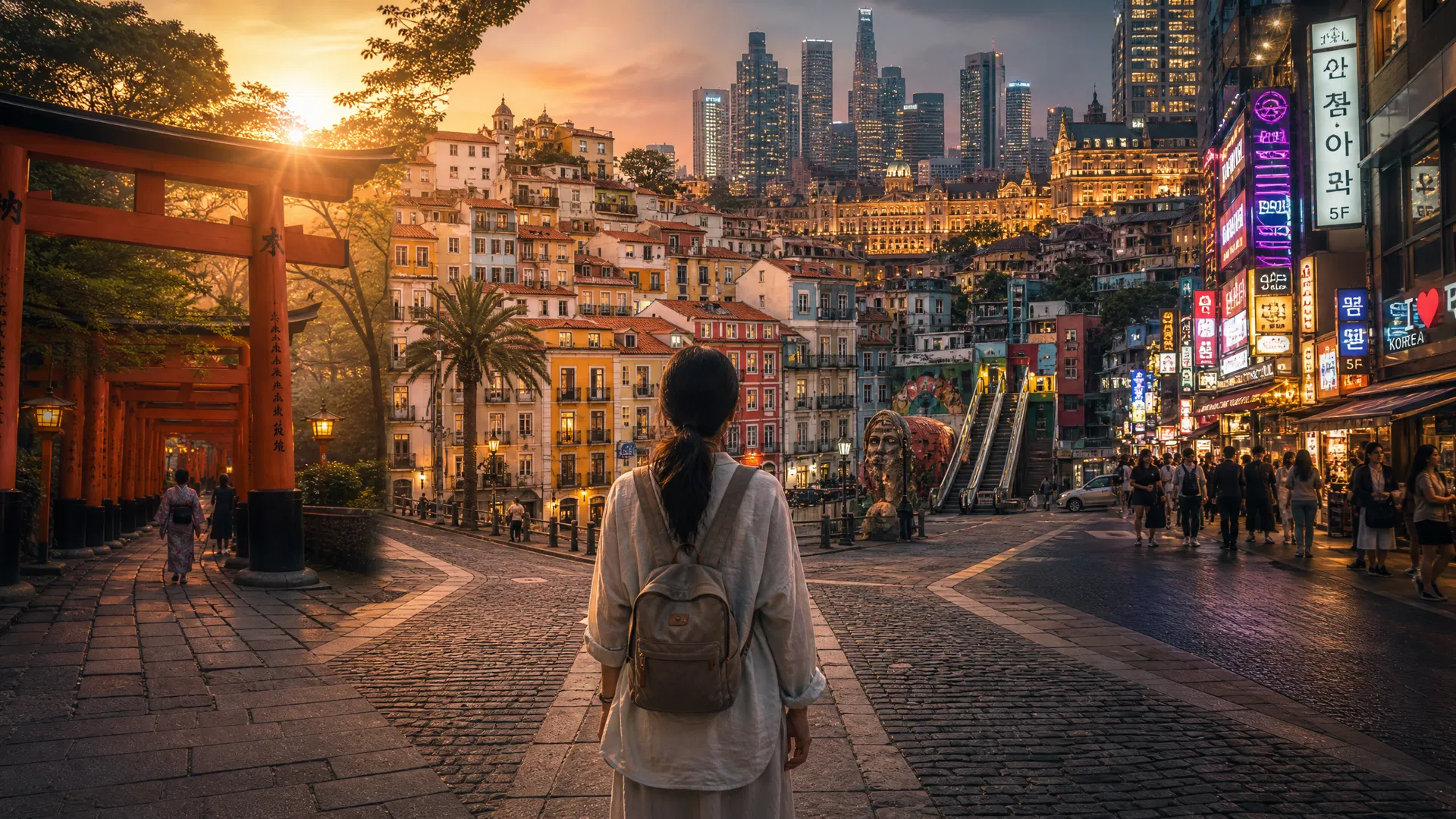
The Cities Where Traveling Alone as a Woman Is Not a Compromise. It's the Point.
Destination: Global
Category: travel-tips
The Cities Where Traveling Alone as a Woman Is Not a Compromise. It's the Point.
Every list of cities for solo female travelers starts in the same place. It opens with a reassurance — "these cities are safe," "you'll feel comfortable," "harassment is rare" — and then presents a ranked collection of destinations organized by crime statistics, solo traveler forums, and the general absence of things going wrong. The lists are not wrong. The cities on them are genuinely safe. But safe is not the same as extraordinary, and the conflation of the two has produced a genre of travel content that reads less like a recommendation and more like a risk assessment. You deserve better than a risk assessment.
The cities on this list are safe. That is the minimum acceptable standard and it is not what earns a place here. What earns a place here is something different: each of these six cities has something specific about its culture, its infrastructure, or its social architecture that makes solo female travel not a constraint to be managed but an advantage to be used. In each of these cities, the fact of traveling alone as a woman produces an experience that is not just possible but specifically, measurably better than the experience available to travelers who arrived with company. The izakaya counter seat in Tokyo. The fado house in Lisbon. The jjimjilbang in Seoul. The ryokan kaiseki in Kyoto. These are not experiences that accommodate solo female travelers. They are experiences that solo female travel unlocks.
The thesis of this post is not "these cities are safe for women." It is "these are the cities where being a solo female traveler is the correct way to arrive."
Tokyo: The City That Freed You Before You Arrived
Tokyo does not accommodate solo female travelers. It was built, without intending to, to make them feel entirely at home — and the distinction between accommodation and design is the entire point. Where most cities treat the solo female traveler as an edge case to be managed, Tokyo's urban infrastructure produces an experience of freedom that travelers from cultures with more restrictive social norms consistently describe as transformative. The city's specific architecture of independence — the women-only train carriages, the 24-hour convenience store network, the counter-seat culture at its yakitori bars and ramen shops — was not designed with solo female travelers in mind. It was designed for the specific pressures of Japanese urban life. The fact that it serves solo female travelers so completely is a consequence of the same cultural logic that produced it.
The women-only carriages on Tokyo's major rail lines — the Chuo, Keio, Odakyu, and Seibu lines among others — exist because of the chikan problem: the groping of women on crowded rush-hour trains that became sufficiently documented and sufficiently serious in the 1990s that the railway companies responded not with enforcement campaigns but with structural separation. The carriages are marked in pink, operate during morning and evening rush hours, and are positioned at specific ends of each train. The cultural response to a harassment problem was not to police the harassers more aggressively — it was to give women their own space. That decision, and the cultural logic behind it, tells you more about Tokyo's relationship with female autonomy than any crime statistic.
The counter-seat culture at Tokyo's yakitori bars and ramen shops is the second piece of the architecture. In most Western cities, the solo diner at a restaurant is given the worst table — the one near the kitchen, the one facing the wall, the one that signals to the room that this person could not find company. In Tokyo, the counter seat is the best seat. The specific geography of the yakitori counter — the grill at eye level, the chef working directly in front of you, the other solo diners arranged alongside you in a companionable parallel — produces conversation with the chef rather than the awkward social isolation of the table-for-one. In Shimokitazawa, Tokyo's most independent creative neighborhood, the yakitori bars along Suzunari Yokocho operate almost entirely on counter seating. A solo woman eating and drinking alone at 10pm is not a social signal requiring explanation. She is practicing the correct relationship with the space.
The 24-hour konbini network — Lawson, 7-Eleven, FamilyMart — is the third element, and the one that most travelers underestimate. Japanese convenience stores are not the fluorescent-lit afterthoughts of Western cities. They are fully stocked, meticulously maintained community anchors that provide food, ATMs, printing, package pickup, and a specific quality of ambient safety at any hour. The staff training at major konbini chains includes protocols for identifying and assisting customers who appear distressed. The stores are positioned at intervals that make them navigable on foot across most of Tokyo's neighborhoods. At 3am in Shinjuku, the konbini is not a last resort. It is a destination.
For the full Tokyo experience as a solo traveler, the Tokyo solo travel guide sequences the neighborhoods in the order that makes the city most comprehensible — starting with Shinjuku's density and moving outward to Shimokitazawa's creative village and the specific quietness of Yanaka, one of the few neighborhoods that survived the 1923 earthquake and the 1945 firebombing and still looks like what Tokyo looked like before it became Tokyo.
Where Tokyo proves that solo female travel can be structurally supported by urban infrastructure, Lisbon proves something different — that it can be culturally supported by a city's specific emotional register.
Lisbon: The City That Already Understood Why You Came Alone
Lisbon has a specific cultural relationship with solitude that most travel content about the city fails to name. The Portuguese concept of saudade — the emotional register that encompasses longing, melancholy, and a specific appreciation for being alone with one's thoughts — is not a tourist-facing concept. It is the city's actual emotional architecture. The miradouros, the fado houses, the long Sunday afternoons in the Alfama — these are not experiences designed to attract visitors. They are the way Lisbon relates to itself. And for a solo female traveler, that relationship produces something rare: a city where being alone is not conspicuous. It is the correct proportion to the space.
The Miradouro da Graça at 6pm is the specific experience that proves this. Not the Miradouro de Santa Catarina, which by late afternoon has become a tourist gathering point with its own social logic, but the Graça — the quieter viewpoint above the Alfama where the neighborhood's residents rather than its visitors occupy the benches at the end of the working day. The social culture of the Lisbon miradouros is specific: conversation between strangers is initiated by the shared experience of the view rather than by social obligation. A solo woman sitting with a glass of wine watching the light change over the Tagus is not an object of concern or curiosity. She is practicing the correct relationship with the city. She is more likely to have a genuine conversation with a local than a couple is — because the couple is already in conversation, and the solo traveler is available.
The fado house solo dining experience is the second competitive gap that most Lisbon content misses. Tasca do Chico, in the Bairro Alto, is the specific venue that makes this argument most clearly. The house has perhaps thirty seats and a performance space barely larger than a living room. The solo diner at the counter is given the best view of the performance — not the worst table — because the counter is positioned directly facing the musicians. The specific fado etiquette of silence during performance means that solo dining is socially identical to group dining: everyone is quiet, everyone is listening, and the absence of a companion to whisper to is not a deficit but a freedom. You can give the music your full attention. The couples at the tables behind you cannot.
The LxFactory Sunday market, in the repurposed industrial complex in Alcântara, is the third experience that rewards the solo traveler specifically. The market's layout — long corridors of vendors selling vintage clothing, ceramics, books, and food — produces a browsing pace that is individual by nature. The vendor conversations are one-on-one. A solo traveler moves at her own speed, stops when something interests her, and has the undivided attention of the vendor in a way that a group traveler never does. The group negotiates its pace. The solo traveler sets it.
The Lisbon solo travel guide covers the city's neighborhoods in the sequence that makes the most sense for a traveler arriving alone — starting in the Alfama and moving through Mouraria to the Bairro Alto, with specific attention to the specific hours when each neighborhood is most itself. The Lisbon food guide covers the specific pastelaria and tasca culture that is best experienced alone, including the specific counter-seat protocol at the city's oldest tascas.
Where Lisbon offers the solo female traveler a city that understands her emotional register, Medellín offers something more confrontational: a city that has undergone the kind of transformation that makes the act of witnessing it feel like a privilege.
Medellín: The City That Transformed Itself and Knows What That Costs
No competitor list of cities for solo female travelers has made the argument for Medellín that this post is making, and the absence is revealing. Most lists either exclude Medellín entirely — on the grounds that Colombia's historical reputation for violence makes it an uncomfortable recommendation — or include it with so many safety caveats that the recommendation is functionally a warning. Neither approach is honest about what Medellín actually is in 2025, and neither approach explains why a solo female traveler who understands what this city was and sees what it has become will have an experience unavailable anywhere else.
Medellín in the 1980s and early 1990s was the most dangerous city in the world. The Medellín Cartel's assassination rate peaked at 381 murders per 100,000 residents in 1991 — a number that makes it essentially incomparable to any other city in the modern era. The transformation that followed was not accidental and not inevitable. It was the product of specific decisions: the outdoor escalators built in 2011 in Comuna 13, the hillside neighborhood that had been the most violent in the most violent city in the world; the Biblioteca España, constructed in the most marginalized neighborhood as a deliberate investment in human capital; the urban acupuncture projects that connected the city's hillside comunas to its valley center through cable cars and public space. The city that emerged from those decisions is not just safer. It is specifically interesting in a way that no other city can replicate, because no other city has that specific history and that specific response to it.
The escalators in Comuna 13 are the most visible symbol of the transformation, but the guided tour by former residents is what makes them comprehensible. The escalators themselves — six sections covering 384 meters of vertical rise — were built to connect a neighborhood that had been physically isolated from the rest of the city by its own topography and its own violence. The street art that covers the walls alongside the escalators documents the transformation in real time: murals commissioned from local artists, many of them women, that depict the neighborhood's history without sanitizing it. The correct way to experience this is with a guide who grew up in the neighborhood — not the English-language tour operators in El Poblado, but the community-run tours that depart from the escalator base and are led by residents who can explain what the murals mean because they lived the history the murals describe.
The Biblioteca España — the library designed by Giancarlo Mazzanti and completed in 2007 in the Santo Domingo Savio neighborhood — is the second piece of the argument. The civic decision to build a library rather than a police station as the primary intervention in the city's most marginalized neighborhood was a specific claim about what transformation requires. The library runs literacy programs, digital access programs, and community meeting spaces. The building itself — three irregular black volumes on the hillside, visible from across the city — is a statement about what public investment in human dignity looks like. A solo female traveler who spends a morning there understands something about civic will that no museum or monument can teach.
For the specific Medellín experience that rewards the solo traveler, stay in Laureles rather than El Poblado. El Poblado is the neighborhood that most international travelers default to — it is safe, legible, and full of other travelers. Laureles is where Medellín's creative and professional community actually lives. The restaurants on Avenida El Poblado in Laureles are not tourist restaurants. The coffee shops are not tourist coffee shops. The Medellín 4-day itinerary covers both neighborhoods and explains the specific routing that makes the most of each. The Medellín food and culture guide covers the Mercado del Río in the creative district, where the city's most innovative chefs — several of them women who trained in Europe and returned specifically to participate in the city's culinary evolution — run counter-seating restaurants that are best experienced alone.
Where Medellín asks the solo female traveler to witness transformation, Seoul asks her to take a position on one.
Seoul: The City Where the Argument Is Still Happening
Medellín's transformation is historical — it happened, it is documented, and the solo female traveler who engages with it is a witness. Seoul's transformation is present tense. The city that produced the most globally influential feminist cultural moment of the 21st century — the #MeToo movement in South Korea, followed by the 4B movement in which Korean women organized around the specific refusal of heterosexual relationships, marriage, and childbearing as a political act — is still in the middle of the argument it started. For a solo female traveler, that means Seoul is not just safe and not just interesting. It is the city where the conversation about what solo female travel means is most alive, most contested, and most worth having.
The 4B movement — bihon (no marriage), bichulsan (no childbirth), biyeonae (no dating), bisekseu (no sex) — emerged specifically from Seoul's young female professional community in response to a patriarchal culture that the women of that community had decided they were no longer willing to accommodate. The movement is not a tourist attraction. But its existence has produced a specific infrastructure of feminist community spaces in Seoul's Gangnam and Hongdae neighborhoods — cafés that are de facto gathering points for the women who organized it, reading groups and discussion events that happen in those spaces, a specific intellectual energy that has no equivalent in any Western city's café culture. A solo female traveler who finds her way into one of these spaces is not observing a movement. She is in the room where the argument is happening.
The jjimjilbang — the Korean public bathhouse — is the specific solo female experience that Seoul offers and no other city on this list can replicate. The women-only sections of the 24-hour jjimjilbang near Hongik University are where Seoul's specific female community experience is most concentrated: the communal bathing pools, the sleeping areas where women spread out on heated floors with wooden pillows, the snack bars where the specific Korean bathhouse food — sikhye, baked eggs, ramen — is consumed in the specific social culture of women who are comfortable with each other's bodies in a way that Western culture rarely produces. The experience has no Western equivalent and no adequate description. It requires going.
The Dongdaemun Design Plaza — Zaha Hadid's building, completed in 2014 — is the third Seoul experience that specifically rewards the solo female traveler. The DDP operates until 5am, which means its specific culture of late-night visitors — designers, students, people who work in the adjacent fashion market — is accessible at hours when most urban cultural institutions are closed. The building's interior is a continuous curved surface with no right angles, which means navigation is intuitive rather than directed, and the solo traveler moves through it at her own pace without the group negotiation that most architectural experiences require.
The Seoul solo travel guide covers the city's neighborhood structure in the sequence that makes the feminist geography most legible — from Hongdae's creative energy to Insadong's traditional arts district to the specific hillside neighborhoods of Bukchon and Ihwa that are best explored alone. The Seoul food guide covers the specific street food culture of Gwangjang Market, where the solo diner at the bindaetteok stall is the correct proportion to the experience.
Where Seoul places the solo female traveler in the middle of a living argument, Vienna places her at the beginning of a recovered one.
Vienna: The City Where the Women Were Always There. Someone Just Stopped Saying So.
Vienna in the early 20th century was the intellectual capital of the world. Freud, Wittgenstein, Klimt, Schiele, Mahler, Schoenberg — the names are familiar because they have been repeated for a century. What has not been repeated with equal frequency are the names of the women who inhabited that intellectual world alongside them: Berta Zuckerkandl, whose salon at Döblergasse 4 connected Klimt to the Secessionists and whose journalism shaped Vienna's cultural conversation for three decades; Eugenie Schwarzwald, whose progressive school educated the daughters of Vienna's intellectual elite and whose summer house in Grundlsee hosted the discussions that produced some of the century's most important ideas; the female patients of Sigmund Freud whose case studies — Anna O., Dora, the Rat Man's sister — produced the theories that made Freud famous, and whose own accounts of their experiences were systematically suppressed or reframed. A solo female traveler who engages with that recovered history finds a Vienna that is more interesting and more personally relevant than the standard Klimt-Schiele-Freud tour. She finds the city that was always there underneath the one that was documented.
Berta Zuckerkandl's salon at Döblergasse 4 in the 8th district is now an unremarkable apartment building with no commemorative plaque. The address is in the historical record — her memoirs, published in 1939, describe the salon's specific geography and the specific conversations that happened there — but the building itself has been absorbed into the fabric of the city without acknowledgment. A solo female traveler who walks to that address and stands in front of it is doing something that no guided tour offers: she is finding the specific place where the intellectual history of the 20th century was partly made by a woman whose name most visitors to Vienna have never heard.
The Café Central is the second experience that rewards the solo female traveler specifically. The coffeehouse — one of Vienna's most famous, in the Palais Ferstel on Herrengasse — was historically a democratic intellectual space where women could participate in public intellectual life in an era when they were excluded from universities. The specific afternoon hour when the tourist crowd thins — between 3pm and 5pm on weekdays — is when the coffeehouse returns to something closer to its original function. A solo woman sitting for two hours with one Melange and one book is not an anomaly. She is practicing the correct relationship with the space that the coffeehouse was designed to produce. The table near the window on the left side of the main hall, facing the courtyard, is the specific seat that produces the best combination of light and quiet.
The Kunsthistorisches Museum contains works attributed to "workshop of" or "circle of" male masters that ongoing academic research is in the process of correctly attributing to female artists. The attribution debate is most active in the Dutch and Flemish galleries on the first floor, where several works previously attributed to male masters have been reattributed to female artists in the past decade. A solo female traveler who reads the attribution labels carefully — and who knows to look for the specific hedging language of "attributed to" and "circle of" — is reading the museum's own ongoing argument with itself about who made what.
The Vienna solo travel guide covers the city's cultural geography in the sequence that makes the recovered women's history most accessible — including the specific museums and archives that hold the primary sources. The Vienna food guide covers the specific coffeehouse culture in depth, including the specific ordering protocol and the specific pastries that are correct for a two-hour afternoon sitting.
Where Vienna asks the solo female traveler to recover a history that was always there, Kyoto asks her to practice something that requires no recovery at all — because it was never lost.
Kyoto: The City Where Solo Travel Is Not a Category. It's a Practice.
Where Vienna asks the solo female traveler to recover a history that was always there, Kyoto asks her to practice something that requires no recovery at all — because it was never lost. The two cities prove something together that neither proves alone: where Vienna demonstrates that women's contributions to intellectual culture were systematically erased and can be found again, Kyoto demonstrates that the specific relationship between solitude, beauty, and ritual has always been available and has never required excavation. Where Tokyo proves that solo female travel can be structurally supported by urban infrastructure, Kyoto proves that it can be culturally supported by a city's specific relationship with solitude and daily practice. The specific Kyoto experiences that produce the best solo female travel — the dawn temple visits, the tea ceremony protocol, the ryokan kaiseki — are not experiences that accommodate solo travelers. They are experiences that solo travel unlocks. A solo woman in a Kyoto ryokan is not a traveler who couldn't find a companion. She is a traveler who understood that the ryokan's specific beauty requires solitude to be fully comprehensible.
The solo ryokan experience in Kyoto's Higashiyama district is the most intimate accommodation experience available in Japan, and it requires solo travel to work correctly. The kaiseki dinner — the multi-course seasonal meal served at the in-room table by a kimono-wearing attendant — is timed to the individual diner's pace rather than the table's consensus. The courses arrive when the previous course is finished, which means the meal expands or contracts to fit the diner's rhythm. For a group, this requires negotiation. For a solo traveler, it requires nothing except attention. Several ryokan in Higashiyama have accepted single-occupancy bookings without surcharge since the 1990s — a specific policy decision that reflects the ryokan's understanding that the solo traveler is not an incomplete group but a complete guest.
The dawn Fushimi Inari experience is the second piece of the Kyoto argument. The mountain trail behind the Fushimi Inari shrine — the path through the thousands of orange torii gates that has become one of Japan's most photographed experiences — is transformed at 5am. The tourist crowds that make the trail feel like a queue by 9am are absent. The pilgrims who are present at 5am are primarily Japanese women making their own early morning devotional visits — older women in particular, who have been making this walk for decades and who treat the pre-dawn mountain as their specific space. A solo female traveler on the trail at 5am is not a tourist in a crowd. She is a participant in a practice that has been happening on this mountain for centuries.
The Nishiki Market — the covered food market in central Kyoto known as "Kyoto's Kitchen" — is the third experience that rewards the solo traveler specifically. The vendors who line the narrow corridor sell pickled vegetables, fresh tofu, grilled skewers, and the specific Kyoto ingredients that don't appear in supermarkets. The solo visitor without a group to manage has the time and attention that group visitors never have — the vendor conversation that explains what the ingredient is, how it's used, and why this specific vendor's version is different from the one three stalls down. The market is too narrow for comfortable group navigation. It was designed for the individual browser.
The Kyoto solo travel guide covers the city's temple circuit in the sequence that makes the most of the early morning hours — starting at Fushimi Inari at dawn and moving north through Gion to Higashiyama before the crowds arrive. The Kyoto food guide covers the Nishiki Market vendors in depth and the specific kaiseki restaurants that accept solo diners without the surcharge that most high-end Japanese restaurants impose.
The Cities That Didn't Make This List (And Why That Matters)
A curation is only as honest as its exclusions. Three cities appear on virtually every competitor list of destinations for solo female travelers, and none of them appear here. The reasons are specific.
Amsterdam is excluded because its specific culture of solo female travel is primarily based on the absence of negative experiences rather than the presence of positive ones. The cycling infrastructure is excellent. The liberal culture is genuine. The solo female traveler in Amsterdam is unlikely to be harassed, unlikely to feel unsafe, and unlikely to have a bad time. She is also unlikely to have an experience that is specifically better because she is traveling alone. The Amsterdam experience for a solo female traveler is essentially the same as the Amsterdam experience for any traveler — which means it doesn't meet the thesis. The floor is high. The ceiling is the same as everyone else's.
Reykjavik is consistently ranked the world's safest city for women and appears on every competitor list. It doesn't appear here for the same reason: the safety ranking, while accurate, reflects the absence of danger rather than the presence of the specific experiences that make solo female travel extraordinary. Reykjavik is an extraordinary destination — the AskLeif library covers it in depth — but the argument for Reykjavik as a solo female travel destination is essentially "nothing bad will happen to you," which is the floor, not the ceiling.
New York is an extraordinary solo female travel destination and has its own place in the AskLeif library. It doesn't appear here because the specific argument for New York — the cultural institutions, the freedom of urban anonymity, the specific female community in the creative industries — is better made in a dedicated New York context than as one of six cities in a curation post. New York deserves its own thesis. It will get one.
Planning Your Trip
These six cities span four continents and don't suggest a single routing. The planning logic for this list is organized around what each city offers specifically to solo female travelers rather than around geography or conventional travel logic.
If you want structural freedom — the experience of a city that has built independence into its infrastructure — start with Tokyo. Five days is the minimum to understand the city's neighborhood logic; seven days allows you to move from Shinjuku's density to Shimokitazawa's creative village to the specific quietness of Yanaka. The Tokyo 7-day city guide covers the full range. Budget travelers should note that Tokyo is significantly more affordable than its reputation suggests — the Tokyo budget guide covers the specific konbini and standing-bar culture that makes the city accessible at any price point.
If you want cultural resonance — the experience of a city that understands the emotional register of solo travel — Lisbon is the answer. Four days is sufficient; five days allows you to add a day trip to Sintra or Setúbal. The Lisbon 5-day travel guide covers the full city. Lisbon pairs naturally with Porto for a two-city Portugal trip — the Lisbon-Porto itinerary covers the combination.
If you want transformation — the experience of witnessing what intentional civic change looks like — Medellín requires at least four days to do the argument justice. Stay in Laureles. Take the community-run tour in Comuna 13 on day two. The Medellín couples guide is useful even for solo travelers for its coverage of the city's restaurant and nightlife geography.
If you want intellectual engagement — the experience of a city where the conversation about gender and power is most alive — Seoul rewards a longer stay. Five days minimum; seven days allows you to move beyond the obvious neighborhoods into the specific hillside communities where the city's creative community lives. The Seoul 5-day itinerary covers the full city.
If you want recovered history — the experience of finding the women who were always there — Vienna is the destination. Three days is sufficient for the core cultural geography; four days allows you to add the specific archives and the specific coffeehouse afternoons that make the recovered history most tangible. The Vienna 4-day itinerary covers the city's cultural circuit.
If you want practice — the experience of a city that treats solitude as a skill rather than a deficit — Kyoto is the answer. Five days minimum; the dawn temple circuit requires early mornings that need recovery time built in. Kyoto pairs naturally with Tokyo for a Japan trip that proves both arguments simultaneously.
The AskLeif itinerary generator can build a solo trip around any of these cities — or around a combination of them — with the specific timing, neighborhood sequencing, and solo-traveler-specific logistics that make the difference between a trip that's possible and a trip that's extraordinary.
The Point
Tokyo frees you before you arrive — through infrastructure so specifically designed for independence that the freedom feels structural rather than earned. Lisbon understands why you came alone — through a cultural relationship with solitude so embedded in the city's emotional architecture that your presence feels not just accepted but correct. Medellín transforms you through the act of witnessing what transformation costs and what it produces — the specific civic will that turned the world's most dangerous city into one of its most interesting. Seoul argues with you — through the most alive conversation about gender and power available in any major city, conducted in cafés and bathhouses and design plazas that operate until 5am. Vienna recovers the women who were always there — through the specific addresses and the specific attribution debates and the specific coffeehouse afternoons that make the recovered history tangible rather than theoretical. Kyoto solves the problem that most travel content about solo female travel never names — that the goal is not to make solo travel possible but to make it the correct way to arrive.
Six cities. Six dimensions of what extraordinary solo female travel looks like. None of them are here because they're safe. All of them are here because they're irreplaceable.