The Best Cities for History Obsessives Are Not Museums. They Are Evidence.
Destination: Global
Category: comparison
At the Basilica of San Clemente in Rome, you enter through a twelfth-century church, take a staircase down into a fourth-century church, then keep descending until the walls stop being Christian and become Roman. There is a Mithraic temple below the altar. There is a first-century apartment building below the basilica. Water still runs through an ancient channel. The experience lasts less than an hour, but it corrects a mistake most history travel makes before the trip has even begun: it imagines the past as a room you enter, rather than the pressure underneath the room where you are standing.
The best cities for history obsessives are not necessarily the ones with the largest museums, the oldest stones, or the longest UNESCO citation. Those measures describe what a place has managed to cordon off. The cities that matter most for this kind of traveler are places where the past has not been successfully separated from the present—where a metro platform contains an excavation, a daily route follows an imperial road, a religious claim remains active, or an entire capital sits on the material consequence of what an earlier capital destroyed.
This post argues that the best cities for history obsessives are the ones whose past is still evidence: evidence of a decision, a conquest, a faith, a fear, a refusal, or an argument that continues in the life of the city. Rome layers. Athens asks. Jerusalem argues. Istanbul accumulates. Kyoto chooses. Mexico City excavates. These are not six interchangeable stops for people who enjoy old buildings. They are six different ways a city can make history present tense.
Cairo belongs in a different conversation: its Egyptian antiquities and the proximity of Giza deserve a dedicated argument on their own terms. Beijing warrants more room than a single section can give its imperial and contemporary political context. Petra is among the most consequential archaeological places on earth, but it is an archaeological site rather than a city you inhabit alongside its ordinary present. The six cities here are selected by a narrower, harder standard. They let you live inside the evidence.
The Best Cities for History Obsessives Need a Different Standard
A monument can be magnificent and still be easy to misunderstand. Put it behind ropes, attach a date, give it a ticket desk, and it begins to look resolved. But history is rarely resolved. It is usually a continuing negotiation over land, memory, access, language, religion, and whose version of the past gets to sit at street level.
That is why the most rewarding history city trip has less to do with collecting landmark photographs than learning to recognize a city's working seams. Look for the subway excavations, the reused stone, the contested names, the market that follows an older commercial geography, the modern building that reveals what was cleared to make room for it. A history obsessive does not need a city to perform antiquity at every hour. The better city makes an ordinary errand feel implicated in an older story.
The six cities below make that relationship visible in different ways. Rome makes vertical time physical. Athens keeps a fifth-century BC experiment in public argument. Jerusalem contains sacred claims that cannot be made abstract. Istanbul lets successive capitals occupy one shoreline and one skyline. Kyoto protects a deliberate continuity against the speed of replacement. Mexico City exposes the architecture of conquest in the center of contemporary life.
Rome: The City That Is Still Being Excavated From Underneath Itself
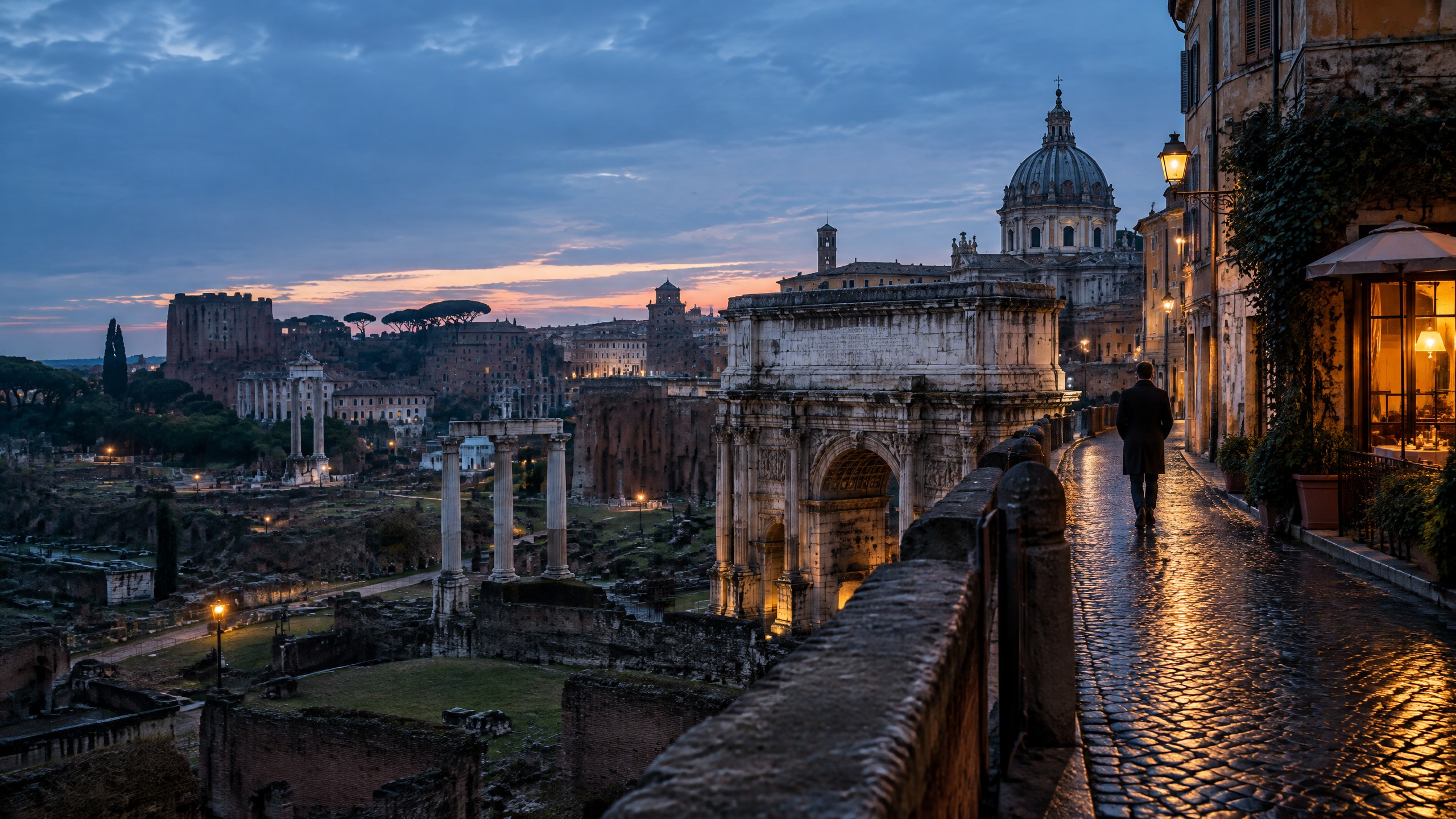
Rome belongs first because the past is physically under its present, not politely adjacent to it. Its current street level is often meters above the city people think they came to see. Piazza Navona follows the footprint of Domitian's Stadium, its curved shape inherited from an arena whose walls became useful structure for the city that followed. Campo Marzio does not present antiquity as a separate district; it lets traffic, apartments, cafés, and fragments of imperial topography occupy the same mental map.
That is why a first-time Rome itinerary should be planned less as a greatest-hits sequence than as a descent through levels. San Clemente is the clearest lesson: a medieval basilica above an early Christian basilica above a Roman building and Mithraic sanctuary. The point is not merely that the layers are old. It is that each layer repurposed, concealed, or built directly upon the one below it. Rome did not replace itself cleanly. It kept moving upward.
Largo di Torre Argentina gives the same argument a more casual setting. Four Republican-era temples sit below modern street level in the middle of the city; the sacred area is associated with the place where Julius Caesar was killed in 44 BC. You can notice the archaeological site from a bus or while crossing toward a coffee appointment. That casual proximity changes the scale of the event. Caesar's assassination is not confined to a chapter in a book; it took place in a sunken part of a living neighborhood where the city continues to route around the consequences.
For the fullest version of Rome's horizontal time, walk the Appian Way early, ideally on a car-free Sunday when the basalt paving, tombs, and open Campagna have room to register. The Via Appia Antica was a road before it was a heritage object. Its surviving stones make the useful question immediate: what did it mean to build a road intended to carry military force, trade, funerary procession, and civic ambition outward from the capital? Pair that walk with Rome through its food geography in Testaccio, where the city's eating culture remains tied to the institutions and labor that formed it. Rome's layers do not stop at the Forum. They carry into the way the city still inhabits old systems.
Athens: Where the Fifth Century BC Is Still the Standard of Argument
Where Rome makes time vertical, Athens makes a fifth-century BC argument unavoidable in the present city. The Acropolis sits above traffic, apartments, political demonstrations, cafés, and the daily density of a contemporary capital. Its proximity is the point. Athens does not allow the Parthenon to become a distant classical image for long; turn through Monastiraki or Psirri, and the hill returns to the line of sight.
The strongest first morning is a sequence rather than a single ticket: start at the Acropolis Museum when it opens, then walk up to the Acropolis while the marble fragments, Caryatids, and Parthenon frieze context are still fresh. The museum gives the architectural system its pieces; the hill gives the pieces their scale, weather, and relationship to the city below. A five-day Athens travel guide can give that pairing the time it deserves instead of treating the Acropolis as a quick early stop before moving on to Plaka.
Kerameikos supplies the corrective that the grand hill cannot. Ancient Athens appears in the cemetery through grave stelae that show people not as civic ideals but as people with jewelry boxes, household gestures, companions, and work. The place asks a different historical question: what does a democracy look like in the intimate life of the people who lived beside its institutions? Arrive early enough to let the site be quiet. The value is not silence as atmosphere; it is the chance to look at the evidence before the Acropolis returns as the only available story.
Then take the metro. At Syntagma, a transit station used by commuters incorporates archaeological finds exposed during construction: graves, water channels, and structures from older Athens displayed in glass cases along the route. The city did not uncover these materials for a museum field trip. It found them because modern Athens needed a subway. That is exactly why the display matters. Athens continues to build its present through the ground of its past.
For the history obsessive, Athens wins over another classical stop because its question remains public. What do democracy, philosophy, theater, and civic memory look like once they have become global reference points and local burdens at once? A food-and-culture route through Athens helps keep the answer grounded in the markets and neighborhoods beneath the hill. Athens asks, and it expects the visitor to keep answering.
Jerusalem: Where Three Civilizations Still Argue About the Same Hill
Where Athens asks a philosophical question, Jerusalem makes competing historical claims materially impossible to ignore. In less than one square kilometer, the Old City contains the Jewish, Muslim, Christian, and Armenian quarters; the Western Wall, the Haram al-Sharif/Temple Mount, and the Church of the Holy Sepulchre sit within a walk that can be completed in one morning and understood for a lifetime. The closeness is not a convenience. It is the source of the city's intensity.
Jerusalem cannot be read responsibly as a cabinet of sacred sites. The holy places are active places of prayer, custody, ritual, and political meaning. The history obsessive should arrive ready to move slowly, follow current access rules, dress appropriately, and recognize that every name and route carries a perspective. A three-day Jerusalem culture-and-history itinerary belongs here not because it can settle the city's meanings, but because it organizes a visit around the fact that those meanings remain lived and contested.
The Jerusalem Archaeological Park near the Western Wall gives physical scale to the argument. At the southern and southwestern edges of the Temple Mount, excavated streets, steps, and Robinson's Arch disclose a Herodian city level below the contemporary one. Stones that once carried pilgrims and commerce sit beneath the surface that now organizes another sacred, civic, and security-bound reality. Go early, when permitted, and do not treat the archaeology as proof that one period cancels another. The lesson is the opposite: each era has left a claim on the same ground.
The Church of the Holy Sepulchre offers a parallel form of continuity. Its architecture, chapels, liturgies, custodial arrangements, and crowd patterns do not resemble a clean historical reconstruction because the building has never been one. It is a working religious center with a long, complicated life. The early hours can make that present-tense quality clearer, when worship rather than sightseeing organizes the interior. The experience requires attentiveness, not extraction.
Outside Damascus Gate, the morning movement of residents, vendors, and worshippers makes the city legible beyond its maps. Jerusalem's food, work, prayer, checkpoints, and routes all live within historical density. That is why it belongs on this list and not merely in a roundup of sacred destinations. Jerusalem argues. The argument has never stopped, and the traveler must not pretend it has.
Istanbul: The City That Has Been Every Civilization's Capital and Remembers All of Them
Where Jerusalem concentrates claim and counterclaim on one hill, Istanbul spreads accumulation across an entire strait. Byzantium became Constantinople, Constantinople became Istanbul, and none of those names is adequate by itself. The city has been Greek settlement, Roman imperial capital, Byzantine Christian center, Ottoman capital, and modern Turkish metropolis. It remembers each of those identities because their materials, institutions, water routes, and religious buildings still meet one another in the daily city.
Hagia Sophia makes the accumulation visible in one structure. Its life as cathedral, mosque, museum, and mosque again is often reduced to a headline, but the building asks for longer attention: the dome, Christian mosaics, Islamic calligraphy, the threshold between tourist site and active worship space, and the surrounding square where multiple eras remain in view. A five-day Istanbul city-and-culture route gives you enough room to visit it at a time that respects current prayer access and still walk the surrounding Byzantine and Ottoman geography.
Chora, or Kariye, is another essential counterpoint. Its late Byzantine mosaic and fresco cycles survived an Ottoman conversion in part because they were covered rather than destroyed; their recovery and current context make preservation a layered act rather than a simple rescue story. The mosaics have an intimate narrative energy that differs from Hagia Sophia's public scale. They show that Istanbul's history is not a hierarchy in which one capital replaces the last. It is an archive that keeps changing its filing system.
The commercial waterfront at Eminönü puts that archive into ordinary circulation. Balık ekmek boats, the Galata Bridge fishing culture, ferries crossing between continents, and the movement from Spice Bazaar to quay make the Bosphorus more than a view. Water has organized exchange here through Byzantine, Ottoman, and modern life. Read the route through a food-focused Istanbul guide, and a fish sandwich becomes less like an attraction than a small, edible reminder that empire depended on access to a working waterfront.
The Grand Bazaar makes the same point in commerce. Its fifteenth-century foundation matters, but its ongoing work matters more: shutters lifting, deliveries moving, merchants arranging a day inside a market that has been revised rather than frozen. Istanbul belongs here because it accumulates without pretending the accumulations are frictionless. The city lets a traveler see what happens when every capital leaves something behind and the next one has to live with it.
Kyoto: The City That Chose Its History Over Its Future Every Time
Where Istanbul accumulates through conquest and conversion, Kyoto preserves through repeated decisions not to erase itself. Its central grid still reflects the Heian-period plan established when the city became Japan's capital in 794. Temples, shrines, machiya townhouses, canals, workshops, and neighborhood rituals do not form a historic district around the city; they are embedded in the city's daily operating pattern.
Kyoto's significance is not a claim that it avoided change. The city changes constantly, and development pressure on machiya is real. The point is that its continuity has required choices: choices about what is protected, what gets rebuilt, what remains in use, and what a capital can lose without losing its coherence. A five-day Kyoto culture-and-history journey is most useful when it treats the old imperial grid as a way of navigating, not a decorative fact to absorb on a bus tour.
Fushimi Inari is a good place to test that distinction. The thousands of torii gates are often photographed as a visual tunnel, but the gates are also donations: material records of merchants, businesses, and people asking Inari for prosperity. Walk early enough that the route can be read as an archive of commercial devotion rather than a line for an image. Each gate places a continuing practice into the landscape. The shrine is not a relic of belief; it is belief receiving another contribution.
Nijō Castle reveals a less tranquil historical technology. The nightingale floors were designed to chirp underfoot, warning guards that someone moved through the corridors. Inside the reception rooms, power presents lacquer, gold, and ceremony. Underfoot, it confesses anxiety. That tension makes the Tokugawa shogunate feel immediate in a way dates cannot. Kyoto preserves political history alongside devotional history, and the two should not be collapsed into a single mood.
For another kind of intellectual continuity, walk the Philosopher's Path between Ginkaku-ji and Nanzen-ji and remember the twentieth-century philosopher Nishida Kitarō, whose daily route helped lend the path its name. The fact is modest but useful: ideas have physical habits. A solo Kyoto plan built around contemplative routes can give the path a morning rather than relegating it to a spare hour. Kyoto chooses. It has spent twelve centuries making preservation an active verb.
Mexico City: The City Built on Top of the City It Destroyed
Where Kyoto chooses continuity, Mexico City reveals the moral cost of a continuity imposed through conquest. The Spanish colonial capital was built over Tenochtitlan, the Aztec capital it destroyed, and the central city still displays the collision in its materials and topography. The Metropolitan Cathedral stands beside the Templo Mayor archaeological site; colonial power and Mexica memory do not appear as separate historical chapters. They confront one another in the center of a city of more than twenty million people.
Start at the Templo Mayor with enough time for both the museum and the excavated precinct. The discovery of the Coyolxauhqui stone in 1978 during electrical work made the buried temple impossible to keep abstract. The museum's offerings, sculptures, and ritual objects make clear that the surrounding colonial fabric was not built on an empty field. A five-day Mexico City itinerary should treat this first day as an orientation to the city's foundational contradiction, then let the rest of the trip unfold from it.
Tlatelolco's Plaza de las Tres Culturas gives that contradiction three visible layers: pre-Hispanic ruins, the colonial church of Santiago Tlatelolco, and twentieth-century housing. It also carries the memory of the 1968 massacre of student protesters. The site resists any pleasant story of historical succession. A city does not simply evolve from one civilization into the next; it carries violence, displacement, and official forgetting in the spaces where new residents live ordinary lives.
Then leave the monumental center for Xochimilco. Its chinampas—the agricultural islands and canals developed in the pre-Columbian lake system—make Tenochtitlan's environment easier to grasp than a map can. A trajinera ride is more useful if you understand that the waterways are fragments of a larger engineered world that colonial urbanization largely transformed. A Mexico City budget guide can help keep the day's logistics realistic, but the important preparation is conceptual: you are not escaping the city for a canal excursion. You are visiting evidence of the ecological system beneath the metropolis.
Mexico City belongs on this list because it excavates—not only in a technical archaeological sense, but in the way the city keeps exposing the premise underneath its own center. This is history with no innocent viewpoint. The traveler is asked to see not only what survived, but what was built from what was taken.
How History Obsessives Should Choose Their City
Choose Rome if you want to understand how a city can use one era as the foundation for another until the ground itself becomes a timeline. Give it at least four full days, and reserve one morning for San Clemente or the Appian Way rather than letting every hour cluster around the Colosseum and Forum.
Choose Athens if the question that interests you is how an ancient civic experiment remains a reference point in a noisy modern capital. Four to five days makes room for the Acropolis Museum-Acropolis sequence, Kerameikos, Syntagma, and the neighborhoods that keep the hill in ordinary view.
Choose Jerusalem if you are ready to travel with seriousness, patience, and respect for current conditions. Three or four days can be intellectually dense, but avoid trying to reduce the city to a checklist. Check access rules, local guidance, and the security situation immediately before booking; its present circumstances are inseparable from the history you came to understand.
Choose Istanbul if you want the broadest civilizational span in one urban landscape. Five days lets Byzantine, Ottoman, republican, and contemporary Istanbul register through neighborhoods and crossings rather than one overloaded day in Sultanahmet. Budget for ferries, paid sites, and a few meals that keep you in the city after dark instead of returning to a hotel as soon as the monuments close.
Choose Kyoto if your interest is sustained cultural continuity: architecture, devotion, political history, craft, and the daily work of keeping a city legible. Four to five days works best; split early mornings across Fushimi Inari, a temple precinct, and the Philosopher's Path, leaving the middle of the day for the places that reward slower looking.
Choose Mexico City if you want history that refuses moral comfort. Five days allows the Centro Histórico, Tlatelolco, Xochimilco, and the museums and neighborhoods that show how the metropolis has kept expanding around its founding rupture. It can also pair naturally with a wider central Mexico trip, though the city alone holds more than enough evidence for one visit.
Do not attempt to combine these cities on one rushed itinerary. Rome and Athens create a strong Mediterranean sequence if you have ten days or more. Istanbul and Jerusalem require more logistical and current-affairs preparation but make a compelling eastern Mediterranean study when travel conditions allow. Kyoto and Mexico City do not need a counterpart; each deserves the kind of itinerary that leaves room for unplanned observation. If you want help translating one of these historical questions into a day-by-day route, AskLeif can build an itinerary around the sites, pacing, neighborhoods, and travel style that fit the argument you actually want to follow.
The Past Is Not Behind Glass
The point of traveling to these cities is not to become fluent in every dynasty, doctrine, battle, or excavation. No trip could do that. The point is to acquire a more accurate instinct: to recognize when the street beneath you has been raised over another street, when a public square is carrying several incompatible memories, when a religious building is still doing religious work, when an old plan continues to organize new lives.
Rome layers. Athens asks. Jerusalem argues. Istanbul accumulates. Kyoto chooses. Mexico City excavates.
Those verbs are not metaphors pasted onto six destinations. They are six ways history remains active. Go to the city whose verb you need to understand. Then walk until the evidence stops feeling like a lesson and starts feeling like the ground.