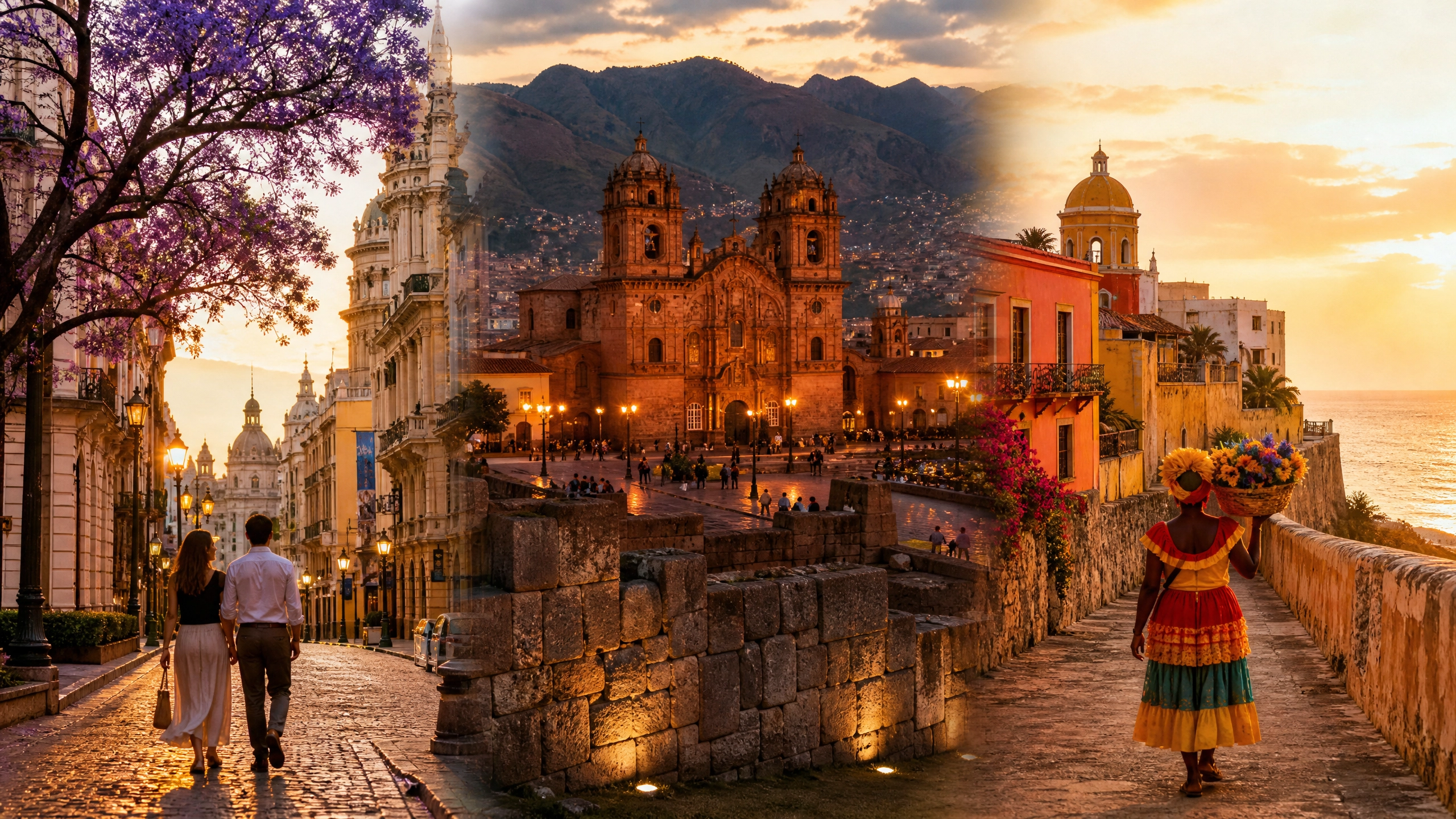
Most First-Timers See South America. Six Cities Let You Understand It.
Destination: South America
Category: Travel Guides
The Curation Argument
There is a version of a first South America trip that most people take. It involves a flight to Buenos Aires, a connection to Lima, a bus to Cusco, a train to Machu Picchu, and then — because the itinerary has space and the flights are cheap — a detour to Rio de Janeiro. Sometimes Patagonia gets added. Sometimes the Galápagos. The trip covers six countries in three weeks and produces photographs that look exactly like the photographs on every travel site that recommended the itinerary in the first place.
The traveler comes home having seen South America. They have not understood it.
The continent is enormous in a way that photographs and itinerary planners consistently underrepresent. The distance between Buenos Aires and Cusco is roughly equivalent to the distance between New York and Los Angeles. The distance between Cartagena and Santiago is greater than the distance between London and Tehran. Adding destinations to a South America itinerary does not enrich the trip — it replaces depth with coverage, and coverage is what you do when you don't trust the places you've chosen to be enough on their own.
This post is a curatorial argument, not a list. The six cities here were selected because they do the most work per day on the ground — because the culture, the food, the history, and the geography are most concentrated and most accessible to someone who has never been to the continent before. Every city is evidence for the thesis. Every city excluded from this list was excluded for a reason, and those reasons are explained explicitly below.
The first-timer who visits these six cities — even two or three of them — leaves understanding something about South America that the six-country itinerary never produces: that the continent has a logic, a register, a way of being that becomes legible only when you stay long enough in one place to feel it.
Buenos Aires: Where the Continent Calibrates Itself
Buenos Aires earns the first position on this list for the same reason Bangkok earns the first position on any Southeast Asia itinerary — it calibrates. A first-time visitor to South America needs a city that provides enough familiar framework to feel oriented while delivering enough that is genuinely new to establish the continent's register. Buenos Aires is that city.
The European comparison is unavoidable and accurate. The Recoleta neighborhood, with its Haussmann-influenced boulevards and café culture that has been running continuously since the 1800s, feels like Paris transposed to the Southern Hemisphere — except that it isn't Paris, and the differences matter. The tango is not a performance for tourists. It is a social practice that emerged from the working-class conventillos of La Boca and San Telmo in the late nineteenth century, and it is still practiced as such. The milonga at Club Gricel on La Rioja — a neighborhood venue that has been running since 1949 — fills on Thursday nights with couples who have been dancing together for decades. You can sit at the edge and watch without participating, and what you see is not a show. It is a conversation conducted in movement.
The food argument for Buenos Aires is chronically underrated in international travel writing. The city is one of the great beef cultures in the world, but the specific parrilla that locals use is not the tourist-facing restaurants on Cabrera Street in Palermo. It is La Carnicería on Thames Street — a butcher-turned-restaurant where the menu changes based on what came in that morning and the wine list is organized by the winemaker's philosophy rather than the grape. The Sunday San Telmo market is the tourist version of the neighborhood's food culture; the daily Mercado de San Telmo, open six days a week, is where the city actually shops. The distinction matters because one is a performance and the other is a practice, and Buenos Aires rewards the traveler who learns to tell the difference.
Three nights minimum. Four is better. The city operates on a schedule that runs two hours later than anywhere else — dinner before 9pm marks you as a tourist, and the best of the city doesn't start until 10.
Plan your Buenos Aires trip → | Buenos Aires food guide → | Buenos Aires couples →
Santiago: The City That Unlocks a Geography
Where Buenos Aires calibrates the continent's cultural register, Santiago unlocks something different — the understanding that South America's cities and their surrounding geographies are inseparable in a way that European or North American cities are not. You cannot understand Santiago without understanding what surrounds it, and what surrounds it is extraordinary.
The Andes are visible from the city center on clear days. Not as a distant backdrop but as an immediate presence — the snow line at 3,000 meters, the peaks at 5,000, the entire eastern horizon occupied by mountains that make the city feel simultaneously small and protected. The Maipo Valley wine country is 45 minutes south. The Pacific coast at Valparaíso is 90 minutes west. The ski resorts at Valle Nevado are an hour east. No other major South American city gives a first-timer access to this range of geography within a day trip radius, and understanding Santiago means understanding that the city and its surroundings are not separate experiences but a single argument about what it means to live at the edge of the Andes.
The city itself has enough standalone content to justify three nights before the geography takes over. Barrio Italia — the neighborhood that has been colonized by the city's creative class over the past decade — runs a weekend vintage market on Avenida Italia that operates nothing like the tourist-facing markets in the center. The vendors are dealers, not performers; the prices are negotiated, not fixed; and the objects — mid-century Chilean ceramics, Argentine leather goods, Bolivian textiles — tell a story about the continent's material culture that no museum presents as clearly. The Lastarria neighborhood's café culture is where Santiago's writers and architects actually work, not the tourist-facing spots on the main plaza.
For the traveler who wants to understand Chilean wine without a bus tour, Viña Cousiño Macul in the Maipo Valley offers bicycle tours through the vineyards — a format that produces a fundamentally different experience than the standard tasting room visit. The Lo Valledor market, open from 4am and winding down by 8, is where the city's chefs source their ingredients. Arriving at dawn means arriving when the market belongs to the people who use it rather than the people who photograph it.
Plan your Santiago trip → | Santiago food guide → | Santiago family guide →
Cartagena: The Thesis Made Visual
If Santiago argues for the relationship between a city and its geography, Cartagena makes a different argument entirely — that South America's colonial history is not an abstraction but a physical object you can walk around the perimeter of in two hours. The walled city, built by the Spanish between 1586 and 1796, is the most complete colonial fortification in the Americas. It is also the most concentrated expression of the continent's colonial history available to a first-time visitor in a single walkable district.
The specific argument for Cartagena over Bogotá as Colombia's first-timer city is accessibility. Cartagena's Old City is compact, walkable, and immediately legible in a way that Bogotá's complexity rewards only after several days of orientation. The walls themselves — 11 kilometers of coral and stone, up to 17 meters thick in places — are best walked before 8am, when the heat is still manageable and the light on the Caribbean is the specific shade of gold that makes the city's colors — the yellows, the pinks, the blues of the colonial facades — look like they were painted for exactly this moment. After 10am, the walls belong to the heat. Before 8, they belong to you.
The distinction between the Old City and Getsemaní — the neighborhood immediately outside the walls that was, until recently, the city's working-class barrio and is now its most interesting — is the distinction between Cartagena as it performs for visitors and Cartagena as it actually lives. The tourist-facing restaurants on Plaza de los Coches serve decent food at inflated prices to people who don't know where else to go. La Cevichería on Calle Stuart in Getsemaní — a small, unassuming room that has been serving the city's best seafood since 2009 — is where the city actually eats. The ceviche is made with fresh catch from the Caribbean market that morning. The aguardiente comes in a carafe. The bill is a third of what you'd pay on the plaza.
The nearby islands offer a sea turtle conservation experience on Isla Barú — a program run by the Fundación Tortugas del Mar that allows visitors to participate in nighttime nest monitoring during nesting season (May through October). It is the kind of experience that doesn't appear in any top-ranking travel guide for Cartagena, which is precisely why it belongs here.
Plan your Cartagena trip → | Cartagena food guide → | Cartagena couples →
Lima: The City That Ate the World
Cartagena makes the case for South America's colonial history as a physical experience. Lima makes a case that has nothing to do with history and everything to do with the present — specifically, with the fact that Lima has the best food scene in the Western Hemisphere, and that this is not a local claim but the considered verdict of the international food world, which has placed Peruvian restaurants at the top of global rankings for over a decade.
Central, Maido, Astrid y Gastón — these are restaurants that people fly to Lima specifically to eat at. But the broader Lima food culture that surrounds them is the more important argument for the first-timer. The Surquillo Mercado No. 2 — the market that Gastón Acurio has cited publicly as the best single source for ceviche ingredients in the city — operates six days a week on Calle Recavarren in Surquillo. The stalls are organized by ingredient rather than by vendor, which means the leche de tigre station is next to the ají amarillo station is next to the fresh catch station, and watching a cevichero assemble a dish from components sourced within a ten-meter radius is the most efficient education in Peruvian food culture available anywhere.
The neighborhood distinction matters enormously in Lima. Miraflores is where most visitors stay — it is safe, convenient, and full of restaurants that serve excellent food to people who don't know where else to go. Barranco, 20 minutes south by taxi, is where the city's creative class actually lives. The clifftop walk along the Malecón Cisneros at sunset, the Puente de los Suspiros, the Galería Lucia de la Puente — these are not tourist attractions. They are the texture of daily life in a neighborhood that happens to be extraordinarily beautiful.
La Mar cevichería, Gastón Acurio's most accessible restaurant, is a lunch destination only — the kitchen closes at 5pm, and the ceviche at 1pm, made with the morning's catch, is categorically different from the ceviche at 4pm. This is the kind of operational detail that doesn't appear in any travel guide but determines whether the meal is extraordinary or merely good.
Plan your Lima trip → | Lima culinary guide → | Lima family guide →
Medellín: The City That Decided to Become Extraordinary
Lima makes the case for South America's present. Medellín makes the case for something rarer — the possibility of deliberate transformation, of a city that survived something terrible and decided, with specific intention, to become extraordinary.
The facts of Medellín's recent history are well documented. In 1991, the city had the highest murder rate of any city in the world. Pablo Escobar's Medellín Cartel operated from the hillside comunas that ring the city center, and the violence that defined the city's international reputation for a decade was not abstract — it was specific, targeted, and systematic. By 2013, the murder rate had fallen by 95 percent. The city won the Urban Land Institute's award for the world's most innovative city. The transformation was not accidental.
What makes Medellín essential for a first-time South America visitor is not the transformation story itself — which has been told many times — but the specific evidence of that transformation that you encounter on the ground. The Metrocable Line K, which connects the hillside comunas to the city center, was not built as a tourist attraction. It was built as infrastructure — as a way of integrating neighborhoods that had been physically and economically isolated from the city for decades. Riding it at 6:30am, before the tourist crowds, means riding it with the people it was built for: the workers, the students, the vendors carrying goods down to the market. The view of the comunas from the cable car is not a photograph. It is a lesson in what urban investment actually looks like.
The neighborhood distinction in Medellín is the same as in Lima — the tourist version and the local version are different cities. El Poblado is where most visitors stay, and it is comfortable and well-serviced and entirely disconnected from the city that locals actually inhabit. Laureles, the neighborhood immediately west of El Poblado across the river, is where the city's middle class lives — the restaurants are better, the prices are lower, and the experience of being in a Colombian neighborhood rather than a tourist district is immediate and unmistakable. Galería Café Libro on Avenida El Poblado is where the city's creative community actually goes — a bookshop-café that has been hosting readings, concerts, and conversations since 1993 and feels nothing like the rooftop bars that most travel guides recommend.
The Feria de las Flores in August — the flower festival that fills the streets with silleteros carrying elaborate floral arrangements on their backs — is the single best argument for timing a Medellín visit to a specific week. The festival has been running since 1957 and is the most concentrated expression of Antioquian culture available to a visitor in a single event.
Plan your Medellín trip → | Medellín food guide → | Medellín couples →
Cusco: The Indigenous Heart of the Continent
Medellín makes the case for South America's capacity for transformation. Cusco closes the argument by returning to something older and more fundamental — the indigenous civilization that existed before the Spanish arrived, that was partially destroyed by the conquest, and that has been partially reconstructed in the centuries since in a way that makes Cusco unlike any other city on the continent.
The former capital of the Inca Empire sits at 3,400 meters above sea level in the Andes, and the altitude is the first thing a first-timer encounters. The acclimatization sequence matters: arrive in the afternoon, rest for the remainder of the day, drink coca tea rather than alcohol, eat lightly, sleep. The first full day in Cusco should be a walking day in the city rather than an excursion to the Sacred Valley or Machu Picchu — not because the city isn't worth a day but because the body needs the time to adjust, and the traveler who ignores this advice spends their first Machu Picchu morning with a headache rather than with the experience the journey deserves.
The city itself is the argument. The Inca stonework — the precisely fitted polygonal stones that form the foundations of the colonial buildings the Spanish built on top of them — is the most visible evidence of the layering that defines Cusco. The Spanish demolished the Inca temples and built their churches on the same foundations, using the same stones, and the result is a city where every colonial building sits on an Inca base, where the Catholic cathedral on the Plaza de Armas was built on the foundations of the palace of Inca Viracocha, where the relationship between conquest and continuity is architectural rather than historical.
The San Pedro Market — the city's daily market, operating since the nineteenth century — is the correct alternative to the tourist-facing craft markets near the plaza. The vendors are selling to the city's residents: the dried herbs, the chicha morada, the anticuchos, the fresh bread. The tourist markets sell alpaca sweaters. San Pedro sells the city's actual food culture.
The day trip that most Cusco visitors miss — because they spend their second day in the Sacred Valley doing the same Machu Picchu preparation that every tour operator recommends — is the Maras salt pans and Moray terraces. The Maras salt pans, which have been harvested continuously since the Inca period, are a series of terraced evaporation pools fed by a single saltwater spring. The Moray terraces — circular agricultural terraces that descend 30 meters into the earth, creating a series of microclimates that the Inca used to experiment with crop cultivation — are the most visually extraordinary piece of Inca engineering that most visitors to Cusco never see. Both can be visited in a single day by bicycle from Maras village.
For the Machu Picchu journey itself: the Vistadome train, with its panoramic windows and elevated seating, costs more than the Expedition but produces a fundamentally different experience of the descent from Cusco through the cloud forest to Aguas Calientes. The journey is three and a half hours. On the Expedition, you see the Urubamba River through a standard window. On the Vistadome, the cloud forest arrives from above.
Plan your Cusco trip → | Machu Picchu guide → | Sacred Valley road trip →
The Exclusion Argument: Why Rio, Patagonia, the Galápagos, and Bogotá Are Not on This List
A curation is only as credible as the decisions it makes against the obvious. Every first-timer's South America itinerary includes at least one of the following: Rio de Janeiro, Patagonia, the Galápagos Islands, or Bogotá. None of them appear on this list, and the reasons are specific.
Rio de Janeiro is extraordinary and is not a first-timer city. The favela geography requires neighborhood knowledge that a first-time visitor to Brazil doesn't have. The beach culture — which is the city's primary draw — requires understanding the distinction between Ipanema, Leblon, Copacabana, and Barra, and understanding which parts of each beach belong to which social groups, and understanding that the city's best version is not the version that most travel guides describe. The carnival timing dependency means that Rio in February is a different city than Rio in July, and a first-timer who visits outside carnival season often leaves thinking they understand Rio. They understand Rio's tourist circuit. Those are different things. Rio belongs on a second South America trip organized around Brazil specifically — not on a first trip organized around understanding the continent.
Patagonia is a two-week destination that most first-timer itineraries compress into three days. Torres del Paine requires five days minimum to be more than a photograph — the W Trek, the full circuit, the specific light on the towers at dawn that justifies the journey. Adding Patagonia to a first-timer itinerary means removing a city that rewards depth with something that punishes brevity. The traveler who spends three days in Torres del Paine leaves having seen a photograph they've already seen. The traveler who spends three days in Medellín leaves understanding something about the continent that no photograph communicates.
The Galápagos Islands are the most expensive item on any South America itinerary and the one that requires the most advance planning — liveaboard boats book six months out, the national park entrance fee is $200, and the logistics of getting from the mainland to the islands and back consume two days of a trip that most first-timers don't have to spare. More importantly, the Galápagos are entirely disconnected from the cultural and historical argument this post is making. The islands are a natural history destination. They belong on a second South America trip organized around natural history, not a first trip organized around understanding the continent's cities and the civilization that built them.
Bogotá is Colombia's most important city and has a food and cultural scene — the Gold Museum, the Candelaria neighborhood, the Usaquén Sunday market, the restaurant scene that has emerged in the past decade — that rivals any on the continent. It is also a city that rewards familiarity in a way Cartagena does not. A first-timer gets more from three nights in Cartagena's concentrated Old City than three nights in Bogotá's sprawling complexity. Bogotá is the correct choice for a second Colombia trip, or for a traveler who has more than three weeks and can give both cities the time they deserve.
Planning Your South America First Trip: Routing, Timing, and Nights
Unlike the Southeast Asia itinerary, which has one correct order, South America's geography allows multiple valid routings depending on where you're flying from and how much time you have.
The full six-city routing makes geographic sense as a loop: Buenos Aires (4 nights) → Santiago (3 nights) → Lima (3 nights) → Cusco (3 nights) → Cartagena (3 nights) → Medellín (3 nights). This routing moves south to north, takes advantage of the Buenos Aires–Santiago land crossing or short flight, and ends in Colombia for the easiest international connections back to North America or Europe. Total: 19 nights, approximately three weeks.
The two-country focus — the same argument this post makes against the four-country Southeast Asia itinerary — works particularly well in South America. Peru and Colombia together (Lima + Cusco + Cartagena + Medellín) cover the food thesis, the colonial history thesis, the transformation thesis, and the indigenous civilization thesis in four cities that can be connected by direct flights. Argentina and Chile together (Buenos Aires + Santiago) cover the European calibration thesis and the geographic gateway thesis. Either pairing produces a more coherent trip than the six-country loop.
Timing: South America's seasons are inverted from the Northern Hemisphere. The Southern Cone (Buenos Aires, Santiago) is best visited from October to April — the austral spring and summer. The Andean cities (Cusco, Lima) are best visited from May to October — the dry season, when the Machu Picchu trail is clear and the altitude is most manageable. Colombia (Cartagena, Medellín) has two dry seasons — December to March and July to August — and is generally fine year-round. The Feria de las Flores in Medellín runs the first week of August and is worth timing a trip around.
Budget range: Buenos Aires and Santiago are the most expensive cities on this list — budget $150–200 per day for accommodation, food, and transport at a comfortable level. Lima, Cartagena, and Medellín are significantly cheaper — $80–120 per day covers accommodation in good neighborhoods, meals at the restaurants worth eating at, and all local transport. Cusco sits in the middle, with the Machu Picchu train and entrance fees adding $150–200 to the trip's total cost regardless of budget.
Plan Your South America Trip with Leif
AskLeif has built detailed itinerary guides for every city on this list — covering the specific neighborhoods, the specific restaurants, the specific experiences, and the specific logistics that make each city work for different kinds of travelers.
Buenos Aires guides: 5-Day First-Timer · Food & Culture · Couples · Budget · Solo · Family
Santiago guides: 4-Day Itinerary · Food & Culture · Budget · Family
Cartagena guides: 5-Day First-Timer · Food & Culture · Couples · Budget · Solo · Family
Lima guides: Food & Culture · 3-Day Culinary · Couples · Budget · Family
Medellín guides: 4-Day Itinerary · Food & Culture · Couples · Budget · Family
Cusco guides: 3-Day Itinerary · Machu Picchu · Budget · Family · Sacred Valley Road Trip
Use Leif's itinerary generator to build a custom South America trip — enter your cities, your travel style, and your timeline, and get a day-by-day plan that reflects the specific version of each city that's worth your time.
The traveler who visits all six of these cities leaves South America having encountered something that the six-country itinerary never produces: a continent with a logic. Buenos Aires calibrates. Santiago unlocks. Cartagena concentrates. Lima feeds. Medellín transforms. Cusco completes. Together they make an argument about what South America is — not as a collection of photographs but as a civilization, a history, a present tense, and a set of possibilities that no other continent offers in quite this combination.
Most first-timers see South America. These six cities let you understand it.