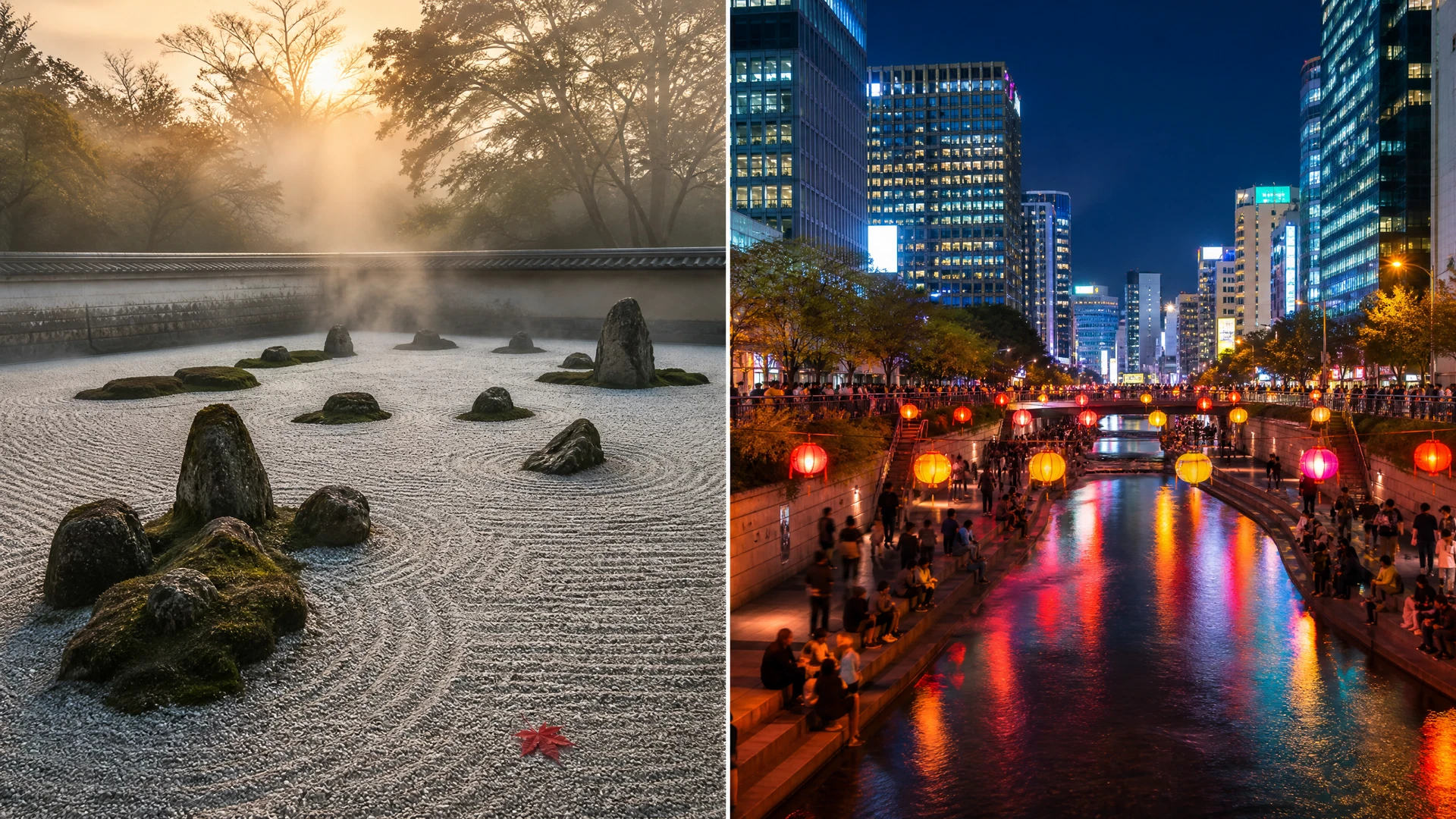
Japan Has Been Refining Itself for 2,700 Years. South Korea Built Everything It Has in 40. Here's What Each One Produces.
Destination: Japan & South Korea
Category: comparison
The question comes up in every East Asia travel conversation, on every forum, in every hostel common room from Tokyo to Seoul. Japan or South Korea? And the answer that comes back, almost universally, is: Japan for temples and food and trains. South Korea for Seoul and K-pop and nightlife. Go to Japan if you want the traditional. Go to South Korea if you want the modern.
That answer is not wrong. It is also not the point.
The correct framing is not about which country has better specific attractions. It is about two countries that share the same Confucian social foundation, the same Buddhist cultural heritage, the same chopstick culture, the same high-speed rail infrastructure, and the same specific relationship between extreme urban density and extreme natural beauty — and that are simultaneously the product of the most antagonistic bilateral relationship in Asia. Japan colonized Korea from 1910 to 1945. The specific consequences of that specific 35-year occupation are still being actively negotiated in diplomatic, cultural, and personal terms. Understanding this is not a prerequisite for enjoying either country. It is the prerequisite for understanding why both countries produce the specific travel experiences they produce.
Japan has been refining itself for 2,700 years without interruption — the only major country in Asia that was never colonized by a European power, the only country in Asia that colonized others rather than being colonized. South Korea built everything it has in 40 years — from one of the poorest countries on earth in 1953 to the 12th largest economy in the world in 2023, and then produced the most dramatic national cultural export in recorded history. The Japan versus South Korea question is a question about what 2,700 years of uninterrupted refinement produces versus what 40 years of reconstruction from rubble produces. Both answers are extraordinary. They are not the same answer.
Identity: What 2,700 Years of Refinement Produces vs What 40 Years of Reconstruction Produces
Japan's cultural confidence has a specific quality that is available nowhere else in East Asia. It is the confidence of a culture that has never been interrupted — that has been working on itself, refining itself, absorbing and transforming outside influences on its own terms, for longer than any comparable living culture. The specific 2,700-year imperial tradition. The specific Shinto relationship with the natural world that organized Japanese aesthetics before written history. The specific Buddhist synthesis that arrived from Korea and China in the 6th century and was absorbed and transformed into something specifically Japanese — the specific Zen Buddhism, the specific temple garden, the specific relationship between emptiness and beauty that produced the specific raked gravel of Ryōan-ji and the specific moss of Saihō-ji. The specific Meiji Restoration of 1868 that deliberately modernized Japan's economy and military while explicitly preserving the specific cultural and political structures that European modernization had eliminated everywhere else it touched. Japan's identity is the product of the longest uninterrupted process of cultural refinement available in any major travel destination.
South Korea's identity is the most dramatic available argument for what a culture can produce when it is given no alternative but to reinvent itself from nothing. The specific 1910–1945 Japanese colonial period suppressed the Korean language — the specific 1938 ordinance made Japanese the sole official language of Korea and prohibited Korean language instruction in schools. The specific Hangul alphabet, invented by King Sejong in 1443 and celebrated by the specific statue in Gwanghwamun Square that is the most visited monument in Seoul not because of tourism but because of specific cultural meaning, survived the colonial period underground as an act of cultural resistance. The specific 1950–1953 Korean War killed approximately 3 million people and left Seoul — occupied four times in three years by four different armies — in rubble. The specific Miracle on the Han River accomplished in 40 years what comparable European industrial development required 200 years to produce. And then the specific Korean Wave — the specific global dominance of K-pop, K-drama, Korean cinema, Korean beauty products, and Korean food that began in the 1990s and has made South Korea one of the three most culturally influential countries on earth.
Japan's identity is the product of the longest uninterrupted refinement. South Korea's identity is the product of the most dramatic reconstruction. Both are extraordinary. They feel completely different when you stand inside them.
Food: Revelation vs Transformation
Where Japan's identity is built on refinement, Japan's food culture is built on revelation — the specific philosophy that the correct relationship with food is to reveal rather than transform, to present the specific ingredient at its specific peak and to interfere as little as possible with what the ingredient already is. The specific kaiseki — the multi-course meal that follows the specific seasonal calendar, that requires the specific chef to know not just technique but the specific moment when each ingredient is most itself. The specific sushi — not as a meal but as the specific philosophy that the best rice, the best fish, and the best human skill should combine to produce something that none of the three could produce alone.
The Tsukiji outer market in Tokyo operates at 5am for a specific reason: the professional buyers select the best cuts before the retail market opens at 7am. The specific otoro versus chutoro versus akami distinction — the fatty belly versus the medium-fatty versus the lean — is not a menu category. It is the specific Japanese argument that the relationship between ingredient quality and price is a philosophical position rather than a luxury preference. The specific 7-Eleven onigiri that costs 120 yen and is simultaneously the most democratic and the most seriously considered food available at that price point exists because the specific Japanese consumer demands quality at every price point regardless of context. The Tokyo Food Guide and the Kyoto Food Guide each cover a distinct dimension of this philosophy — Tokyo's democratic precision, Kyoto's seasonal kaiseki tradition.
South Korea's food culture is the most communal and the most specifically fermented available in any major food tradition — the specific philosophy that food is not a private relationship between chef and ingredient but a shared relationship between community and table. The specific banchan — the small dishes that arrive automatically with every Korean meal regardless of price point — is the most democratic available fine dining experience because the best Korean restaurants and the cheapest Korean restaurants serve the same philosophy of abundance and sharing with different ingredients. The specific kimchi — the specific fermentation tradition with 200+ varieties, the specific UNESCO Intangible Cultural Heritage recognition, the specific kimchi jjigae that is simultaneously the most commonly eaten dish in Korea and the most specific expression of the fermentation philosophy.
The Gwanjang Market in Seoul has been operating since 1905 — the oldest and largest traditional market in Korea. The specific bindaetteok (mung bean pancake) has been fried at the same stalls by the same families for generations. The specific mayak gimbap — named because the specific combination of sesame, carrot, and pickled radish produces a flavor that regular visitors describe as addictive — costs 3,000 won and is the most specific single food experience available in Seoul for under $3. The Seoul Food & Culture Guide builds the food itinerary around the specific markets, the specific neighborhoods, and the specific fermentation culture that no restaurant guide captures.
Aesthetics: The Codified and the Global
Japan's aesthetics is the most codified and the most specifically philosophical available in any national aesthetic tradition. The specific wabi-sabi — the specific Japanese aesthetic philosophy that finds beauty in imperfection, impermanence, and incompleteness, originating in the specific tea ceremony tradition of the specific Sen no Rikyū who formalized wabi-cha in the 16th century. The specific ma — the specific Japanese concept of negative space, the specific pause, the specific interval between notes or between objects that is as important as the notes or objects themselves. The specific mono no aware — the specific Japanese sensitivity to the pathos of things, the specific awareness of impermanence that makes the specific cherry blossom season the most emotionally resonant natural event in Japanese culture because the flowers are most beautiful precisely because they will fall.
The specific Kyoto machiya townhouse interior — the specific traditional wooden townhouse that is simultaneously the most complete physical expression of Japanese spatial aesthetics and the most endangered building type in Japan because the specific inheritance tax structure incentivizes demolition over preservation. The machiya renovation movement that began in Kyoto in the 1990s as the specific response to the specific demolition rate that was eliminating the specific urban fabric that made Kyoto comprehensible is now the most important preservation movement in Japanese architecture. The Kyoto Solo Guide covers the specific neighborhoods where the machiya culture is most intact.
South Korea's aesthetics in 2026 is the most globally influential aesthetic movement available in any national cultural tradition. The specific K-beauty visual language, the specific K-drama production design, the specific Korean streetwear culture, and the specific Korean interior design aesthetic have been adopted by the global creative class with a speed and completeness that no national aesthetic movement has achieved since Japanese aesthetics in the 1980s. The specific Korean beauty philosophy — the specific 10-step skincare routine — is simultaneously the most specific cultural export in Korean history and the most serious available argument that the relationship between beauty and health is the correct relationship.
The Bukchon Hanok Village distinction is the most specific available argument for why Korean aesthetics is more interesting than its global reputation suggests. The specific neighborhood of traditional Korean hanok houses in Seoul is simultaneously the most photographed neighborhood in Korea and the most actively inhabited. The specific residents who live in the specific hanok houses are not heritage performers but specific Seoul professionals who chose to live in traditional architecture in the center of a hyper-modern city. This is more interesting than Kyoto's preserved neighborhoods because the specific coexistence of the traditional and the contemporary in Bukchon is not a museum — it is a living argument about what a culture chooses to keep.
Tokyo vs Seoul: The Organized and the Alive
Tokyo is the most specifically organized large city on earth — the specific system of neighborhoods each with a specific character and a specific function that exists nowhere else at this scale. The specific Shibuya for youth culture and fashion. The specific Shinjuku for nightlife and the specific Golden Gai — the specific 200-bar alleyway network where each bar holds eight people and the specific conversations that happen in those eight-person rooms are the specific reason Golden Gai is the most interesting drinking experience in Asia. The specific Yanaka for the specific pre-war Tokyo that survived the specific 1923 earthquake and the specific 1945 firebombing. The specific Aoyama for the specific concentration of the world's most serious architecture in the smallest available urban area.
Tokyo is experienced correctly at walking pace. The specific route from the specific Nezu Shrine through the specific Yanaka cemetery and down the specific Yanaka Ginza shopping street is the most concentrated available experience of pre-war Tokyo — the specific shotengai (shopping street) that has been operating continuously since before the war, the specific tofu shop and the specific sembei shop and the specific cat that sits in the specific window of the specific antique store. The Tokyo Solo Guide builds the walking itinerary around the specific neighborhoods that deliver this experience.
Seoul is the most energetically alive major city in East Asia — the specific consequence of a city that was rebuilt from rubble in 1953 and has been building and rebuilding and reinventing itself at maximum speed ever since. The specific Han River that divides Seoul into the specific Gangnam south bank — the specific economic miracle made concrete — and the specific north bank with the specific Bukchon Hanok Village and the specific Insadong antique market and the specific Gyeongbokgung Palace.
The specific Cheonggyecheon stream is the most important single event in Seoul's post-war urban history. The specific elevated highway that was demolished in 2005 and replaced with the specific 11-kilometer urban stream reversed the specific 1950s–1970s decision to prioritize cars over people. The specific reason this matters for the traveler: the Cheonggyecheon is not a tourist attraction. It is the specific argument that Seoul is a city capable of changing its mind about what it wants to be. The specific Hongdae for the specific youth culture and the specific independent music scene. The specific Itaewon for the specific collision between Korean culture and every other culture that has arrived in Seoul in the past 70 years. The Seoul 5-Day Itinerary covers the specific neighborhoods that deliver the energy the thesis requires.
Nature: The Seasonal and the Accessible
Japan's natural landscape is the most specifically seasonal available in any major travel destination. The specific cherry blossom season produces the specific sakura front that moves from south to north across the specific Japanese archipelago from late March through early May — the specific Japan Meteorological Corporation forecast that tracks the front's progress and that the specific Japanese public follows with the specific attention that other cultures reserve for sports results. The specific autumn foliage season produces the specific momiji color that moves from north to south from late September through November. The specific Mount Fuji — the specific 3,776-meter volcano that is simultaneously the most photographed mountain in the world and the most specific Japanese cultural symbol. The specific Hakone — the specific mountain resort town with the specific ryokan tradition and the specific onsen culture and the specific view of Fuji across the specific Lake Ashi that is the most accessible available version of the Japan that the photographs promise. The Hakone Mt. Fuji & Onsen Guide covers the specific ryokan, the specific onsen, and the specific Fuji viewing points that deliver the thesis.
South Korea's natural landscape is the most accessible dramatic nature available in East Asia. The specific Seoraksan National Park — the specific granite peaks in the specific Taebaek mountain range on the specific east coast that are the most dramatic available in Korea and that are accessible from Seoul by the specific three-hour express bus. The specific autumn foliage at Seoraksan in October is the specific most beautiful natural event in Korea and the specific reason October is the correct month for the Korea-Japan combination trip — both countries are at their most visually extraordinary in the same window.
The specific Jeju Island is the most undervisited international destination in South Korea. The specific haenyeo — the specific female free-divers who have been diving for seafood on the specific Jeju coast for over 1,500 years, who range in age from 50 to 80, who free-dive to depths of 10–20 meters without equipment on specific morning tide schedules — whose specific tradition UNESCO recognized as Intangible Cultural Heritage in 2016. The specific reason the haenyeo tradition is dying: the specific younger generation of Jeju women has not continued the practice and the specific average age of active haenyeo is now 74. The Jeju Island Couples Guide covers the specific haenyeo experience, the specific Hallasan volcano hike, and the specific Seongsan Ilchulbong sunrise peak.
When to Go, Getting There, Getting Around
When to go: October is the correct month for the Japan-South Korea combination trip. Both countries are in their autumn foliage peak — Japan's momiji moving south from Hokkaido, Korea's Seoraksan at its most dramatic. Cherry blossom season (late March to early May) is the correct alternative for Japan specifically, though South Korea's spring is less dramatically seasonal. Summer (July–August) is hot, humid, and crowded in both countries. Winter is cold but less crowded, and Japan's ski culture (Hokkaido, Nagano) is the specific reason to go in February.
Getting there: Both countries are served by major international hubs. Tokyo's Narita and Haneda airports and Seoul's Incheon airport are among the most efficient in the world. The specific Osaka to Busan ferry — the 19-hour overnight crossing operated by Panstar Cruise — is the most specific available transition between the two countries for the traveler who wants the experience of arriving by sea rather than by air. It departs Osaka at 3pm and arrives Busan at 10am the following day. It costs approximately $80–120 for a basic cabin.
Getting around: Japan's JR Rail Pass is the most efficient available tool for the multi-city Japan itinerary — the specific 14-day pass covers the specific shinkansen network and the specific local JR lines and costs approximately $400, which pays for itself within the first three shinkansen journeys. South Korea's T-money card covers the specific Seoul metro, the specific intercity buses, and the specific Jeju rental car system for a single rechargeable card. The specific KTX high-speed rail connects Seoul to Busan in 2.5 hours and Seoul to Gyeongju in 2 hours. The Japan 10-Day Food & Culture Guide and the Seoul Budget Guide cover the specific transport logistics for each country.
Planning: How to Choose, How to Combine
Japan is right for you if you want to encounter a culture that has been refining itself for 2,700 years without interruption and that shows the specific depth that 2,700 years of uninterrupted refinement produces. If you want the specific seasonal precision of cherry blossoms and autumn foliage and kaiseki menus that change weekly. If you want the specific Japanese service culture — the specific omotenashi — that anticipates your needs before you express them. If you want to experience the specific beauty of something perfected rather than the specific energy of something being built. The Osaka Food Guide and the Kyoto Food Guide are the correct entry points for the food dimension of the Japan thesis.
South Korea is right for you if you want to encounter a culture that built itself from rubble in 40 years and produced something the entire world came to. If you want the specific energy of a city still becoming itself. If you want food that is communal and abundant and fermented and shared. If you want the specific Korean warmth that is the specific product of a specific survival — the warmth of a people who understand what it means to have been through something catastrophic and to have built something extraordinary on the other side of it. The Seoul Solo Guide covers the specific neighborhoods, the specific food culture, and the specific energy that the thesis requires.
Both right for you if you have three weeks: fly into Tokyo, spend ten days in Japan moving between Tokyo, Kyoto, Osaka, and Hakone, take the overnight ferry from Osaka to Busan or the two-hour flight to Seoul, spend ten days in South Korea moving between Seoul, Gyeongju, and Jeju. Come back understanding why these two countries are simultaneously the most similar and the most different major destinations in East Asia — and why the difference is the most interesting available argument about what culture is for.
The AskLeif itinerary generator builds either trip — or both — around your specific dates, budget, and travel style, accounting for the seasonal conditions, the specific regional variations within each country, and the specific experiences that are worth the planning they require.
The Honest Answer: Japan or South Korea?
The honest answer is that the question reveals more about what you value than about which country is better. Japan and South Korea are not competing for the same traveler. They are offering two fundamentally different answers to the same question: what does a culture do with its history?
Japan's answer: you refine it. You work on it for 2,700 years. You absorb outside influences on your own terms and transform them into something specifically yours. You develop the specific aesthetic concepts — wabi-sabi, ma, mono no aware — that codify the relationship between beauty and impermanence. You build the specific service culture that anticipates the guest's needs before they are expressed. You produce the specific food culture that treats the ingredient with the specific reverence that 2,700 years of refinement produces. You become the specific thing that the world comes to study.
South Korea's answer: you rebuild it. You take the specific rubble of 1953 and you build the specific Miracle on the Han River. You take the specific cultural suppression of the colonial period and you produce the specific Hangul pride and the specific King Sejong monument and the specific Korean Wave that makes the entire world want to learn your language. You take the specific devastation and you produce the specific energy that makes Seoul the most alive major city in East Asia. You become the specific thing that the world comes to feel.
The traveler who wants to understand something complete chooses Japan. The traveler who wants to witness something still becoming chooses South Korea. The traveler who wants both — who understands that the most interesting available argument about culture is the one between the perfected and the reinvented — takes the overnight ferry from Osaka to Busan and spends three weeks finding out that the question was never either/or.
Japan refined. South Korea rebuilt. Japan preserved. South Korea reinvented. Japan perfected. South Korea surprised.
Six verb pairs. Two countries. One question that has been waiting for the correct framing.