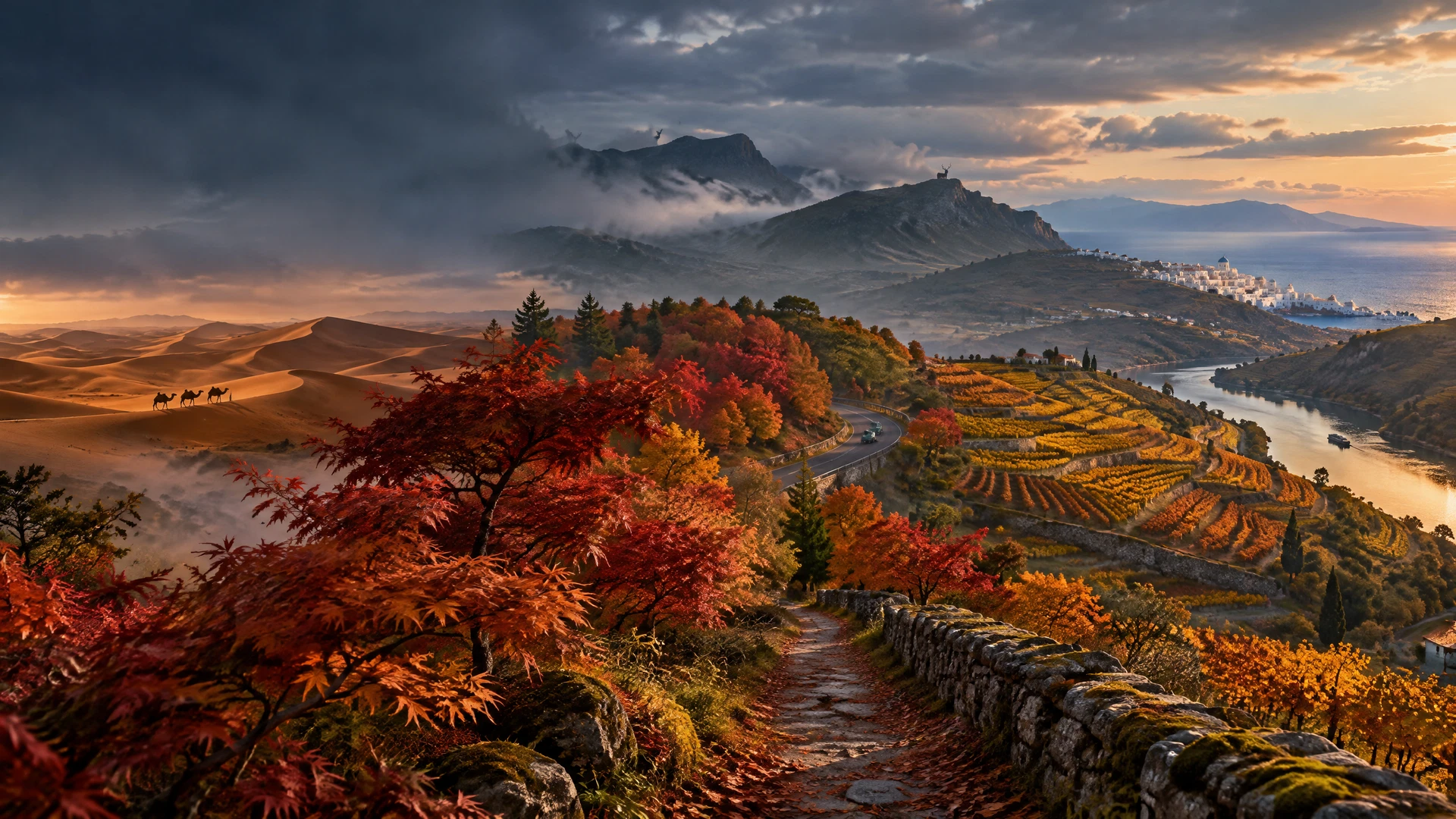
Where to Travel in October: Six Places That Finally Have Room to Breathe.
Destination: Global
Category: comparison
Where to travel in October is usually answered with a photograph of a maple tree and a vague promise of smaller crowds. That answer sells the month short. October does not exist to make summer travel less expensive or to give a city one more pleasant month before winter. For a small number of places, it changes the actual terms of the trip. The color arrives at the right time. The heat finally loosens. A harvest finishes but its energy remains. An animal season reaches its loudest moment. An island stops acting for the people who have been watching it all summer.
September gets credit for being the sensible shoulder-season choice. It still carries some of summer's momentum: beach reservations, late school holidays, the habit of treating warmth as the main evidence that a trip is worth taking. November has its own position, framed as the quiet pause before the holidays. October is not a lower-cost extension of summer; it is the calendar's most exact window for places that need a seasonal change to become fully legible. October sits between those months and gets mistaken for an in-between period. It is not. It is the point at which a specific set of destinations stops accommodating a season and starts revealing one.
That distinction matters because fewer people is not, by itself, a reason to fly anywhere. A square with half the crowd is still the same square if nothing else has changed. The places worth booking in October are places where the season alters the experience from the ground up: Japan's maples begin their second annual performance after the sakura audience has gone; Morocco's Sahara becomes an all-day landscape again; New England reaches the color event that justifies its annual pilgrimage; Portugal's Douro settles into the weeks after harvest; Scotland gains low light, roaming deer, and relief from midges; Greece keeps its sea and its tavernas while losing the summer script.
This is an argument about where to travel in October, not a directory of destinations with acceptable weather. These six were chosen because autumn fundamentally changes their conditions rather than merely turning down the volume. Japan's October is a second seasonal peak. Morocco's is a reopening. New England's is saturation. Portugal's is release. Scotland's is a wildlife season. Greece's is the return of ordinary island life. Replace any one of those mechanisms with another place and the argument gets weaker.
That is also why obvious answers have been left outside the frame. Italy can be excellent in October. New York City can make a deeply pleasant urban autumn trip. Thailand can work when you understand which coast belongs to which weather pattern. None of those facts are enough. The useful question is sharper: where does October give you something that summer, spring, and winter cannot reproduce? Start there, and the calendar becomes the first decision of the trip rather than a footnote after the destination has already been chosen.
Japan: Where to Travel in October for the Second Seasonal Peak
Japan is the first proof that October changes a place rather than simply cooling it down: the country has a second color season that is every bit as culturally serious as cherry blossom season, yet it is approached with a fraction of the international frenzy. Momiji—the maple leaves that move from north to south across the archipelago—turn the calendar into a map. Early autumn color begins in northern elevations, then works its way toward the temple districts and gardens that many travelers know only through April blossom photographs. October offers the beginning of that long procession, when the season feels discovered rather than assigned.
Nikko is the precise opening move. In the middle of the month, the slopes and river corridors around Nikko National Park begin making their case before Kyoto reaches its late-autumn height. Walk the Kanmangafuchi Abyss beside the Daiya River, where the line of stone Jizo statues meets maple color and dark moving water. Then give Toshogu enough time to be more than its carved entrance gate: cedar forest, lacquered detail, and the mausoleum of Tokugawa Ieyasu all demand a slower kind of looking. The fall color is not decoration around the cultural material. It changes the scale of it.
Kyoto arrives later, which is an advantage for anyone willing to plan by week instead of by an entire month. At Tofuku-ji, the Tsutenkyo Bridge looks over a ravine packed with maples, and the final Tuesday or Wednesday of October gives a more usable encounter than the compressed weekend rush that follows the first peak reports. The smart October traveler does not chase a single viral forecast. They arrive when the city can still absorb them. If food belongs in the center of the trip, this Kyoto food guide through tofu, kaiseki, and the city’s deeper eating culture gives the temple days a real culinary rhythm rather than leaving every meal to chance.
October also changes what Japan serves. Matsutake season produces the short, aromatic window for matsutake gohan and dobin mushi—mushroom rice and broth that are built around an ingredient Japanese kitchens wait for all year. That is the distinction between traveling during a color season and traveling during a seasonal culture. The leaves bring you outside; the food tells you why the month matters at the table as well. Use a two-week rail route through Tokyo, Kyoto, Osaka, and longer Japan distances if Nikko needs to sit inside a larger journey rather than become a rushed overnight detour.
Japan earns this place over any generic fall-color destination because October is the moment an internationally famous seasonal culture becomes available on different terms. The traveler who goes only for sakura sees a spectacular public ritual. The traveler who goes for momiji, temple ravines, cedar paths, and matsutake gets a second peak that asks less performance from everyone involved.
Morocco: Where to Travel in October When the Desert Reopens
Where Japan colors through a long seasonal procession, Morocco makes the October argument with a door that has finally opened again. The Sahara is not a place to treat as an accessory to a quick Marrakech stay, and from June through September the heat makes that temptation even less honest. By October, the Erg Chebbi dunes near Merzouga become possible as a full experience: daytime temperatures have eased enough for movement, while desert nights carry the cool that makes a camp, a fire, and a wool blanket feel earned rather than theatrical.
The timing matters most in the late afternoon. A three-hour camel approach to an overnight camp gives the dunes time to become three different landscapes: hard-edged under the late sun, copper at the moment it drops, then nearly blue once the temperature changes. In October, an evening departure can place camp arrival around golden hour instead of forcing every activity into the narrow dawn window that high summer requires. Walk beyond the tents after dinner. The useful part of the desert is not the image of a camel in profile; it is the silence that arrives once there is no reason to keep taking the same photograph.
Morocco's October is also a road trip month. The Todra Gorge, with limestone walls rising roughly 300 meters above its narrow floor, becomes more reasonable for walkers and climbers once the fierce summer heat has left the south-facing rock. The Dades Valley has its own autumn register: red rock, kasbah roads, palms in the valley floor, and the switchbacks that make the drive part of the point. A ten-day Morocco route linking Marrakech, the Sahara, Fes, and Chefchaouen gives that sequence enough room to become a country rather than a chain of transfers.
Fes supplies the urban counterweight. Get to the Chouara tannery terraces early, when the vats, hides, dye, labor, and smell register as a living system rather than a view to collect. Then stay in the medina long enough to understand its interior rhythm: the Qarawiyyin area, fountains tucked into alleys, workshops, bread ovens, and routes that stop being straight lines. October's low-to-mid-20s Celsius days make a full walk possible without turning every hour into a search for shade. This three-day Fes guide that treats the medina as more than a single tannery balcony is the right companion for that slower kind of attention.
Morocco belongs here instead of another warm-weather escape because October restores the desert's full day. It is not merely less hot than July. It allows the dunes, the Atlas approaches, and the old cities to occupy the same itinerary without asking the traveler to retreat from the central reason they came.
New England: Where to Travel in October for the Foliage That Justifies the Entire Region
Where Morocco reopens through temperature, New England reaches the one October condition that justifies organizing an entire trip around a landscape: foliage becomes the destination itself. The region's color is not one tree or one overlook. It is the overlap of sugar maple, red maple, American beech, birch, stone walls, wet roads, farm fields, and elevation. In the right week, the land appears to have been painted at several different speeds. The experience rewards a traveler who gives up the fantasy of choosing one perfect leaf-peeping day and instead follows the sequence of peaks.
Vermont Route 100 is the clearest argument. The road runs much of the state's length, but the Mad River Valley stretch between Warren and Waitsfield is where the maples, barns, ridgelines, and small towns compress into a drive that actually deserves its reputation. The first week of October is usually the essential Vermont window. Pull off for a walk rather than treating every stop as a windshield exercise; the side roads toward the Green Mountains are where the scale becomes legible. The seven-day New England fall foliage road trip from Boston through the White Mountains, Vermont, and Cape Cod provides the wider route when a single state is not enough.
New Hampshire offers a different kind of density. The 34-mile Kancamagus Highway runs through the White Mountains with enough elevation change to make a single drive hold early color on higher slopes and later color closer to the valleys. The third weekend of October can become saturated precisely because those timings briefly overlap. That does not mean it is automatically the correct weekend for everyone. It means you should leave room for an early start, a walk to a river or waterfall, and the patience to let the road's rhythm outweigh a perfect forecast.
Maine gives the category its Atlantic edge. In Acadia National Park, October clears much of the summer haze that can flatten the Cadillac Mountain view, while color begins working through the island vegetation and the Park Loop Road no longer moves at the pace of a permanent queue. Sunrise is still a reason to arrive early, but the better October reward can be the rest of the day: Jordan Pond paths, granite shore, and a late afternoon when the coast looks sharpened by cold air. This five-day Acadia adventure guide for coastal walks, lobster, and sunrise helps make the park more than a one-morning summit ritual.
New England is selected over a generic “fall getaway” because October makes the entire region a coordinated visual event. Japan's color is tied to temples, food, and a cultural season. New England's is tied to roads, elevation, forests, and the peculiar American permission to spend a day chasing a landscape that will look different by the time you drive back.
Portugal: The Douro Valley After the Harvest Has Done Its Work
Where New England blazes through abundance, Portugal rests into October after the harvest has done its work. The Douro Valley does not need travelers to arrive during the frantic crush to prove that wine is made there. The more revealing window comes two or three weeks after harvest, when the vines turn toward gold, amber, and rust; the quintas regain their balance; and the valley's terraces look like a working landscape releasing a held breath.
That post-harvest calm is visible at a place such as Quinta do Crasto. The lagares—the stone treading tanks used during harvest—carry the immediate memory of the vintage, while the surrounding slopes have started their seasonal change. A visit in this window gives travelers a better question than “which bottle should I buy?” Ask how the harvest finished, what was difficult about the year, which parcels came in first, and how the fruit is being handled. Wine country becomes more useful when it connects people to the work that preceded the tasting.
The Linha do Douro makes the landscape possible without putting every traveler behind a rental-car wheel. From Porto Campanhã toward Pocinho, the train follows the river through terraced hillsides, tunnels, small stations, and bends that keep changing the angle of the vineyards. In October, the route gains the color that the summer train cannot offer. Start with Porto’s food guide for riverfront cellars, port tastings, and the city’s working tables, then use the Douro as the place where the city’s trade history finally becomes physical terrain.
Portugal's October case is stronger than a generic European wine weekend because the valley is in the aftermath rather than the anticipation. A ten-day Portugal route through Lisbon, Porto, and the Algarve is useful for travelers who need a broader country structure, but the October decision should not be made for a beach add-on. It should be made for the Douro itself: a river valley whose geometry, labor, and color suddenly line up in the same weeks.
Portugal is chosen over Italy because Italy's October harvest and truffle stories already occupy every shoulder-season conversation. The Douro's post-harvest interval offers the less rehearsed version of the same human rhythm: the work has happened, the new wine is beginning, and the valley has enough quiet to show the traveler what the work was for.
Scotland: The Highlands When the Landscape Starts Roaring Back
Where Portugal rests after labor, Scotland roars in October. The Highlands become a different proposition once the first frosts thin the midges, the heather has moved from late-summer purple toward bronze, and red deer rutting season begins to carry across the glens. This is not a claim that the weather becomes gentle. Rain, wind, and fast shifts of light remain part of the Highland contract. The October reward is that those conditions begin working together rather than merely asking to be endured.
Glen Etive and Rannoch Moor are two of the clearest places to understand the rut. At dawn or dusk, stags call across open ground, and the sound makes the landscape feel occupied in a way a postcard never can. Watch from a respectful distance; the season is not a request to approach wildlife for a closer frame. The point is to feel the valley's scale through the sound of animals moving through it. A seven-day Scottish Highlands road trip through castles, lochs, and open country lets that kind of stop fit into a real route rather than a hurried detour from Edinburgh.
Glencoe changes the photographic argument. The Three Sisters need low light more than they need clear blue sky, and October's lower sun gives the ridgelines definition that a summer overhead sun can erase. Reach Glencoe Lochan around 8 a.m. when wind and light cooperate, then stay long enough for the weather to rewrite the scene. Good Highland travel is not a collection of guaranteed views. It is an agreement to pay attention when the conditions finally make a view possible.
The Cairngorms add a quieter October detail. Mountain hares can be seen in transitional coats, moving from summer brown toward winter white, while birch and rowan shift along the lower ground. The result is a season with multiple kinds of change occurring at once: color in the trees, behavior in the deer, and camouflage changing on the mountain. Use this four-day Isle of Skye adventure guide for rugged roads, ridges, and island-scale weather when the route needs a western extension and the flexibility to follow conditions rather than a fixed daily script.
Scotland earns the slot that a second wine or foliage destination cannot because October gives it movement. Portugal's valley is settling. Scotland's landscape is becoming loud, bronze, cold, and active. The absence of midges alone changes what it means to stand still beside a loch at dusk; the rut tells you why you stayed.
Greece: The Islands After the Performance Ends
Where Scotland rewards the traveler who can stand in weather and listen, Greece offers the opposite October relief: the islands become quiet enough to hear ordinary life again. The sea retains much of the warmth accumulated through August, often sitting around 23°C, while the air has fallen back to the low-to-mid 20s. Taverns, ferries, archaeological sites, and small boat trips are still running. What has changed is the audience. Cruise-day compression, package rhythms, and the sense that every viewpoint must be consumed at the same sunset hour have begun to lift.
Santorini makes the contrast easiest to see because the summer version is so heavily choreographed. At Oia Castle in October, sunset remains a serious event, but it no longer requires claiming a square meter of wall two hours in advance. The caldera has room to be an actual geological shape again. Walk from Fira toward Imerovigli early, when the volcanic edge carries a few hikers rather than a continuous processional line, then leave time for a winery or a swim where the sea has not yet given up its summer heat. This five-day Santorini itinerary that builds in caldera walks, archaeology, and island pace is a useful framework when the island needs more than its most photographed village.
Crete adds the urgent outdoor version of the same argument. Samaria Gorge usually closes in the middle of October, which makes the first half of the month an unusually good hiking window: the gorge floor has lost its punishing summer heat, the season has not yet reached its closure, and the walk from Xyloskalo toward Agia Roumeli can be handled as a full day rather than a test of heat tolerance. The island's size also lets you put the gorge beside food, mountain villages, and a long coastal drive rather than treating it as a single excursion. This seven-day Crete family guide offers a practical island structure even for travelers without children because it respects the distances that make Crete a country-sized island rather than a beach resort.
Naxos and Paros supply the quieter Cycladic proof. In October, local tavernas have a better chance of serving people who live nearby as well as people passing through for a night. The port has fewer arrivals treating the island as an interchangeable backdrop. You can take a slower ferry, linger over a meal, or swim without making heat relief the sole purpose of the water. Greece is selected over New York City because Central Park in October is a familiar urban answer. Greek islands in October make a more radical seasonal claim: the essential infrastructure remains, while the performance built around it begins to disappear.
Where to Travel in October: Choose the Mechanism, Then the Week
The useful October decision is not “which of these looks best on a screen?” It is “which seasonal mechanism fits the trip I want?” Japan is for the traveler who wants color held inside temple grounds, train windows, and a food calendar. Morocco is for someone who wants a desert day to feel long again. New England is for road time, elevation, and the permission to reorganize a route around a forest. Portugal is for a working wine landscape after its loudest weeks. Scotland is for weather, wildlife, and low sun. Greece is for swimming and island life after the visitor-facing season loses its grip.
| If the October trip needs… | Choose… | Give it… | The most precise timing |
|---|---|---|---|
| Temple color, seasonal food, and a rail-based trip | Japan | 8–14 days | Nikko in mid-October; Kyoto later in the month |
| Dunes, gorge roads, and medina walking | Morocco | 8–10 days | Most of October, with evenings built around the desert |
| The most concentrated foliage road trip | New England | 6–8 days | Early October for Vermont; later weeks at lower elevations |
| Wine country after harvest and river travel | Portugal | 5–8 days | Two to three weeks after the Douro harvest |
| Wildlife, low light, and Highlands roads | Scotland | 6–9 days | October dawns and dusks, with weather margin |
| Warm sea, hiking, and islands without peak pressure | Greece | 7–10 days | First half for Crete’s Samaria Gorge; the full month for island pace |
The calendar requires some honesty. New England foliage does not peak everywhere on the same weekend; use elevation and latitude to shape the route instead of booking a rigid loop around one forecast. Scotland should have extra time because rain and wind are not mistakes in the schedule. Morocco needs a realistic desert camp and enough transfer time that the Sahara does not become an overnight stunt. In Japan, use the later Kyoto color window without assuming a map can guarantee a leaf report. Greece can be combined with a mainland arrival or a single island group, but it should not be turned into a frantic ferry checklist. Portugal rewards a few slower Douro nights more than a long list of tasting rooms.
Start by reserving the thing the month makes scarce: a Japan room near the temple district on the exact week you want, a responsible desert camp outside Merzouga, an Acadia or Vermont lodging base, a Douro quinta stay, a Highland car that leaves room for weather, or a Greek island room that is still open after high season. Then leave space around it. The best seasonal trips are not tight. They preserve a morning for a clear mountain view, an evening for a new vintage conversation, a weather shift, a long ferry lunch, or the unexpected decision to stay one more night.
Leif can turn that chosen October mechanism into an itinerary built around the calendar rather than a generic destination list: the right arrival city, the right week, the transfer day that should be protected, and the margin that keeps a changing season from feeling like a failed plan. The month does not reward travelers for seeing the most. It rewards them for being in the right place when the place changes.
Why Italy, Thailand, and New York City Are Not on This List
Italy in October is genuinely good. Tuscany is in harvest rhythm, Piedmont begins leaning toward truffle season, Rome becomes easier to walk, and the Amalfi Coast can regain some breathing room. Italy is not included because its October case has already become the default answer in almost every shoulder-season conversation. It does not need another generic endorsement. Portugal earns the wine-country place because the Douro's post-harvest interval is a more specific and less rehearsed October experience.
Thailand is excluded for the opposite reason: October demands a level of coast-by-coast weather knowledge that this format cannot responsibly flatten. The southwest monsoon is easing on one side of the country while conditions can remain unsettled in the places many travelers had in mind. Thailand deserves a dedicated seasonal post that can explain the Andaman and Gulf decision properly. Morocco's October desert proposition is clearer: the heat has lifted enough for the central experience to return.
New York City has a real October: Central Park color, walking weather, and an urban energy that works beautifully after summer. It is absent because it is the least surprising October recommendation in America. This list needs places where the month is carrying a more decisive burden. New England offers the foliage system behind the city’s familiar park; Greece offers warm water after summer has left; Scotland offers a wildlife season that no Manhattan avenue can replicate.
The exclusions are part of the evidence. A useful October list cannot simply collect every place that becomes pleasant after September. It has to distinguish between places with a good month and places whose entire travel proposition changes when October arrives.
October does not extend summer. It changes the terms.
Japan colors. Morocco reopens. New England blazes. Portugal rests. Scotland roars. Greece exhales.
Six verbs. Six places that become briefly, precisely available in ways no neighboring month can reproduce. The traveler who understands that does not arrive looking for a discounted version of peak season. They arrive when the destination has finally stopped performing and started telling the truth.