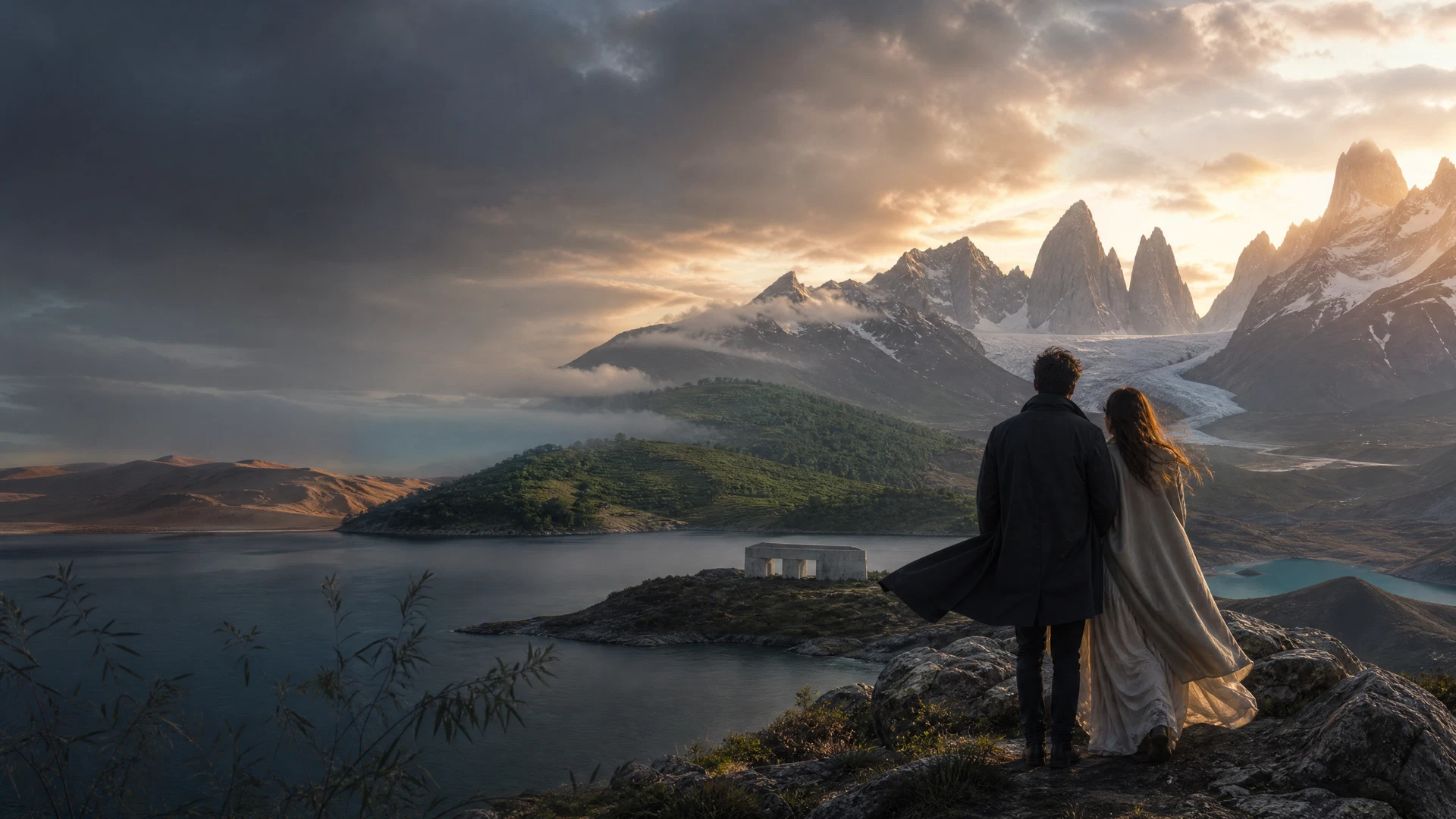
Six Honeymoon Destinations for Couples Who Want to Come Home Different.
Destination: Global
Category: comparison
The most expensive honeymoon photograph in the world may be the one in which nothing has happened. There is a private pool, an improbable horizon, two robes arranged with the ceremonial precision of a hotel turn-down service, and a couple who will return home with proof that they went somewhere beautiful. What the photograph cannot tell you is whether they learned anything about each other there. Whether either of them was surprised. Whether they got lost, changed a plan, made a difficult decision, stayed quiet together in a way that felt new, or found themselves laughing at six in the morning because the day had already gone wrong in exactly the right way.
There is nothing defective about a beach honeymoon. Rest is a serious pleasure, and a good hotel can give two newly married people something they may not have had in months: time with no demands attached to it. But honeymoon travel has allowed the setting to become the whole story. The market repeats the same visual language—private beach, infinity pool, flower-strewn bath, overwater villa—until the destination is interchangeable with the infrastructure built on top of it.
The better question is not which place is most romantic in the generic sense. It is which place will give two people a shared experience so specific that they will be telling it, accurately or inaccurately, for the rest of their marriage. A honeymoon should not be the backdrop to the relationship. It should be its first chapter: the small, durable piece of evidence that the two of you can see the world together in a way no one else can.
These are the best honeymoon destinations for couples who want that kind of beginning. Japan teaches two people how to be alone together. Morocco overwhelms them into becoming a team. Patagonia proves what they can do when the weather turns. Naoshima gives them a new language for beauty. Sri Lanka adapts when two people want different things. The Azores rewards the decision to choose the unexpected. None is here because it looks good from a sun lounger. Each is here because something happens there.
Japan: The Country That Teaches Couples How to Be Alone Together
Japan belongs on this list because it teaches couples that intimacy is not the same thing as constant conversation. The Japanese idea of ma—the meaningful interval between things—becomes less like an art-school word and more like a practical condition of travel when two people are navigating a place in which silence has structure. A train ride does not need to be filled. A garden does not need to be explained while standing inside it. Dinner can take three hours without either person treating the duration as a problem to solve.
That is why Kyoto, rather than Tokyo or Osaka, is the first useful honeymoon base. Kyoto makes a couple slow down through the mechanics of the day. A lane behind Gion narrows. A temple opens at a particular hour. A small counter has six seats and cannot accommodate the evening's impatience. The city asks for attention, but it does not demand performance. You can spend an afternoon moving between the moss at Gio-ji and the back streets of Arashiyama with almost nothing to say, then understand over dinner that the silence was not empty.
The ryokan is the purest expression of that experience. At a serious traditional inn, the room is not a neutral box between sightseeing obligations. It is the evening's event. Shoes come off at the threshold. Yukata replace street clothes. A staff member brings a sequence of dishes into the room at a pace that makes rushing impossible. In-room kaiseki is better for a honeymoon than restaurant kaiseki for the least glamorous of reasons: you are not staging intimacy in public. You are allowed to respond to the food, the unfamiliar ritual, and each other without worrying about the table beside you.
Private bathing adds another layer. A kashikiri onsen is a reservable bath, usually for a fixed window, that gives two people the Japanese bathing experience without forcing them into the social rules of a communal bath on their first encounter with it. The point is not that a private bath is more luxurious than a public one. It is that both people are slightly outside their ordinary competence at once. You learn the showering sequence, the etiquette, the temperatures, the strange calm of sitting in hot water while cold air moves over your shoulders. Shared unfamiliarity is one of travel's most reliable forms of closeness.
Go to Arashiyama early enough to make the timing part of the story. The bamboo grove is not secret; it has not been secret for years. At five in the morning, though, the sound is different. The first light comes down through the canes before the rickshaws, tour buses, and group photography have turned the path into a corridor. Arriving early together is not a superiority contest. It is the simple pleasure of having earned a quiet hour by choosing the alarm over the hotel breakfast.
The right plan is a Kyoto honeymoon itinerary built around ryokan stays, temple mornings, and a slower four-day rhythm, not a frantic attempt to collect every famous gate. Add the Hakone guide for Mount Fuji views and onsen time if the bath experience is the point, and use a Kyoto couples route that protects room for unplanned evenings if you want the city to feel lived in rather than completed.
Japan teaches because it makes two people notice the space between their usual habits. Morocco follows with the opposite instruction. It removes the comfortable space altogether.
Morocco: The Country That Overwhelms Two People Into Becoming a Team
Where Japan teaches a couple to inhabit quiet together, Morocco overwhelms a couple into becoming a team. Marrakech does not allow the traveler's normal decision-making process to remain abstract for very long. The medina compresses direction, sound, scent, traffic, commerce, heat, and negotiation into streets that can appear to end and then open into another market. Two people who arrive as parallel tourists quickly learn whether they can divide the work: one remembers the last turn, one watches the motorbikes, one says no to the third guide who has offered assistance, one notices that the tea shop looks useful.
That is not a warning against Marrakech. It is the reason to take it seriously as a honeymoon destination. The city produces a particular kind of memory because it refuses to be passively consumed. You emerge from the souk into Djemaa el-Fna at dusk and have to decide together what to do with the evening: follow the smoke from the grills, find the orange-juice stalls, keep walking toward a rooftop, or retreat to the riad while the square gets louder. The decisions are small. The feeling of moving through a place in concert is not.
The riad is the counterargument to the square. Behind an unmarked or modest door, a courtyard can hold tiled floors, a fountain, orange trees, shadow, and a silence that makes the noise outside feel almost impossible. The best riads do not imitate a European boutique hotel with a few lanterns added. They retain the spatial surprise that makes Moroccan domestic architecture work: privacy inward, complexity outward. On a honeymoon, that contrast matters. The two of you spend the day negotiating public intensity and return to a place designed around retreat.
Make the hammam part of the trip only if you are willing to let it remain a ritual rather than a spa prop. A private couples hammam at a serious hotel can be a gentle introduction, but the important element is surrendering to the sequence: heat, black soap, exfoliation, water, rest. Neither person is in charge. Neither person is polished. It is a shared interruption of the usual travel impulse to optimize every hour.
Then leave the city. The Sahara section of a Morocco honeymoon should not be a sunset camel ride added to a Marrakech weekend because the internet says it is romantic. It needs the road. The shift through the Atlas, the villages, the changing soil, and the long approach toward Merzouga is what makes the dunes feel consequential when they arrive. In Erg Chebbi, sunset is crowded because everyone knows what light does to sand. Dawn is better. The night has cooled, the camp has gone quiet, and the dunes are not yet being arranged around other people's plans. A private tent with an actual bed matters less because it is luxurious than because it lets the morning be a shared one rather than a logistical recovery from a poor night's sleep.
The Marrakech couples guide that connects riads, hammams, and the medina at a workable pace gives the city its due without pretending it is the whole country. For the desert, Fes, and southern road sequence, use the ten-day Morocco route through Marrakech, the Sahara, Fes, and Chefchaouen. It is the kind of honeymoon that remembers the route, not merely the destination.
Morocco overwhelms because it asks two people to act together under pressure. Patagonia raises the stakes. It asks whether they can keep acting together when the weather has no interest in their itinerary.
Patagonia: The Place That Proves What You Are Made of Together
Where Morocco makes a couple into a team through sensory pressure, Patagonia proves what that team can do when the conditions become real. A Patagonia honeymoon is not an anti-romance statement, and it does not need to be a self-punishing expedition. It is a decision to let a landscape require something from both people: an early wake-up, a wet layer packed properly, a weather delay accepted without blame, a final hill climbed when both legs are already tired.
The right shared challenge is usually the W Circuit in Torres del Paine, not the full O Circuit. The O is longer, more remote, and asks for a larger commitment to technical comfort and logistics. The W offers the central experiences—the French Valley, Grey Glacier country, the towers themselves—without turning the honeymoon into an argument about whether either person has enough wilderness experience to enjoy it. The goal is not to prove that you are the toughest couple in the airport lounge. The goal is to come home with a story that required both of you.
Accommodation changes the equation. Refugio bunks have their place, and couples who genuinely love the communal trek atmosphere may prefer them. But the difference between a bed in a shared dorm and a geodesic dome at EcoCamp is not trivial on a honeymoon. The dome gives you insulation from the part of the experience that does not need to be shared with strangers: the exhausted hour after a long hike, the pre-dawn tea, the moment when wind hits the wall hard enough to make both people pause and listen. It retains the weather without making discomfort the centerpiece.
Mirador Las Torres is the emotional test case. The final ascent from the Camping Torres side is steep, loose in places, and often undertaken in wind that makes the last stretch feel longer than the map suggests. If conditions allow, reach the viewpoint early. The granite towers may emerge from cloud, or they may not. That uncertainty is the entire proposition. You have not purchased a view. You have made yourselves available for one. When the water turns still enough to hold the towers' reflection, the image is not a reward for athleticism. It is the consequence of having gone there together when the landscape did not owe you a clean answer.
Patagonia also gives a new marriage an unusually useful lesson about contingency. A rain day in Puerto Natales or El Chaltén is not a failed day; it is why you built an extra day into the plan. The person who is calm when the boat schedule shifts, and the person who notices the bakery before morale declines, may be showing you something more consequential than their hiking ability. Great shared trips do not prove that nothing goes wrong. They reveal how two people behave when it does.
For the hiking concentration, the Torres del Paine adventure guide provides the appropriate five-day shape. If you want Patagonia to be a larger first-marriage chapter rather than one trek, the ten-day Patagonia road trip through Chile and Argentina gives the weather, glacier, and border-crossing logic enough room to breathe.
Patagonia proves through effort. Naoshima, reached through a different kind of planning altogether, reveals what two people notice when effort gives way to attention.
Naoshima: The Island Where Art Builds a Private Language for Two
If Patagonia proves what a couple can do in difficult conditions, Naoshima reveals what they can see when nothing is asking them to hurry. This small island in the Seto Inland Sea is an unlikely honeymoon choice if one is still using the conventional checklist. There is no long beach-resort strip. There is no nightly spectacle designed to reassure you that you are on vacation. Instead, there are ferries, concrete, sea light, old houses adapted into art spaces, and a deliberately concentrated relationship between landscape and contemporary art.
Naoshima's central experience is the Chichu Art Museum, Tadao Ando's largely underground building designed so that the landscape above it remains almost intact. The museum is not large in the usual tourist sense, and that is part of its force. You do not rush through fifty rooms looking for a highlight. You move through a small number of carefully controlled encounters, including Claude Monet's Water Lilies in a room that receives changing natural light. The paintings are familiar in reproduction. In that space, under the shifting light that the building has made part of the viewing, they become something else: a conversation about color, silence, and whether two people are seeing the same thing.
That is a very particular honeymoon gift. Beach resorts tend to agree on what romance should feel like before you arrive. Naoshima gives a couple the chance to disagree productively. One person may want to stay longer with the Monet room; another may care more about the geometry of the building. At the Art House Project in Honmura, the conversation gets stranger. Traditional houses have been turned into permanent installations, and James Turrell's Minamidera asks visitors to sit through a period of darkness long enough for the eye to change its understanding of the room. What emerges is not an attraction in the normal sense. It is a shared perceptual event.
Stay overnight if the budget allows. Benesse House is both hotel and museum, and the real advantage is temporal rather than decorative. Day visitors have left. The outdoor works become available in the softer light of dusk and morning. You can walk toward Yayoi Kusama's yellow pumpkin before the ferries have turned every path into a queue. The sea beside an artwork is not scenery added afterward; it is part of the work's condition.
Naoshima does require operational seriousness. Chichu timed tickets should be booked well ahead, particularly for dates when the island is popular. Ferry timetables are not a suggestion. And the island works best as a conscious pause in a larger Japan trip, usually via Uno or Takamatsu, not as a hurried detour shoved between Kyoto hotels. The Japan rail-pass itinerary that connects Tokyo, Kyoto, Osaka, and Hiroshima provides the wider movement logic, while the two-week Japan rail route gives you enough days to make an island interlude feel chosen rather than stolen.
Naoshima reveals through attention. Sri Lanka is the answer for couples who do not want one dimension at all, because it can adapt to several without turning the honeymoon into a compromise.
Sri Lanka: The Island That Refuses to Make You Choose One Honeymoon
Where Naoshima gives a couple a private language for beauty, Sri Lanka adapts to couples who have not yet agreed on what kind of honeymoon they want. One person may want an ancient city and a train through tea country. The other may want a beach, wildlife, and a hotel where the verandah actually encourages a long lunch. In many destinations, that difference creates a negotiation in which each person gets half a trip. Sri Lanka makes the apparent conflict into an itinerary.
The geographical compression is the argument. Sigiriya rises from the surrounding landscape as a fifth-century rock fortress with frescoes, water gardens, and a summit that changes the scale of the plains below it. Kandy offers the Temple of the Tooth, a city built around a sacred object and a lake that gives the place an internal rhythm. Ella and the hill country add tea estates, mist, and the slow railway that runs through terrain too steep and green to understand from a highway. Galle brings Dutch fort walls, Indian Ocean weather, and streets that can be walked after the heat softens. Then there is the south coast, where the right season can include whale watching, beach time, and the almost absurd relief of ending a culturally dense trip by the sea.
Sigiriya is best before the first large coach groups arrive. The seven-o'clock opening is not about collecting an empty photograph of Lion Rock. It gives you time to move through the water gardens and begin the climb before the stairs become a sequence of other people's pauses. The pleasure gardens at the base are not an optional prelude. They make the fortress legible as a royal project: water, geometry, pleasure, defense, height. A couple who starts early can have the summit view, then sit down for breakfast before the day has turned into a crowd-management exercise.
The Ella-to-Kandy train is the opposite kind of experience. It is slow enough to make impatience irrelevant. From an open doorway or window, the tea country rolls by at a pace that lets you see the track's relationship to the hills: small stations, workers walking beside the line, terraces, mist that changes the distance every few minutes. The Nine Arch Bridge has been photographed into public consciousness, but the point of the route is not the bridge alone. It is the time produced by the train. On a honeymoon, time that no one can accelerate is often more valuable than another hotel amenity.
Galle Fort provides the final shift. Inside walls built during the Dutch colonial period, the best hours are morning before the lanes warm and late afternoon when the sea wall becomes a place to sit rather than a route between shops. A stay at a restored historic hotel can be genuinely romantic here, but Galle works because the fort is still a town: schoolchildren, cricket, errands, sea air, and residents living inside the scenery. It has more texture than a purpose-built honeymoon enclave because it was never made for honeymooners.
Use the seven-day Sri Lanka couples itinerary that connects temples, tea trains, wildlife, and the coast as the backbone. The Colombo city and culture guide is useful if your flights make the capital more than an arrival hall, especially if you want the journey to begin with food and urban life before the island opens outward.
Sri Lanka adapts because it allows different desires to coexist. The Azores takes the opposite position: it asks a couple to choose one less obvious desire together and then rewards the decision with the feeling that they have gone farther than the usual honeymoon script.
The Azores: The Honeymoon That Begins With Choosing the Unexpected
Where Sri Lanka gives a couple almost every kind of honeymoon on one island, the Azores discovers what happens when the couple chooses the unexpected over the obvious. Nine volcanic islands in the middle of the Atlantic do not function as a convenient answer to a generic beach question. You have to decide to go. The journey is not accidental, the weather does not promise constant compliance, and the reward is a shared sensation that the two of you selected a version of the world most people did not think to consider.
Start on São Miguel, where volcanic geology is not background scenery. At Furnas, the ground exhales. Steam rises through the caldeiras, mineral water changes color in pools and channels, and the local cozido is cooked underground by the heat below the village. The famous version is served at restaurants such as Tony's after hours in the earth, but the best part is not the novelty of the meal. It is the coherence of it. The stew tastes like a place that has used its geology for dinner instead of merely putting it on a postcard.
Sete Cidades has the visual reputation, and deservedly: twin lakes in a vast crater, green slopes changing with cloud cover, a landscape that seems to revise itself every time the weather moves. But Lagoa do Fogo often carries the more private honeymoon argument. Reaching it requires a little more intention—conditions, access rules, a walk when the road is not the whole answer—and that effort protects it from feeling entirely prepackaged. The lake appears inside a volcanic basin with a kind of stillness that makes even a couple accustomed to filling every quiet moment stop.
Then there is the ocean. The Azores are one of Europe's serious whale-watching places, with sperm whales among the species that can be encountered in the broader season. Treat any trip as wildlife, not a guaranteed performance. Go with an operator that respects distance, weather, and animal behavior. The value of seeing a whale surface from a small boat is not the claim that you have seen the biggest thing available. It is the temporary recalibration of scale: two people, a shifting Atlantic, and an animal whose presence makes the boat's usual concerns look very small.
Pico adds a different kind of proof. Its vineyards are protected by black basalt walls built to shelter vines from wind and salt, making the landscape look at once agricultural and lunar. A tasting there should not be treated as a box to tick after the crater lakes. It is the same Azorean premise repeated in another form: people have made a life from difficult conditions by reading the island closely rather than trying to flatten it into convenience.
The five-day Azores adventure guide built around volcanic lakes, coastal roads, and the archipelago's wild Atlantic rhythm gives the trip enough structure without over-scheduling the weather out of it. Build buffer time. Rent the car. Accept that cloud may conceal the exact view you planned, then clear ten minutes later to make the road feel like a discovery.
The Azores discovers because the trip begins with an uncommon choice. The practical question is which of these six kinds of story belongs to the two of you.
How to Choose the Right Honeymoon Destination—and Book It Like the Trip Matters
Choose Japan if your relationship is strongest when you are calm, observant, and allowed to leave space around a day. Choose Morocco if you want the honeymoon to feel like a shared initiation into a place that will not smooth every edge for you. Choose Patagonia if physical effort, weather, and a hard-won view sound more romantic than a fixed dinner reservation. Choose Naoshima if art, design, and slow conversation are the things you will remember. Choose Sri Lanka if you want the trip to move from temples to trains to tea country to sea without forcing either person to surrender their preferred version of travel. Choose the Azores if you want the pleasure of having gone somewhere because the two of you noticed it, not because an algorithm kept placing it in front of you.
Trip length follows the same logic. Japan deserves at least eight nights if Kyoto, Hakone, and a city are all involved; ten to fourteen becomes better if Naoshima is part of the plan. Morocco needs seven nights at the absolute minimum if the Sahara matters, but ten gives the country room to become more than Marrakech plus a long car ride. Patagonia deserves eight to twelve nights once international flights and weather buffers are included. Naoshima can be one or two nights within Japan, not a standalone international itinerary. Sri Lanka works remarkably well in nine to twelve nights. The Azores can feel complete in seven to nine days on São Miguel and Pico, though island-hopping changes the equation.
Budget is not simply a luxury scale. Japan's ryokan and rail costs can make it expensive, especially if the honeymoon is built around peak seasons. Patagonia carries high logistics costs because flights, transfers, weather buffers, and quality lodging all matter. Morocco can deliver the most sensory density per dollar, although the better riads and private desert camps are priced accordingly. Sri Lanka is often the most flexible across budgets. The Azores sit in the middle: flights and a rental car matter, while local food and rural lodging can prevent the trip from becoming a resort-cost exercise.
Book the non-negotiables before you begin filling the rest of the days. Kyoto's serious ryokan rooms and private bath times go early. Chichu Art Museum requires advance timed reservations. Patagonia refugios or EcoCamp-style stays can determine the entire W Circuit calendar. Sri Lanka's scenic train seats, high-quality safari operators, and the right Galle hotel need attention before the route is locked. In the Azores, the car is often the trip's enabling piece, particularly during popular travel periods. This is the honeymoon equivalent of choosing the right foundation before arguing about paint colors.
If your shared travel style does not fit neatly into one of these categories, use AskLeif's itinerary builder to make the combinations honest rather than generic. A Japan-and-Naoshima route can privilege ryokan quiet over city pace; a Morocco itinerary can add desert dawn without making you sprint through every imperial city; a Sri Lanka trip can give one partner wildlife and the other tea-country rail time. A good honeymoon plan does not split the difference. It notices what both people are actually hoping to come home with.
Why the Best Honeymoon Destinations on This List Exclude Maldives, Santorini, and Bali
The Maldives deserves its place in the global imagination. Clear water, atolls, privacy, and a well-run resort can produce real rest. It is excluded here because the experience is too dependent on the resort to carry this article's argument. Remove the villa, staff, meal plan, private beach, and spa infrastructure, and the honeymoon has little friction with the place itself. That may be exactly what some couples want. It is not the kind of shared story these six destinations are designed to make.
Santorini is also beautiful, and beauty is not a reason to be dismissive. But the standard August Santorini honeymoon asks a couple to share its famous light, lanes, restaurants, and sunsets with the enormous global audience that has arrived for the same proof of romance. The island can be more nuanced in quieter seasons, but it still sits closer to setting than story in the particular honeymoon category this post is defending.
Bali is the hardest exclusion because it has real cultural depth, serious food, Hindu-Balinese ritual, landscapes that can still surprise, and years of deeply justified appeal. The problem is not Bali. It is the honeymoon version of Bali that arrives pre-assembled: a wellness menu, a floating breakfast, an infinity-pool photograph, a sunset that has already been assigned its role. The tourism infrastructure can keep a couple from having to enter the cultural conditions that made the island compelling in the first place. Bali offers a good honeymoon. It does not belong on this specific list because the story-first thesis demands a place where the two of you have to meet the destination before it meets your expectations.
The Honest Answer: Which Honeymoon Will Change You?
There is no universally correct honeymoon, and pretending otherwise is how every list ends up recommending the same four places. If the wedding has exhausted you and what you need is rest with no decisions, choose the beach. It is not a lesser desire. If you want the first trip of your marriage to contain a shared story that has not been handed to you in a welcome packet, choose the condition you want to meet together.
Choose Japan for quiet. Choose Morocco for intensity. Choose Patagonia for proof. Choose Naoshima for attention. Choose Sri Lanka for range. Choose the Azores for discovery.
The rest is itinerary design. The important decision is deciding that your honeymoon should ask something of you both—and give you something that no one else's honeymoon could have supplied.
Japan teaches. Morocco overwhelms. Patagonia proves. Naoshima reveals. Sri Lanka adapts. The Azores discovers.
Six destinations. Six different first chapters. A setting can be rented. A story has to be lived.