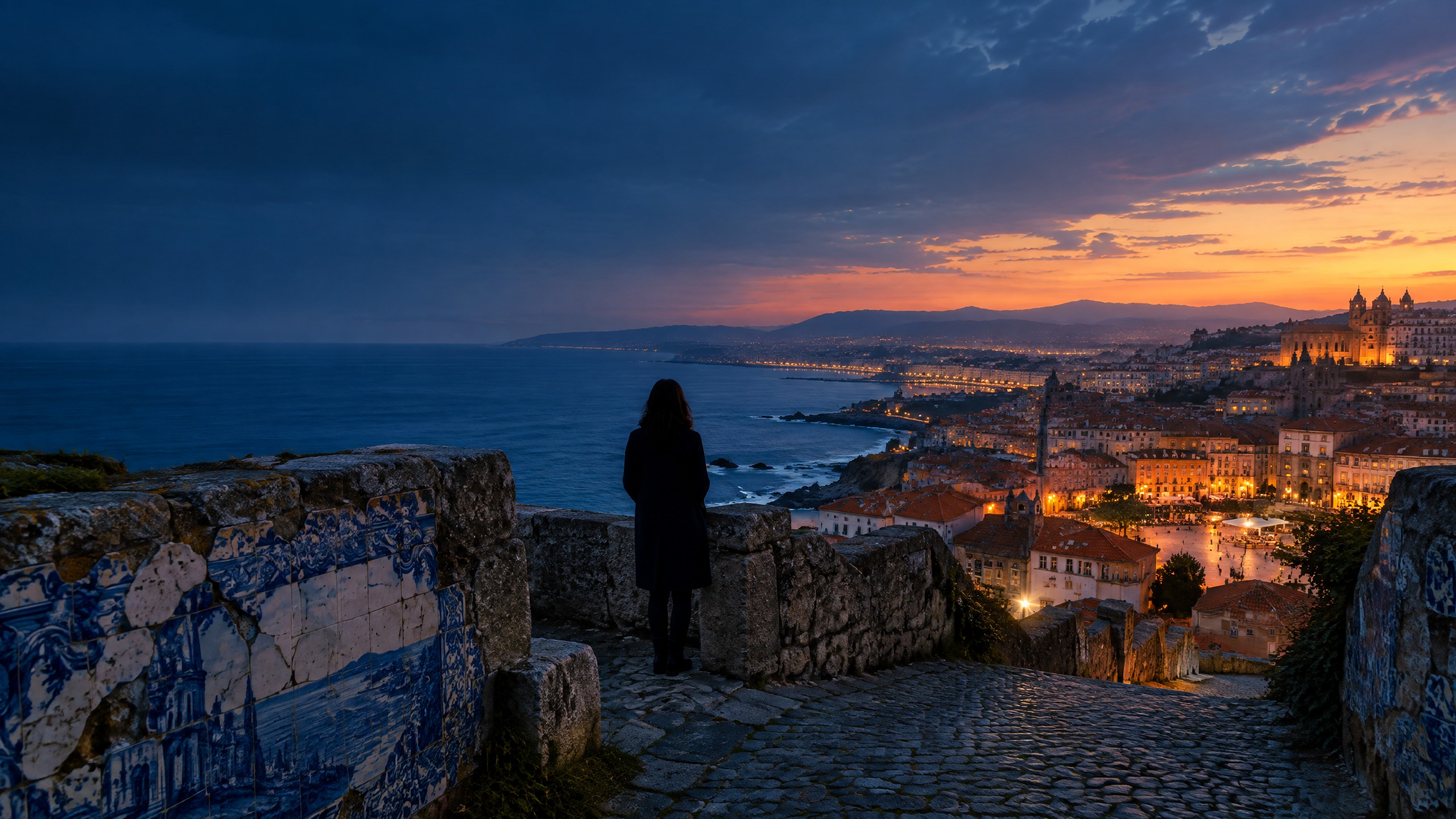
Portugal and Spain Share a Border. They Do Not Share a Travel Instinct.
Destination: Portugal & Spain
Category: comparison
Portugal vs Spain becomes a different question at the end of the day. In Lisbon, the light falls across the Tagus as if the city has been waiting for it. In Madrid, the day is only beginning: chairs move onto terraces, people are still arriving for dinner, and the street gathers force long after a visitor expects a European capital to quiet down. Portugal and Spain share the Iberian Peninsula, an Atlantic edge, a complicated border, and centuries of exchange. Yet a traveler who crosses from one to the other does not feel as though they have changed countries by degree. They feel as though they have changed verbs.
The standard Portugal vs Spain comparison asks which is cheaper, warmer, easier, or better for food. Those are reasonable questions with uninteresting answers. Prices move. Weather depends on the month. Both countries contain great cities, great coastlines, and enough regional cooking to undo any single national verdict. The choice that actually matters is temperamental. Portugal is shaped by the memory of a reach it could not keep; Spain is shaped by the energy of a nation that has never stopped contesting what it might become.
This post argues that Portugal and Spain are not competing versions of one Iberian trip. Portugal remembers, quiets, accepts, and stays. Spain argues, performs, insists, and keeps discovering another version of itself. That is why Lisbon feels different from Madrid before you can name a landmark, why Porto and Barcelona make such unlike second cities, and why the Atlantic means something else on either side of the border. Choose Portugal when you want a country that rewards attention. Choose Spain when you want a country that turns attention into participation.
Morocco belongs near this conversation geographically and historically, especially for travelers looking at the Tarifa–Tangier crossing. It does not belong inside this comparison. The Portugal-versus-Spain question is about two countries whose border, imperial competition, and shared peninsula produced divergent European national temperaments. Morocco changes the civilizational frame rather than sharpening it. France is another tempting addition, but it makes the comparison too broad and too familiar. This is a narrower argument: two neighboring countries, one long entanglement, two radically different travel instincts.
Portugal vs Spain Cannot Be Answered by a Price Chart
The first mistake is treating Portugal as Spain's affordable, quieter alternative. Portugal can cost less, and parts of Spain can be expensive, but the difference is too unstable to carry the decision. A budget can alter the hotel choice. It cannot explain why one country asks you to lower your voice and the other invites you to stay out later.
The deeper context begins in 1143, when the Treaty of Zamora recognized Portugal as an independent kingdom, and becomes harder to ignore in 1494, when the Treaty of Tordesillas divided much of the newly encountered world between Portugal and Castile. For sixty years, from 1580 to 1640, the Iberian Union placed Portugal and Spain under the same Habsburg crown. The countries share an enormous amount of political and oceanic history. Their divergence is therefore more revealing, not less.
Portugal built a maritime empire whose routes reached Africa, India, Brazil, China, and Japan, then spent later centuries living with the shrinking of that reach. Spain built an imperial system of larger continental scale while holding together Castilian, Catalan, Basque, Galician, Andalusian, and other identities that never agreed to become merely regional color. The distinction is not that one country has history and the other has energy. Both have too much history. It is that Portugal often turns history inward, while Spain turns it into an argument conducted in public.
That is the frame for every choice that follows. Lisbon versus Madrid is not a contest of city-break highlights. Porto versus Barcelona is not a contest of second cities. The table, the coast, and the rural interior each make the same larger claim in a different register.
Portugal vs Spain: History Produced Two Different National Moods
Portugal enters the comparison as a country organized around remembrance; Spain enters it as a country organized around unresolved plurality. In Portugal, saudade is often translated as longing, but the word is more useful as a travel instruction than a vocabulary lesson. It describes attachment to something absent without pretending the absence can be fixed. You hear the register in Fado, read it in Pessoa, and feel it in the way Lisbon's riverfront remains pointed toward departures long after the ships have gone.
The twentieth century sharpened that inwardness. Portugal's authoritarian period began with the 1926 military coup and consolidated into the Estado Novo under António de Oliveira Salazar; the regime's censorship and isolation lasted until the Carnation Revolution of 1974. That history does not turn contemporary Portugal into a museum of dictatorship. It helps explain why certain local rhythms, building textures, and neighborhood habits survived an internationalizing Europe differently. A five-day Lisbon guide makes more sense when you read the tiled facades, old cafés, and deliberately unhurried meals as part of a culture that has retained its own pace, not as set dressing.
Spain's twentieth-century break produced a different release. After Franco's death, the democratic transition anchored in the 1978 Constitution opened political and cultural space that had been tightly constrained for decades. Madrid's La Movida became the visible creative eruption of that change: music, film, fashion, nightlife, irreverence, and a city learning to perform its freedom in real time. The strongest Madrid solo itinerary does not reduce that story to a late dinner. It lets you see why the city treats public life as a collective art form.
Portugal remembers without demanding that the visitor solve the loss. Spain argues without demanding that the visitor pick a side. That is the first choice. The cities make it impossible to miss.
Lisbon and Madrid: Two Capital Cities Built for Opposite Kinds of Attention
Where the national mood makes Portugal reflective and Spain expansive, Lisbon and Madrid turn that difference into the rhythm of an ordinary day. Lisbon asks a visitor to notice what remains between the headline viewpoints. Madrid asks a visitor to enter the current and see how long they can stay there.
In Lisbon, that means resisting the idea that Alfama alone is the old city. Alfama deserves the early walk: its medieval street pattern grew from the Moorish al-Ushbuna that preceded the Christian reconquest, and the climb changes the relationship between river, roofline, and hill. But Mouraria, just beside it, supplies a more revealing counterpoint. It carries the memory of the medieval Muslim quarter while also holding layers of later migration—South Asian, Chinese, Bangladeshi, African, and Brazilian lives among older Lisbon institutions. Start at Largo do Intendente, follow Rua dos Cavaleiros, then let the route move without a checklist toward Martim Moniz. That is the Lisbon that explains itself through coexistence rather than through a postcard.
Use a Lisbon food guide to anchor this attention at the table. Petiscos work best when you stop treating them as a Portuguese answer to tapas. The formats overlap; the pace does not. A plate of pica-pau, a few clams with garlic and coriander, and a small glass at a neighborhood counter ask you to stay with the conversation rather than turn the meal into a crawl. Manteigaria's warm pastéis de nata can be excellent, but the point of Lisbon is not finding the only correct custard tart. It is seeing how a city keeps everyday rituals intact around an increasingly international audience.
Madrid is the contrary proposition. The Prado, Reina Sofía, and Thyssen-Bornemisza form one of Europe's most concentrated walks through painting, but their placement beside Retiro and within a city that does not consider 10pm late changes what museum-going means. You leave Guernica and return to a street that is gaining velocity. In Lavapiés, the evening table is an argument against any narrow definition of Spanish food: Indian, Moroccan, Bangladeshi, Senegalese, Latin American, and old-style tabernas occupy the same few blocks. Madrid's multiculturalism does not dilute its identity. It displays the capital's appetite for incorporation.
A Madrid food-and-tapas route is most useful when it gives Lavapiés the same seriousness travelers usually reserve for the old center. Lisbon asks, “What has lasted?” Madrid asks, “Who is here now, and why would the night end early?”
Porto and Barcelona: The Second Cities That Refuse to Be Secondary
Where Lisbon and Madrid reveal opposite capital-city rhythms, Porto and Barcelona show that each country gives its second city a completely different job. Porto makes Portugal's memory tactile and mercantile. Barcelona makes Spain's internal argument architectural, linguistic, and impossible to ignore.
Porto's steep streets and granite facades can look austere until you understand the Douro as an economic system rather than a view. Across the river in Vila Nova de Gaia, the port lodges are not simply tasting rooms. They are the storage architecture of a trade shaped by the eighteenth-century Methuen Treaty, British merchants, river transport, and a wine whose maturation historically depended on conditions away from the vineyards. Stand on the Ribeira side at dusk, then cross Dom Luís I on foot to Gaia. The movement teaches the city better than any single cellar tour: production inland, aging across the river, commerce outward toward the Atlantic.
That route also clarifies why Porto should not be treated as Lisbon without hills. Lisbon's relationship to empire is panoramic: the river opens toward an imagined world. Porto's is granular: warehouses, contracts, granite, barrels, and a working river made the global scale legible through local labor. Walk Rua das Flores toward the water in the morning, when deliveries and residents arrive before the riverfront becomes a stage, then cross to Gaia before sunset. The essential Portuguese sensation is not having discovered an untouched place. It is sensing how much of the world's history passed through a place that still moves at its own scale.
A four-day Porto itinerary gives the city time to be more than a compact Lisbon. Follow the line from São Bento's azulejo panels through the upper deck of the bridge, then leave the riverfront before dinner. On Rua de Passos Manuel, the francesinha at Café Santiago is not delicate and is not supposed to be. Layered meat, melted cheese, fried egg, and a beer-tomato sauce create the kind of local excess that outsiders often misread as a dare. Porto's point is that an industrial city can still make intensity feel private.
Barcelona chooses the opposite exposure. Catalonia's language and civic identity are visible before you reach a museum: on signs, menus, bookshops, schools, and the social expectation that the city belongs to a culture larger than a visitor's itinerary. Gaudí's buildings are compelling partly because they make that self-confidence physical. Casa Milà, Casa Batlló, Park Güell, and the still-unfinished Sagrada Família do not quietly decorate a Spanish city; they insist on an architectural language that could have emerged nowhere else.
The right Barcelona architecture-and-beach guide should therefore pair modernism with a district that resists easy consumption. Walk the Eixample grid to Gràcia after dark, when the plazas fill with neighbors rather than sightseeing groups, and notice how much civic life happens at the scale of a bench, a terrace, and a corner shop. Porto turns a former commercial reach into atmosphere. Barcelona turns a continuing national argument into a city you walk through.
The Table: Portugal Simplifies, Spain Multiplies
Where Porto and Barcelona show two kinds of second-city confidence, the table reveals the most intimate difference: Portugal reduces an ingredient toward its point, while Spain develops many regional answers at once. Neither approach is more sophisticated. They create opposite reasons to travel.
Portuguese food begins with preservation, restraint, and what the Atlantic makes possible. Bacalhau is the obvious example, not because the country has a ritual number of recipes to recite, but because salted cod carries oceanic trade into domestic cooking. A food once suited to long voyages became a national pantry ingredient, and its variations reveal how much Portuguese cooking trusts salt, olive oil, onion, potato, egg, and heat to do their work without theatrical intervention. In Porto, make room for grilled fish at a small neighborhood restaurant one day and a francesinha another; the contrast is more instructive than trying to decide which dish represents the city.
A Porto food itinerary can keep that sequence human. Take the Mercado do Bolhão seriously in the morning, when vendors and regular shopping still set the rhythm, then leave enough time for a long lunch rather than stacking tastings. Portugal rewards a traveler who lets one ingredient explain a meal.
Spain multiplies. It can move from a Castilian roast to Valencian rice, Andalusian fried fish, Catalan sauces, Basque grill culture, and Galician shellfish without producing a single stable national plate. San Sebastián is the sharpest proof because it is both globally famous and intensely local. The visitor who never leaves the old town's tight pintxos lanes can have a good evening; the visitor who crosses the Urumea into Gros sees a different relationship with the same culture. Thursday night in Gros, when local groups move through bars with a purpose that does not depend on a guidebook, is a reminder that pintxos are less a collection of small dishes than a social choreography.
A San Sebastián food guide should be used as a map of that choreography rather than a scoring sheet. Order one or two things, move on, and pay attention to how the room changes by hour. Portugal makes the table a place to settle. Spain makes it a system that keeps generating another region, another bar, another reason to continue.
The Atlantic: Portugal Looks Out, Spain Turns Back In
Where Porto and San Sebastián turn the table into two forms of local belonging, the Atlantic gives Portugal and Spain different horizons. Portugal faces the ocean as origin, departure point, and permanent psychological weather. Spain's Atlantic edge reveals regions that feel least like the tourist image of Spain because they have long looked toward the water and northward worlds of their own.
The Algarve is not the whole Portuguese coast, and that distinction matters. Its sea caves and limestone cliffs are beautiful, but the Portugal that best serves this argument begins when you drive west from the developed resort corridor toward Sagres and then north along the Alentejo coast. At Cabo de São Vicente, the land feels like an edge without needing to turn itself into a symbol. It was associated with the age of navigation long before tourism sold it as a final-stop sunset. The useful experience is to arrive in the afternoon, walk a short stretch away from the parking area, and let the wind make the continental geography practical.
For a grounded southern route, use an Algarve family itinerary as logistics rather than as a resort prescription. The best adjustment is often a few days in the Algarve followed by slower time near the Alentejo coast, where the beaches and small towns ask less of the visitor. Portugal's Atlantic holds the feeling of what left.
Spain's Atlantic lives most fully in Galicia and the Basque Country, where rain, granite, cider, language, and shellfish refuse the Mediterranean shorthand. Galicia's Rías Baixas are drowned river valleys, and their cold-water shellfish culture makes the coast taste mineral, briny, and fiercely local. Yet the more accessible Spanish guide cluster lies farther east in San Sebastián, where the Bay of Biscay and Basque cooking give the Atlantic a social rather than elegiac character.
A San Sebastián couples itinerary is useful even for travelers who are not treating the trip as romantic, because it slows the city down to walks along La Concha, meals in Gros, and a coastline that is always part of the evening rather than a beach break attached to it. Portugal looks out and remembers departure. Spain turns along the coast, enters a region, and discovers that the country contains another country again.
Slow Travel: Portugal Stays Put, Spain Keeps Discovering Its Interior
Where the Atlantic makes Portugal outward-looking and Spain regionally plural, slow travel brings the contrast inland: Portugal rewards staying; Spain rewards finding what the main itinerary missed. The difference is visible in the Douro Valley and Extremadura, two landscapes that should never be mistaken for the city extensions they are often sold as.
The Douro is not a day trip to be completed from Porto between breakfast and dinner. Its terraced vineyards, quintas, river bends, and rail line ask for a night or two at minimum. The best hour is not a tasting appointment. It is the moment after lunch when the heat lowers, the river begins reflecting the slopes, and there is nothing practical left to do except walk a short track or sit outside with a glass from the landscape in front of you. Start with a Lisbon-to-Porto itinerary, then lengthen the northern portion rather than adding another city. Portugal's strongest invitation is permission to remain.
South of Lisbon, the Alentejo makes the same case with cork oak, olive groves, whitewashed towns, and distances that change the body clock. Around Alqueva, the dark sky is not a novelty to add to a packed route; it is an argument for doing less. A trip through this part of Portugal should allow a rural quinta, an unhurried lunch, and a night outside Évora or Monsaraz. The country becomes more legible when you stop trying to optimize it.
Spain's slow-travel argument is not silence. It is discovery. Extremadura—the dehesa country of holm oak, cork oak, and Iberian pig—has the sensation of a Spain that the main rail map has not flattened into a familiar itinerary. Mérida's Roman theater, built in the first century BC and still used for summer classical performances, gives that discovery a form: ancient infrastructure continuing to perform its original cultural work. You do not go to Extremadura to escape Spain. You go to see how much Spain exceeds the version built from Barcelona, Madrid, and the coast.
Use Madrid as the starting point rather than the entire answer. Spain rewards the road that leads away from the capital toward a region with its own products, history, and tempo. Portugal tells you that staying can be enough. Spain tells you that the second route may reveal an entirely different country.
Portugal vs Spain: The Honest Answer Depends on How You Want to Travel
Where slow travel exposes Portugal's gift for remaining and Spain's gift for revelation, the honest Portugal vs Spain answer is about the version of yourself you want a trip to bring forward. The countries are close enough to combine and different enough that they should not be chosen by spreadsheet alone.
Choose Portugal if you want a week with fewer sharp transitions and more room for a place to work on you gradually. Build the trip around Lisbon, Porto, and either the Douro or the Alentejo rather than trying to cover the full coastline. You will eat well, spend less energy negotiating the pace, and find that the memorable moments often arrive after you stop looking for them: a Fado room that feels more intimate than performative, a late river view from Gaia, a long lunch that becomes the day.
Choose Spain if you want a trip that gathers momentum as you travel. Madrid and Barcelona make a productive first pairing because their contrast is already part of the national argument; Madrid is central, social, and late, while Barcelona is Mediterranean, Catalan, and exacting about its own identity. A Barcelona food-focused guide can add the table to that comparison without treating tapas as a generic category. Add San Sebastián if eating is a principal reason for the trip, or head inland if you want Spain's regional variety to become the argument.
Choose both only if you have at least three weeks. Ten days in Portugal can move from Lisbon through the Douro and Porto without hurry. Another ten days in Spain can connect Madrid to San Sebastián and Barcelona, or redirect south toward Andalucía. The border crossing is most satisfying when it happens after each country has had time to establish its own grammar.
If the right route depends on whether you want more river time, museums, beaches, late dinners, wine-country stays, or a specific balance between them, AskLeif can turn the comparison into a day-by-day itinerary rather than a list of places to pin.
The Border Does Not Explain the Difference
Portugal remembers. Spain argues. Portugal quiets. Spain performs. Portugal accepts. Spain insists.
Those pairs are not a reason to flatten either country into a mood board. Portugal contains noise, invention, and impatience; Spain contains melancholy, stillness, and extraordinary restraint. But travel is partly the art of recognizing a destination's dominant invitation. Portugal asks you to notice what a small country does with the memory of having reached the world. Spain asks you to enter a large country that is still debating how many worlds it contains.
They share a border. They do not share a travel instinct. Choose the one whose verb you need. Then give it enough time to prove the choice right.