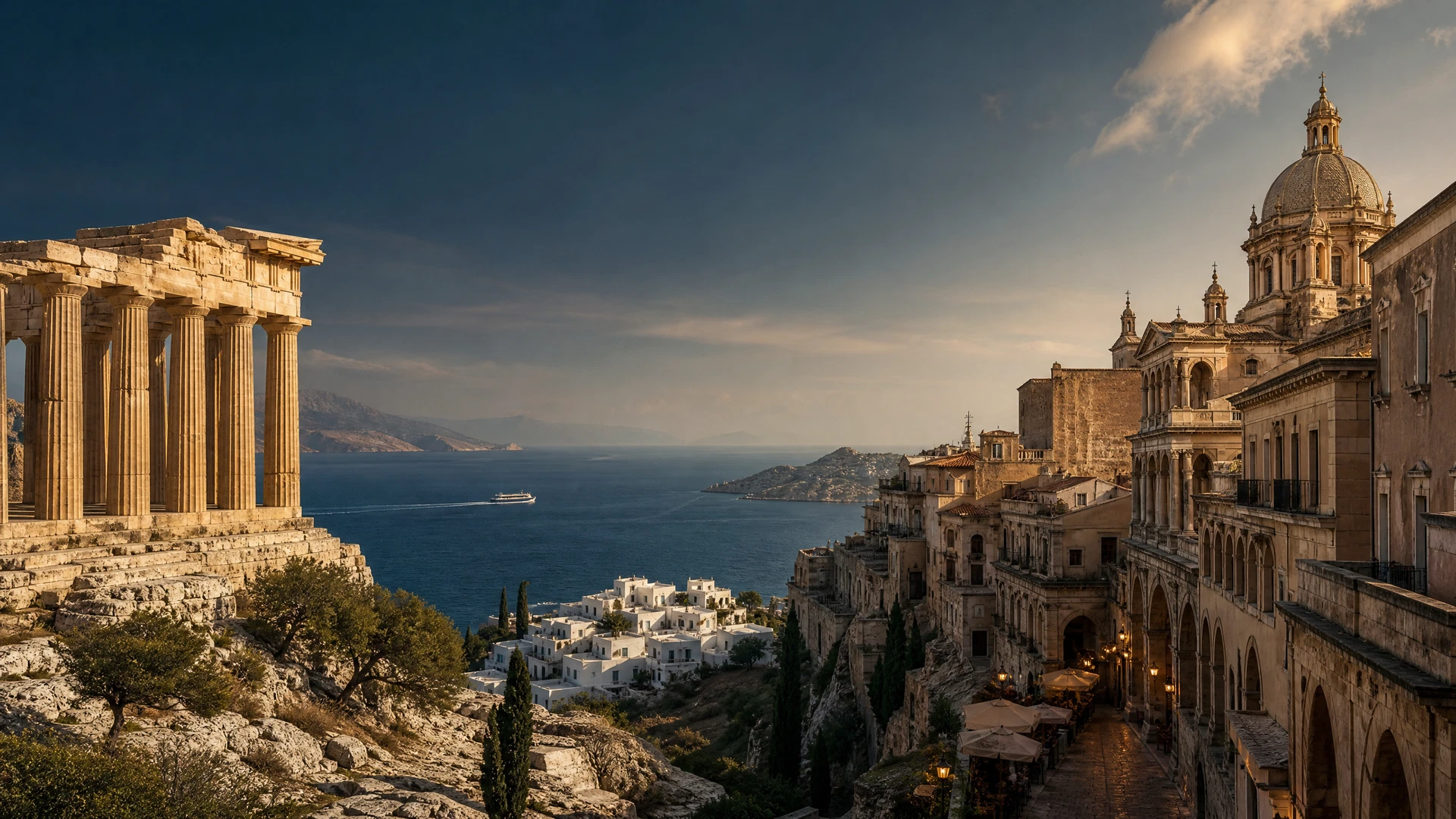
Italy Performs. Greece Reveals.
Destination: Greece and Italy
Category: comparison
Greece vs Italy is usually asked as though it were a referendum on an itinerary: ruins or museums, tavernas or trattorias, Santorini or the Amalfi Coast, a ferry deck or a high-speed train. That is not wrong. It is simply too small. The real choice begins when you notice that the Pantheon and the Parthenon do not ask the same thing of the person standing beneath them.
In Rome, the past is always being used. A temple becomes a church. An imperial road becomes a traffic artery. A piazza carries a fountain, a café terrace, a bus stop, a procession, and a layer of argument from five different centuries. Italy has made continuity into an art form. Its greatest skill is accumulation: the ability to keep adding without ever fully throwing the old thing away.
In Athens, the past is above you before it is around you. The Acropolis rises from its limestone ridge not as an enclosure built around a city but as the fact that organized the city below. At Delphi, the mountain is part of the sanctuary’s sentence. On an island, a white village follows a contour because the rock and wind made that contour necessary. Greece does not place history in its landscape after the fact. It lets the landscape explain why the history happened where it did.
That is the real Greece vs Italy comparison: Italy is the country that built on its past; Greece is the country that built its past into the land. Italy performs civilization as a living, layered present. Greece reveals civilization as a problem of light, stone, water, distance, and memory. Neither is better. But they produce radically different kinds of beauty, and a traveler who understands that difference will choose more honestly than one who merely compares a beach photograph with a museum ticket.
This is not a vote for the easier answer. It is an argument for the one that tells you what kind of attention you are looking for. Italy rewards the traveler who wants the density of human invention. Greece rewards the traveler who wants to feel how human invention answered a particular piece of earth. The food, ruins, islands, and logistics all follow from that original divide.
Greece vs Italy: One Country Inherits Its Past, the Other Keeps Meeting It
Greece belongs on one side of this comparison because its ancient identity remains a live, unresolved encounter rather than a seamless inheritance. Modern Greece is descended from a civilization that gave the Western world the vocabulary of democracy, tragedy, geometry, and philosophy, then passed through Macedonian, Roman, Byzantine, Ottoman, and European spheres of power before fighting its way into a modern state. The Greek War of Independence began in 1821; Lord Byron died in Missolonghi in 1824 while supporting it; the state that finally emerged was new in the political sense and ancient in every cultural sense that mattered. That tension is still visible in Athens, where the Acropolis is both the nation’s emblem and a ridge occupied by the scale of what came before.
Start with the five-day Athens travel guide, but do not treat it as a checklist for clearing the ancient sites. Go to the Acropolis early enough that the heat and the coach traffic have not yet flattened the place into an obligation. From the western approach, the Propylaea makes sense less as an entry gate than as a deliberate interruption: the hill forces a change in pace before the temples reveal themselves. Then come back down into Plaka and Anafiotika, where small Cycladic-looking lanes sit on the slope beneath a monument from a different civilizational scale. The present does not replace the ancient city. It improvises under it.
Italy enters this first dimension as the opposite form of historical confidence. Rome fell as an empire, but the city did not become culturally blank. Papal Rome claimed and repurposed imperial Rome; the Renaissance argued with antiquity through Florence; the Baroque revised the same streets again; contemporary Italy still lives amid that accumulated argument. The Pantheon gives the comparison its cleanest physical evidence. Built as a Roman temple, converted into a Christian church in the seventh century, and still used for Mass, it has not been cordoned off from ordinary life by the label “ruin.” Its 43.3-meter dome makes the room feel engineered and devotional at once.
That is why a five-day Rome city break is useful when Italy is your answer. It should not rush from the Forum to the Colosseum to the Vatican as though historical periods were separate attractions. Walk from the Teatro di Marcello through the Jewish Ghetto toward the Portico d’Ottavia, then continue to Campo de’ Fiori and Piazza Navona. The distance is short. The centuries are not. A Roman theater wall becomes part of an apartment block; a medieval lane opens into a Baroque square; ancient brick appears where no museum label is necessary.
Greece is for the traveler who wants to feel a long discontinuity and ask what survives it. Italy is for the traveler who wants to walk through a civilization that rarely stopped building. Greece makes its historical distance visible. Italy makes historical distance almost impossible to maintain. That is the first decision, and it explains why the rest of the trip will feel different even when both countries appear to offer the same category of ancient Europe.
Where Italy’s Layers Become Greece’s Ingredient-First Food
If identity is where Italy accumulates and Greece confronts, food is where the distinction becomes intimate. Greek cooking belongs to the land-and-sea argument because its finest expressions refuse to travel far from the conditions that produced them. A plate of horta is not compelling because it is rustic; it is compelling because the greens, lemon, olive oil, and salt are doing almost all the work. The best grilled octopus does not arrive as a chef’s thesis. It arrives because an octopus was dried, charred, sliced, and served close to the water where the logic of that treatment is obvious.
Athens makes this clear before you reach an island. Use the Athens food and culture guide to understand the difference between eating Greek food and recognizing its rhythm. At Varvakios Market, the fish counters, spice sellers, butcher stalls, and crates of produce make a better argument than an expensive menu about the relationship between the city and the country around it. In the evening, a table of meze changes the structure of dinner. Taramosalata, grilled sardines, fava, bitter greens, bread, and a carafe of wine appear as a shared field rather than a sequence of courses. The meal asks people to stay in the conversation long enough for the table to become the event.
The Greek salad is often misunderstood for the same reason Greece itself is misunderstood: visitors expect construction where the culture values restraint. Tomatoes, cucumber, olives, feta, oregano, and olive oil are not trying to become a composed restaurant object. In season, their directness is the point. Greek food trusts proximity. The more clearly the ingredient carries the sun, soil, seawater, or hillside that made it, the less the kitchen needs to announce itself.
Where Athens makes restraint legible, Rome and the wider Italian peninsula make difference legible. Italian food is not one national cuisine so much as the surviving map of dozens of political units, climates, and agricultural zones. Butter and rice change the north; olive oil, tomatoes, durum wheat, and citrus change the south. Emilia-Romagna works with cured pork, egg pasta, Parmigiano Reggiano, and balsamic vinegar in combinations that would not make historical or agricultural sense in Sicily. In Rome, pasta is its own local language: cacio e pepe, gricia, carbonara, and amatriciana share ingredients yet declare allegiance through proportion and technique.
A Rome food itinerary belongs in the comparison not because Rome beats Athens at dinner, but because it gives you the opposing pleasure: watching a region turn detail into identity. Eat supplì standing near a trattoria in Testaccio; make time for the market’s produce stalls; then sit down for tonnarelli cacio e pepe somewhere patient enough not to bury the dish under cream. The Roman question is not, “How little can I do to this ingredient?” It is, “What can this exact ingredient become in this exact place if I know its rules?”
Italy is right when you want every meal to tell you where you are within a peninsula. Greece is right when you want the meal to remove the distance between the table and the geography outside it. Neither side needs the other’s language. A taverna plate of raw red mullet and a Roman bowl of pasta are not interchangeable Mediterranean pleasures; they are two theories of how a place should feed you.
Where Greek Ruins Use the Land and Italian Ruins Keep Working
If food takes Italy’s layers into the body and Greece’s geography into the meal, the ruins make the argument impossible to avoid. Greece’s sacred sites were chosen with a physical intelligence that modern photography often turns into scenery. The Acropolis is not merely an elevated location for the Parthenon; the hill creates the approach, the exposure, the visibility across the Attic plain, and the separation from the city’s ordinary commerce. The building is inseparable from the ridge because the ridge was part of the architectural decision.
Delphi takes that proposition further. The sanctuary climbs the flank of Mount Parnassus above the Pleistos Valley, so the path toward the Temple of Apollo changes the visitor’s body as it changes the view. The Treasury of the Athenians, the theater, the stadium, the terraces, and the drop toward the olive groves make ancient belief feel less abstract. The oracle was not placed in a neutral field and then decorated with mythology. The mountain gave the claim its force.
That is why the ten-day Greece islands and Athens itinerary should be treated as a route between different kinds of terrain, not simply a sampler of famous names. Athens gives you the citadel over the city. Delphi gives you a sanctuary inside a mountain system. Meteora, if you add it, gives you monasteries raised on sandstone pillars. The point is not to collect classical references; it is to notice how often Greek sacred and civic architecture uses the topography as one of its materials.
Italy’s ruins do something almost inverse. They reveal not placement but reuse. In the Roman Forum, the republican and imperial core became a medieval grazing ground, then an archaeological site, then a modern civic symbol. You look through columns, basilica fragments, triumphal arches, gardens, fences, excavation trenches, and the massive flank of the Palatine all at once. The complexity is not a flaw in the view. It is the view.
Florence extends that layered logic beyond antiquity. The city’s medieval street pattern, Renaissance palaces, guild churches, and museum collections form a place where art history is not sealed in a district. At Orsanmichele, a former grain market became a church, while the guild niches on its exterior tell the story of Florence’s civic order in stone. At the Basilica of San Lorenzo, Brunelleschi’s architecture and Michelangelo’s Medici tombs pull different centuries into the same interior. A four-day Florence city itinerary lets you read those overlaps more intelligently than a one-day sprint between the Uffizi and the Duomo.
Greece is for the traveler who wants a temple to make the land around it feel newly intentional. Italy is for the traveler who wants the surviving building to contain its later lives as well as its first one. Greek ruins ask you to look outward—to the slope, harbor, ravine, and horizon. Italian ruins ask you to look through—to the church, street, plaster, garden, and generation built afterward. Greece places. Italy keeps building.
From Italy’s Built World to Greece’s Navigable One
Where Greek ruins use the land and Italian ruins continue working inside cities, the islands show what happens when both countries carry that relationship to the water. Greece is not the better island destination because it has more blue water. It is the better choice when you want navigation itself to become part of the experience. The Aegean reads as a scatter of routes, wind patterns, harbors, whitewashed settlements, and distinct island histories. Ferries do not merely transport you between highlights. They teach you the scale and fragmentation that shaped the Greek world.
Santorini is the most obvious example and also the easiest one to misunderstand. The caldera is not a pretty cliff behind a hotel; it is the rim of a flooded volcanic system. The villages of Fira, Imerovigli, and Oia sit where the geology permits them, facing an interior sea created by eruption and collapse. Assyrtiko vines are trained low in basket-like coils to protect fruit from the wind, and the resulting wine carries the dry, mineral severity of the island more convincingly than most sunset photographs do. A five-day Santorini itinerary gives the caldera time to become a landscape rather than a single dinner view.
But Greece’s larger island argument needs contrast. Crete is not a bigger Santorini. Its Venetian harbor at Chania, the archaeological gravity of Knossos, the White Mountains, and the food culture of its inland villages make it closer to a complete country in miniature. The Crete family itinerary is valuable beyond family travel because it demonstrates the scale that a serious Greek island trip can contain: beaches, mountain roads, Minoan material, harbor life, and meals that change as the terrain changes. Corfu, meanwhile, carries Venetian facades and Ionian greenery rather than Cycladic dryness. The islands are not a brand. They are a survey of what the Mediterranean has done to different pieces of land.
Italy’s island answer begins where Greece’s architectural navigation gives way to geology and regional appetite. Sicily is the clearest case. The island holds Greek temples at Agrigento, Roman mosaics at Villa Romana del Casale, Arab-Norman Palermo, Baroque towns in the Val di Noto, and Mount Etna above all of it. Its internal diversity would be enough without the volcano; Etna gives it a physical center that keeps changing the terms of the place.
The Sicily family itinerary works here as an introduction to that density: the Valley of the Temples, Taormina’s theater, Palermo’s markets, and the coast do not belong to separate “Sicilies.” They are the island’s argument about what happens when civilizations meet repeatedly on the same strategically placed ground. In the Aeolian Islands north of Sicily, Stromboli sends its regular bursts above the sea and Vulcano vents sulfur from a landscape whose name gave English the word “volcano.” Italy’s island drama is not primarily about hopping. It is about pressure, eruption, conquest, and cuisine concentrated on land with nowhere to hide.
The Amalfi Coast travel guide adds an important mainland-island comparison. Positano, Amalfi, Ravello, and the road between them turn the Tyrrhenian coast into a built response to slope, but their story is more urban and architectural than the Aegean’s dispersed network. Choose Greece if you want the ferry, the harbor arrival, and the feeling that each island has been shaped by its own exposure to wind and trade. Choose Italy if you want the coast and islands to register as a compressed succession of geological force and human layering.
Greece vs Italy Planning: Ferries Teach Patience; Trains Reward Momentum
If the islands make the difference visible on water, the practical question makes it useful. Greece demands a little more surrender to schedule. A serious Greek itinerary is shaped by ferry timetables, wind, port connections, and the knowledge that moving from one island to another can consume more of a day than the map appears to promise. That is not an argument against Greece. It is the country being honest about its geography. The traveler who treats ferries as dead time will misread the trip; the traveler who sees a ferry deck as the threshold between distinct worlds will get the country.
Keep the sequence intentional. Athens first gives the ancient and contemporary frame. Then choose one island group rather than trying to touch every color on the map. The Cyclades make sense for dry light, stone, and the classic Aegean rhythm; the Ionian makes sense for Venetian inheritance and greener water; Crete makes sense for a deeper, slower island that will not yield to a two-night stop. Greece can be affordable, but Mykonos and Santorini are no longer the uncomplicated budget escape sold in old travel lore. Sifnos, Naxos, Milos, and Folegandros can offer more room to breathe if you are willing to plan around sailing times rather than airport convenience.
Italy is the easier country to move through quickly, and that convenience is one of its genuine pleasures. Rome to Florence can be about ninety minutes on high-speed rail; Florence to Venice often takes about two hours; Rome to Naples can take roughly an hour. Trenitalia and Italo turn a multi-city trip into a series of arrivals directly inside urban life. You step off a train near the city’s operating center rather than at the edge of an island transport chain, and the next historical layer is already waiting outside the station.
That accessibility changes the budget calculation. Italy rewards the traveler who books trains early, stays slightly beyond the most compressed central districts, and lets secondary cities carry some of the trip’s weight. It also punishes the traveler who assumes every famous stop is priced like a local secret. Venice’s visitor-management rules and city taxes, Rome’s accommodation tax, and the expense of the Amalfi Coast in peak season are part of the contemporary trip, not a footnote. Italy is efficient, not automatically inexpensive.
| If this is what you want | Choose Greece | Choose Italy |
|---|---|---|
| Your central experience | Landscape, water, and the long approach to a place | Cities, layers, and a new historical register every few blocks |
| Your best transport rhythm | Athens plus a deliberately chosen island group | Rail between Rome, Florence, Venice, Naples, Bologna, or Milan |
| Your food logic | Seasonality, simplicity, sharing, and proximity | Regional distinction, technique, and a meal that locates you on the peninsula |
| Your ruins | Temples and sanctuaries in terrain that explains them | Buildings, streets, and institutions still carrying former lives |
| Your necessary patience | Ferry schedules, wind, and moving more slowly than the map implies | Ticketing, crowds, timed entries, and the pressure of too much choice |
The conversion bridge is simple because the decision itself is personal. A custom itinerary should not begin by asking whether Greece or Italy is “better.” It should begin by asking whether you want to wake up with the sea determining the day or leave a train station with two millennia of city life already pressing in. Let Leif build around that answer: ports and island groups if Greece is the right country, rail legs and regional changes if Italy is. The mistake is not choosing one. The mistake is asking both countries to deliver the other’s kind of trip.
The Honest Greece vs Italy Answer Is About the Kind of Beauty You Need
The obvious third options deserve to be left out of this comparison on purpose. Spain is the most common interruption to the Greece-versus-Italy conversation, particularly for travelers who want Mediterranean weather, food, art, and a lower practical friction. It belongs in its own argument with Italy because Iberian history, regional identity, and the relationship between Madrid, Barcelona, Andalusia, and the coast are not a supporting subplot here. Spain would dilute a comparison built around two civilizations whose ancient inheritances formed a central part of the Western imagination.
Turkey is also not a budget substitute for Greece in this article, even though it shares the Aegean and contains Greek, Roman, Byzantine, and Ottoman material of extraordinary depth. Turkey’s role in the story is not peripheral; that is precisely why it needs a dedicated treatment. Its Byzantine inheritance, Ottoman urban culture, Anatolian geography, and eastern Mediterranean position create a different civilizational argument. Folding it into a Greece-versus-Italy verdict would make all three countries smaller.
There is one scenario in which the answer is both. If you have three weeks, begin in Rome and give Italy ten days: Rome for density, Florence for the Renaissance’s conversation with antiquity, and either the Amalfi Coast or Sicily for the southern release. Then fly to Athens and give Greece ten days: the Acropolis for the frame, a Peloponnese or Delphi extension for the terrain, and one intentionally chosen island group for the water. The countries will not blur together. They will sharpen each other.
But if you have one country to choose, resist the temptation to split the difference. Pick Greece if you want beauty that opens outward: temples on ridges, harbors in coves, tables whose ingredients still carry the climate, and a past so immense that the present cannot pretend it has settled the matter. Pick Italy if you want beauty that deepens inward: a church inside a temple, a city built over a road built over a forum, a meal that changes with each regional border, and a culture that has kept its earlier selves in circulation.
Greece landscapes. Italy layers. Greece simplifies. Italy accumulates. Greece places. Italy builds.
That is why the comparison matters. Italy gives you the human record at full density, still active, still arguing, still adding another floor. Greece gives you the older and quieter revelation: that human ambition began by looking at a hill, a harbor, an island, a mountain, and deciding that the land itself knew where the story belonged.