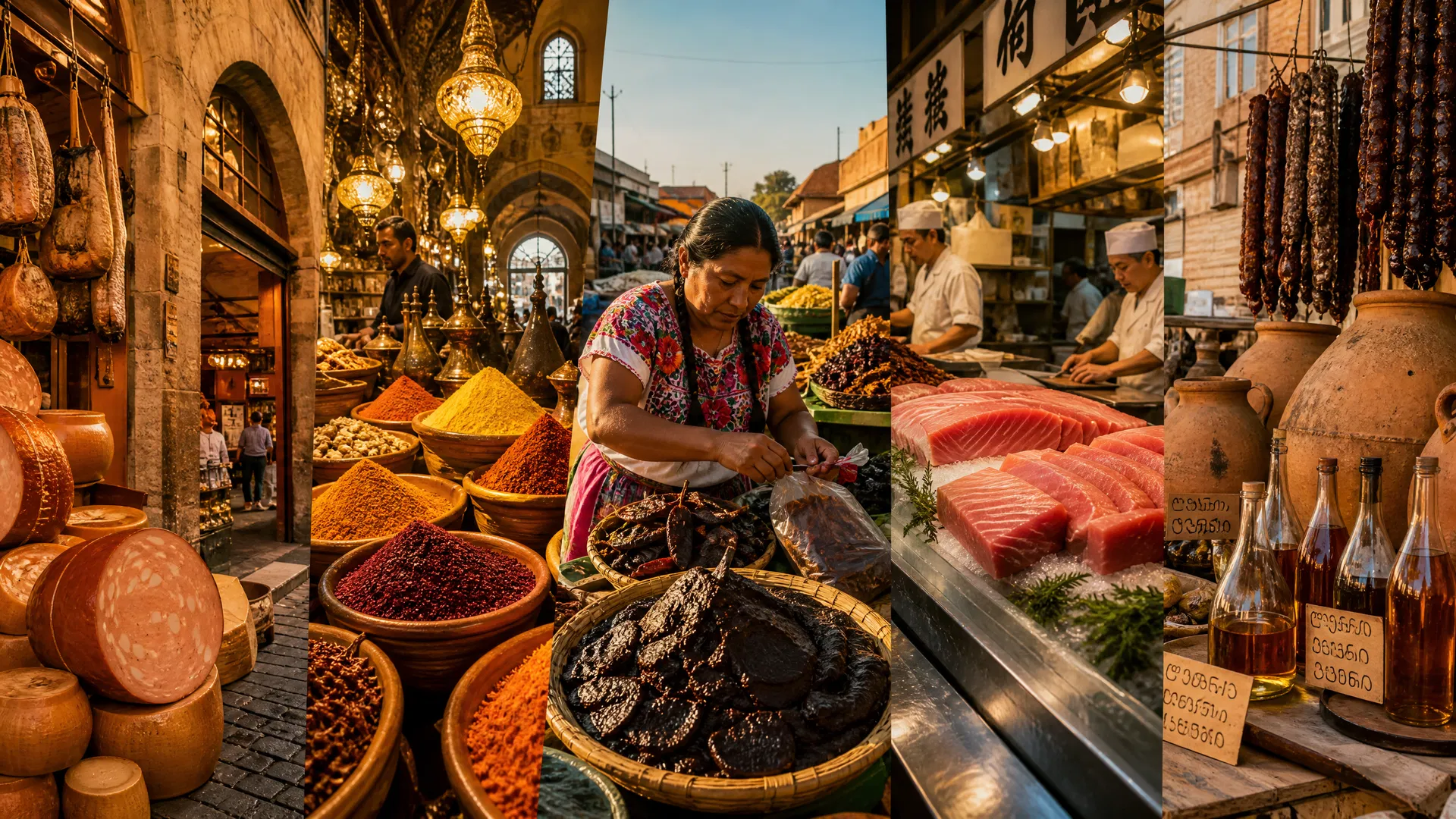
Every City Has a Market. These Are the Cities Where the Market Has the City.
Destination: Global
Category: Variant
There is a version of the food market that every travel publication has already written about. It involves arriving at a famous covered hall, photographing the produce stalls, eating a pastry, and moving on to the next item on the itinerary. This version treats the market as an attraction — colorful, photogenic, worth an hour of your morning before you get to the real business of the day.
This post is not about those markets.
A food market is not a supermarket with better lighting. It is the most honest version of a city's food culture — the place where the supply chain ends and the relationship between producer and consumer is most direct, most legible, and most specific to the geography that produced it. In the cities on this list, the market is not a stop on the itinerary. It is the argument for the entire culture. Understanding the market means understanding the city in a way that no museum, no restaurant, no landmark achieves. These cities were not chosen because they have markets. Every city has markets. They were chosen because their markets have them — because the market is the organizing principle around which the city's food culture, commercial identity, and historical memory have arranged themselves for centuries.
Five cities. Five dimensions of what it means for a market to be the argument rather than the attraction. Bologna proves. Istanbul persists. Oaxaca remembers. Tokyo perfects. Tbilisi ferments.
Bologna: Where the Market Is the Proof of Everything the City Claims
Bologna calls itself La Grassa — The Fat One — and the claim requires evidence. Every Italian city has a nickname. Not every Italian city can prove it. Bologna can. The proof is the Quadrilateri market district, a six-block medieval street grid in the city center that has been organized around food production and sale since the 13th century, where the same families have been selling the same products — mortadella, Parmigiano-Reggiano, tortellini, tagliatelle, crescentine — from the same stalls, in the same streets, organized by the same guild logic that assigned each product category its own lane seven hundred years ago.
This is not a heritage reconstruction. The Quadrilateri is a functioning daily market that operates Monday through Saturday from 7am, that supplies Bologna's restaurants and households, and that has never reorganized itself around tourist convenience because it has never needed to. The tourists arrived later. The market was already there.
The specific operating logic of the Quadrilateri is what separates it from every other Italian food market. Via Caprarie is the street of the cheese and cured meat vendors. Via Pescherie Vecchie is the street of the fishmongers, named for the fish market that has occupied it since the medieval period. Via degli Orefici, one block east, was historically the goldsmiths' street — the guild organization by product category that Bologna shares with Istanbul's Grand Bazaar and Marrakech's souk system, a commercial logic so efficient that it has outlasted every attempt to modernize it. When you walk through the Quadrilateri, you are walking through a piece of urban planning that has been continuously validated by seven centuries of daily commercial use.
At Via Caprarie 1, Tamburini has been operating since 1932 — which, in the context of the Quadrilateri, makes it relatively recent. The counter where mortadella is sliced to order is the specific reason to arrive before 12:30pm, when the locals eat their standing lunch of tigelle and crescentine (small flatbreads split and filled with mortadella or squacquerone cheese) before the tourist lunch hour begins. The vendor slices the mortadella at a thickness they determine based on what you tell them you're going to do with it — thicker for eating alone, thinner for filling, paper-thin for wrapping around a breadstick. This is not a performance. It is professional knowledge applied to a specific product that the vendor has been selling since before you were born.
Two doors down at Via Caprarie 7, Paolo Atti e Figli has been rolling pasta by hand since 1880. The sfogline — the women who roll pasta — work at a marble counter visible from the street, producing the fresh tagliatelle and tortellini that Bologna's restaurants buy daily. The full range of fresh pasta requires a minimum 24-hour advance order, not because the shop is overwhelmed with tourists but because the pasta is made to order and the sfogline work on a production schedule that has been calibrated over 140 years. If you want to understand why Bolognese food culture produces the specific quality it produces, stand at this window for five minutes and watch the work.
The Mercato delle Erbe, one block north on Via Ugo Bassi, is the indoor market that Bologna's locals use when the Quadrilateri feels too exposed to the tourist circuit. On Tuesday and Friday mornings, the Apennine hill farmers bring their seasonal produce directly to the Erbe rather than through wholesalers — the specific reason these two mornings produce a different market than the other five days of the week, with varieties of mushrooms, chestnuts, and mountain herbs that don't appear in the wholesale supply chain.
For the Bologna food guide that goes deeper into the Quadrilateri's specific vendor sequence and the specific dishes that require the market's ingredients rather than substitutes, the four-day itinerary is organized around the market's operating logic rather than the city's tourist circuit.
Istanbul: The Market That Has Never Stopped Running
Where Bologna's Quadrilateri proves a claim about food culture, Istanbul's market system does something more fundamental: it demonstrates that a commercial infrastructure can outlast every political, religious, and economic transformation a city can experience over five and a half centuries without losing its organizing logic.
The Grand Bazaar has been continuously operating since 1461. This is not a record of survival. It is a record of relevance — the specific reason the bazaar has never been replaced by a more modern commercial format is that its format has never been improved upon. The copper workers are still in the copper workers' street. The jewelers are still in the jewelers' street. The carpet merchants are still in the carpet merchants' street. The geographic organization by trade that was assigned in the 15th century under Sultan Mehmed II has never been reorganized, because the guild logic that produced it — the commercial efficiency of clustering specialists together so that buyers can compare, negotiate, and develop expertise in a single lane — is as efficient today as it was when the bazaar was built.
Most visitors experience the Grand Bazaar as a maze of carpet sellers and souvenir vendors. What they're actually walking through is a functioning commercial district organized around wholesale trade, with the tourist-facing retail layer occupying the outer lanes while the interior streets operate as they have for centuries. The specific streets that tourists never find are the ones organized around commercial categories that don't translate to tourist consumption — the hans (caravanserais) inside the bazaar that are wholesale trading floors still functioning as they did in the 16th century, where the actual commercial transactions that supply Istanbul's businesses take place.
The food market argument for Istanbul is made most clearly not at the Grand Bazaar but at Kadıköy on the Asian side. The Tuesday and Friday market at Kadıköy supplies the Asian side's restaurants with the specific fish, produce, and prepared foods that define the eastern shore's food culture. The fishmonger row at Kadıköy displays the catch from the Bosphorus and the Sea of Marmara with a specificity of species identification — the specific labeling of lüfer (bluefish), çipura (sea bream), levrek (sea bass) by size, season, and fishing method — that reflects five hundred years of Istanbul fish culture. The tarama (fish roe paste) prepared behind the counter at the Kadıköy fishmongers is not the product you find in supermarkets. It is made from fresh roe, prepared the same morning, using a recipe that the vendor's family has been using for generations.
The Balık Pazarı (Fish Market) in Beyoğlu, on the European side, is the correct introduction to Istanbul street food for a specific reason that no travel guide has adequately explained: the mussels stuffed with rice, currants, pine nuts, and spices (midye dolma) sold from street carts at the market entrance are the most direct expression of Ottoman palace cuisine available for less than a dollar. The stuffed mussel recipe is a simplified version of the dolma tradition that originated in the Topkapı Palace kitchens. The street cart vendors appear at the Balık Pazarı around 11am and sell out by early afternoon — the specific timing that determines whether you experience this correctly or miss it entirely.
At the Mısır Çarşısı (Spice Bazaar), the vendor knowledge that distinguishes the serious spice merchants from the tourist-facing stalls is the ability to identify the regional origin of specific spices by smell. Any reputable saffron vendor will demonstrate the difference between Iranian, Turkish, and Spanish saffron before purchase — the specific test being the color saturation of a single thread dissolved in warm water, with genuine saffron producing a deep amber rather than the immediate bright yellow of adulterated product. This demonstration is not a sales technique. It is professional knowledge that the vendor's family has been applying to the same product for generations.
The Istanbul food guide covers the Kadıköy market sequence in detail, including the specific ferry crossing from Eminönü that makes the Asian side accessible as a half-day itinerary. For solo travelers, the Istanbul solo guide organizes the bazaar navigation around the specific interior streets that the tourist circuit misses.
Oaxaca: The Market That Remembers What the Others Forgot
Where Istanbul persists through political transformation, Oaxaca's Tlacolula market does something that no other market on this list can claim: it has been operating continuously, without significant reorganization, without meaningful penetration by the global food system, on the same site, in the same format, serving the same indigenous communities, since before Spanish contact. The Tlacolula Sunday market is not a heritage reconstruction or a cultural preservation project. It is a living market that has been running for approximately five hundred years because the Zapotec communities of the Central Valleys of Oaxaca have never stopped needing it.
This is the most specific competitive gap available in food market travel writing: every post about Oaxacan food mentions the markets. None of them explain why Tlacolula is different from every other traditional market in the Americas. The difference is continuity. The specific Zapotec women who sell at Tlacolula are selling products — tlayudas, mezcal, handwoven textiles, dried chiles, chapulines (toasted grasshoppers) — that are specific to the Central Valleys of Oaxaca and unavailable anywhere else on earth. The market is not a tourist market that happens to sell traditional products. It is a community market that tourists are permitted to attend.
The specific geography of Tlacolula matters. The butcher section in the market's eastern section sells tasajo (dried beef) and cecina (chili-marinated pork) that are specific to the Oaxacan Valley and unavailable outside this region. The barbacoa preparation visible in the market's eastern section — whole sheep slow-cooked in underground pits overnight for the Sunday market — requires arriving by 7am before the best cuts are sold. This is not a tip for getting a good deal. It is the specific timing that determines whether you experience the market as a producer-direct food culture or as a tourist attraction that happens to open early.
The mezcal palenque vendors at Tlacolula bring their production directly to market rather than through distributors. The maestros mezcaleros who appear at the market on Sunday mornings are the producers themselves — not resellers, not brand representatives, but the people who made the mezcal in the specific palenque (distillery) in the specific village using the specific agave variety that produces the specific flavor profile in the small dried gourd they hand you for tasting. The tasting protocol — the gourd rather than a glass, the specific comparison between tobalá (wild agave, rare, expensive, floral) and espadín (cultivated agave, the most common variety, the baseline for understanding what mezcal is) — is not a sales performance. It is the correct way to taste mezcal, developed by the culture that invented it.
In Oaxaca city, the Mercado Benito Juárez contains the specific section dedicated to barro negro (black clay pottery) that is specific to the village of San Bartolo Coyotepec, twelve kilometers south of the city. The vendors who are the potters rather than the resellers can be identified by the specific technique of polishing the unfired clay with a quartz stone that produces the specific sheen that distinguishes authentic barro negro from the imitations sold in the tourist market stalls. The molinos (chocolate grinding stalls) in the Benito Juárez market grind cacao, sugar, cinnamon, and almonds to order into the specific Oaxacan chocolate paste that is the base of both mole negro and the local hot chocolate. The ratio adjustments that different vendors make — more cinnamon for drinking chocolate, less sugar for mole — reflect a product knowledge that no packaged chocolate can replicate.
The Oaxaca couples guide covers the Tlacolula Sunday market as a full-day excursion from Oaxaca city, including the specific colectivo (shared taxi) route from the second-class bus terminal that costs a fraction of the tourist shuttle and arrives at the same market.
Tokyo: Where the Market Is the National Character Made Edible
Where Oaxaca's market remembers a pre-colonial food culture, Tokyo's market system expresses something different and equally specific: the national character trait that makes Japan extraordinary in every domain — the specific obsession with quality, presentation, and the correct execution of every step in a process — applied to food sourcing with an intensity that produces results indistinguishable from perfection.
Japan has more Michelin-starred restaurants per capita than any other country on earth. This is not a coincidence. It is the downstream consequence of a food sourcing culture that begins at the market and applies the same standards at every subsequent step. The Tsukiji outer market, the depachika (department store basement food halls) that constitute Japan's most democratic luxury food experience, and the specific vendor relationships that supply Tokyo's restaurants are all expressions of the same national relationship with food: in Japan, a food market is not where you buy food. It is where food is taken seriously.
The Tsukiji outer market at 5am is the specific experience that travel writing has documented but rarely with the precision that makes it useful. The tuna sashimi breakfast available at the outer market stalls is not simply fresh tuna. It is the specific cut hierarchy that determines what to order: otoro (fatty tuna belly, the most prized and most expensive cut), chutoro (medium fatty tuna, the correct balance of fat and flavor for most palates), and akami (lean red tuna, the cut that most restaurants serve because it is the most abundant). The otoro from the outer market at 5am is superior to the same cut at a restaurant not because the fish is different but because the time between the tuna auction and the plate is measured in minutes rather than hours. The outer market vendors have been buying from the same auction for decades. They know which boats, which fishing methods, and which seasons produce the specific quality they require.
The depachika — the basement food halls of Tokyo's department stores — are the most misunderstood food market format in the world. They are not gourmet supermarkets. They are the specific intersection of Japanese craft food production and democratic luxury consumption, where the same quality standards that apply to the city's finest restaurants are applied to a takeaway bento box. The Isetan depachika in Shinjuku, the Mitsukoshi in Ginza, and the Takashimaya in Nihonbashi each contain vendor stalls that represent the specific regional food cultures of Japan — the specific wagashi (traditional confectionery) from Kyoto, the specific ramen from Sapporo, the specific mentaiko (spiced fish roe) from Fukuoka — curated and presented with the same attention to provenance and quality that a wine merchant applies to a cellar selection.
The specific vendor knowledge at the Tsukiji outer market and the depachika is the same knowledge, expressed at different price points. The fishmonger who explains the difference between hirame (flounder) and karei (halibut) by pointing to the specific placement of the eyes is not performing expertise for tourists. The depachika vendor who explains the specific rice variety used in a particular onigiri is not upselling. Both are applying professional knowledge to a product that the Japanese food culture has decided deserves that level of attention.
For the Tokyo food market experience in depth, the Tokyo food guide covers the Tsukiji outer market sequence, the depachika circuit, and the specific Toyosu market tuna auction ballot system for visitors who want to attend the wholesale auction rather than the outer market. The Tokyo 4-day food guide concentrates the market experience into a tighter itinerary for shorter visits.
Tbilisi: The Market Where the Wine Is 8,000 Years Old
Where Tokyo perfects the present, Tbilisi's market system connects the present to something so ancient that the word "tradition" is inadequate. Georgia claims 8,000 years of continuous winemaking — the oldest confirmed wine culture on earth, predating French winemaking by 6,000 years, predating Roman winemaking by 5,000 years — and the Tbilisi market system is where that claim is most physically present and most directly accessible.
The Dezerter Bazaar, the covered market near the train station that supplies Tbilisi's restaurants, is the correct starting point for understanding Georgian food culture. At 7am, before the tourist circuit has woken up, the Dezerter Bazaar is a working market organized around the specific produce, dairy, and prepared foods that define Georgian cooking: tkemali (sour plum sauce, available fresh only in September and October when the wild plums ripen, the rest of the year sold from jars), churchkhela (walnut-stuffed grape juice candy, made in the market rather than factory-produced, the specific vendors who make their own product identifiable by the fresh-pressed grape juice smell rather than the caramelized sugar smell of the commercial version), and the specific regional cheeses — sulguni from Samegrelo, guda from the mountain regions, imeruli from Imereti — that reflect the geographic diversity of a country the size of West Virginia that contains four distinct culinary traditions.
The wine vendors at the Dezerter Bazaar bring their family's qvevri-fermented natural wine directly to market from the Kakheti and Kartli regions. A qvevri is a large clay vessel buried in the earth, used for fermenting and aging wine using a technique that has been continuously practiced in Georgia for 8,000 years. The specific amber wine produced by extended skin contact in the qvevri — the grape skins, seeds, and stems remain in contact with the fermenting juice for weeks or months — produces a tannin structure and color that looks like orange juice and tastes unlike any wine produced by European methods. The market vendors who bring their qvevri wine to the Dezerter Bazaar are not artisanal producers responding to a natural wine trend. They are the continuation of a production method that predates the trend by eight millennia.
The Dry Bridge market on Sunday mornings is the largest outdoor antiques and curiosities market in the Caucasus, and the specific section that matters for understanding Georgian wine culture is the Soviet-era wine paraphernalia section: the drinking horns (kantsi), the qvevri fragments, the wine press components, and the specific Soviet-era wine labels from the Georgian SSR that document the period when Georgian wine production was collectivized, industrialized, and stripped of the regional specificity that defined it before and after Soviet rule. The vendors who are the grandchildren of winemakers can identify the regional origin of a qvevri fragment by its clay color and texture — the specific red clay of Kakheti, the gray clay of Kartli, the darker clay of the mountain regions — the same way a geologist reads a rock sample.
The natural wine bar circuit in Tbilisi's old town is the contemporary expression of the same wine culture. Vino Underground on Galaktion Tabidze Street is the specific address where the natural wine revival is most concentrated — the bar that opened in 2010 and became the first venue in Georgia to present qvevri wines as a category rather than a curiosity, the bar where the producers who bring their harvest directly to the city in October can be found at the counter explaining the specific vintage conditions that produced the specific wine in the glass. The amber wine tasting protocol that Vino Underground uses — served at a slightly warmer temperature than European white wine, in a wider glass that allows the tannin structure to open, with a specific sequence that moves from lighter to more tannic varieties — is not a sommelier affectation. It is the correct way to taste a wine that has been made by a method that European wine education has no framework for.
For the full Tbilisi market and wine culture experience, the Tbilisi food guide covers the Dezerter Bazaar morning sequence, the Dry Bridge Sunday market, and the specific Kakheti wine region day trip to Telavi where the village market on Sunday is the correct destination for purchasing qvevri wine directly from producers. The Tbilisi 4-day itinerary integrates the market culture into a broader city experience for first-time visitors.
The Exclusion Argument: Why La Boqueria, Borough Market, and Pike Place Don't Belong Here
The three markets that every food travel publication puts on this list are La Boqueria in Barcelona, Borough Market in London, and Pike Place Market in Seattle. None of them appear here. The reasons are specific and worth stating directly, because the exclusion argument is the thesis defense — it proves what the thesis rules out.
La Boqueria, Barcelona. La Boqueria is the most photographed market in Europe and one of the most tourist-facing. The produce vendors who supply Barcelona's restaurants left La Boqueria years ago when the tourist density made professional buying impractical. The market that remains is beautiful, photogenic, and organized around tourist consumption rather than the community it once served. It is an attraction. It is not the argument for Barcelona's food culture. The markets that supply Barcelona's restaurants — the Mercat de l'Abaceria in Gràcia, the Mercat de Santa Caterina in the Born — are the argument. La Boqueria is the postcard.
Borough Market, London. Borough Market is excellent and has been written about so comprehensively that including it here would produce the least differentiated section in the post. Every food travel publication has covered Borough Market. The market is also, by the standards of this thesis, a premium retail market rather than a market that has the city — it is a destination for food enthusiasts rather than the organizing principle of London's food culture. London's food culture is organized around its restaurant scene, its ethnic neighborhood food clusters (Brixton, Dalston, Whitechapel), and its supermarket chains. Borough Market is a Saturday morning luxury. It is not the argument.
Pike Place Market, Seattle. Pike Place is an extraordinary market with genuine producer relationships and genuine community function. It doesn't appear here because Seattle doesn't have the same density of market culture as the five cities on this list. Pike Place is the exception in Seattle rather than the expression of a broader food market ecosystem. A city that belongs on this list has markets that express its entire food culture — not one market that is excellent in isolation. The thesis requires that the market has the city. In Seattle, Pike Place is excellent. The city has other things.
Planning: Which Market City Matches Your Food Travel Motivation
The five cities on this list are not interchangeable. They represent five different relationships between a city and its market culture, and the correct choice depends on what specifically you want from a food market experience.
If you want the producer-direct relationship at its most direct: Tlacolula on a Sunday morning in Oaxaca. The Zapotec women selling at Tlacolula are the producers. The mezcal vendor is the maestro mezcalero. The tasajo vendor dried the beef. There is no supply chain between the producer and your purchase. This is the most direct food market experience available anywhere in the Americas, and it requires arriving early, speaking some Spanish, and approaching the market as a community event rather than a tourist attraction. The Oaxaca 4-day couples itinerary covers the logistics.
If you want historical continuity as a physical experience: Istanbul's Grand Bazaar and Kadıköy market, organized as a two-day market itinerary. The Grand Bazaar for the commercial architecture that has been running since 1461; Kadıköy for the food market that supplies the city's restaurants. Budget three to four days minimum to experience both sides of the Bosphorus. The Istanbul 4-day food itinerary and Istanbul couples guide cover both circuits.
If you want the highest concentration of food knowledge per square meter: Bologna's Quadrilateri, organized around the 7am–12:30pm window before the tourist lunch hour begins. This is the most compact food market experience on the list — six blocks, seven centuries, the highest density of specific food expertise available in Italy. The Bologna 4-day food itinerary covers the vendor sequence and the specific products that require the market's ingredients.
If you want precision applied to food sourcing at every price point: Tokyo's combination of the Tsukiji outer market at 5am and the depachika circuit in the afternoon. This is the most expensive city on the list but also the one where the quality differential between market-sourced food and restaurant food is most legible. Budget five to seven days to experience both the wholesale market culture and the retail luxury market culture. The Tokyo 5-day food itinerary and the 7-day Tokyo city guide cover both.
If you want the oldest food culture still in active production: Tbilisi's Dezerter Bazaar and the Kakheti wine region day trip. The qvevri wine culture that you encounter at the Dezerter Bazaar on a Tuesday morning is the same wine culture that has been practiced in Georgia for 8,000 years. The Tbilisi food and wine guide covers the market sequence and the wine bar circuit. The Tbilisi 4-day city itinerary integrates the market culture into a broader city experience.
The optimal trip length for each city: Bologna requires three to four days to experience the Quadrilateri across multiple mornings. Istanbul requires five to seven days to experience both the European and Asian sides adequately. Oaxaca requires four to five days to include the Tlacolula Sunday market and the city's own market circuit. Tokyo requires five to seven days for the full market culture experience. Tbilisi requires four to five days including the Kakheti day trip.
The Argument, Confirmed
Bologna proves that a city's claim about its own food culture can be physically verified in a six-block radius. Istanbul demonstrates that a commercial infrastructure organized around guild logic can outlast five centuries of political transformation without losing its relevance. Oaxaca shows that a market can maintain pre-colonial continuity not as a heritage project but as a living community institution. Tokyo applies the national character trait of precision to food sourcing with an intensity that produces results that no other food culture has replicated. Tbilisi ferments the oldest wine culture on earth in clay vessels buried in the ground and brings it to market on Tuesday mornings.
In each of these cities, the market is not the attraction. It is the argument. The argument that food culture is the most direct expression of what a place actually is. The argument that the supply chain between producer and consumer is the most honest relationship in any city's economy. The argument that understanding where a city's food comes from, who produces it, and how it reaches the table is the most efficient way to understand the city itself.
Every city has a market. These are the cities where the market has the city.