Your Kids Will Remember These Places. You Will, Too.
Destination: Global
Category: comparison
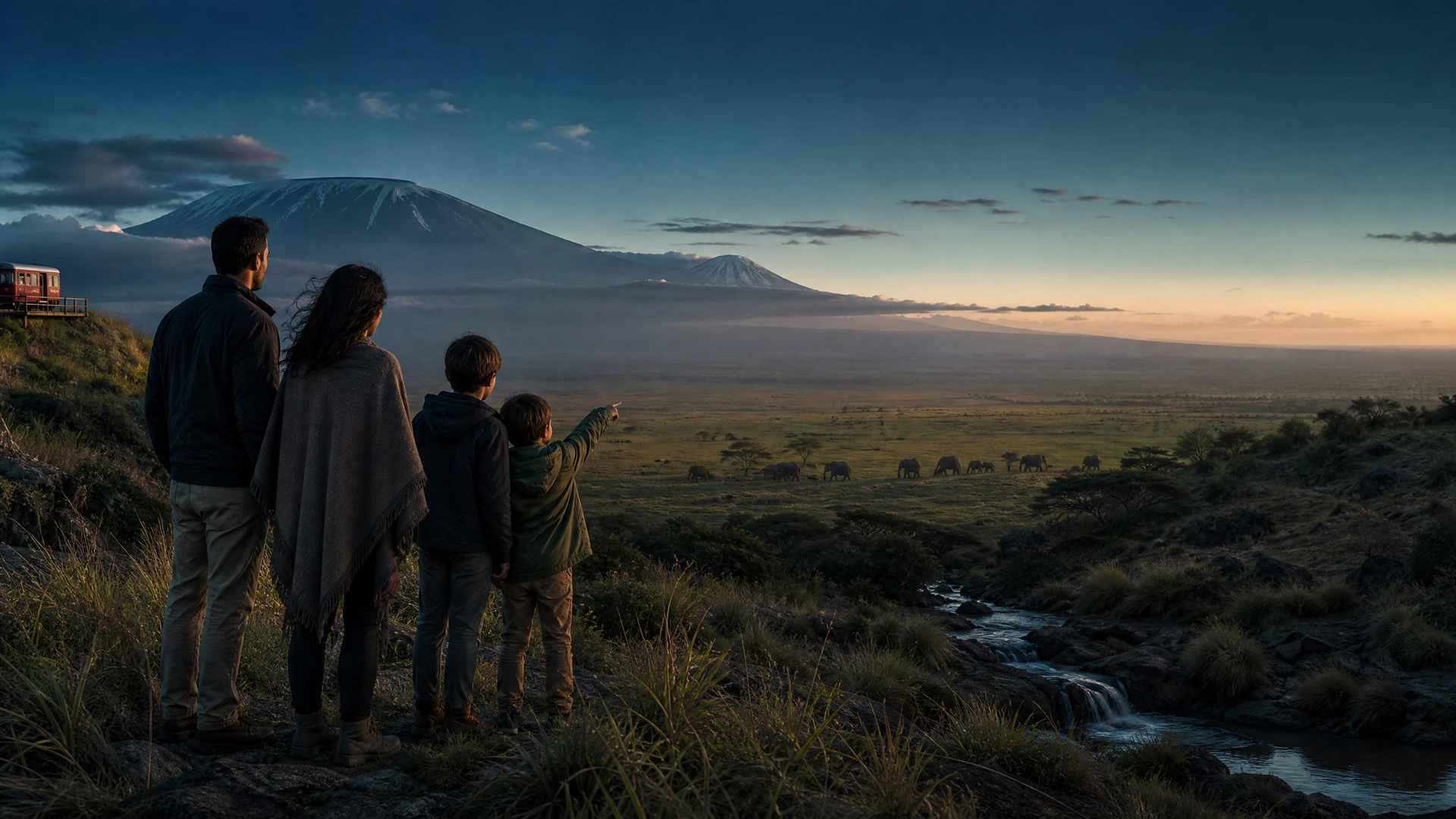
The best family travel destinations make their case in moments rarely designed into an itinerary. It is the eight-year-old standing beneath the blue-green ceiling of Waitomo Cave and deciding, without prompting, that the glowworms are a galaxy. It is the child who sees a giant mechanical crab above a Dotonbori shopfront and understands dinner before anyone has translated a menu. It is the silence inside a safari vehicle when an elephant herd crosses the road with enough authority to make every adult stop pretending to know what comes next.
The best family travel destinations are not the places most expertly designed to prevent that moment from becoming inconvenient. Most family travel advice begins with a checklist of strollers, kids’ menus, short transfers, predictable rooms, fenced pools, and entertainment designed to occupy children while the adults experience the actual place nearby. There is nothing wrong with a trip that needs to be easy. Family logistics are real. But a destination does not become a great family destination simply because it has learned how to contain a child.
The best family travel destinations make a stronger offer. They are places where children improve the encounter rather than merely being accommodated within it; where their curiosity, lack of self-consciousness, appetite for the physical world, and willingness to ask the obvious question open a version of the destination that adult-only travelers often miss. The right measure is not whether a place is possible with children. It is whether the children give the place a new register.
That standard changes the list. It leaves Orlando off it, not because a theme park cannot produce a good day, but because a good day inside a managed attraction is not the same thing as a destination revealing itself. It leaves the all-inclusive Caribbean package off it, not because beaches and rest lack value, but because the family experiences worth carrying home usually include one unplanned meal, one stranger who changes the conversation, one piece of weather, landscape, or history that refuses to behave like a resort amenity.
These six destinations were selected because each makes a distinct argument for traveling with children. Japan makes curiosity feel serious. Costa Rica makes nature feel active. Portugal lets children enter public life rather than being diverted from it. Hokkaido gives different ages and different months a version of the same island. Tanzania returns the adult to an honest sense of scale. New Zealand treats adventure as ordinary life. None can replace another without changing the claim.
Japan: The Best Family Travel Destination for Children Who Want to Know How Things Work
Japan is the first proof that children can make a destination better because they approach its precision without embarrassment. Adults often arrive preoccupied with doing Japan correctly: decoding etiquette, deciding whether a ramen counter is too intimidating, checking the platform twice, taking photographs carefully enough to justify the journey. Children notice a simpler and more useful fact first. The train is exactly where the board said it would be. The bowl in front of them has been made by somebody who cared about the broth. The room changes when they move through it. Japan rewards that direct attention.
Start in Tokyo with teamLab Planets, where the experience works best when the family accepts its physical logic rather than trying to observe it from a safe distance. The knee-deep water room makes adults hesitate over trousers, socks, phones, and what they are supposed to look like; children tend to step in and find out what the water is doing. The mirrored spaces have the same effect. A child who has not learned to moderate delight gives the installation its intended scale. Reserve a timed entry in advance, and choose a slot that does not force the rest of the day to run late. That booking is not a small logistical footnote. It is the difference between arriving ready to participate and arriving with a hungry family trying to solve a queue.
Tokyo also gives children a way into the city that does not depend on language mastery. The six-day Tokyo family adventure is useful as a base because its digital-art, panda, and neighborhood rhythm recognizes that curiosity needs room between larger stops. Let the Shinkansen become part of the story rather than an efficient transfer that adults quietly manage. Show children the departure board; ask them to find the car number; watch the platform choreography when the doors open. Punctuality becomes visible, almost theatrical, when someone young is looking for it.
Osaka is where the argument becomes edible. Dotonbori can overwhelm an adult who approaches it as a district to be navigated, but it gives children an instant visual vocabulary: the giant moving crab, the illuminated takoyaki signs, the Glico runner, steam rising from a stall where the food is made in front of them. A child can point to the thing they want and be right. That changes the family dinner from a negotiation over unfamiliarity into a collective experiment. Eat the takoyaki carefully—it is hotter than it looks—then move a few streets away from the canal for an okonomiyaki table where the cooking arrives as part of the meal rather than a hidden kitchen process.
Japan also knows how to give children an honest route into difficult history. At Hiroshima’s Peace Memorial Park, the Children’s Peace Monument offers a more emotionally available starting point than asking a child to absorb the entire weight of the bombing at once. Sadako Sasaki’s story and the paper cranes give grief a human scale without shrinking its seriousness. The Hiroshima and Miyajima cultural journey creates enough time for that conversation to continue beyond the monument, through the museum at the pace your family can handle, and across to Miyajima where the water, deer, ferry, and torii gate allow the day to breathe again.
Choose Japan over a European capital that promises children a softened version of adult culture. In Japan, the children are not being handed the junior edition. The rail system, food, design, public courtesy, craft, and history are the experience. Their questions make the experience larger. Japan teaches.
Costa Rica: Where Japan’s Curiosity Becomes a Better Relationship With the Living World
Where Japan teaches children to notice how a society makes things, Costa Rica lets them discover that nature is not background scenery. This is the family destination for people who do not want wildlife reduced to a distant photograph taken from a boardwalk. Costa Rica’s strength is not that it provides an “eco” version of a conventional vacation. Its strength is that the forest, coast, river, insect, frog, bird, and volcano can occupy the same central place in a child’s day that a ride or a screen might occupy at home.
The clearest example is Tortuguero, where the calendar matters as much as the destination. During the green turtle nesting season, broadly July through October, a guided night beach walk can show children why darkness, distance, and restraint are part of seeing wildlife responsibly. They need to understand the rules before they enter: no flash photography, no crowding, no treating an animal that has returned to lay eggs as a family spectacle. That is the point. A large turtle returning to the beach where she hatched, covering her nest, and disappearing back toward the water is more than an extraordinary sight. It teaches a child that wonder can require discipline.
In Monteverde, make the hanging bridges more than a convenient canopy walk. They put the family at the height where a forest stops being a green wall and becomes habitat: epiphytes, dripping leaves, distant bird calls, branches whose scale changes once you are standing level with them. The Children’s Eternal Rainforest gives the conservation story a form children can grasp because schoolchildren helped fund its protection. A child learns that another child, far away, could do something concrete for a forest. That is a better lesson than a plaque asking visitors to care.
For a trip that needs a practical backbone as well as cloud forest time, the Costa Rica family vacation guide connects wildlife, beaches, and activity without turning every day into an endurance test. Arenal and La Fortuna deserve a different kind of attention. The volcano is the obvious visual anchor, but the family memory often comes from the descent to La Fortuna Waterfall: the steps down, the sound getting louder, the cold water at the base after the climb back up. The Arenal and La Fortuna three-day guide makes sense if your children are old enough to enjoy that physical rhythm and if the adults understand that the return climb belongs to the experience too.
Costa Rica earns its place over a resort-forward beach destination because the child is never asked to stay on the margins of the landscape. They can look for a sloth without being hurried past it. They can learn why a canopy bridge sits where it does. They can leave a beach walk understanding why the guide protected the dark. The country does not offer nature as a decorative break between amenities. It asks the family to enter the ecology together. Costa Rica reveals.
Portugal: Where Costa Rica’s Shared Wonder Turns Into a Shared Public Life
Where Costa Rica puts a family inside the living world, Portugal puts children inside the daily life of a country without making them an interruption to it. This is a more consequential advantage than it first appears. In many places, families are welcomed on condition that they use a separate schedule: early children’s meals, a defined activity zone, a hotel pool while adults go somewhere else. Portugal more often treats children as participants in the ordinary evening, at the table, on the tram, in the square, and in the café.
That begins with dinner. An 8 p.m. meal in Lisbon with a child at the table is not an act of parental defiance or an inconvenience to a restaurant. It is a familiar social arrangement, one that lets a family travel on the local rhythm rather than operating in a parallel one. The four-day Lisbon family guide gives that rhythm a useful structure through the Oceanarium, trams, and Sintra, but the larger lesson is to leave enough evening unplanned. Buy a pastel de nata in Belém, ride a route where your child can watch the city change through the window, and allow dinner to take the amount of time it actually takes.
Sintra makes children’s existing imagination an asset rather than something to correct. Pena Palace has yellow and red towers, sculpted details, a knight’s gate, and a position above the hills that makes it look less like a lesson in nineteenth-century Romanticism than a castle assembled by somebody who remembered what castles were supposed to feel like. That is not a misunderstanding of the site. It is an entry point. Arrive at the park opening, around 9:30 a.m., before the larger Lisbon coach rhythm builds. The early window gives children space to look upward instead of being carried forward by the crowd.
Portugal’s coastline offers the same inclusion through motion. Near Lagos, the sea stacks and grottos around Ponta da Piedade are more legible from water than from a cliff path because the family enters the geology rather than merely looking down on it. Age rules and sea conditions vary by operator, so confirm them for the children in your group before booking; the important decision is to choose a small, weather-appropriate trip rather than assuming every boat excursion is interchangeable. In the compact old town afterward, the Mercado Municipal de Lagos can turn lunch into a conversation about the morning catch before the fish ever appears on a plate. For an Algarve stay that preserves beach time without reducing the coast to beach time, use the seven-day Algarve family adventure as the longer-route reference.
Portugal is selected over London and Paris not because those cities fail families. They are excellent, and they have earned their large place in family travel writing. But they are already documented from every angle: museum trails, changing of the guard, children’s menus, park routes, queues, and rainy-day backups. Portugal makes a less discussed argument. It does not construct a parallel children’s experience beside its culture. It welcomes the child into the original experience. Portugal welcomes.
Hokkaido: Where Portugal’s Hospitality Becomes a Different Season for Every Family
Where Portugal welcomes a child into a shared public rhythm, Hokkaido recognizes that a family of five-year-olds, teenagers, parents, and grandparents may need the country to change shape with the calendar. Hokkaido appears separately from Japan because this is not Tokyo’s argument repeated farther north. It is Japan’s geographic range made useful to families: an island with a distinct version of itself for the family that needs snow, flowers, dairy farms, road-trip space, or early autumn color.
In February, Sapporo’s Snow Festival turns craft into a scale children immediately understand. At Odori Park, large illuminated sculptures replace the adult instruction to “appreciate public art” with a more honest response: people made an entire temporary city out of snow. Go after dark when the light gives the figures their edge, then leave enough time for the smaller activities and food stalls around the main site. An ice slide will not be the deepest cultural achievement of the trip. It may be the reason a child carries the memory of Japanese winter long after they have forgotten the name of the sculpture.
By July, Furano changes the proposition. Farm Tomita’s lavender fields become a family place not because they are purple in photographs, but because the color allows a child to enter the landscape before they understand agricultural cycles or regional identity. Lavender ice cream does the same thing through taste. A child is allowed to start with the purple cone and arrive later at the field, the scent, the rows, and the mountain weather. That sequence is valid. Families do not always need to lead with the explanatory plaque.
On a summer road trip between Furano and Asahikawa, make room for the Shirogane Blue Pond near Biei. Its blue is tied to mineral-rich water from the nearby Shirahige Waterfall, but the chemistry should arrive only after the first look. Children deserve to register the wrongness of the color before an adult turns it into a fact. The five-day Hokkaido adventure guide is the right practical link because it holds together the island’s hot springs, seasonal landscape, and driving logic without pretending one week can contain every Hokkaido.
Hokkaido belongs here instead of another ski-and-summer region because its distinctions are unusually clear. Winter is not a diluted version of summer. July flowers are not a substitute for Tokyo’s spring. The dairy culture—milk, cheese, and ice cream—has its own regional argument. Families can pick the Hokkaido that matches the age, confidence, and season of the people actually traveling. Hokkaido adapts.
Tanzania: Where Hokkaido’s Seasonal Wonder Becomes a Lesson in Honest Scale
Where Hokkaido gives a family the version of Japan that fits its moment, Tanzania strips away the adult habit of treating wildness as a mediated experience. A family safari works when it is planned around the children’s real capacities, not when the children are asked to keep up with an adult safari merely because the adults have flown a long way. Tanzania is on this list because children often restore the first encounter to its proper magnitude. An adult has watched documentaries, read the animal briefing, packed the long lens, and knows what they hope will happen. A child sees an elephant herd crossing the track and has the better response: the world is larger than expected.
The Ngorongoro Crater is often the strongest opening for families because its caldera holds an extraordinary concentration of wildlife in a contained, legible landscape. The floor is vast, but the day has a shape. Children can see why the guide is scanning a particular line of grass, understand the contrast between open plain and crater wall, and return to camp before attention becomes exhaustion. The crater is roughly 19 kilometers across, yet it reads as a single natural amphitheater. That coherence can work better with younger travelers than an extended, open-ended game drive across the Serengeti.
For older children who can sit with longer distances, early starts, and the uncertainty of an animal not appearing on demand, the Serengeti adds a different lesson: a landscape does not owe you a climax. The six-day Tanzania and Serengeti safari guide can help families understand the rhythm of the circuit. Use it to create real rests between drives rather than treating every sighting as a reason to lengthen the day. The more effective safari is one with enough quiet that the family can talk about what it saw.
Tarangire gives the itinerary another emotional register. Its ancient baobabs are immediately readable to children—the upside-down-tree comparison arrives without coaching—and its elephant herds often provide the patient, repeated observation that makes a safari feel less like a hunt for one iconic frame. The Tanzania budget safari route through Serengeti, Ngorongoro, and Tarangire is useful even for a family spending at a higher level because it keeps the three parks in a single planning logic. Lodge choice matters more than families sometimes realize: look for a property used to children, with room configurations, downtime, and guides who understand that a good morning can end before lunch.
Tanzania earns its place over a theme park because it does not offer controlled surprise. A roller coaster begins when the attendant closes a gate; a lion sighting begins when it begins. That difference can feel inconvenient until it becomes the lesson. A child learns that attention is not the same as entertainment, and an adult remembers that seeing something cannot be scheduled into certainty. Tanzania restores.
New Zealand: Where Tanzania’s Scale Becomes an Everyday Permission to Try
Where Tanzania restores the family’s sense of scale, New Zealand gives that sense a practical outlet. It is the country on this list that treats children as capable participants in an outdoor life, provided adults are equally capable of choosing the right version of the challenge. New Zealand is not valuable to families because every activity is extreme. It is valuable because the baseline expectation is that a child can walk, carry, climb, paddle, get cold, ask for a snack, recover, and continue.
That philosophy runs through the Department of Conservation hut network, a system of hundreds of backcountry huts that makes multi-day travel feel possible rather than exclusive. A full backcountry route will not suit every family, and it should not. But even the idea that a child can carry part of a pack to a hut shifts the story of who adventure belongs to. The fourteen-day New Zealand road trip gives a broader structure for families who need a vehicle, rest days, and a realistic mix of islands rather than a string of aspirational hikes.
Tongariro is where adult judgment has to protect the child’s experience. The full Alpine Crossing is long, exposed, and not the correct family day for younger children or anyone unprepared for volcanic weather. That does not mean the family has to abandon the landscape. Choose a shorter section from the Mangatepopo Valley toward the South Crater only if conditions, fitness, and official guidance support it; otherwise, select a lower-stakes volcanic walk where children can still read lava shapes, alpine plants, and the scale of the plateau. Saying no to the famous route can be the decision that lets the family say yes to New Zealand itself.
Waitomo offers another kind of access. A quiet boat beneath the Arachnocampa luminosa glowworm display asks almost nothing of the child except attention. The darkness, the water, and the blue-green points of light make a natural phenomenon feel immediate before it becomes an explanation about larvae and bioluminescence. Do not rush out of the cave into the next activity. Let the child describe what they think they saw first. Their language may be better than the scientific version for the first few minutes.
Queenstown turns the country’s outdoor default into a family operating system. The gondola, luge, and Shotover River jet boat can scale a day from the cautious five-year-old to the adult who wants a larger rush, all within reach of town. The five-day Queenstown adventure guide provides a focused base, but resist the temptation to fill every slot. A lakefront walk, an early dinner, and the chance to watch older children decide whether they are ready for the next thing can become the part that proves the larger point.
New Zealand is here instead of a destination where family adventure has to be bought as a series of attractions. It makes challenge part of the culture, then asks parents to match the challenge to the child in front of them. That is not the same as treating children as fearless. It is more respectful. New Zealand challenges.
Best Family Travel Destinations: How to Choose the Argument That Fits Your Family
The question is not which of these destinations is objectively best. The question is which kind of shared discovery your family needs right now. A child who wants to understand systems, food, design, and history may flourish in Japan. A family that needs to move, swim, notice wildlife, and come home muddy will find its clearest answer in Costa Rica. Portugal works when you want a European trip that does not separate dinner, streets, culture, and children into different categories. Hokkaido rewards people willing to make season the first decision. Tanzania is strongest when the group can slow down and meet wildlife with patience. New Zealand belongs to the family ready to let its children test what they can do.
| Destination | Best fit | A practical reality to plan around | Useful trip length |
|---|---|---|---|
| Japan | Curious families with children who enjoy transport, food, and sensory discovery | Secure teamLab timed entry before fixing the day around it. | 8–14 days |
| Costa Rica | Families who want wildlife and physical activity to be the main event | Match the route to season, especially for Tortuguero turtle walks. | 7–10 days |
| Portugal | Mixed-age families who want culture and coast in the same trip | Arrive early for Pena Palace and confirm sea conditions for Algarve boat outings. | 7–12 days |
| Hokkaido | Families whose dates determine the trip’s identity | Choose one season’s Hokkaido rather than trying to cover the whole island. | 5–8 days |
| Tanzania | Families with the budget and patience for a wildlife-focused journey | Choose a child-ready lodge and avoid packing every day with game drives. | 7–10 days |
| New Zealand | Families ready for a road trip with real outdoor participation | Reserve Great Walks and DOC accommodation well ahead when those are part of the plan. | 10–16 days |
Budget should be treated as a group decision rather than a per-person number that quietly surprises everyone later. Japan and Portugal can work across a wide range if the family accepts trains, smaller rooms, and deliberately chosen splurges. Costa Rica’s costs move with transfers, guides, and the level of lodge; build in one or two experiences that justify the price instead of trying to do every canopy tour, rafting run, and wildlife outing. Tanzania has the highest operational floor because vehicle, guide, park, and lodge decisions are inseparable from the experience. New Zealand can feel manageable until a rental vehicle, fuel, one-way fees, and peak-season beds are added; price the route as a route.
The destinations can combine, but only when the combination respects the family’s energy. Japan and Hokkaido make a powerful two-part trip if the calendar allows it: cities and rail first, then a northern landscape with more air around the days. Portugal can pair Lisbon and the Algarve without turning the drive into a race. Costa Rica benefits from a deliberately limited loop rather than a claim on every region. Tanzania and New Zealand do not need to be combined with anything; each rewards the decision to stay long enough to settle into its particular pace.
This is also the point at which planning becomes personal. A good family itinerary cannot be made from ages alone. It has to account for the child who loves trains and the sibling who needs a swim by 3 p.m.; the teenager who will stay quiet until the glowworms appear; the parent who wants a serious meal and the grandparent who needs fewer stairs. Leif can help shape those trade-offs into a route without reducing a family trip to an activity schedule. The goal is a plan with enough structure to work and enough open space for the moment nobody could have ordered.
What the Best Family Travel Destinations Leave Out—and Why That Matters
Orlando belongs in any honest conversation about family pleasure. It is enormously effective at what it does, and a child can have an extraordinary time there. It is not on this list because its central experience is infrastructure-dependent. Remove the gates, queues, branded characters, and ride systems, and there is no deeper Orlando argument this post needs to make. These six destinations generate their family experience from a place: the forest, the train, the market, the crater, the cave, the road, the public square.
The Caribbean all-inclusive is excluded for a different reason. It can offer real rest to people who urgently need it, and that should not be dismissed. But its model is designed to eliminate the very frictions that sometimes become family memory: the unfamiliar fish on a market counter, the wrong turn that leads to a conversation, the weather that changes an afternoon, the guide who explains why a beach has to remain dark. A resort can be a recovery trip. It is not the right evidence for an argument about children making a destination more alive.
London and Paris are absent even though both can be excellent with children. They are not omitted for lack of substance. They are omitted because the family versions of those cities are already the most thoroughly mapped European category in travel writing. This list needed destinations that prove a less familiar claim: that the child is not simply a person to be managed through travel. In the right place, the child is the reason the adult sees more.
The Memory Is Not the Attraction
The families who travel well are not the ones who fit the most activities into a week. They are the ones who leave a little room for their children to alter the story. In Japan, that might be a question about why the train is on time. In Costa Rica, it might be a child standing still long enough to see a sloth move. In Portugal, it might be dinner continuing after the adults thought it should be over. In Hokkaido, it might be purple ice cream giving a field its meaning. In Tanzania, it might be the first honest silence in a vehicle. In New Zealand, it might be the first time a child realizes they can walk farther than they believed.
Japan teaches. Costa Rica reveals. Portugal welcomes. Hokkaido adapts. Tanzania restores. New Zealand challenges.
Those are not six ways to keep children busy. They are six ways to let children make a trip more complete. Years later, the family may disagree about the restaurants, lose the photographs, or forget the order of the days. They will remember who noticed first. They will remember what the world looked like when one of them did.