For Art Lovers, These Are the Cities That Refuse to Keep Art Behind Glass
Destination: Global
Category: comparison
At the foot of the Duomo in Florence, the most consequential thing in view is not contained by a wall label. Brunelleschi’s dome rearranges every nearby street and every upward glance; it gives the city a horizon made by human nerve. In Mexico City, a government staircase carries Diego Rivera’s argument about conquest, labor, and revolution into the daily life of a public building. In Oaxaca, a weaver rubs cochineal against a surface and turns an insect, a cactus, and inherited knowledge into red. None of these encounters asks a traveler to stand quietly in front of an object and move on. They ask something harder: to notice that art has been organizing the city all along.
Most art travel reduces a place to its collection. It counts museums, names masterworks, and treats a city as a sequence of rooms to visit between lunch and dinner. That is useful information, but it misses the reason certain cities stay with you after the tickets have been folded into a pocket. The best art cities do not merely possess great art. They have allowed artists, workshops, public images, arguments, wounds, and materials to shape how the city understands its own life.
The best cities for art lovers are the places where art cannot be separated from the city itself: where it alters the streets, the civic conversation, the daily work, and the way residents recognize what matters. These six were selected by that standard. Florence turns an artwork into a civic compass. Mexico City puts political argument on public walls. Vienna records a crisis over what modern art could be. São Paulo refits modernism for democratic contact. Berlin makes visual work from historical rupture. Oaxaca keeps Indigenous art in the present tense.
That standard leaves out several obvious names. Paris contains an incomparable concentration of art, but its familiar art itinerary is overwhelmingly institutional: Louvre, Orsay, Pompidou, gallery district. New York’s museums and market are exceptional, yet the city’s art story is already the most rehearsed one in travel media. Amsterdam’s great museums make an argument through holdings rather than the broader urban-life integration that defines this list. This is not a ranking of collections. It is a case for cities where art gets into the air.
The Best Cities for Art Lovers Are Cities with an Argument
A real art city requires more than a good museum district. It needs a visible answer to a human question: What is art for? Florence answers that it can be the highest form of civic ambition. Mexico City answers that it can narrate who a people are and what was done to them. Vienna answers that beauty may have to become psychologically uncomfortable before it becomes honest. São Paulo asks whether a museum can stop demanding reverence and begin inviting use. Berlin insists that a city cannot live around a wound without making forms for it. Oaxaca refuses the idea that Indigenous art belongs to a finished past.
The distinction changes how you travel. You still reserve the museum. You still see the painting. But you also leave room for the streets that made the painting possible, the workshop where its materials retain a future, the public space that absorbs its argument, and the neighborhood where contemporary artists are pushing back at the present. The goal is not to collect six cities. It is to inhabit one of their questions long enough for it to recalibrate your own.
Florence: Where a City Is Still Finishing One Artwork
Florence earns its place because it makes the Renaissance claim—that human imagination can shape a whole civic world—feel operational rather than historical. The Uffizi matters, of course. But the deeper Florence experience begins before a gallery door opens: the dome is already there, drawing the scale of the city, reappearing at the end of narrow streets, turning a simple walk between coffee and dinner into a conversation with a single act of design.
The four-day Florence art and culture itinerary works best when you resist treating its major stops as separate appointments. Start with the cathedral complex at opening and climb the cupola only if you are prepared for the physical work and close passages. The reward is not simply the panorama. Inside the dome, the route lets you see why the building remains astonishing: the double-shell construction, the steep curve of the interior, and the relationship between the structure and Vasari’s Last Judgment frescoes. By the time you emerge at the lantern, the city below has stopped looking like a collection of terracotta roofs. It looks like a place that accepted an apparently impossible problem and made it its center.
That is why Florence belongs here rather than in a generic Renaissance list. The city has not kept the art in its institutions. Piazza della Signoria remains an outdoor theater of civic sculpture, even when the crowds make it difficult to read at first glance. The copy of Michelangelo’s David outside Palazzo Vecchio is not a substitute for the Accademia original; it is a reminder of the work’s original public ambition. The sculpture faced the city as a declaration about vigilance, vulnerability, and a smaller republic confronting more powerful neighbors. Florence still asks a passerby to meet that declaration in a square rather than in a sealed room.
Cross the Arno to Oltrarno for the other half of the argument. This is where Florence can feel less like a perfected Renaissance stage set and more like a city with working hands. Around Santo Spirito, Via Maggio, Borgo San Frediano, and the side streets between them, small studios continue forms of labor that belong to the city’s long workshop tradition: bookbinding, leatherwork, framing, restoration, paper, gilding, and metal. A visitor should not mistake every shopfront for a surviving medieval bottega, nor should they buy a made-in-elsewhere souvenir simply because it is near a church. The useful practice is slower: look for evidence of work underway, ask whether the maker is present, and let the encounter remain a conversation rather than a consumption ritual.
The Florence food guide can make this side of the city more legible because meals in Oltrarno create breathing room between the monumental encounters. Florence needs that rhythm. Book the Uffizi’s first available entry rather than surrendering half a morning to a queue, then leave enough unscheduled time to stand on the other side of the Arno as the dome changes color before dusk. A city built around an artwork should not be visited like a checklist.
Florence completes the argument by making art spatial. You do not go there only to see what the Renaissance made. You go to feel how a city still lives under the decision to make it.
Mexico City: Where Public Art Refuses to Stop Arguing
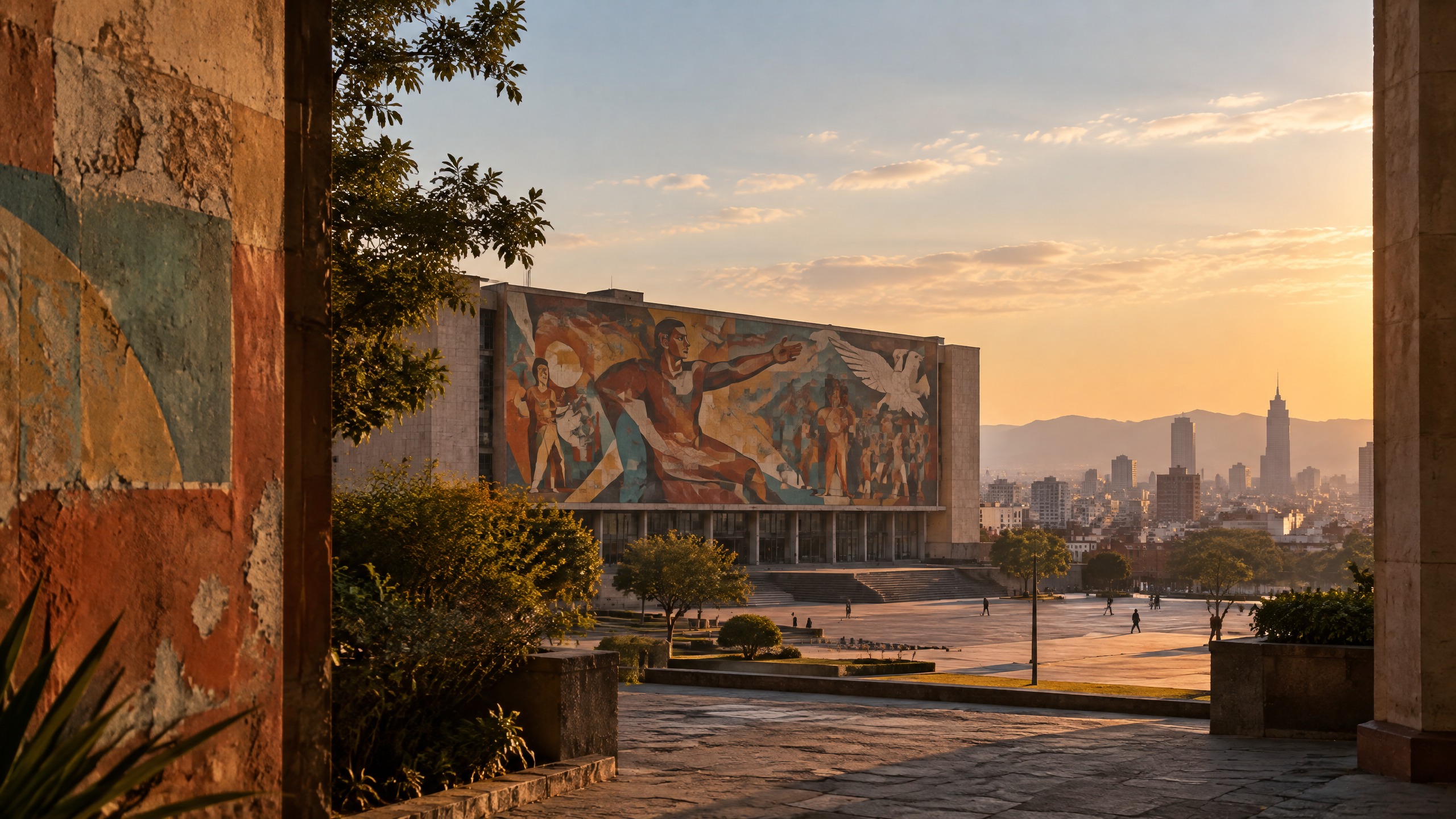
Where Florence makes art into a civic compass, Mexico City makes it into a public argument that is still underway. The mural movement did not begin as a decorative flourish around a new state. After the Mexican Revolution, muralists such as Diego Rivera, José Clemente Orozco, and David Alfaro Siqueiros were given walls because the country was trying to decide how its history should be seen. Their work turns buildings into propositions about Indigenous civilization, colonization, class, labor, revolution, and the uses of public memory.
Begin at Palacio Nacional with Rivera’s mural cycle, The History of Mexico. Access policies can shift because this is a working government complex, so check current requirements before building a day around it. Once inside, do not try to process the paintings as a sequence of highlights. The power comes from standing in the courtyard and understanding the scale of the claim: a national story, rendered across walls large enough to make the viewer physically small, with a point of view that refuses neutrality. Rivera is not offering a polished timeline. He is making a political account of what Mexico has endured and who has shaped it.
The five-day Mexico City itinerary gives the city enough time to avoid flattening that experience into a single stop. Pair the palace with the Secretaría de Educación Pública, where Rivera’s murals occupy courtyards and corridors in a building most travel plans overlook. The contrast is instructive. At the palace, history is announced. At the education ministry, labor, music, markets, workers, and festivals move through the architecture of a public institution. Art here is not added after the building is complete. It helps explain why a public building exists.
Then go south to Coyoacán, where Frida Kahlo’s Casa Azul changes the scale from national narrative to a life lived through a body, a home, and a recurring set of images. Advance tickets are essential, and the house is often crowded. The most useful preparation is not to arrive expecting an untouched shrine. Casa Azul is a museum with the pressures of a globally recognized artist’s legacy. Look instead at the details that keep the work from becoming a logo: the studio arrangement, the objects connected to Kahlo’s mobility and pain, the Tehuana dresses, the courtyard, and the way Diego Rivera’s presence complicates any simple solo-genius story.
Contemporary Mexico City keeps the mural argument alive outside official walls. Roma and Condesa have visible street art, but a visitor should resist treating it as a scavenger hunt for photogenic facades. The better question is what the images are responding to: gender violence, environmental precarity, displacement, Indigenous rights, commercial appropriation, and the rapid remaking of neighborhoods. The Mexico City food guide is a useful companion for this part of town because markets and street food make clear that public life in the capital is produced through movement, conversation, and labor—not merely through attractions.
Mexico City argues because it refuses the fantasy of apolitical art. The city asks what an image owes the people moving past it every day.
Vienna: Where Beauty Broke and Had to Become Honest
If Mexico City demonstrates art as public argument, Vienna shows what happens when a city concludes that its inherited beauty is no longer telling the truth. The Vienna Secession of 1897 was not a minor style adjustment. It was a rupture with academic respectability, historical imitation, and the complacent surfaces of late imperial culture. Gustav Klimt, Koloman Moser, Josef Hoffmann, Egon Schiele, and their contemporaries made art that could hold ornament, anxiety, desire, fracture, and modern psychology at the same time.
The Secession Building on Friedrichstraße is the most concentrated place to meet that rupture. Its gold-leaf dome and compact geometry are frequently photographed, but the exterior only begins the experience. Inside, Klimt’s Beethoven Frieze makes a case for art as total environment: architecture, music, psychology, and movement through space are meant to bear on one another. Give the basement gallery more time than a quick circuit. The work is allegorical, excessive, and uneasy; it should not be reduced to a decorative prelude before the next café.
A four-day Vienna itinerary can place the Secession beside the Ringstrasse, the imperial collections, and the city’s coffeehouse rhythm, which helps explain what the Secession resisted. Vienna is at its most revealing when the polished official city and the unsettled modern city are allowed to rub against each other. Walk from Karlsplatz toward the Naschmarkt rather than taking a car between sites. The change in streetscape gives the artistic conflict a geographic form.
The Leopold Museum takes the argument further through its Schiele holdings. Schiele’s figures are not designed to reassure anyone about the human body. They are attenuated, angular, sexual, sickly, exposed, and startlingly direct. Seeing a concentrated group of them is different from knowing a few reproductions: you begin to understand why the modern figure had to stop looking like the harmonious Renaissance ideal. This is Vienna’s distinctive contribution to an art trip. It does not let beauty stay uncomplicated.
Saturday morning at the Naschmarkt adds a smaller, more contingent version of the same story. The flea-market side can be uneven, commercial, and crowded; it is not a museum annex, and no one should arrive expecting a reliable cache of Secession treasures. But the objects on tables—printed ephemera, domestic design, old glassware, posters, small fragments of twentieth-century life—can reset your understanding of the city’s applied arts. Vienna’s artistic revolution did not only happen on canvases. It happened in furniture, graphics, interiors, cups, typography, and the proposition that daily objects deserved serious thought.
The Vienna food guide gives this city the pace it requires. A coffeehouse is not an intermission from art; it is part of the social infrastructure through which a city thinks in public. Vienna crises, then creates, because it refuses to let grace become a substitute for feeling.
São Paulo: Where Modernism Learned to Meet the Street
Where Vienna makes a crisis of art visible, São Paulo transforms the question by asking what modernism becomes when it has to meet a vast, unequal, intensely lived Brazilian city. Its answer is not a softened European model. It is an art culture built around access, collision, improvisation, and the conviction that a museum can be civic space rather than a temple.
Start at MASP, the Museu de Arte de São Paulo, on Avenida Paulista. Lina Bo Bardi’s building hovers above an open civic span, and that suspended volume already tells you the museum’s argument: art does not need to seal itself away from public life. Inside, the celebrated glass easel system places works on transparent supports so visitors can move around them, see their backs, and encounter the collection without a fixed procession of authoritative walls. The display has changed across the museum’s history, but its governing idea remains radical—painting is an object in a shared space, not an untouchable icon delivered from above.
Visit with time for the plaza beneath the building, especially when the city is actually using it. The value is not in claiming a crowd is more authentic than an empty room. It is in seeing the museum’s architecture share an address with protests, vendors, skaters, commuters, and ordinary Avenida Paulista motion. The São Paulo budget guide is particularly relevant here because the city’s strongest art encounters do not all demand a high-ticket itinerary. A traveler can structure the day around public space, free or reduced-entry museum hours when available, and neighborhoods where the visual culture has not been confined to an institution.
Vila Madalena offers a second register. Beco do Batman is no secret, and its popularity creates the familiar problems of a heavily photographed alley. Yet the density of successive murals still makes a visible record of São Paulo’s changing graphic languages—political image-making, lettering, characters, abstraction, commercial commissions, and pieces that appear and disappear as walls are repainted. Go early if you want time to look rather than pose, then continue onto the surrounding streets where the city’s painted surfaces become less choreographed.
Pinacoteca de São Paulo introduces a third version of the relationship between art and urban life. The museum’s historic building, adapted with contemporary interventions by Paulo Mendes da Rocha, does not make old and new compete for dominance. Steel, glass, brick, circulation routes, and courtyards create a setting where the inherited shell becomes more useful precisely because it has been altered. This is not the architecture argument from the earlier city-architecture curation. In São Paulo, the building matters because it changes the social conditions of encountering art: how people gather, move, look, and return.
The São Paulo food and culture guide rounds out that experience in Liberdade, the Mercadão, and the city’s neighborhood meals. São Paulo transforms because it does not ask art lovers to leave the city behind when they enter the museum. It asks the museum to keep up.
Berlin: Where a Wound Became a Material
If São Paulo transforms the museum into a civic meeting point, Berlin makes a harder demand: it turns historical rupture into material without pretending that material can resolve the rupture. Berlin’s art life is inseparable from the twentieth century, the Wall, the Holocaust, division, reunification, migration, and the relentless redevelopment of a city whose past is constantly being contested in public.
The East Side Gallery is the most immediate entry point. This 1.3-kilometer section of the former Berlin Wall was painted by artists from many countries in 1990, immediately after the border opened. It is popular and often crowded, but its fame should not turn it into a backdrop. Walk its length slowly enough to notice that the site contains celebration, warning, grief, caricature, hope, and the early uncertainty of reunification. The paintings are not historical decoration added to an inert remnant. They make the wall’s surface an ongoing argument over what should be remembered and who gets to tell the story.
The Berlin solo travel guide provides a good structure for joining this encounter to Kreuzberg, Friedrichshain, and the city’s other layered neighborhoods. Kreuzberg’s galleries, painted walls, Turkish-German commercial life, music venues, courtyards, and housing pressures make it one of the best places to see why contemporary Berlin art cannot be detached from the politics of rent, identity, and displacement. Do not enter a street-art area expecting permanent works in fixed locations. The instability is part of the medium. A wall can become a gallery, an advertisement, a protest, or a future construction site with unnerving speed.
Berlin’s most difficult visual experience may not fit a conventional museum itinerary at all. Peter Eisenman’s Memorial to the Murdered Jews of Europe uses 2,711 concrete stelae over a large field near the Brandenburg Gate. The effect depends on bodily movement: at the edges, the blocks are low and the city remains visible; deeper inside, the ground drops and the vertical forms crowd the field of vision. It is a site for attentiveness, not an opportunity for a quick image. The information center below adds historical documentation that the abstract field intentionally does not provide. Together they establish a critical distinction: art and memorial form can create an encounter, but they do not absolve the visitor of learning the history.
Hamburger Bahnhof gives Berlin’s contemporary art scene a different scale. In a former railway station, large installations and changing exhibitions inhabit spaces built for movement, arrival, and public circulation. The point is not that every exhibition will speak equally to every traveler. The point is that Berlin has a habit of repurposing the structures of its own past so the present can argue inside them. The Berlin budget guide helps preserve the necessary room in a visit for free memorial sites, galleries, neighborhood walks, and the unplanned detour that often produces the city’s most revealing encounter.
Berlin wounds because it will not let art seal history into a safe distance. It keeps reopening the question of what a city owes its past.
Oaxaca: Where Indigenous Art Has Never Become Past Tense
Where Berlin makes art from a wound, Oaxaca continues an artistic life that conquest, museums, markets, and tourism have repeatedly tried to freeze into heritage. Oaxaca belongs on this list because Zapotec and Mixtec knowledge is not an antique layer beneath the contemporary city. It is present in clay, dye, weaving, printmaking, cooking, community institutions, and the work of artists who understand that tradition survives only by changing without surrendering its terms.
Start with barro negro in San Bartolo Coyotepec, a short trip south of Oaxaca City. The black clay associated with the town has a specific material logic: forms are burnished before firing to create their distinctive sheen, and workshops work with a technique that has deep local roots while producing objects for contemporary buyers and collectors. Avoid the urge to reduce this to a demonstration. Ask about process, purchase directly when the circumstances are clear, and recognize that a workshop visit concerns labor as much as it concerns visual pleasure.
Oaxaca City offers a broader civic frame through the legacy of Francisco Toledo. Toledo’s own art matters, but the more radical part of his contribution was institutional and communal. The Instituto de Artes Gráficas de Oaxaca, known as IAGO, connected his collection to public access, print culture, and local cultural life. His efforts to defend Oaxaca’s public character, including opposition to a McDonald’s proposed for the Zócalo, made a sharp point: an artist’s work in a city can include preserving the conditions under which local life remains legible. Art is not private possession. It is civic responsibility.
The Oaxaca couples itinerary can serve any traveler willing to move at the city’s actual tempo rather than forcing a compressed art crawl. Build in a day for Teotitlán del Valle, where families weave wool rugs with natural dyes. Cochineal, harvested from insects that live on nopal cactus, can yield reds ranging from soft rose to deep crimson; indigo and other natural materials create their own vocabulary of color. It is tempting to call this an unbroken ancient practice, but that phrase makes living artists disappear behind a romantic story. The stronger truth is that generations of weavers have retained technical knowledge while responding to changing designs, buyers, markets, and artistic ambitions.
Back in the city, visit contemporary spaces with the same curiosity you bring to a village workshop. Oaxaca’s art scene includes print studios, galleries, public graphic work, markets, and artists whose work responds to land, language, migration, gender, and extractive tourism. The city asks a visitor to stop looking for a clean boundary between craft and art. That boundary was never particularly useful here.
Oaxaca continues because it makes the present accountable to inherited knowledge. The art is not behind glass, and it is not safely behind time.
How Art Lovers Should Choose the City That Matches the Question They Actually Have
Choose Florence if you want art to feel like a complete civic environment and can tolerate the logistics of one of Europe’s most visited historic centers. Four full days lets you reserve the Uffizi and Accademia without making them the entire trip, climb the dome if conditions suit you, cross into Oltrarno, and leave room for ordinary walking. Florence is expensive in central accommodation and high-demand tickets, so the planning intelligence is simple: reserve the fixed experiences early and protect unscheduled hours for the city itself.
Choose Mexico City if you want art to carry political voltage. Five days is the useful minimum because Palacio Nacional, Coyoacán, museums, neighborhood street life, and the city’s scale should not be forced into a weekend. Budgets can range widely, but traffic and travel time are the real cost; group districts thoughtfully rather than treating the map as a set of interchangeable pins.
Choose Vienna if you want to understand the moment art stopped believing that beauty alone was adequate. Three to four days can hold the Secession, Leopold, major collections, coffeehouses, and a slower neighborhood walk. It is one of the more manageable cities on this list for a short cultural trip, though concert schedules and special exhibitions can influence accommodation prices.
Choose São Paulo if you want contemporary urban energy and are willing to let art be dispersed across a huge city. Give it at least four days. Use metro access where practical, make Avenida Paulista and MASP a central day rather than an add-on, and treat weather, traffic, and neighborhood distance as real planning variables. The city can be much more affordable than European capitals, but it rewards informed routing.
Choose Berlin if you want art that confronts history, political change, and the instability of public memory. Four to five days creates room for memorial sites, contemporary museums, street-level work, and the time to absorb a city that cannot be summarized cleanly. Choose Oaxaca if you want art rooted in material, community, and continuity. Four days in the city plus a day for surrounding villages makes the trip more responsible and less extractive than a rapid weekend visit.
Some combinations make genuine sense. Florence and Vienna create a conversation between Renaissance humanism and the modern fracture of that humanist ideal. Mexico City and Oaxaca show two Mexican art worlds that are connected yet irreducibly different: one argues through public institutions and urban scale; the other through Indigenous materials, local institutions, and continuing practice. Berlin and São Paulo are compelling for travelers interested in how cities make public space carry contemporary art. If you need the sequence to fit your pace, interests, access needs, and budget, Leif can shape the itinerary around the question you want the city to answer rather than simply lining up museum appointments.
The Cities Where Art Still Has a Life Outside the Frame
Florence completes. Mexico City argues. Vienna ruptures. São Paulo transforms. Berlin wounds. Oaxaca continues.
That is why these cities matter to art lovers. They do not ask you to visit art and then return to the real city. They make the real city impossible to separate from what artists have made, challenged, repaired, and kept alive.