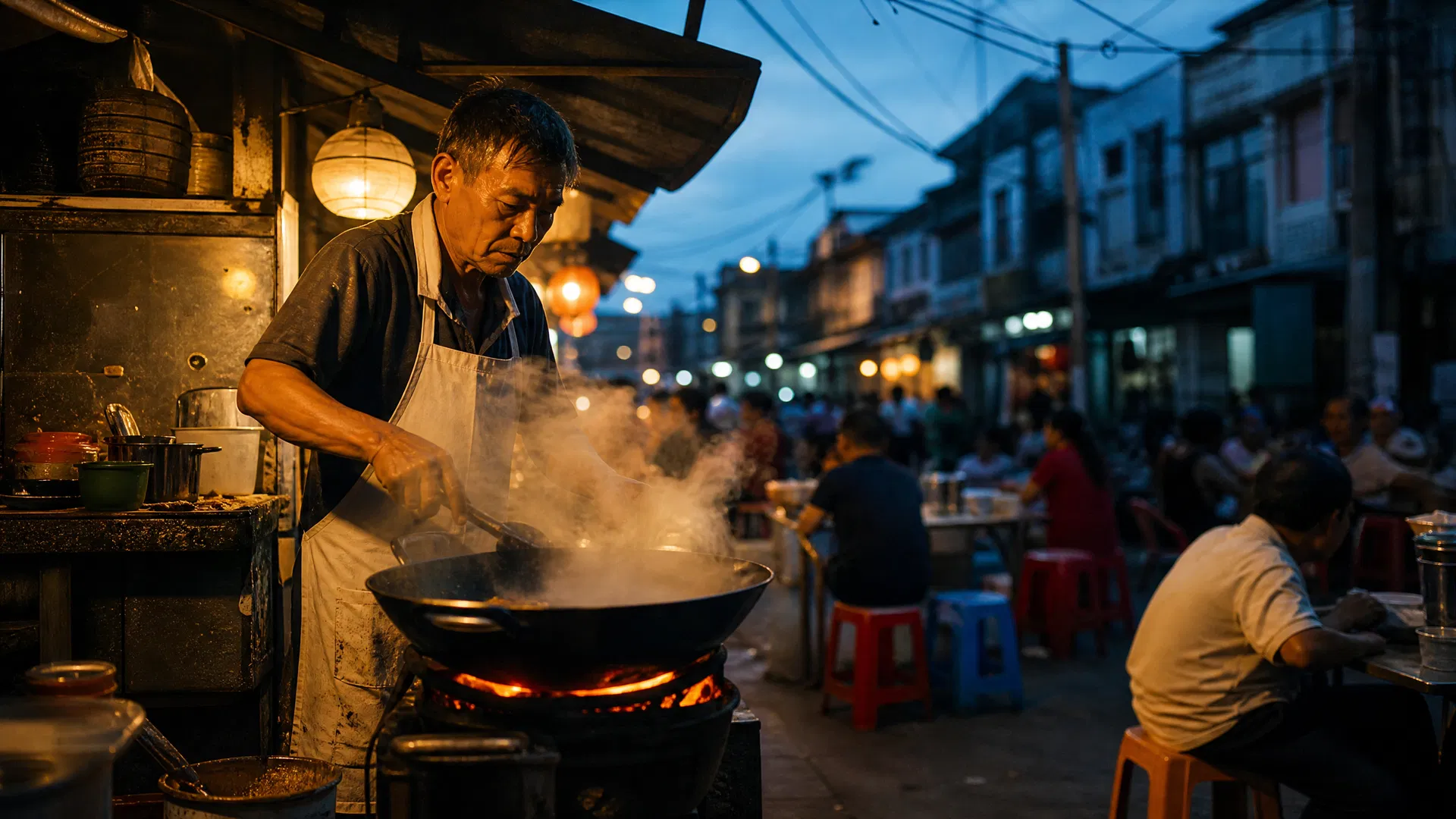
What a City Actually Eats When It's Not Performing for Anyone
Destination: Global
Category: destination
There is a version of every food city that exists for visitors. It has a name, a reputation, a Michelin star or two, and a line around the block that moves slowly enough to photograph. It is not bad food. It is often very good food. But it is food that knows it is being watched — food that has been adjusted, translated, made legible to someone who arrived last Tuesday and leaves next Sunday.
Then there is the other version. The version that exists at 7 a.m. on a Tuesday when no one is performing anything. The vendor who has been making the same bowl of noodles since before the neighborhood had a name. The market stall that has no sign because the people who need it already know where it is. The plastic stool that has been occupied every morning for forty years by the same retired civil servant who orders without looking at the menu because there is no menu.
This post is about that version. Not about street food as a tourist attraction — as something to photograph and check off a list — but about the cities where street food is the actual food culture. Where the best meal you will eat is not in a restaurant with a reservation and a tasting menu, but at a cart that closes when it runs out, made by someone who has cooked one dish for thirty years and has no interest in a dining room.
The thesis here is specific: these are not cities where street food is a supplement to the restaurant scene. These are cities where the restaurant scene is, at best, a supplement to the street. Where the food that matters — the food that defines what people eat, how they eat, and who they are — happens outside, at a counter, on a stool, or standing up. The cities that follow are not equally good at street food. They are each the best answer to a specific dimension of what it means for a city to eat honestly.
Bangkok: Where the Street Is the Kitchen, and the Kitchen Has Been Open Since the Ayutthaya Kingdom
Bangkok does not have a street food scene. Bangkok is a street food scene, and everything else — the restaurants, the hotel dining rooms, the rooftop bars — exists in its shadow.
The history here matters. Thai street food grew out of the ethnic Chinese enclaves of Bangkok, and the tradition of cooking and selling food outdoors traces back to the Ayutthaya Kingdom (1351–1767), when vendors sold rice porridge and grilled fish to traders along the city's rivers. By the time Bangkok became the capital in 1782, the street was already the kitchen. The modern iteration — the wok-fired stalls, the noodle carts, the charcoal grills — became commonplace in the 1970s as the city industrialized and workers needed to eat cheaply and quickly. What emerged was not a food court. It was a culinary infrastructure.
The competitive gap that most travel content misses about Bangkok is not the famous Yaowarat Road in Chinatown — every guidebook covers that. It is Song Wat Road, a few blocks away from the main Yaowarat strip, where a 100-year-old bao shop operates next to a hip café with French pastries, and where the crowd is almost entirely Thai. And it is Banthat Thong Road, where young Thais in their twenties and thirties queue for Somboon Seafood — reportedly the inventor of Thai curry crab — while almost no tourists are present. These are the streets where Bangkok eats when it is not performing for anyone.
The other detail that does not appear in most Bangkok food coverage: the city's street food culture is currently under threat. Since 2017, the Bangkok government has been clearing vendors from footpaths and relocating them to designated hawker centers, a policy that has accelerated in recent years. Vendors like Looknam Sinwirakit, who sells 50-baht fried glutinous rice cakes in Chinatown, operate under the constant threat of fines and eviction. The Bangkok you eat in today — the one that still has vendors charring meat over charcoal on the sidewalk at midnight — is not guaranteed to exist in five years. That is not a reason to avoid it. It is a reason to go now.
If you are planning a Bangkok trip and want to eat the way the city actually eats, Leif's Bangkok Thailand 5-Day Itinerary builds the food infrastructure into the daily structure — not as a side note, but as the organizing logic of the trip.
Hanoi: Where Bún Chả Is Not a Dish. It Is a Time of Day.
Where Bangkok rewards the traveler who wanders, Hanoi rewards the one who pays attention to sequence. Hanoi street food is not organized by neighborhood or by cuisine. It is organized by time. The city has a different food on every corner at every hour, and the locals who eat it know exactly which stall opens when, which vendor runs out by 10 a.m., and which dish is only worth eating in the first two hours after it is made.
Bún chả is the clearest example. The dish — grilled pork patties and slices served in a bowl of fish sauce broth with white rice noodles and fresh herbs — was first recorded in writing in 1959 by Vietnamese food writer Vũ Bằng, though the tradition is considerably older. The first bún chả restaurant in Hanoi was on Gia Ngư street in the Hoàn Kiếm District. Today, the dish is served almost exclusively at lunch, and the best versions are gone by 1 p.m. This is not a marketing strategy. It is simply how the dish works: the charcoal-grilled pork is best eaten within an hour of cooking, and the vendors who have been making it for decades know this and plan accordingly.
The detail that most street food coverage misses about Hanoi is the relationship between the dish and the time of day. Phở is a morning dish — the broth has been simmering since 4 a.m. and the best bowls are served before 9. Bún chả is a lunch dish. Bánh mì — the French-Vietnamese baguette sandwich — is an all-day food, but the best ones come from stalls that bake their own bread rather than buying it wholesale. Eating in Hanoi well requires understanding this architecture, not just knowing the names of the dishes.
The other competitive gap: Hanoi's Old Quarter is organized by trade — Silk Street, Paper Street, Tin Street — and the food stalls within it reflect the working population of each street rather than a curated tourist experience. The best phở in the Old Quarter is not at a restaurant with an English menu. It is at a stall with four plastic stools and a grandmother who has been making the same broth since 1978.
Leif's Hanoi Vietnam 4-Day Couples Guide covers the food architecture of the city in detail — which dishes to eat at which hours, and which neighborhoods to be in when.
Istanbul: Where the Simit Has Been on the Street Since Sultan Süleyman the Magnificent
If Hanoi proves that street food is organized by time, Istanbul proves that it is organized by history. The city's street food is not a modern phenomenon. It is a 500-year-old infrastructure that has survived empires, wars, and the rise of the restaurant industry without fundamentally changing what it is.
The simit is the clearest proof. The sesame-encrusted bread ring — dipped in molasses water before baking, which gives it its distinctive caramelized crust — first appeared in Ottoman texts in 1525. A kitchen ledger dated 1651 lists 95 simit rings among the baked goods served to Sultan Mehmed IV. The palace of Sultan Süleyman II allocated 30 simit daily. The guild of simit sellers — known as Esnâf-ı gevrekciyân — was a formal Ottoman institution, with inspectors in plain clothes checking the quality of flour and whether vendors were adhering to specified dimensions. The 17th-century Ottoman traveler Evliya Çelebi described simit vendors decorating their carts and threading rings "as big as cart wheels" onto poles to carry through the streets.
Today, the simit cart is still the first thing you see when you exit any Istanbul metro station. The price is still approximately 10 lira — less than a dollar. The vendor still carries the rings on a tray balanced on his head. Nothing about this has changed in 500 years except the price, and even the price has only changed in the direction of remaining cheap.
The second Istanbul street food that most travel content underserves is balık ekmek — the fish sandwich sold from boats moored at the Galata Bridge in Eminönü. The dish is exactly what it sounds like: a grilled mackerel fillet in a white bread roll, with onions, lettuce, and a squeeze of lemon. Its roots go back to the 1800s, when fishermen sold their catch directly from boats on the Bosphorus. The specific location — under the Galata Bridge, with the Golden Horn behind you and the Süleymaniye Mosque above — is not incidental to the experience. It is the experience. The fish sandwich tastes different because of where you are eating it.
What Istanbul proves, and what separates it from every other city on this list, is that street food here is not a survival of an older food culture. It is the food culture, continuous and uninterrupted, from the Ottoman palace to the present day. Leif's Istanbul Turkey 5-Day Budget Guide and Istanbul Turkey 5-Day Couples Guide both build the street food infrastructure — simit, balık ekmek, the Kapalıçarşı spice vendors — into the daily itinerary rather than treating it as a footnote.
Oaxaca: Where the Market Is the Restaurant, and the Restaurant Has Been Open Since Before Mexico Was Mexico
Where Istanbul's street food is organized by history, Oaxaca's is organized by the market. The city's two central markets — Mercado Benito Juárez and Mercado 20 de Noviembre — are not tourist attractions. They are the food infrastructure of the city, and they have been since the pre-Columbian period when Zapotec traders gathered in the valley below Monte Albán.
Mercado 20 de Noviembre is the more specific proof of the thesis. The market is organized around a central corridor of charcoal grills — the pasillo de humo, the smoke corridor — where vendors cook tasajo (Oaxacan skirt steak), chorizo, and cecina (dried, salted beef) over wood fires. You choose your meat from the stall, pay for it, and the vendor grills it while you wait. The tlayuda — a large, partially dried tortilla coated in asiento (unrefined pork fat) and black bean paste, topped with Oaxacan cheese and your choice of meat — is the canonical Oaxacan street food, and the best version is not at a restaurant. It is at Tlayudas La Chinita, a streetside operation at the intersection of 20 de Noviembre and Calle de Nuño del Mercado, where a full team chars chorizo to perfection and flips the massive tortillas — moon-shaped, eclipsing any normal dinner plate — until they are as crispy as chips.
The competitive gap that most Oaxaca content misses is the memela. A memela is a hand-rolled and pressed tortilla, grilled on the comal and topped with bean paste, queso fresco, and a savory topping — the simplest version, sencillo, is just asiento, beans, and cheese. It is Oaxaca's most basic and essential food, and it is almost never mentioned in travel coverage that focuses on mole and mezcal. The best memelas in the city are at the stands inside Mercado Sánchez Pascuas, on the western side of the Centro, where they have been made the same way for generations.
The other detail: Oaxaca's street food is not separate from its mezcal culture. The two are inseparable. The city eats late, drinks mezcal in the evening, and then eats again at midnight — which is why the tlayuda stands on 20 de Noviembre are busiest after 11 p.m. The food and the drink are designed to work together, and the sequence matters. Leif's Oaxaca Mexico 4-Day Couples Guide covers the market infrastructure, the mezcal-to-food sequence, and the specific vendors worth finding.
Singapore: Where Street Food Is UNESCO-Listed, and the Hawker Who Has Been Making Fish Balls Since His Grandmother Taught Him Is the Proof
If Oaxaca proves that the market is the restaurant, Singapore proves that the hawker center is a civilization. In 2020, Singapore became the first country to have its street food culture — specifically, its hawker center tradition — inscribed on the UNESCO Representative List of the Intangible Cultural Heritage of Humanity. This is not a marketing achievement. It is a recognition of something that Singaporeans have understood for 200 years: that the hawker is not a street vendor. The hawker is the keeper of the city's food memory.
The history of Singapore's hawker culture begins with the British establishment of a trading post in 1819. The island's population grew tenfold within decades as Chinese, Indian, and Malay workers arrived to trade and labor. These workers needed quick, hearty meals, and itinerant hawkers — carrying baskets on poles balanced on their shoulders, pushing carts equipped with stoves — filled the need. The Malay satay man would bring his skewers and peanut sauce to Chinese communities. The Chinese noodle man would appear in Indian-dominant enclaves. This cross-cultural exchange, happening at the level of the street cart rather than the restaurant, is how Singaporean cuisine — a genuine hybrid of Chinese, Malay, and Indian cooking techniques — was created.
The competitive gap that most Singapore food coverage misses is the endangered nature of the tradition. Many Singaporeans regard hawking as a low-level trade, and few young people are entering the profession. Douglas Ng, who earned a Michelin Bib Gourmand award in 2016 for his fish balls at The Fishball Story in the Golden Mile Food Centre, got into the business specifically because it was the least expensive way to enter the food industry — and because he wanted to preserve his grandmother's recipe, which he learned by following her around her kitchen with a video camera. The hawker center is not just a place to eat. It is a place where family recipes that would otherwise disappear are kept alive by people who understand what would be lost if they stopped.
The second detail: Singapore's hawker centers are not uniform. The residential ones — in Toa Payoh, in Bedok, in Ang Mo Kio — are where Singapore actually eats. The tourist-facing ones are where Singapore performs. Leif's Singapore 5-Day Food Guide and Singapore 4-Day Food Guide both prioritize the residential hawker centers over the tourist-facing ones, and explain why the distinction matters.
Seoul: Where the Pojangmacha Is Not a Trend. It Is a Post-War Survival Strategy That Became a Culture.
Where Singapore's hawker culture was shaped by colonial migration, Seoul's street food culture was shaped by war. The pojangmacha — the orange-tented street stall that is one of Seoul's most recognizable images — did not emerge from a long culinary tradition. It emerged from the Korean War (1950–1953), when unemployment was catastrophic and the street was the only available commercial infrastructure. People who had nothing else to sell cooked what they could and sold it from carts. The pojangmacha was a survival strategy before it was a culture.
What it became is something more specific. By the 1990s, Seoul had approximately 3,100 pojangmacha operating across the city. The modern pojangmacha grew out of two traditions: the post-war Korean street stall and the Japanese yatai culture — mobile food stalls that date back to the Edo period — which influenced Korean street food during the Japanese occupation. Today, the pojangmacha serves tteokbokki (rice cakes in spicy gochujang sauce), odeng (fish cake skewers in broth), sundae (blood sausage), and makgeolli (rice wine), and it operates primarily at night, when the combination of cheap food and cheap alcohol creates the specific social atmosphere that Koreans call pojangmacha culture — informal, slightly melancholy, deeply communal.
The competitive gap that most Seoul food coverage misses is the history of tteokbokki itself. The dish originated in the late Joseon Dynasty as royal court cuisine — a sautéed rice cake dish made with soy sauce, not the spicy gochujang version that exists today. The spicy version was created in the 1950s when gochujang became widely available and affordable. The dish moved from the palace to the street in less than a century, and in doing so became one of the most consumed foods in South Korea. Seoul's gireum-tteokbokki — tteokbokki fried in oil rather than simmered in sauce — is a regional variation that appears almost nowhere in English-language food coverage.
Leif's Seoul South Korea 4-Day Food Guide covers both the pojangmacha circuit and the bunsikjip culture, with specific neighborhoods and timing.
Taipei: Where the Night Market Is Not a Tourist Attraction. It Is the City's Living Room.
Where Seoul's street food culture was born from post-war necessity, Taipei's was born from agricultural surplus. The night market — Taiwan's most distinctive food institution — began in the late Qing Dynasty and through the 1960s as a way to sell agricultural goods that had not moved during the day. Shilin, now the site of Taipei's most famous night market, was at the heart of the distribution of agricultural goods in Taipei — a market for vegetables, fish, meat, and grain that ran from morning until the vendors had sold what they had. The night market was the evening extension of the day market, and it was organized around the same principle: sell what you have, at whatever price clears the inventory, before it spoils.
What Shilin Night Market became — a 500-stall complex in a dedicated building, operating every night until 1 a.m. — is a transformation that happened over about sixty years. But the principle has not changed. The food at Shilin is not designed for tourists. It is designed for the Taipei residents who have been eating there since childhood, who know which stall has the best oyster vermicelli and which one has the best scallion pancake.
The competitive gap that most Taipei food coverage misses is Raohe Street Night Market, which is consistently rated by Taipei residents as the better night market — more manageable in size, higher in quality, less overwhelmed by tour groups. Raohe is organized around a central street with vendors on both sides, and it is anchored at one end by the Songshan Ciyou Temple, which means that the experience of eating there includes the specific atmosphere of a working religious site at night — incense smoke, the sound of prayer, the light from the temple lanterns mixing with the glow of the food stalls.
The second competitive gap: Taipei's breakfast culture — specifically the dòu jiāng (warm soy milk) and yóu tiáo (fried dough sticks) breakfast that has been eaten in Taipei since the mainland Chinese migration of the late 1940s — is one of the most specific and least-covered food experiences in Asia. The best version is at a breakfast stall that opens at 5 a.m. and closes when it runs out, usually by 9. It is not photogenic. It is not Instagrammable. It is just the best breakfast in the city, eaten by people who have been eating it every morning for fifty years.
Leif's Taipei Taiwan 4-Day Food Guide and Taipei Taiwan 4-Day Budget Guide both cover the night market architecture and the breakfast culture, with specific stalls and timing.
How to Plan a Trip Around This Thesis
The cities on this list are not equally accessible or equally similar in what they require from a traveler. Bangkok and Hanoi reward travelers who are willing to eat at odd hours and in places that have no English signage. Istanbul rewards travelers who understand that the best food is often the cheapest food, and that the simit cart outside the metro station is not a lesser option than the restaurant inside the hotel. Oaxaca rewards travelers who are willing to eat in markets rather than restaurants, and who understand that the market is the restaurant. Singapore rewards travelers who go to residential neighborhoods rather than tourist-facing hawker centers. Seoul rewards travelers who stay out late enough to find the pojangmacha in full operation. Taipei rewards travelers who wake up early enough to find the breakfast stalls before they close.
The common thread is this: in each of these cities, the best food is not the most visible food. It is the food that exists for the people who live there, not for the people who are visiting. Finding it requires a different kind of attention — not the attention of someone following a list, but the attention of someone who is genuinely curious about how a city feeds itself.
This is where Leif's itinerary generator is useful in a specific way. The guides linked throughout this post are built around the principle that the food infrastructure of a city is as important as its monuments — that knowing where to eat at 7 a.m. in Hanoi is as valuable as knowing which temple to visit at noon. If you are planning a trip to any of these cities and want to eat the way the city actually eats, the guides are the place to start.
The Plastic Stool Is the Point
There is a specific moment that happens in every city on this list, and it is the moment the thesis becomes real. It happens when you sit down on a plastic stool at a cart that has no sign, order something by pointing at what the person next to you is eating, and receive a bowl of something that is better than anything you have eaten in a restaurant in the past year.
The moment is not about the food, exactly. It is about what the food reveals: that this city has been eating this way for a very long time, that the person making it has been making it for most of their life, and that the restaurant version — the version with the menu and the lighting and the reservation — is not the real thing. It is a translation of the real thing, made legible for people who need it translated.
Bangkok calibrates what street food can be when it is the entire food culture of a city. Hanoi proves that the best food is organized by time, not by neighborhood. Istanbul shows that a 500-year-old food tradition can survive empires and still cost less than a dollar. Oaxaca demonstrates that the market is the restaurant, and always has been. Singapore preserves the food memory of a city through the hawker who learned his grandmother's recipe on a video camera. Seoul shows what happens when survival becomes culture. Taipei shows what happens when the night market becomes the city's living room.
The plastic stool is not a compromise. It is the point.