Tokyo Doesn't Meet Your Expectations. It Obliterates Them.
Destination: Tokyo, Japan
Category: destination-guide
Tokyo doesn't meet your expectations. It obliterates them.
The first thing Tokyo does is overwhelm you. Not in a bad way — in the way that a great piece of music overwhelms you, where there is simply too much to process at once and you have to surrender to it. You step out of Shinjuku Station — the busiest train station on earth, handling over three million passengers a day — and the city hits you from every direction: the neon signs stacked ten stories high, the smell of yakitori smoke drifting from a side alley, the sound of a thousand conversations in a language you do not speak, the extraordinary orderliness of it all.
Tokyo is the largest metropolitan area in the world — roughly 37 million people — and it functions with a precision and cleanliness that makes every other megacity look like it is still figuring things out. Trains run on time to the second. Streets are spotless. Lost wallets are returned. Strangers give you directions with the patience of a tour guide. The city operates at a frequency that is simultaneously intense and deeply, profoundly calm.
It is also the most culinarily dense city on earth. Tokyo has more Michelin-starred restaurants than any other city — more than Paris, more than New York, more than London. But the more important number is the ramen shops, the conveyor belt sushi bars, the standing soba counters, the izakayas where you eat grilled skewers and drink cold Sapporo until midnight. The best meal you will eat in Tokyo will probably cost less than $15.
No city on earth does more things simultaneously, more brilliantly, than Tokyo. And no city rewards the curious traveller more generously.
The Neighbourhoods: A City of Villages
Tokyo is not one city. It is forty cities stacked on top of each other, each neighbourhood with its own personality, its own food, its own reason to stay for an afternoon.
Shinjuku is the city at full volume. The east side is neon and chaos: Kabukicho entertainment district, Golden Gai (a network of alleys containing over 200 tiny bars, each seating six to eight people), the Omoide Yokocho yakitori alley where smoke from charcoal grills hangs in the air like incense. The west side is corporate towers and the Tokyo Metropolitan Government Building, which has a free observation deck with views that stretch to Mount Fuji on clear days. Shinjuku is where you go to feel the full force of what Tokyo is.
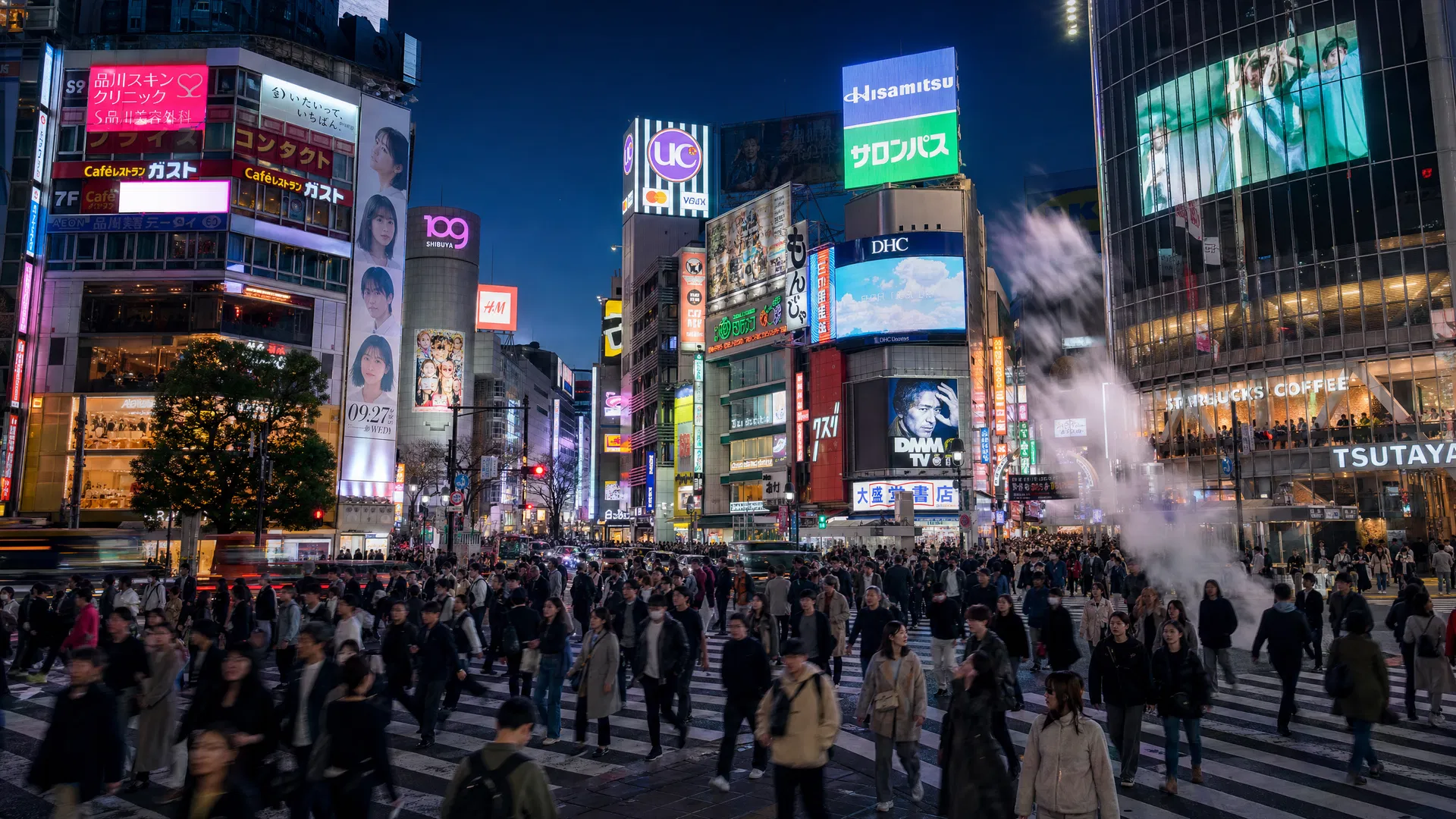
Shibuya is the crossing. You have seen it in photographs — the scramble intersection where, when the lights change, pedestrians surge from all directions simultaneously, thousands of people crossing at once in a choreography that should not work but does, perfectly, every time. The crossing is the icon, but Shibuya is also Daikanyama (the neighbourhood just south, full of independent bookshops, coffee bars, and the kind of boutiques that make you reconsider your wardrobe) and Nakameguro (the canal-lined street that becomes the most beautiful place in Tokyo during cherry blossom season, and a very good place to eat and drink the rest of the year).
Harajuku is two things at once. Takeshita Street is the teenage fashion district — cosplay, crepes, candy-coloured everything, a sensory overload that is genuinely fascinating even if you are not sixteen. Two minutes' walk away is Omotesando, Tokyo's most elegant boulevard, lined with flagship stores by every major luxury brand, the architecture alone worth the walk. And behind Harajuku is Yoyogi Park, where on Sunday afternoons you can find rockabilly dancers, amateur musicians, picnickers, and the general sense that Tokyo knows how to enjoy itself.
Asakusa is old Tokyo — the Tokyo that survived the 1923 earthquake and the 1945 firebombing, or at least a version of it. Senso-ji Temple, the oldest temple in the city, is reached through the Nakamise shopping street, where vendors sell ningyo-yaki (small cakes filled with red bean paste), fans, folded paper, and every variety of souvenir. The temple itself is genuinely magnificent, especially at night when the crowds thin and the lanterns glow. The neighbourhood around it — rickshaws, traditional craft shops, old-school izakayas — is the closest Tokyo gets to what it looked like a century ago.
Akihabara is the electronics and anime district, and it is unlike anything else on earth. Multi-storey buildings dedicated entirely to manga, figurines, retro video games, components for building your own computer, maid cafés where the staff call you "master." It is overwhelming and specific and completely committed to its own aesthetic. Even if you have no interest in anime, it is worth an afternoon just to understand that this level of specialist enthusiasm exists.
Yanaka is the neighbourhood that the guidebooks call "old Tokyo" but that actually feels like a village that somehow survived inside the city. Narrow streets, wooden houses, a cemetery that is the best place in Tokyo to watch cherry blossoms fall, independent shops selling handmade goods, cats sleeping in doorways. It is the antidote to Shinjuku, and it is twenty minutes away.
The Food: Everything, Everywhere, All at Once
Tokyo's food culture is not a scene. It is a civilisation. The city has been refining its culinary traditions for centuries and importing and perfecting the food of every other culture for decades, and the result is a density of excellent eating that is simply without parallel anywhere in the world.
Ramen is the entry point for most visitors, and rightly so. Tokyo-style ramen is shoyu (soy sauce) based, with a clear, complex broth, thin wavy noodles, and toppings that vary by shop. But the city also has exceptional versions of tonkotsu (pork bone, rich and cloudy), miso, and shio (salt) ramen. The best ramen shops have queues. The queues are worth it. The Tokyo Food & Ramen Culture 4-day guide is built around exactly this — the ramen alleys, the regional styles, and the meal-by-meal logic of eating through the city in four days.
Sushi in Tokyo is a different category of experience from sushi anywhere else. At the high end, an omakase dinner at a counter with eight seats, where the chef places each piece directly on the wooden counter in front of you, is one of the great dining experiences on earth. At the low end, the conveyor belt sushi (kaiten-zushi) chains — Sushiro, Kura Sushi, Hamazushi — serve fresh, excellent sushi for ¥100–150 per plate. Both are worth doing.
Yakitori — chicken skewers grilled over charcoal — is the food of the izakaya, and the izakaya is the social institution around which much of Tokyo's evening life is organised. You sit at a counter or a low table, you order skewers (thigh, breast, liver, cartilage, skin — every part of the bird), you drink cold beer or highballs, and you stay for hours. The best yakitori bars are in the alleys under the train tracks in Yurakucho and in the Omoide Yokocho in Shinjuku.
Tempura done properly — light, greaseless batter on prawns and seasonal vegetables, fried in fresh oil at exactly the right temperature — is one of the most technically demanding dishes in Japanese cuisine, and Tokyo has some of the best tempura restaurants in the world. The lunch sets at mid-range tempura restaurants are one of the city's great bargains.
Depachika — the basement food halls of Tokyo's department stores — are a world unto themselves. Isetan in Shinjuku, Mitsukoshi in Ginza, Takashimaya in Nihonbashi: each has a basement level (or several) dedicated entirely to food, where you can buy the most perfect fruit you have ever seen, handmade chocolates, prepared bento boxes, regional specialties from across Japan, and pastries that look like they belong in a museum. Budget an hour and eat your way through.
For travellers who want to structure their entire Tokyo trip around the food — from the Tsukiji outer market breakfast to the late-night ramen counter — the Tokyo 5-day food guide maps out the Michelin stars, the ramen alleys, and the depachika deep dives in sequence.
Solo in Tokyo: The World's Best City for Travelling Alone
Tokyo is, by a significant margin, the best city in the world for solo travel. It is safe — Japan has one of the lowest crime rates of any country, and Tokyo is safer than almost any city of comparable size anywhere. It is designed for the individual: single-seat counters at ramen bars and sushi restaurants, capsule hotels that are engineering marvels of compact comfort, a transit system so comprehensive and logical that you can reach any corner of the city without a car or a guide.
The solo traveller's Tokyo is the one discovered at your own pace: the 6am walk through Tsukiji outer market before the crowds arrive, the afternoon in a Shimokitazawa record shop, the evening in a Golden Gai bar where you are the only foreigner and the conversation happens in gestures and shared drinks. Tokyo rewards the person who wanders without a plan and punishes no one for being alone.
The Tokyo 5-day solo guide covers the full solo itinerary — Shinjuku, Akihabara, the hidden bars, and a day trip to Nikko — built around the rhythms of a traveller who wants to move at their own speed.
Tokyo for Couples: Romance in the Neon City
Tokyo is not an obvious romantic destination — it does not have the candlelit piazzas of Rome or the sunset terraces of Santorini — but it is one of the most romantic cities in the world for couples who know where to look. The intimacy of a tiny Golden Gai bar at midnight. The stillness of Meiji Shrine at dawn. The cherry blossoms along the Meguro River in early April, when the trees form a tunnel of pink over the water and the whole city seems to hold its breath.
The Yanaka neighbourhood on a slow afternoon. An omakase dinner where you sit side by side at a counter and eat the same extraordinary meal at the same moment. The view from the Tokyo Skytree at dusk, when the city lights come on in every direction as far as you can see.
The Tokyo 5-day couples guide builds the romantic itinerary around these moments — the Yanaka walks, the Daikanyama boutiques, the Shinjuku Golden Gai date nights, and a day trip to Hakone for an onsen stay with views of Mount Fuji.
Tokyo on a Budget: The Expensive City That Isn't
Tokyo has a reputation for being expensive that is only partially deserved. The city can be extraordinarily affordable if you know where to eat and how to move around. The transit system is cheap and comprehensive. The convenience stores (7-Eleven, FamilyMart, Lawson) sell excellent food — onigiri, sandwiches, hot foods — for ¥100–300. The standing ramen and soba counters feed you well for ¥700–1,000. The public parks, temples, and shrines are free. The city's best experiences — wandering Yanaka, watching the Shibuya crossing, exploring Akihabara, sitting in a konbini at 2am eating a perfect egg sandwich — cost nothing.
The Tokyo 5-day budget guide works through the ¥8,000-per-day framework — IC card hacks, ¥100 sushi, free shrines, capsule hotels — and proves that Tokyo is one of the most rewarding cities in the world at any budget level. For travellers who want a full week on a shoestring, the Tokyo 7-day budget guide extends the itinerary to cover more ground without breaking the bank.
Tokyo Luxury: When Only the Best Will Do
At the other end of the spectrum, Tokyo is also one of the world's great luxury destinations — and it delivers a kind of luxury that is different from anywhere else. The Aman Tokyo, in the upper floors of the Otemachi Tower, is the most serene urban hotel on earth: a Japanese aesthetic applied to a scale and quality that makes most five-star hotels look like they are trying too hard. The Park Hyatt in Shinjuku, where Lost in Translation was filmed, still has the best bar view in the city from the 52nd floor.
Omakase sushi at a counter with eight seats, where the chef has been making the same dish for thirty years and has nothing left to prove. Kaiseki dinner in a private room overlooking a garden. A private ryokan in Hakone with a rotenburo (outdoor hot spring bath) and a view of Fuji at dawn. These are the experiences that Tokyo does better than anywhere.
The Tokyo 5-day luxury guide covers the Aman, the omakase counters, the ryokan retreats, and the extraordinary experiences that make Tokyo the world's most refined luxury destination.
Families in Tokyo: More Fun Than You Think
Tokyo with children is a revelation. The city is extraordinarily child-friendly — clean, safe, with a transit system that accommodates strollers, and a food culture that has something for every age. teamLab Borderless (now relocated to Azabudai Hills) is the digital art museum that is the single most extraordinary visual experience in the city, and children lose their minds in it. Ueno Zoo has giant pandas. Odaiba has a Legoland Discovery Center and a giant Gundam statue. Harajuku has crepes in every conceivable flavour. Akihabara has more video games than any child has ever seen in one place.
The Tokyo 6-day family guide builds the itinerary around the digital art, the pandas, the Odaiba day, the Shibuya crossing at dusk, and the conveyor belt sushi that children universally love.
The Full Week: Tokyo in Seven Days
Seven days in Tokyo is the right amount of time to begin to understand the city. Not to know it — Tokyo takes a lifetime — but to understand its structure, to find your neighbourhood, to develop the habits (the morning konbini run, the evening izakaya, the Sunday morning temple) that make a city feel like yours.
A full week lets you do the big things — Shinjuku, Shibuya, Asakusa, Akihabara — and the slow things: a morning in Yanaka, an afternoon in Shimokitazawa, a day trip to Kamakura or Nikko. It lets you eat your way through the food categories without rushing. It lets you get lost, which is the best thing you can do in Tokyo.
The Tokyo 7-day city and culture guide covers the full week — the neighbourhoods, the day trips, the food, the culture — in a sequence that builds understanding rather than just ticking boxes.
Beyond Tokyo: Japan Awaits
Tokyo is the entry point for most Japan trips, and it is worth treating it as such. The Shinkansen bullet train network connects Tokyo to Kyoto in 2 hours 15 minutes, to Osaka in 2 hours 30 minutes, to Hiroshima in 4 hours. Hakone — the mountain resort town with views of Mount Fuji and some of the best ryokan in Japan — is 85 minutes by train.
For travellers who want to combine Tokyo with the rest of Japan, the Japan 14-day rail pass itinerary and the Japan 14-day first-timer rail pass guide both start in Tokyo and build out to Kyoto, Osaka, Hiroshima, and beyond. For a food-focused Japan trip, the 10-day Japan food and culture guide takes the culinary thread from Tokyo's ramen alleys through Kyoto's kaiseki restaurants to Osaka's street food chaos.
What Nobody Tells You Before You Go
The IC card is everything. Get a Suica or Pasmo card at the airport, load ¥3,000–5,000 on it, and use it for every train, subway, bus, and convenience store purchase. It works everywhere. You do not need to buy individual tickets for anything.
The convenience stores are genuinely good. 7-Eleven, FamilyMart, and Lawson in Japan are not the convenience stores you know from home. They sell fresh onigiri made that morning, hot foods, excellent sandwiches, decent coffee, and a range of prepared meals that would embarrass most restaurants in other countries. Eat from them without shame.
Shoes matter. You will walk 15–20km a day in Tokyo without trying. Wear comfortable shoes. Also: many traditional restaurants, ryokan, and some temples require you to remove your shoes, so wear socks without holes.
The queues are real and worth it. Tokyo has a queue culture — for ramen shops, for popular bakeries, for teamLab. The queues move efficiently and the food/experience at the end is almost always worth the wait. Join them.
Cash still matters. Japan is less cashless than you might expect. Many smaller restaurants, temples, and markets are cash only. Keep ¥5,000–10,000 in your wallet at all times. ATMs at 7-Eleven and Japan Post accept foreign cards.
The vending machines are a joy. Tokyo has approximately one vending machine for every 23 people. They sell hot and cold drinks, sometimes hot food, occasionally beer. They are everywhere, they are cheap, and they are one of the small daily pleasures of being in the city.
Jet lag works in your favour. Tokyo is 13–14 hours ahead of the US East Coast. You will wake up at 4am for the first few days. Use it. The Tsukiji outer market, Senso-ji Temple, and Meiji Shrine at dawn are completely different experiences from the same places at noon.
The weather has seasons. Cherry blossom season (late March to mid-April) is the most beautiful time to be in Tokyo and the most crowded. Autumn foliage (November) is the second most beautiful and slightly less crowded. Summer (July–August) is hot, humid, and intense. Winter (December–February) is cold but clear, and the city is less crowded and cheaper.
Planning Your Tokyo Trip
Tokyo is the city that changes the way you think about cities. You arrive with assumptions — about scale, about complexity, about what a place this size should feel like — and Tokyo dismantles them one by one. The trains run on time. The food is extraordinary at every price point. The streets are safe at 3am. The people are kind. The city is beautiful in ways you did not expect.
Whether you are coming for five days or seven, travelling solo or with a family, eating on a budget or sitting at a counter where the chef has three Michelin stars — Leif builds your Tokyo itinerary around your actual travel style. The ramen alleys, the temple mornings, the Golden Gai nights, the Shinkansen to Kyoto — all of it shaped around your dates, your budget, and what you actually want from one of the greatest cities on earth.
Start with the Tokyo 7-day city and culture guide and let Leif take it from there.