Singapore Broke Every Assumption I Had About Southeast Asia
Destination: Singapore
Category: destination-guide
There is a version of Singapore that exists in the imagination before you arrive: gleaming towers, immaculate streets, a city so orderly it feels almost sterile. A place where chewing gum is illegal and everything runs on time. The city-state of superlatives — most expensive, most efficient, most connected. You picture it as a kind of airport that became a country.
Then you land, take the MRT to your hotel, and within twenty minutes you are standing in a hawker centre at 11pm, sweating through your shirt in the best possible way, watching a third-generation char kway teow master work a wok over flames so high they lick the hood above the stall. The noodles hit the table. You take one bite. And the version of Singapore you thought you knew dissolves completely.
This is what Singapore does. It lets you carry your assumptions all the way to the table, then quietly dismantles them, one dish at a time.
The City That Organized Itself Around Food
Ask a Singaporean what time it is and there is a reasonable chance they will answer in meals. "Have you eaten?" is not a pleasantry here — it is a genuine question, a form of care, a way of saying I see you. The hawker centre is the great equalizer: a billionaire and a construction worker sit at the same plastic table, eating the same plate of chicken rice, arguing about which stall is better.
UNESCO recognized Singapore's hawker culture in 2020 as an Intangible Cultural Heritage of Humanity. This is not a small thing. It means the world's cultural body looked at a collection of outdoor food stalls and said: this is worth protecting. And they were right.
Maxwell Food Centre in Chinatown is where most first-timers begin, and for good reason. Tian Tian Hainanese Chicken Rice has had a queue since before you were born. The chicken is poached to a silkiness that seems physically impossible, served over fragrant rice cooked in the same stock, with a ginger-chilli sauce that will ruin every other chilli sauce for you. Gordon Ramsay once tried to replicate it on television and the stall owner, Mdm Foo, was unimpressed.
But Maxwell is just the beginning. Old Airport Road Food Centre in Geylang is where serious eaters go — a sprawling complex with stalls that have been operating for forty years, serving things like Hokkien mee and rojak to people who have been eating there since childhood. Lau Pa Sat in the CBD is the most architecturally beautiful hawker centre in the world, a Victorian cast-iron market from 1894 that now hosts satay stalls at night, the smoke drifting through the colonnades while office workers loosen their ties.
If you are planning your first visit and want to understand how to navigate the food landscape — from hawker centres to the kopitiam breakfast culture to the late-night supper spots — the Singapore 4-day itinerary guide is built around exactly this kind of eating-first logic. It structures your days around the food, not the other way around.
Four Neighborhoods, Four Singapores
The thing that surprises most visitors is not the efficiency or the cleanliness — it is the density of distinct cultures packed into 733 square kilometres. Singapore is not a melting pot. It is more like a mosaic: Chinese, Malay, Tamil, Peranakan, Eurasian, each community maintaining its own architecture, its own food traditions, its own festivals, all coexisting within walking distance of each other.
Chinatown is the most visited and the most misunderstood. The touristy stretch of Pagoda Street with its souvenir shops is real, but so is the Sri Mariamman Temple (the oldest Hindu temple in Singapore, sitting in the middle of Chinatown, which tells you everything about how this city works), the Chinatown Heritage Centre, and the back streets where old men still play chess under the trees. Come for the temples, stay for the hawker centres, and do not leave without eating something from a stall that has been there longer than you have been alive.
Little India around Serangoon Road is the most sensory-overwhelming neighbourhood in the city — which is saying something. The smell of jasmine garlands and incense, the sound of Tamil film music from electronics shops, the colour of saris in the fabric stores. The Sri Veeramakaliamman Temple is one of the most spectacular religious buildings in Southeast Asia. Come on a Sunday evening when the whole neighbourhood comes alive with workers on their day off.
Kampong Glam is the Malay-Arab quarter, built around the golden dome of Sultan Mosque. The surrounding streets — Haji Lane, Arab Street, Bussorah Street — have become one of the most photogenic areas in the city, a mix of independent boutiques, Middle Eastern restaurants, and the kind of street art that makes you stop mid-stride. The area has gentrified significantly but retains a genuine character that the Instagram crowds have not entirely erased.
Katong and the East Coast are where you find the Peranakan culture — the descendants of Chinese immigrants who intermarried with Malay locals and created a hybrid cuisine and aesthetic that is entirely their own. The shophouses along Joo Chiat Road are painted in colours that seem too saturated to be real. The laksa here is different from the laksa everywhere else: richer, more coconut-forward, served in a bowl so deep you need a spoon and chopsticks simultaneously.
The Gardens, the Bay, and the Skyline That Became a Postcard
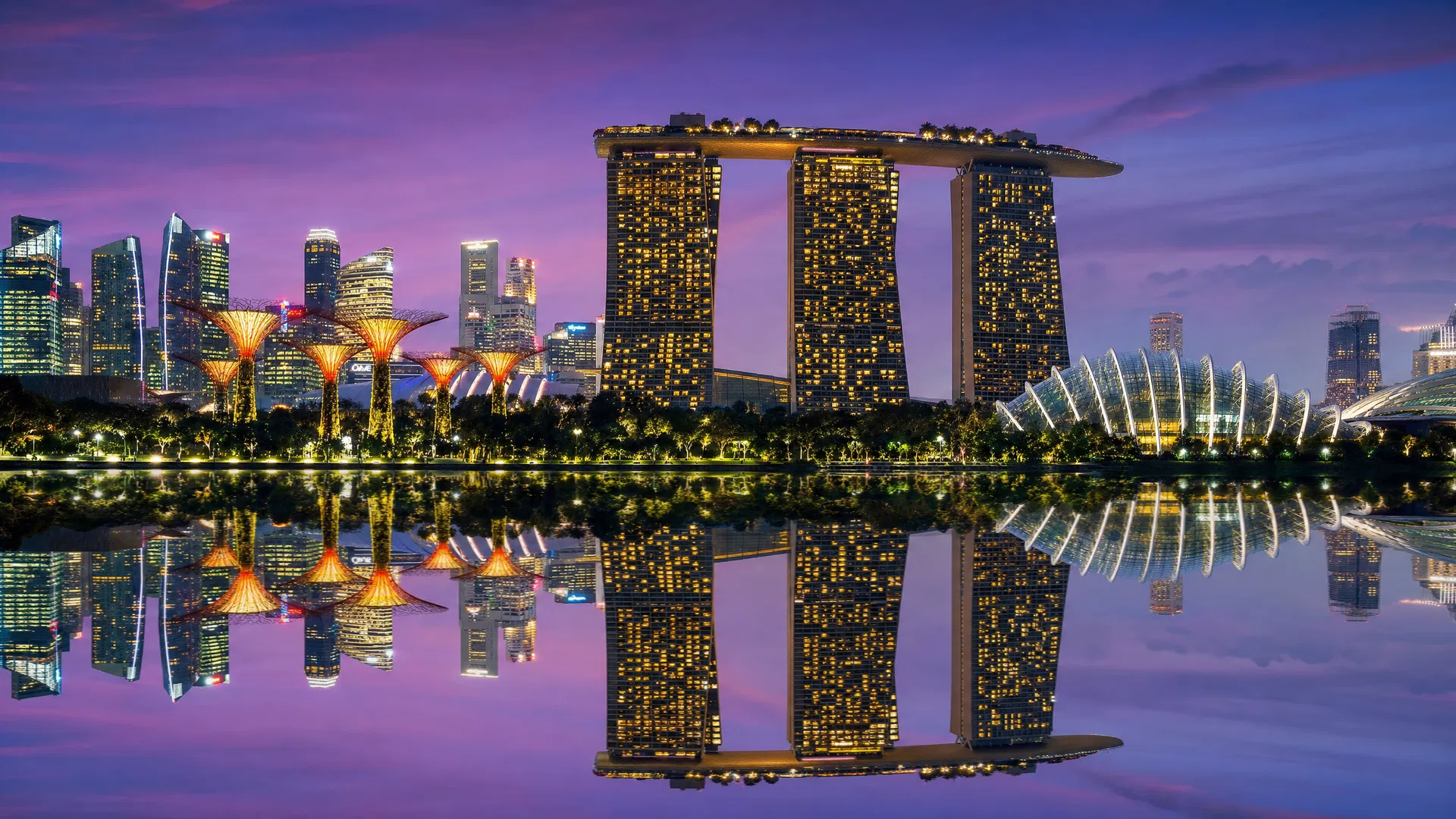
Marina Bay Sands is one of those buildings that has become so iconic it almost stops being a building. The three towers topped by a surfboard-shaped sky park, the infinity pool that appears to float above the city — you have seen it in a hundred photographs and it still manages to be more dramatic in person. The observation deck at sunset, when the light turns the bay gold and the city begins to glow, is one of those moments that justifies the plane ticket.
Gardens by the Bay sits adjacent to Marina Bay Sands and is one of the most genuinely extraordinary things built in the twenty-first century. The Supertrees — eighteen-storey vertical gardens covered in ferns and orchids and bromeliads — are lit up at night in a light show that is simultaneously kitsch and transcendent. The Cloud Forest dome contains a 35-metre indoor waterfall and a mountain of tropical plants inside a climate-controlled glass building. It should feel artificial. Somehow it does not.
The Singapore Flyer, the world's largest observation wheel, gives you the full panoramic context: the Strait of Malacca to the south, the Malaysian peninsula to the north, the city spreading in every direction. It is the moment when the geography of Singapore — this tiny island at the tip of a continent — becomes visceral.
For couples who want to build an itinerary around these landmark experiences while also finding the quieter, more intimate corners of the city, the Singapore 5-day couples guide threads through the skyline moments and the neighbourhood discoveries in a way that feels like a real trip rather than a checklist.
The Food Guide You Actually Need
Singapore has a Michelin Guide. It also has hawker stalls with Michelin stars. This is the only city in the world where a $3 plate of chicken rice has been awarded a Michelin star, and the stall owner responded by saying he was worried the recognition would make his queue even longer.
Hainanese Chicken Rice is the national dish, though Singaporeans will argue about which stall is definitive until the end of time. The chicken is poached, the rice is cooked in chicken stock with pandan and ginger, and the accompanying sauces — chilli, ginger, dark soy — are as important as the protein.
Laksa is a spiced coconut milk noodle soup that exists in at least three distinct regional variations within Singapore alone. Katong laksa is the most famous: thick rice noodles cut short so you can eat it with a spoon, in a broth so rich it coats the back of your throat.
Char Kway Teow is flat rice noodles stir-fried in a screaming-hot wok with egg, Chinese sausage, cockles, and bean sprouts. The best versions have wok hei — the breath of the wok, a smoky char that can only be achieved over extremely high heat by someone who has been doing it for decades.
Chilli Crab is the dish that tourists come for and locals eat on birthdays. A whole mud crab in a thick, sweet-savoury tomato and chilli sauce, eaten with fried mantou buns to soak up the sauce. It is messy and expensive and completely worth it.
Kaya Toast is the breakfast that Singaporeans eat before they eat anything else: thick-cut toast spread with kaya (a coconut jam made with pandan and eggs), a pat of cold butter, dipped into soft-boiled eggs seasoned with dark soy sauce and white pepper. It is the breakfast equivalent of a warm hug.
For travellers who want to structure their entire trip around the food — and there is no better way to see Singapore — both the Singapore 4-day food guide and the Singapore 5-day food guide map out the hawker centres, the neighbourhood specialties, and the meal-by-meal logic of eating your way through the city.
Sentosa and the Other Singapore
Sentosa Island, connected to the mainland by a causeway and a cable car, is Singapore's resort island — Universal Studios, beach clubs, casino, water parks, the whole entertainment complex. It is not subtle. It is also genuinely fun, and if you are travelling with children or simply want a day that does not involve walking through hawker centres in 32-degree heat, it delivers.
The beaches — Siloso, Palawan, Tanjong — are not the beaches of Bali or Thailand. The water is murky, the sand is imported, and the backdrop is container ships. But there is something almost charming about a beach where you can hear the sound of a roller coaster in the distance and see the Singapore skyline across the water. It is a beach that knows exactly what it is.
For families navigating how to balance the theme park energy of Sentosa with the cultural depth of the mainland, the Singapore 5-day family guide has thought through the logistics: which days to go to Sentosa, how to structure the hawker centre visits so children are not overwhelmed, which neighbourhoods have the best mix of activity and accessibility.
Solo in Singapore: The Safest City You Will Ever Visit
Singapore is consistently ranked among the safest cities in the world for solo travellers, and particularly for women travelling alone. The MRT runs until midnight and is clean enough to eat off the floor (not that you would, but the option is there). The hawker centres are designed for solo dining — communal tables, no awkward "table for one" moment, just find a seat and eat. The city is walkable in a way that most Southeast Asian cities are not.
The solo traveller's secret weapon in Singapore is the neighbourhood walk. Pick a starting point — say, the Sri Veeramakaliamman Temple in Little India — and just walk. Through the back streets of Kampong Glam, along the Singapore River, through the colonial district, past the Padang where cricket has been played since 1837. The city reveals itself at walking pace in a way it never does from a taxi.
The Singapore 4-day solo guide is built around this principle: a city that rewards the curious walker, where every neighbourhood is a different world, and where eating alone at a hawker centre is not a sad experience but a genuinely pleasurable one.
The Luxury Layer
Singapore is also, undeniably, one of the great luxury travel destinations in Asia. Raffles Hotel — reopened after a major restoration — is one of the most storied hotels in the world. The Singapore Sling was invented at its Long Bar in 1915. The rooms are suites. The service is the kind that makes you feel like the hotel has been waiting specifically for you.
Beyond Raffles, the hotel scene in Singapore is extraordinary: the Marina Bay Sands infinity pool, the Capella on Sentosa, the Fullerton Hotel in the old General Post Office building. The restaurant scene has Michelin-starred options across every cuisine — French, Japanese, Chinese, Indian, and everything in between.
For travellers who want to experience Singapore at its most elevated — the private dining rooms, the rooftop bars, the butler service — the Singapore 4-day luxury guide navigates the high end without losing sight of what makes Singapore genuinely special: the fact that the best meal you will eat might still cost $4 at a hawker stall.
Singapore on a Budget: The City That Rewards Thrift
Here is the counterintuitive truth about Singapore: it is one of the most expensive cities in the world to live in, and one of the cheapest places in the world to eat well. The hawker centre system means that a full meal — protein, rice or noodles, vegetables, a drink — costs between $3 and $6. The MRT is cheap and goes everywhere. Most of the best things to do are free: the neighbourhoods, the temples, the waterfront, the Botanic Gardens (a UNESCO World Heritage Site), the Southern Ridges walk through the rainforest canopy.
The budget traveller in Singapore is not making sacrifices. They are eating the same food as everyone else, seeing the same city, and spending a fraction of what they would in Tokyo or Sydney.
The Singapore 4-day budget guide works through exactly this logic: how to spend four days in one of the world's most expensive cities without spending like it.
What Nobody Tells You Before You Go
The heat is not negotiable. Singapore sits one degree north of the equator. It is 30–33 degrees Celsius year-round, with humidity that makes the air feel physical. You will sweat. Embrace it. The hawker centres are open-air and the ceiling fans are there for a reason.
The food is the culture. In most cities, food is a component of the experience. In Singapore, it is the experience. The conversations, the arguments, the family gatherings, the business deals — all of it happens over food. If you want to understand Singapore, eat your way through it.
The efficiency is real but it is not the point. Yes, the MRT runs on time. Yes, the streets are clean. Yes, things work. But reducing Singapore to its efficiency is like reducing Paris to its metro system. The efficiency is the infrastructure. The city is everything else.
Go to a hawker centre at 10pm. The late-night supper culture is one of Singapore's great pleasures. The city does not sleep early, and neither should you.
The neighbourhoods are walkable between each other. Chinatown, the CBD, Marina Bay, Kampong Glam, Little India — you can walk between all of them in a morning. The city is small in the best possible way.
Planning Your Singapore Trip
Singapore rewards the traveller who comes with curiosity and leaves the assumptions at home. The city will confound you, feed you, and refuse to be categorized. It is Chinese and Malay and Tamil and Peranakan and colonial and futuristic and ancient all at once, and it holds all of these identities without apparent contradiction.
Whether you are coming for four days or five, travelling solo or with a family, eating on a budget or splurging on Raffles — Leif builds your Singapore itinerary around your actual travel style, not a generic template. The hawker centres, the neighbourhoods, the rooftop bars, the day trips to Sentosa — all of it shaped around your dates, your budget, and what you actually want from a trip.
Start with the Singapore 4-day itinerary and let Leif take it from there.