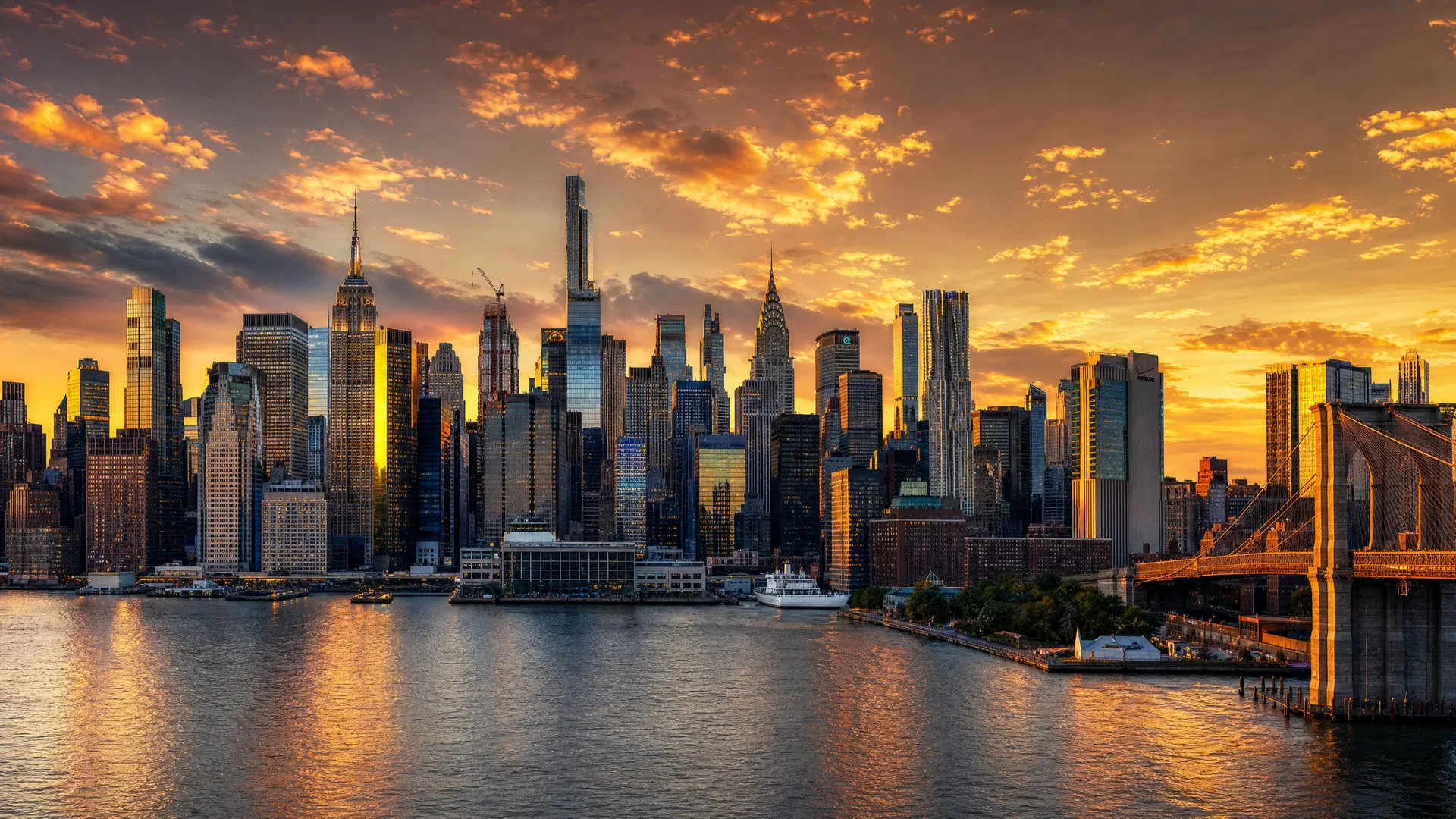
New York City Doesn't Care If You're Ready. It Starts Without You.
Destination: New York City, USA
Category: destination-guide
Every city makes a first impression. New York City makes a declaration.
You step out of Penn Station or Grand Central or JFK and the city doesn't introduce itself — it simply begins. The noise hits first: a thousand conversations, a thousand horns, the metallic shriek of a subway grate releasing steam, a delivery truck reversing into an alley while a guy on a Citi Bike threads the gap between it and a yellow cab with the casual confidence of someone who has done this ten thousand times. Then the scale hits. Then the smell — coffee and hot asphalt and a pretzel cart and something frying in a kitchen somewhere above you. Then, if you are paying attention, something else: the unmistakable sensation that you are standing at the center of the world.
No city on earth has been written about more, filmed more, mythologized more, or argued about more than New York. It has been called the greatest city in the world and the most overrated. It has been declared dead and reborn so many times that both the eulogies and the resurrection stories have become a genre of their own. E.B. White wrote in 1949 that the city "bestows the gift of loneliness and the gift of privacy" — and that observation has aged not a day. Colson Whitehead wrote that "you become a New Yorker the first time you say, 'That used to be a great place.'" Joan Didion said she was in love with the city the way you love the first person who ever touches you. Every writer who has ever spent time here has tried to pin it down, and every one of them has failed, because New York resists being pinned. It is too alive, too contradictory, too relentlessly itself.
What it is, more than anything, is a city that takes you seriously. It assumes you can handle it. It does not slow down for you, does not explain itself, does not offer a gentle on-ramp. It simply starts — and the moment you stop resisting and start moving with it, something shifts. You start walking faster. You start eating standing up. You start having opinions about pizza. You become, briefly and wonderfully, a New Yorker.
The Five Boroughs, Five Worlds
The first mistake most visitors make is treating New York City as synonymous with Manhattan. Manhattan is extraordinary — a thirteen-mile-long island of impossible density, where the financial district and the art galleries and the theater district and the immigrant neighborhoods and the billionaire towers all coexist within walking distance of each other. But Manhattan is one borough of five, and the city does not end at the East River.
Brooklyn is the borough that has, in the past two decades, become the most talked-about neighborhood in the world. Williamsburg, which was a working-class Polish and Puerto Rican neighborhood until the late 1990s, is now the template that every "cool neighborhood" in every city on earth is trying to replicate — the vintage shops, the natural wine bars, the record stores, the rooftop bars with views of the Manhattan skyline. But Brooklyn is also Bed-Stuy, where the brownstones are as beautiful as anything in Paris and the Caribbean food is extraordinary. It is Carroll Gardens, with its Italian-American bakeries that have been making the same cannoli since 1950. It is Sunset Park, where the dim sum rivals anything in Flushing. It is Coney Island, where you can eat a Nathan's hot dog on the boardwalk and watch the Atlantic Ocean and feel, briefly, that the city has exhaled.
Queens is the most ethnically diverse urban area on earth — more than 160 languages are spoken within its borders — and its food scene is the most underrated in the five boroughs. Flushing is the best Chinese food outside of China, full stop. Jackson Heights has the finest South Asian and Colombian food in the city. Astoria has Greek tavernas that have been feeding the neighborhood for sixty years. The entire borough is a masterclass in what happens when immigrants bring their food traditions to a new place and refuse to compromise them.
The Bronx is the birthplace of hip-hop, the home of the New York Yankees, and the location of the New York Botanical Garden — one of the most beautiful green spaces in the city. It is also Arthur Avenue, the "real Little Italy," where the red-sauce Italian-American tradition is maintained with a seriousness that the tourist-trap version in Manhattan abandoned decades ago.
Staten Island is the borough most visitors skip, which is their loss. The Staten Island Ferry is the best free view of the Manhattan skyline and the Statue of Liberty in the city. Snug Harbor Cultural Center is an 83-acre park with Victorian architecture and a Chinese Scholar's Garden that feels like a secret. And the pizza — particularly at Denino's, which has been making coal-fired pies since 1937 — is some of the best in the five boroughs.
The Food. Always the Food.
New York City's food culture is not a scene. It is a religion, and it is practiced with the fervor of the converted.
Start with the basics, because the basics here are not basic. A New York bagel — specifically, a water bagel from a place like Ess-a-Bagel or Russ & Daughters on the Lower East Side, boiled in water with malt barley and baked in a deck oven — is a fundamentally different object from what the rest of the world calls a bagel. The crust has resistance. The interior has chew. Loaded with lox and cream cheese and capers and thinly sliced red onion, it is one of the great breakfast experiences on earth. The argument about which bagel shop is best is one of the city's oldest and most passionate debates, and you are encouraged to form your own opinion immediately.
Then there is the pizza. New York pizza is a style — thin crust, wide slices, sold by the dollar at counter shops where you fold the slice lengthwise and eat it walking, because eating it any other way marks you as a tourist. The debate between old-school coal-fired (Grimaldi's, Totonno's) and the new-wave Neapolitan-influenced (Roberta's in Brooklyn, Una Pizza Napoletana) and the classic dollar slice (Di Fara in Midwood, if you are willing to wait) is the kind of debate that New Yorkers have at 2am with the same intensity that philosophers bring to questions of existence.
The pastrami sandwich at Katz's Delicatessen on the Lower East Side is not a meal. It is a monument. The deli has been operating since 1888, and the pastrami — hand-carved, impossibly thick, steamed until it falls apart — is served on rye bread with a smear of mustard and nothing else. It costs more than you expect and is worth every cent. The same table where Meg Ryan filmed the famous scene in When Harry Met Sally is still there, marked with a sign. Sit at it if you can.
Beyond the icons: the chopped cheese at a Harlem bodega (a New York original that the rest of the world has only recently discovered), the soup dumplings in Flushing, the West Indian roti in Crown Heights, the Puerto Rican pernil in the South Bronx, the Ethiopian injera in the East Village, the Japanese ramen in the East Village, the Korean fried chicken in Koreatown. The city's food map is the map of the world, compressed into five boroughs, and you could eat your way through it for a year without repeating a cuisine.
For visitors who want to eat the way locals do — from the dollar slice to the tasting menu, from the bodega breakfast sandwich to the Chelsea Market lunch — the NYC 7-day culture and food itinerary is built around exactly this principle: that the best way to understand New York is to eat it, neighborhood by neighborhood, borough by borough.
Manhattan: The Neighborhoods That Actually Matter
Manhattan is divided into neighborhoods with the kind of distinct character that most cities spend decades trying to manufacture. Here, it happened organically, over centuries, and the result is a borough where crossing a single street can feel like entering a different world.
The West Village is the neighborhood that everyone who has ever visited New York has fallen in love with. The streets are narrow and irregular — the only part of Manhattan where the grid breaks down — lined with Federal-style townhouses from the 1820s and 1830s, their stoops draped with wisteria in spring. The restaurants are extraordinary (Carbone for red-sauce Italian, Via Carota for the most beautiful vegetable dishes in the city, Corner Bistro for a burger at midnight). The bars are the kind of bars you dream about: dark wood, good whiskey, no television. It is the neighborhood that makes you understand why people spend their entire lives trying to afford to live in New York.
Harlem is one of the most culturally significant neighborhoods in American history — the center of the Harlem Renaissance, the birthplace of bebop, the neighborhood that shaped the careers of Langston Hughes, Zora Neale Hurston, Duke Ellington, and James Baldwin. Today it is a neighborhood in the middle of a complex transformation, with new restaurants and galleries opening alongside the institutions that have been there for generations. The Apollo Theater still hosts Amateur Night on Wednesdays. Sylvia's still serves the best soul food in the city. The Studio Museum in Harlem is one of the finest art museums in the country. Go to Harlem. Spend a full day. Eat everything.
The Lower East Side was the first neighborhood for millions of Jewish, Italian, and Chinese immigrants in the late nineteenth and early twentieth centuries, and it has retained more of that history than almost anywhere else in Manhattan. Katz's Deli is still there. Russ & Daughters, the appetizing shop that has been selling smoked fish since 1914, is still there. The Tenement Museum, housed in actual preserved tenement buildings, is one of the most moving and important museums in the city. The neighborhood is now also home to some of the best bars and restaurants in Manhattan, but the history is always present, layered beneath the new.
SoHo and Nolita are where you go to be seen and to shop, but also to look at the cast-iron architecture — the most intact collection of nineteenth-century cast-iron buildings in the world, their facades painted in shades of cream and grey, their fire escapes zigzagging down to cobblestone streets. The galleries have mostly moved to Chelsea and the Lower East Side, but the bones of what made SoHo the center of the New York art world in the 1970s and 1980s are still visible if you look up.
Astoria and Long Island City in Queens, reachable in fifteen minutes on the N or W train, are where you go when you want to eat like a local and pay like a local. The Greek food in Astoria is the real thing — whole fish, good olive oil, house wine, no pretense. The Museum of the Moving Image in Astoria is one of the most underrated museums in the city. Long Island City has the best skyline view of Manhattan from the ground, and the MoMA PS1 contemporary art museum is housed in a former public school building that is itself a work of art.
New York for Couples: The Most Romantic City in America
New York has a reputation as a city of hustle and noise, but it is also, unexpectedly, one of the most romantic cities in the world. The combination of extraordinary food, world-class culture, and the particular intimacy that comes from navigating a complex city together creates conditions for romance that few places can match.
The classic moves: a walk across the Brooklyn Bridge at dusk, when the Manhattan skyline turns gold and the cables catch the light. Dinner at a West Village restaurant small enough that the tables are touching. A late-night slice at a counter shop on a corner. The High Line at sunrise, before the crowds arrive, when the wildflower plantings are catching the morning light and the city is still quiet. A Sunday morning at the Metropolitan Museum of Art, when the galleries are almost empty and you can stand in front of a Vermeer for as long as you want.
The less obvious moves: a ferry ride to Governors Island, the car-free island in the harbor that is open from May to October, with its nineteenth-century military buildings and its views of both the Manhattan skyline and the Statue of Liberty. A jazz set at Smalls in the West Village, which starts at midnight and goes until 4am. A walk through the Brooklyn Botanic Garden in April, when the cherry blossoms are at peak bloom and the whole city seems to have exhaled at once. The NYC romantic weekend couples guide maps out three days of exactly this kind of experience — the iconic and the intimate, the grand gesture and the quiet corner, the city at its most seductive.
New York on a Budget: The City That Gives Away Its Best Stuff for Free
New York has a reputation for being expensive, and it is not wrong — hotel rooms, restaurant meals, and Broadway tickets can all cost more here than almost anywhere else in the country. But the city also gives away an extraordinary amount for free, and the visitors who know this secret have some of the best experiences in the city.
The Metropolitan Museum of Art, the largest art museum in the Western Hemisphere, operates on a pay-what-you-wish basis for New York State residents and charges a suggested admission for others — but the suggestion is not a requirement. The American Museum of Natural History is the same. The Brooklyn Museum is free on the first Saturday of every month. The Whitney Museum of American Art is free on Friday evenings. Staten Island Ferry: free. The High Line: free. Central Park: free. The Brooklyn Bridge: free. The New York Public Library's main branch on Fifth Avenue, with its Beaux-Arts reading room and its rotating exhibitions: free.
The subway is the great equalizer — a single fare gets you anywhere in the five boroughs, and the subway itself is one of the great urban experiences. It runs 24 hours a day, seven days a week, and it connects every neighborhood in the city. The A train from Far Rockaway to Inwood is 31 miles of New York life, compressed into a single ride. The NYC 5-day budget guide works through the under-$100-per-day framework in detail — the free museums, the dollar slices, the outer borough neighborhoods, the subway culture — and proves that New York is one of the most rewarding cities in the world at any budget level.
New York for Families: The City That Was Built for Wonder
Traveling to New York with children is one of the great parenting moves. The city is extraordinary for kids — not despite its scale and complexity, but because of it. Children respond to New York the way they respond to the best things: with their whole bodies, with their mouths open, with the particular alertness that comes from encountering something genuinely new.
The American Museum of Natural History, with its blue whale suspended from the ceiling of the Hall of Ocean Life and its dinosaur fossils and its Rose Center for Earth and Space, is the best natural history museum in the world. The Metropolitan Museum of Art has an Egyptian wing with an actual temple — the Temple of Dendur, transported stone by stone from Egypt in 1965 — that makes children understand, viscerally, what ancient means. The Intrepid Sea, Air & Space Museum on the Hudson River has a space shuttle. Central Park has a zoo, a carousel, a castle, a model boat pond, and enough space to spend an entire day without seeing the same thing twice.
Beyond the obvious: the New York Hall of Science in Queens, which is the best hands-on science museum in the city. The Brooklyn Children's Museum, the oldest children's museum in the world. The Coney Island boardwalk, with its rides and its Nathan's hot dogs and its ocean. The Staten Island Ferry, which is free and gives children a view of the Statue of Liberty that they will remember for the rest of their lives. The NYC 5-day family vacation guide builds the itinerary around the best of all of this — Central Park, the museums, Brooklyn, and the iconic experiences that work for every age.
New York for Solo Travelers: The City That Welcomes Everyone
New York is one of the great solo travel destinations on earth. The city is safe, navigable, and organized around the individual experience in a way that few cities are. The subway goes everywhere. The restaurants have bar seating. The museums are designed for solitary contemplation. The parks are full of people doing their own thing in their own way, and no one looks twice.
More than that: New York is a city that rewards the solo traveler's greatest asset, which is time. When you are alone, you can follow a neighborhood for as long as it holds your interest. You can eat at the bar at a restaurant you could never get a table at. You can spend three hours in a single gallery at the Met. You can walk from the Brooklyn Bridge to the George Washington Bridge — the full length of Manhattan, fourteen miles — and stop wherever something catches your eye.
The city is also, contrary to its reputation, remarkably friendly to strangers. New Yorkers are not warm in the way that people in smaller cities are warm — they are not going to invite you to dinner — but they are helpful, direct, and genuinely interested in the world. Ask someone for directions and they will not just point; they will walk you to the corner and explain the landmarks. The NYC 7-day itinerary for solo travelers and couples is built around the kind of freedom that solo travel enables — the ability to go deep into a neighborhood, to eat at the bar, to change plans on a whim.
New York Outdoors: The City That Hides Its Nature in Plain Sight
The surprise for many visitors is how much nature exists within and immediately around New York City. Central Park is 843 acres of designed landscape — Olmsted and Vaux's masterpiece — with meadows and forests and a lake and a reservoir and a ramble that feels genuinely wild in the middle of Manhattan. Prospect Park in Brooklyn, also designed by Olmsted and Vaux, is arguably even more beautiful, and far less crowded.
The Jamaica Bay Wildlife Refuge in Queens is a 9,155-acre national park — larger than Manhattan — with over 330 species of birds and a trail system that puts you in the middle of a salt marsh within forty minutes of Times Square. The Rockaways, the barrier beach peninsula in Queens, has a surf break that has produced world-class surfers and a beach culture that is entirely its own. The Catskills are two hours by car or bus, the Adirondacks are four, and the Hudson Valley is ninety minutes — all of which means that New York City is also the gateway to some of the finest wilderness in the Northeast.
For visitors who want to explore the outdoor side of the city and its surroundings — the hiking, the surfing, the climbing, the kayaking — the NYC 5-day outdoor adventure guide covers the Hudson Valley trails, Rockaway Beach surf, the Gunks rock climbing, and the Catskills day hikes that are all within two hours of Manhattan.
The Practical City: What Nobody Tells You Before You Go
New York is a city that rewards preparation, not because it is difficult, but because knowing a few things in advance makes the difference between a good trip and an extraordinary one.
The subway is the correct way to get around. Yellow cabs are fine for short trips in Manhattan, but the subway is faster, cheaper, and more interesting. Get an OMNY card (the tap-to-pay system) or load a MetroCard and use it for everything. The subway map is more intuitive than it looks — the numbered trains run up and down the west side of Manhattan, the lettered trains run up and down the east side and into the outer boroughs, and the crosstown trains connect them. Google Maps gives accurate subway directions. Trust it.
Walk more than you think you should. Manhattan is thirteen miles long and two miles wide, and the neighborhoods are dense enough that walking between them reveals things that no subway ride can. The distance from the High Line to the Brooklyn Bridge is about four miles — a ninety-minute walk that passes through the Meatpacking District, the West Village, SoHo, Tribeca, and the Financial District. Do it.
Eat where the line is. In New York, a line outside a restaurant or food stall is not a deterrent — it is a recommendation. The city's best food is often the food that people are willing to wait for: the bagels at Ess-a-Bagel, the pastrami at Katz's, the pizza at Di Fara, the dumplings at Joe's Shanghai. The wait is part of the experience, and it is almost always worth it.
Book Broadway in advance, but not too far in advance. The best deals on Broadway tickets come from the TKTS booth in Times Square, which sells same-day and next-day tickets at discounts of 20 to 50 percent. Show up in the morning, check the board, and buy what looks good. Some of the best theater experiences in the city come from seeing a show you had never heard of before you walked up to the booth.
Go to Brooklyn. This sounds obvious, but a surprising number of visitors spend their entire trip in Manhattan. The Brooklyn Bridge walk takes thirty minutes. On the other side: DUMBO, with its cobblestone streets and its view of the bridge and the skyline. Brooklyn Heights, with its promenade and its nineteenth-century brownstones. Williamsburg, with its bars and restaurants and its rooftop views. Prospect Park, with its meadows and its lake. The Brooklyn Museum, which has one of the finest collections of Egyptian art outside of Cairo. Cross the bridge. Stay for dinner. Take the subway back.
When to Go
New York is a year-round city, but it has seasons, and each one offers something different.
Spring (April and May) is the city at its most beautiful — the cherry blossoms in the Brooklyn Botanic Garden and Central Park, the wisteria in the West Village, the outdoor dining that returns after winter with the collective relief of a city that has been waiting for it. The weather is mild, the crowds are manageable, and the energy is optimistic.
Summer (June through August) is hot, humid, and crowded — and also extraordinary. The city moves outside: rooftop bars, outdoor concerts, Shakespeare in the Park, the Governors Island ferry, the beach at the Rockaways. The humidity is real, but so is the energy. New York in summer is the city at its most alive.
Fall (September and October) is the consensus best time to visit. The heat breaks, the light turns golden, the foliage in Central Park and Prospect Park is extraordinary, and the city's cultural season begins — the new Broadway shows, the museum exhibitions, the restaurant openings. The weather is perfect for walking, and the city is at its most photogenic.
Winter (November through February) is cold and occasionally brutal, but it has its own magic. The Christmas lights in Dyker Heights in Brooklyn, where the Italian-American community decorates their houses with a competitive intensity that has to be seen to be believed. The ice skating rinks in Central Park and Bryant Park. The holiday markets in Union Square and Columbus Circle. The city in snow, which happens a few times each winter and transforms it completely — the streets go quiet, the taxis slow down, and for a few hours New York becomes something it almost never is: still.
The City That Never Finishes
There is a thing that happens to people who visit New York for the first time. They arrive overwhelmed, spend two days feeling like they are missing everything, and then, on the third or fourth day, something clicks. The city stops being a problem to solve and starts being a place to inhabit. They find their coffee shop. They figure out the subway. They discover a neighborhood they had not planned to visit and spend three hours in it. They eat something extraordinary at a counter with no chairs and no name on the door.
And then they go home, and for weeks afterward they find themselves thinking about it. The particular quality of the light on the Brooklyn Bridge at dusk. The sound of the city at 3am, which is not silence but a different kind of noise. The feeling of being in the middle of something enormous and alive and indifferent to your presence — and finding that indifference, somehow, liberating.
New York does not need you. It was here before you arrived and it will be here long after you leave. But for the time you are in it, it will give you everything it has: the food, the culture, the energy, the beauty, the noise, the life. It will not slow down for you. It will not explain itself. It will simply start — and if you are paying attention, you will start with it.
Ready to plan your New York City trip? The 7-day NYC itinerary is the most comprehensive starting point — covering the neighborhoods, the food, the culture, and the iconic experiences that make the city what it is. Or let Ask Leif build you a personalized New York itinerary from scratch, tailored to your travel style, your budget, and exactly how many days you have.