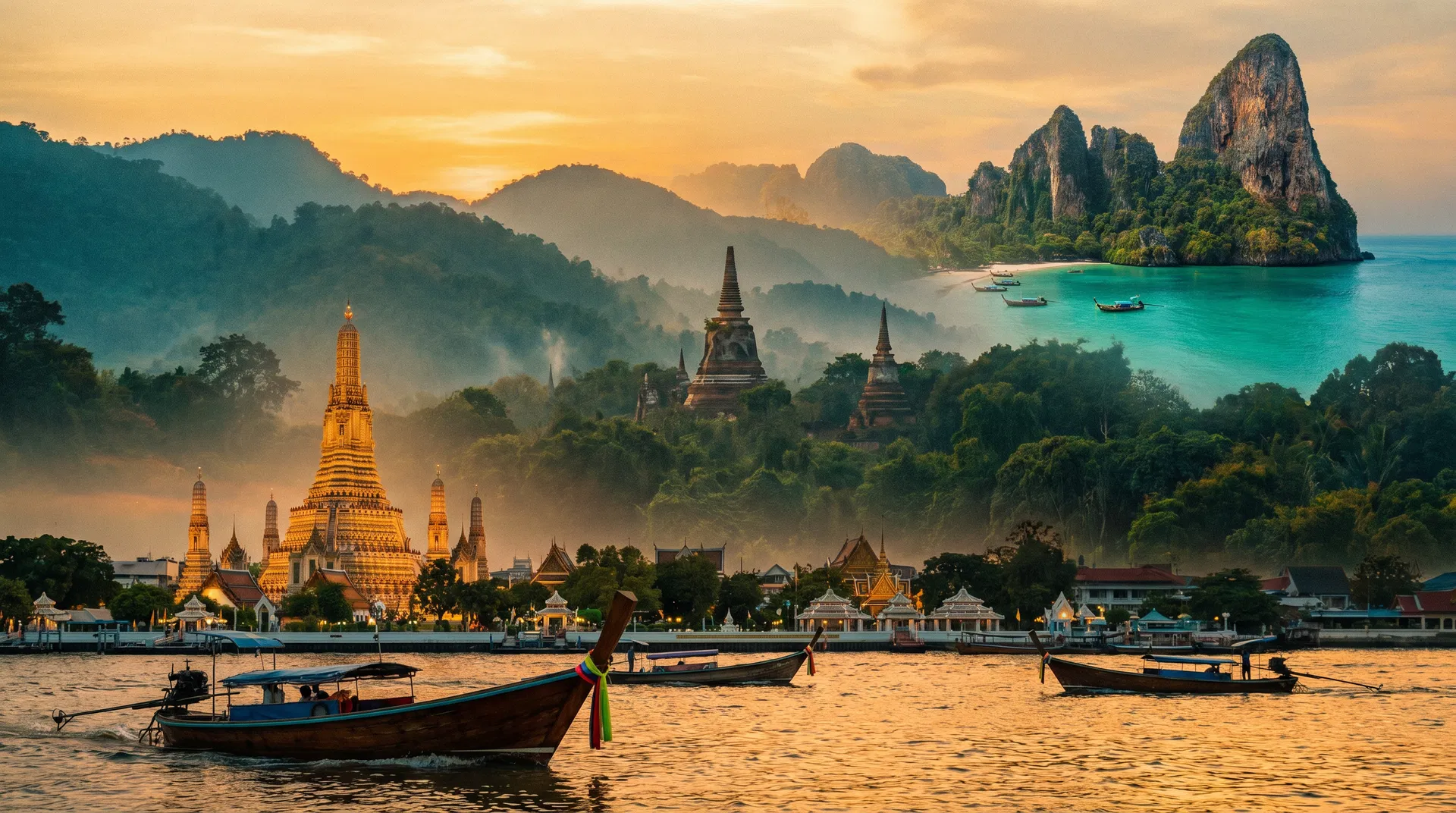
Thailand in Two Weeks: The Bangkok to Chiang Mai Journey That Will Ruin Every Other Trip for You
Destination: Thailand
Category: Destination Guides
There's a reason Thailand is the most-visited country in Southeast Asia. It's not one reason, actually — it's about forty of them, all hitting you simultaneously the moment you step off the plane and into the thick, jasmine-scented air of Bangkok. The heat is immediate and total. The noise is symphonic. A tuk-tuk nearly clips your elbow. Somewhere nearby, someone is grilling pork skewers over charcoal, and the smell alone is enough to make you forget you've been traveling for 22 hours.
Thailand does this to people. It overwhelms you first, then it seduces you, and by the time you're on the overnight train north to Chiang Mai watching rice paddies blur past in the dark, you've already started calculating how soon you can come back.
Two weeks is the sweet spot. Long enough to feel the full arc of the country — the frenetic urban pulse of Bangkok, the ancient temple silence of the north, the turquoise water and limestone karst drama of the south — without rushing through any of it. This is the itinerary that makes sense. Not the one that tries to squeeze in every island and every city in a blur of airports and sunburns. The one that lets Thailand actually land.
Why Thailand Still Earns Every Superlative
Before we get into the logistics, let's address the elephant in the room (sometimes literally): Thailand is one of the most-written-about destinations on the planet. Every travel blog has a Thailand post. Every Instagram feed has the Phi Phi cliffs. Every Reddit thread has someone asking whether it's "still worth it" or "too touristy now."
The answer, from everyone who's actually been recently, is an emphatic yes — with one caveat. The Thailand that rewards you is the one you approach with a little intention. Show up with a plan, even a loose one, and you'll find a country that still has the power to genuinely surprise you. Show up expecting the Instagram version and you'll spend two weeks in a loop of crowded viewpoints and overpriced beach clubs.
The food alone justifies the flight. Thailand has more Michelin-starred restaurants per capita than most European countries, but the more relevant statistic is that a bowl of khao soi in Chiang Mai that costs 60 baht — less than two dollars — will be one of the best things you eat in your life. The temples are extraordinary, the people are genuinely warm in a way that doesn't feel performed, and the infrastructure for travelers is so well-developed that logistics that would be nightmarish in other Southeast Asian countries are almost frictionless here.
The Itinerary: Two Weeks, Three Worlds
Days 1–5: Bangkok — The City That Never Lets You Sleep
Land at Suvarnabhumi, take the Airport Rail Link to the city (45 minutes, 45 baht — don't take a taxi your first day, you'll sit in traffic for two hours), and check in somewhere in the Silom or Riverside area. Drop your bags. Go eat immediately.
Bangkok rewards the curious and punishes the passive. The city has a way of presenting itself in layers — the tourist layer is real and fine, but beneath it is one of the most complex, alive urban environments in Asia. The key is to move between neighborhoods rather than anchoring yourself to Khao San Road, which is essentially a theme park for backpackers and has very little to do with actual Bangkok.
The Grand Palace and Wat Phra Kaew are non-negotiable on day one, not because they're on every list but because they're genuinely staggering — the scale of the complex, the detail of the mosaic work, the sheer accumulated weight of centuries of Thai history. Go early (before 9am) to beat the crowds and the heat. Dress appropriately — shoulders and knees covered — or you'll be renting a sarong at the gate.
Wat Pho, a five-minute walk from the Grand Palace, houses the 46-meter reclining Buddha and some of the finest traditional Thai massage schools in the country. Book a massage here. It costs about 260 baht for an hour and it's the real thing, not the tourist-facing version you'll find on Khao San Road.
The Chatuchak Weekend Market is the largest market in the world — 15,000 stalls across 35 acres — and it's exactly as overwhelming as that sounds. Go with a plan (the market is organized by section; download a map) and budget three to four hours. The food section alone is worth the trip.
For evenings, Bangkok's rooftop bar scene is legitimately world-class. Vertigo at the Banyan Tree and Sky Bar at Lebua (yes, the one from The Hangover Part II) offer views that justify the cocktail prices. But the more interesting evening move is a long-tail boat ride along the Chao Phraya River at dusk, watching the temple spires catch the last of the light while the city hums around you.
Day four, take the train to Ayutthaya — the ancient capital, 80 kilometers north, a UNESCO World Heritage Site that most Bangkok visitors skip entirely. The ruins are extraordinary: headless Buddha statues draped in saffron robes, crumbling prangs rising from the flat plains, a sense of scale and age that Bangkok's modernity can't provide. You can do it as a day trip or stay overnight; overnight is better.
For the full Bangkok deep-dive — street food routes, neighborhood guides, the best rooftop bars, and day trip logistics — our Bangkok 5-Day Itinerary covers every detail. If you're traveling solo, the Bangkok Solo Travel Guide is built specifically for independent travelers navigating the city on their own terms.
Days 6–10: Chiang Mai — The North That Changes Everything
The overnight train from Bangkok's Hua Lamphong station to Chiang Mai is one of the great travel experiences in Southeast Asia. Book a second-class sleeper (about $20–25), watch the city give way to countryside, eat the dining car's surprisingly decent pad thai, and wake up pulling into Chiang Mai station as the morning mist is still lifting off the mountains. It's a 12–13 hour journey that feels like a transition between two entirely different countries.
Chiang Mai is Bangkok's opposite in almost every way. Where Bangkok is relentless, Chiang Mai is contemplative. Where Bangkok is flat and sprawling, Chiang Mai is ringed by mountains. The pace is slower, the air is cooler (especially November through February), and the food — northern Thai cuisine, which is distinct from what most Westerners think of as "Thai food" — is arguably even better.
The Old City is the heart of Chiang Mai: a moat-ringed square kilometer containing over 30 temples, dozens of guesthouses, and the best concentration of restaurants and cafes in northern Thailand. Wat Chedi Luang and Wat Phra Singh are the architectural anchors — both are stunning, both are active temples where monks still live and practice, and both are far less crowded than anything you'll encounter in Bangkok.
The Sunday Walking Street on Wualai Road is one of the best night markets in Thailand — more artisan, more local, less tourist-facing than the Saturday market on Nimman Road. Arrive at sunset and work your way down slowly, eating as you go: sai oua (northern Thai sausage), khao soi (the coconut curry noodle soup that is Chiang Mai's signature dish and one of the greatest bowls of food in the world), and mango sticky rice from the stall that always has the longest line.
Doi Inthanon National Park — Thailand's highest peak, about 90 minutes from the city — is the day trip that most visitors miss and most who do it call the highlight of their trip. The summit is often shrouded in mist, the twin royal chedis are breathtaking, and the waterfalls along the road up are genuinely spectacular. Hire a driver for the day (about 1,500–2,000 baht) rather than renting a scooter; the mountain roads are steep and the trucks are large.
The elephant sanctuary question is one every Chiang Mai visitor faces. The ethical answer is clear: visit a sanctuary that practices observation-only interaction — no riding, no chains, no performance. Elephant Nature Park is the gold standard and books out weeks in advance; reserve before you leave home. A full-day visit costs around $80–100 and is one of the most moving experiences available anywhere in Southeast Asia.
For the full northern Thailand experience — cooking classes, temple routes, the best khao soi spots, and how to structure your days — our Chiang Mai 5-Day Itinerary has everything you need. Couples will find the Chiang Mai for Couples guide particularly useful for the most romantic spots in the city and surrounding mountains.
Days 11–14: The South — Choose Your Island
This is where the itinerary branches, and the right choice depends entirely on what you want from your final four days.
If you want dramatic scenery and adventure: Krabi and the Railay Peninsula. Accessible only by longtail boat (the road is cut off by limestone cliffs), Railay is one of the most visually extraordinary places in Southeast Asia — towering karst formations rising directly from turquoise water, with some of the best rock climbing in Asia bolted into the cliff faces. The snorkeling at Phra Nang Cave Beach is exceptional. The sunsets are the kind that make you put your phone away.
If you want the classic Thai island experience: Koh Phi Phi. Yes, it's famous. Yes, it gets crowded. But Maya Bay — the beach from The Beach — has been closed and reopened with strict visitor limits, and the surrounding water is as clear and blue as anything you'll find in the Mediterranean. The diving around Phi Phi is world-class, and the island's party scene, while real, is easy to avoid if you stay on the quieter eastern side.
If you want luxury and ease: Koh Samui. The most developed of Thailand's islands, with international-standard resorts, excellent restaurants, and the kind of infrastructure that makes a four-day wind-down genuinely restful. The Ang Thong Marine National Park day trip — 42 islands in a protected archipelago — is one of the best boat days in Thailand.
If you want the real thing, away from the crowds: Koh Lanta or Koh Tao. Koh Lanta is a long, relatively undeveloped island with excellent beaches and a Malay-influenced old town that feels a world away from the Koh Phi Phi party circuit. Koh Tao is the best place in Southeast Asia to get your PADI open water certification — the diving is exceptional, the prices are low, and the island has maintained a backpacker character that feels increasingly rare.
For couples heading south, our Krabi for Couples guide covers the Railay Peninsula and island-hopping in detail. The Phuket for Couples itinerary is the right resource if you're after the resort experience with day trips to Phi Phi and the Similan Islands. And if you're traveling with kids, the Koh Samui Family Holiday guide is built specifically for families navigating the south.
The Practical Stuff That Actually Matters
Getting around: Thailand's domestic flight network is excellent and cheap — Bangkok Airways, Thai AirAsia, and Nok Air all run multiple daily flights between Bangkok, Chiang Mai, and the southern airports (Krabi, Koh Samui, Phuket). For Bangkok to Chiang Mai, the overnight train is the romantic choice; the flight is the efficient one. For the south, fly.
When to go: November through February is the golden window — cool in the north, dry in the south, manageable humidity in Bangkok. March through May is hot everywhere. June through October is monsoon season in the south (the Andaman coast gets the worst of it; the Gulf coast — Koh Samui, Koh Tao — is actually drier during this period). If you're going for the islands, check which coast your island is on before booking.
Money: Thailand is still genuinely affordable by any standard. Budget travelers can live well on $30–40/day. Mid-range travelers spending $80–120/day will eat at excellent restaurants, stay in comfortable hotels, and do every activity on this list. The Thai baht is stable; ATMs are everywhere; most markets are cash-only.
Visas: Most Western passport holders receive a 30-day visa on arrival, extendable once at any immigration office for 1,900 baht. Thailand recently extended visa-free stays to 60 days for many nationalities — check the current rules for your passport before you travel.
The one thing everyone gets wrong: Trying to do too much. Thailand is large, the traffic is real, and the distances between destinations are longer than they look on a map. Two weeks is enough to do Bangkok, Chiang Mai, and one southern destination properly. It is not enough to do Bangkok, Chiang Mai, Pai, Ayutthaya, Koh Phi Phi, Koh Samui, and Phuket. Pick your priorities. Go deep rather than wide. The country will reward you for it.
The Part No One Tells You
Thailand has a way of getting under your skin that's different from other destinations. It's not just the food, though the food is extraordinary. It's not just the temples, though the temples are genuinely moving. It's something about the texture of daily life there — the morning alms-giving ceremonies where monks in saffron walk silently through the streets, the spirit houses outside every building draped with offerings of jasmine and incense, the way a city of 10 million people somehow maintains a quality of warmth and patience that most cities a tenth the size have lost.
You'll notice it in small moments. The guesthouse owner in Chiang Mai who draws you a hand-drawn map of the best khao soi spots in the neighborhood. The tuk-tuk driver in Bangkok who, when you tell him you're lost, doesn't just drop you at the nearest landmark but walks you to the door. The family at the table next to you at a roadside restaurant who, noticing you're eating alone, starts passing dishes over without being asked.
Thailand is not a perfect country — no country is — and the tourist infrastructure, particularly in the south, has created its own set of problems. But the core of it, the thing that keeps people coming back year after year, is still very much intact. Go find it.
Ready to start planning? Use Ask Leif to build your custom Thailand itinerary — day by day, tailored to your travel style, budget, and the experiences that matter most to you.