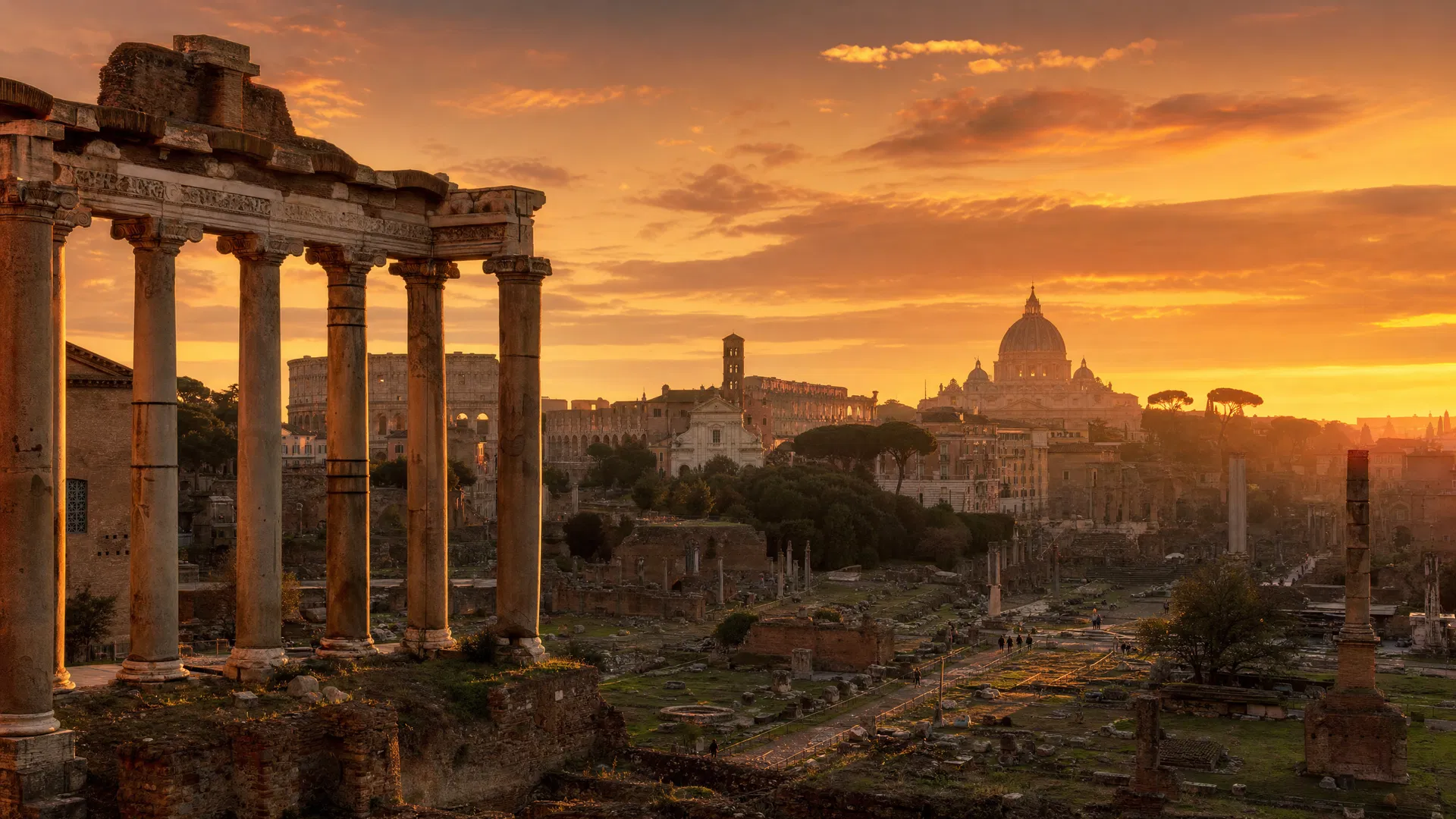
Rome, Italy: How to Visit the Most Overwhelming City on Earth and Actually Love It
Destination: Rome, Italy
Category: Destination Guides
Rome, Italy: How to Visit the Most Overwhelming City on Earth and Actually Love It
There is a moment that happens to almost every first-time visitor to Rome, usually on the second day. You've done the Colosseum, you've thrown your coin in the Trevi Fountain, you've stood in the Vatican and tried to absorb the Sistine Chapel while being gently elbowed by 400 other people doing the same thing. And then, somewhere between the gelato and the evening aperitivo, something shifts. The city stops being a checklist and starts being a place. The cobblestones stop being picturesque and start being the actual ground you're walking on. The noise, the chaos, the layers upon layers of history stacked on top of each other like geological sediment — it stops being overwhelming and starts being the point.
Rome is the most demanding city in Europe. It asks more of you than Paris or Barcelona or Prague. It doesn't organize itself for your convenience. The streets don't make sense, the restaurant hours will confuse you, the traffic will terrify you, and the sheer density of things worth seeing will make you feel perpetually behind. But the cities that ask the most of you are always the ones that give the most back. Rome rewards patience, curiosity, and the willingness to get genuinely lost. This guide is about how to get there faster.
The City in Layers: Understanding Rome Before You Arrive
Rome is not one city. It's about thirty cities stacked on top of each other across three thousand years, and the reason it feels overwhelming is that all of them are simultaneously visible. You can stand at a single intersection and see a medieval church built on top of a Roman temple that was itself built on top of an even older structure. The Pantheon — still the best-preserved ancient building on earth — has been in continuous use since 125 AD. The Colosseum was already ancient when the medieval city grew up around it. The Renaissance palaces were built using stones quarried from the Forum.
This layering is what makes Rome unlike anywhere else. Every other great European city has a dominant historical period — Paris is Haussmann's 19th century, Barcelona is Gaudí's modernisme, Prague is its medieval core. Rome has no dominant period because every period is equally present. Ancient, medieval, Renaissance, Baroque, Fascist, and contemporary Rome all coexist in the same neighborhoods, sometimes in the same block.
The practical implication: don't try to see Rome chronologically or thematically. Don't save the ancient sites for one day and the Renaissance for another. Walk through it the way the city actually exists — all at once, in layers, with the understanding that you will never see all of it and that's exactly as it should be.
The Neighborhoods: Where Rome Actually Lives
Centro Storico — The Historic Center
This is the Rome of the postcards: the Pantheon, the Piazza Navona, the Campo de' Fiori, the Trevi Fountain. It's also the most tourist-dense part of the city, which means it can feel like a theme park during peak hours. The trick is timing. Get up at 6 AM and walk to the Trevi Fountain. You'll have it almost to yourself. The light at dawn on the travertine marble is something the midday crowds never see. The Pantheon at 9 AM, before the tour groups arrive, is a completely different experience than the Pantheon at noon.
The Centro Storico is also where you'll find the best coffee bars, because the locals who live here have been training baristas for generations. Stand at the counter — always stand, never sit unless you want to pay tourist prices — and order a caffè. Drink it in thirty seconds. Order another one. This is how Rome works.
Trastevere — The Neighborhood That Kept Its Soul
Cross the Tiber and you're in Trastevere, and the city changes register entirely. The streets narrow to barely a car's width, the buildings lean toward each other overhead, the laundry hangs between windows, and the restaurants spill out onto the cobblestones at night. Trastevere is where Romans go when they want to feel like they're still in Rome and not in a museum.
It's also where you'll find the best neighborhood restaurants — the ones without English menus, without photos of the food, without a doorman trying to pull you inside. The rule in Rome is simple: if someone is actively trying to get you to eat at their restaurant, don't eat there. The good places don't need to advertise. They're full by 8 PM and closed by midnight and they've been feeding the same families for forty years.
The Basilica di Santa Maria in Trastevere is one of Rome's oldest churches and one of its most beautiful, and at almost any hour you can walk in for free and sit in the golden mosaic light for as long as you want. This is the thing most visitors miss about Rome: the churches are free, they're everywhere, and they contain some of the greatest art in human history. Every church in Rome is a museum that doesn't charge admission.
Testaccio — Where Romans Actually Eat
If Trastevere is the neighborhood that kept its soul, Testaccio is the neighborhood that never lost it. Built around Rome's former slaughterhouse — now converted into a contemporary arts complex — Testaccio is the working-class heart of Roman food culture. This is where cacio e pepe was invented, where carbonara was perfected, where the fifth quarter (offal, tripe, oxtail) became a culinary tradition out of necessity and stayed because it's extraordinary.
The Testaccio Market is the best food market in Rome. Not the most photogenic, not the most famous, but the best — the one where actual Romans buy their produce, their cheese, their cured meats. Go on a weekday morning, eat a supplì (Rome's fried rice ball, not to be confused with Sicily's arancini), drink a glass of house white at one of the market bars, and understand that this is what Italian food actually is when it's not performing for tourists.
Pigneto and Prati — The Neighborhoods Worth Knowing
Pigneto, east of the center, is Rome's creative neighborhood — the one that hasn't been fully gentrified yet, where the aperitivo bars are cheap and the crowd is young and local. Prati, across the Tiber from the Vatican, is the neighborhood where the Vatican employees live, which means it has excellent restaurants that cater to people who eat well every day and don't want to pay tourist prices. Both are worth an evening.
The Monuments: How to See Them Without Losing Your Mind
The Colosseum
Book your tickets online, in advance, always. The line for walk-up tickets can be three hours on a summer morning. The skip-the-line ticket costs the same and saves your entire day. The underground tour — which takes you into the hypogeum, the network of tunnels beneath the arena floor where the gladiators and animals were held before combat — is worth the extra cost. It's the part of the Colosseum that most visitors never see, and it's the part that makes the whole thing click into focus.
The Rome 5-Day First-Timer Itinerary builds the Colosseum into Day 1 with the Roman Forum and Palatine Hill included on the same ticket — the combination that makes the most sense historically and logistically. The Forum is where Roman public life happened; the Palatine Hill is where the emperors lived; the Colosseum is where they entertained the people. Together, they're the complete picture of how Rome worked at its height.
The Vatican
The Vatican Museums contain one of the greatest art collections in human history, and the experience of seeing them is frequently terrible. The crowds in summer are genuinely oppressive — 20,000 people a day moving through corridors designed for a fraction of that number, all trying to reach the Sistine Chapel at the same time. The solution is to book the first entry of the day (8 AM) or the last (the evening tours that run in summer). The early morning visit gives you the Raphael Rooms and the Sistine Chapel in relative quiet. The evening visits give you the whole complex with dramatically better light and dramatically fewer people.
St. Peter's Basilica is free and does not require a ticket. Get there at 7:30 AM, before the tour groups arrive, and you'll walk into the largest church in the world with almost no one else in it. The scale of the place — Michelangelo's dome, Bernini's baldachin, the sheer accumulated weight of two thousand years of Catholic history — hits differently when you're not being jostled.
The Pantheon
The Pantheon is the most perfectly preserved ancient building on earth, and it's been in continuous use since 125 AD. It's also, since 2023, ticketed — €5 to enter, which has actually helped with crowds. Go in the morning, stand under the oculus (the 27-foot hole in the dome that is the only source of light), and look up. On rainy days, the rain falls straight through onto the slightly sloped floor and drains away through ancient Roman drainage channels that still work perfectly. The engineering is 1,900 years old and it still works. That's Rome.
The Trevi Fountain
Go at dawn. This is not a suggestion. The Trevi Fountain at 6 AM, with the light just starting to catch the marble and the square almost empty, is one of the genuinely beautiful experiences Rome offers. The Trevi Fountain at 2 PM in July is a crowd management problem. Same fountain, completely different experience.
The Food: What to Eat, Where to Eat It, and What to Avoid
Roman food is one of the great regional cuisines of Italy, which is to say it's one of the great cuisines of the world. It's also one of the most misunderstood, because the tourist-facing version of Roman food — the carbonara made with cream, the cacio e pepe with too much pepper and not enough technique, the pizza with toppings that would make a Roman wince — bears only a passing resemblance to the real thing.
The Four Pastas
Roman pasta culture is built on four dishes: cacio e pepe (cheese and pepper), carbonara (egg, guanciale, cheese), amatriciana (tomato, guanciale, pecorino), and gricia (guanciale, pecorino, no tomato). Each one is technically simple and extraordinarily difficult to execute well. The difference between a good carbonara and a great one is the emulsification of the egg yolk and the fat from the guanciale — a technique that takes years to master and that no amount of cream can replicate.
The Rome Food & Culinary Journey Guide covers the best spots for each of these dishes by neighborhood, including the Testaccio restaurants that have been making them the same way for generations. The rule: avoid any restaurant near the major monuments. Walk five minutes in any direction and the quality improves dramatically and the prices drop by a third.
Gelato
The gelato rule is visual: look for muted colors and flat surfaces. Bright colors and enormous puffy swirls mean artificial flavors and lots of air. Real gelato is denser, less sweet, and stored in metal containers with lids. The flavors that reveal a gelateria's quality are the simple ones — fior di latte (plain cream), pistachio, and nocciola (hazelnut). If those are good, everything else will be good.
Coffee
Rome's coffee culture is one of the things that ruins you for everywhere else. A perfect espresso, standing at a bar, costs €1–1.50. The same espresso sitting at a table outside costs €3–5. Always stand. Always order a caffè (espresso) unless you specifically want something else. Cappuccino is a morning drink — ordering one after noon marks you as a tourist immediately, which is fine, but know that you're doing it.
What to Avoid
Any restaurant with photos of the food on the menu. Any restaurant with a doorman. Any restaurant within 200 meters of the Colosseum, the Trevi Fountain, or the Vatican. The bread they bring to the table at the start of the meal is not free — it's a cover charge called coperto, typically €2–3 per person. If you don't want it, say so immediately.
Planning Your Trip: Which Itinerary Is Right for You
Rome rewards time. A weekend is enough to see the major monuments and eat well. Five days is enough to start understanding the city. A week is enough to begin to feel at home. The question is what kind of trip you want.
For first-timers who want to cover the essential ground without feeling rushed, the 5-Day Rome First-Timer Itinerary structures the week to avoid the most common mistakes — front-loading the Vatican on Day 1 when you're fresh, building in the afternoon rest that Romans themselves observe, and saving Trastevere for the evenings when it's at its best.
Traveling as a couple? The Rome Couples Itinerary leans into the romantic architecture of the city — the rooftop terraces, the evening passeggiata, the wine bars in the Jewish Ghetto — while still covering the monuments that make Rome worth the flight.
On a tight budget? Rome is actually one of Europe's more manageable cities if you know how to navigate it. The Rome Budget Guide shows how to do five days for around €60/day — including accommodation, food, and entry fees — by eating at the market, using the free churches, and timing the paid attractions strategically.
Traveling solo? The Solo Rome Itinerary is built for independent travelers who want to move at their own pace — including the neighborhoods and experiences that are actually better alone, like the early morning Colosseum visit and the long afternoon in Villa Borghese.
Bringing the family? The Rome Family Itinerary and the Rome with Kids Guide both tackle the specific challenge of keeping children engaged in a city that is primarily ancient and religious — with the gladiator school experiences, the underground tours, and the gelato strategy that makes the monument visits sustainable.
And for the food obsessives — the people who plan trips around what they're going to eat — the Rome Food Guide is built around the four pasta masters, the Testaccio market, the wine bars of the Ghetto, and the specific restaurants that Romans actually go to when they want to eat well.
The Practical Stuff Nobody Puts in the Guidebooks
Getting Around
Rome's metro is small — two main lines, neither of which covers the historic center particularly well, because every time they try to dig a new line they find ancient ruins and have to stop. The bus system is extensive but confusing. The best way to get around Rome is on foot, which is also the best way to see it. The historic center is walkable — the Colosseum to the Pantheon is about 25 minutes on foot, the Pantheon to the Trevi Fountain is 10 minutes, Trastevere to the Vatican is 20 minutes.
Taxis are metered and legitimate. The scam is the unofficial taxis at the airport — always use the official white taxis with the meter running, or book a car service in advance. The car service costs about €20 more than a taxi and is worth every euro for the peace of mind after a long flight.
The Fountains
Rome has over 2,500 drinking fountains — the nasoni, the little iron spigots that run constantly throughout the city. The water is cold, clean, and delicious. Carry a reusable bottle and fill it at the fountains. This is what Romans do. The water from the nasoni is the same water that feeds the Trevi Fountain — it comes from the same ancient aqueduct system that has been supplying Rome since 19 BC.
The Midday Break
Many Roman restaurants close between 3 PM and 7 PM. This is not a mistake or an inconvenience — it's a feature. Plan your eating schedule around it. Lunch by 1:30 PM, dinner no earlier than 8 PM (Romans eat late, and the best restaurants fill up between 8:30 and 9:30 PM). Carry snacks for the afternoon gap. The city is actually quieter and more pleasant during the midday hours, which makes it a good time for churches and neighborhoods rather than restaurants.
Pickpockets
They exist, they're skilled, and they work in teams. The person who approaches you with a petition to sign, a bracelet to give you, or a question to ask is almost always working with someone else who is behind you. Keep your wallet in a front pocket or a money belt. Don't put anything in your back pocket. Be especially careful on the bus and metro, in crowds around the major monuments, and anywhere someone is trying to get your attention.
The Dress Code
The Vatican and many of Rome's churches require covered shoulders and knees. This is enforced. Carry a scarf or a light layer that you can put on at the entrance. The Vatican will turn you away at the door if you're not appropriately dressed, and the line to get back in is not short.
When to Go
April, May, September, and October are the best months — warm enough for outdoor dining and evening walks, cool enough for comfortable sightseeing. June through August is hot, crowded, and expensive. July and August in particular are brutal — 35°C heat, 6 AM queues at the Colosseum, and the sense that you're sharing the city with everyone who has ever wanted to visit it simultaneously. November through March is quieter, cheaper, and cooler — the monuments are less crowded, the restaurants are more relaxed, and the city feels more like itself.
The Thing About Rome
Every city has a version of itself that it shows to tourists and a version that it keeps for the people who live there. In most cities, the tourist version is a simplified, sanitized edition of the real thing. In Rome, the tourist version is genuinely extraordinary — the Colosseum, the Vatican, the Trevi Fountain, the Forum — and the real version is even better. The neighborhood restaurants, the morning fountains, the free churches, the 6 AM Trastevere walk when the city belongs to the bakers and the street cleaners and the cats — that's the Rome that ruins you for everywhere else.
The goal isn't to avoid the monuments. The goal is to see the monuments and then keep going, past the tourist infrastructure and into the city itself. Rome is three thousand years old. It has been absorbing visitors since the Roman Empire made it the center of the known world. It knows how to handle you. Let it.
When you're ready to stop reading about Rome and start planning the actual trip, Leif builds your complete Rome itinerary — day by day, around your travel style, your budget, and how you actually want to spend your time. Not a template. Not a generic five-day plan. Your Rome, built for you.