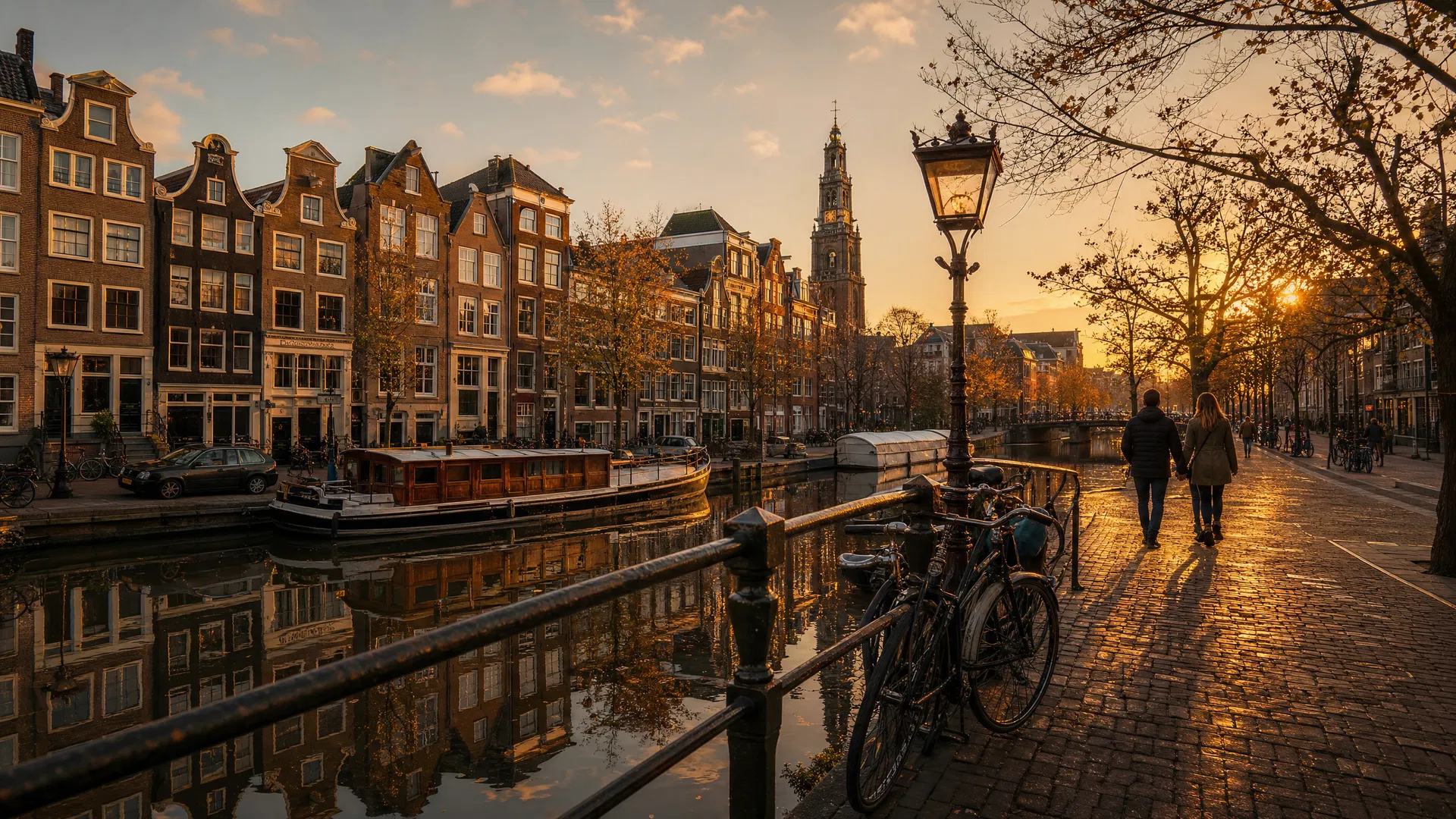
Amsterdam: The Most Misunderstood City in Europe
Destination: Amsterdam, Netherlands
Category: Destination Guides
Amsterdam: The Most Misunderstood City in Europe
Most people think they know Amsterdam before they arrive. They've seen the photos: the canal houses leaning at impossible angles, the bicycles stacked three deep along the bridges, the tulip fields in every direction. They've heard the reputation — the coffee shops, the Red Light District, the liberal everything. They arrive expecting a party city with pretty canals and leave having experienced something they didn't expect at all: a city of extraordinary depth, genuine beauty, and a culture that has been quietly doing things differently from the rest of Europe for four hundred years.
Amsterdam is the most misunderstood city on the continent. The reputation isn't wrong — the coffee shops exist, the Red Light District is real, the nightlife is genuinely world-class — but it's a fraction of what the city actually is. The other fraction is one of the great art collections in human history, a canal network that's been a UNESCO World Heritage Site since 2010, a food scene that's been quietly becoming one of Europe's most interesting, and a cycling culture so embedded in daily life that the city has essentially solved urban transportation in a way that every other city is still trying to figure out.
This is the guide for the Amsterdam that most visitors miss.
The City on Water: Understanding Amsterdam Before You Arrive
Amsterdam was built on a swamp. This is not a metaphor — the city literally sits on millions of wooden piles driven into the soft peat soil of the Dutch delta, and the entire historic center is built on land that was reclaimed from the water over several centuries. The canal ring that defines the city's shape — the Grachtengordel, with its three concentric semicircles of Herengracht, Keizersgracht, and Prinsengracht — was engineered in the 17th century as both a drainage system and a commercial waterway, and it's so well-designed that it still functions essentially as it was built.
The 17th century is the key to understanding Amsterdam. The Dutch Golden Age — roughly 1585 to 1700 — was when the Dutch Republic became the wealthiest nation on earth, when the Dutch East India Company was the most powerful corporation in history, when Amsterdam was the center of global trade, finance, art, and intellectual life. The city you walk through today was largely built during this period: the canal houses, the Rijksmuseum's collection, the Westerkerk, the Jewish Quarter. The Amsterdam of the Golden Age is still the Amsterdam of today, which is either a remarkable achievement of preservation or a city that peaked four hundred years ago and has been living off the interest ever since — depending on who you ask.
The practical implication: Amsterdam is a small city with an enormous amount in it. The historic center is walkable in a way that few major European cities are. The Rijksmuseum to the Van Gogh Museum is a five-minute walk. The Anne Frank House to the Westerkerk is two minutes. The Jordaan neighborhood — one of the most beautiful urban neighborhoods in Europe — is a 15-minute walk from Central Station. You don't need a car, you barely need public transport, and you can cover an enormous amount of ground on foot or by bicycle.
The Neighborhoods: Where Amsterdam Actually Lives
The Jordaan — The Neighborhood That Defines the City
If you have one afternoon in Amsterdam, spend it in the Jordaan. Built in the 17th century as a working-class neighborhood adjacent to the wealthy canal ring, the Jordaan has spent the last forty years gentrifying into one of the most beautiful and livable urban neighborhoods in Europe without losing the qualities that made it worth gentrifying in the first place. The streets are narrow, the canal houses lean at angles that suggest they're having a conversation with each other, the brown cafés (bruine kroegen — the traditional Dutch pubs, named for the tobacco-stained walls) have been serving the same neighborhood for generations.
The Jordaan is also where you'll find the Noordermarkt, Amsterdam's best Saturday market — the organic farmers' market in the morning, the flea market in the afternoon. Come early, buy cheese, drink coffee at one of the outdoor stalls, and understand that this is what Amsterdam looks like when it's not performing for tourists.
De Pijp — The Neighborhood That Grew Up
South of the center, De Pijp was Amsterdam's working-class immigrant neighborhood for most of the 20th century and has spent the 21st century becoming the city's most interesting food and nightlife district. The Albert Cuyp Market — the longest outdoor market in the Netherlands, running the length of Albert Cuypstraat every day except Sunday — is the best street food market in the city: stroopwafels made fresh, raw herring with onions, Indonesian snacks, Surinamese roti, Dutch cheese in quantities that seem implausible.
De Pijp is also where you'll find the best Indonesian food in Europe, which is a direct consequence of Dutch colonial history. The Netherlands colonized Indonesia for 350 years, and the culinary legacy is a rijsttafel — a "rice table" of 15–25 small Indonesian dishes served together — that has become one of the defining eating experiences of Amsterdam. The Amsterdam Food Guide covers the best rijsttafel restaurants in De Pijp alongside the Dutch classics (bitterballen, herring, stroopwafels) and the Indonesian street food that most visitors never find.
The Canal Ring — The Postcard Made Real
The Grachtengordel is what Amsterdam looks like in every photograph, and it's genuinely as beautiful as advertised — the 17th-century canal houses with their distinctive gabled facades, the bridges with their iron railings, the houseboats moored along the water. The difference between seeing it in a photograph and walking through it is the scale: the canal houses are narrower than you expect (they were taxed by frontage width, so they were built tall and deep rather than wide), the canals are closer together, the whole thing is more intimate and more human than the photographs suggest.
The best way to see the canal ring is on foot, in the early morning before the tourist boats start running, when the light on the water is still and the city is quiet. The second best way is by bicycle, which is how the locals see it every day. The third best way is by canal boat, which is how most tourists see it and which is genuinely pleasant even if it's the most obviously tourist thing you can do in Amsterdam.
Amsterdam Noord — The City's New Frontier
Cross the IJ river on the free ferry from behind Central Station and you're in Amsterdam Noord, the post-industrial neighborhood that has spent the last decade becoming the city's creative hub. The NDSM Wharf — a former shipyard turned arts complex — hosts flea markets, festivals, and street art on a scale that makes Shoreditch look modest. The Eye Film Museum, designed by Delugan Meissl Associated Architects, is one of the most striking contemporary buildings in the Netherlands. The food scene is younger, cheaper, and more experimental than the center.
Noord is worth a half-day, especially on a Sunday when the IJ-Hallen flea market runs — one of the largest flea markets in Europe, held in the former NDSM shipyard, where you can spend hours finding things you didn't know you needed.
The Museums: What to See and How to See It
The Rijksmuseum
The Rijksmuseum is one of the great art museums of the world, and the experience of seeing it is significantly better than most people expect. The 2013 renovation by Cruz y Ortiz Arquitectos transformed a Victorian-era building into one of the best museum spaces in Europe — the light is extraordinary, the layout is logical, and the collection is presented in a way that makes the Dutch Golden Age feel genuinely alive rather than historically distant.
The collection's centerpiece is Rembrandt's The Night Watch — the largest and most technically complex painting in the museum, displayed in its own room designed specifically around it. But the Rijksmuseum is also where you'll find Vermeer's The Milkmaid, Jan Steen's domestic comedies, and the extraordinary collection of Delftware that explains why Dutch blue-and-white ceramics became a global phenomenon. Book tickets in advance — the Rijksmuseum is consistently one of the most visited museums in Europe and the queues for walk-up tickets can be substantial.
The Van Gogh Museum
The Van Gogh Museum is the most visited museum in the Netherlands and one of the most visited in the world, and it earns the attention. The collection — assembled largely from the estate of Theo van Gogh, Vincent's brother — traces the complete arc of Van Gogh's career from the dark Dutch peasant paintings of the early 1880s through the Japanese-influenced work of Paris to the extraordinary late paintings of Arles and Saint-Rémy. The Sunflowers, The Bedroom, Almond Blossom — these are not reproductions. They're the originals, and the difference between seeing them in a book and standing in front of them is not small.
Book tickets well in advance. The Van Gogh Museum sells out regularly, especially in summer, and there is no walk-up option for the main collection.
The Anne Frank House
The Anne Frank House is not a comfortable experience, and it's not supposed to be. The building where Anne Frank and her family hid for two years before being discovered and deported — the Secret Annex, the bookcase that concealed the entrance, the rooms where eight people lived in hiding — is preserved essentially as it was, and the weight of what happened there is present in every room. It's one of the most important sites in Europe and one of the most emotionally demanding.
Book tickets months in advance if you're visiting in peak season. The Anne Frank House has a timed-entry system and sells out completely during summer. If you can't get a ticket in advance, there's a small allocation released each morning at 9 AM — but the queue forms before 8 AM.
Planning Your Trip: Which Itinerary Fits You
Amsterdam rewards different approaches depending on what you're after. For first-time solo travelers who want to cover the essential ground — the Rijksmuseum, the canal ring, the Jordaan, the Van Gogh Museum — the Amsterdam Solo Itinerary builds a 3-day plan that moves at a pace that lets you actually absorb what you're seeing rather than sprinting between monuments.
Traveling as a couple? Amsterdam is one of the most romantic cities in Europe — the canal houses at dusk, the brown cafés with their candlelit tables, the evening boat tours when the bridges are lit up. The 4-Day Amsterdam Couples Guide leans into the city's most atmospheric experiences, including the Jordaan at night and the best wine bars in the canal ring. For couples who want a longer, more immersive stay, the 5-Day Romantic Amsterdam Itinerary adds day trips to Haarlem and the tulip fields at Keukenhof (in season) and builds in the slower pace that makes Amsterdam feel like a place you've lived in rather than visited.
Bringing the family? Amsterdam is genuinely excellent with children — the NEMO Science Museum (a hands-on science center in a building shaped like a ship's bow), the Artis Zoo (the oldest zoo in the Netherlands, with a planetarium and aquarium), and the canal boat tours all work well for kids. The Amsterdam Family Guide builds a 3-day plan around the city's best family-friendly experiences without sacrificing the things that make Amsterdam worth visiting as an adult.
On a budget? Amsterdam is one of Europe's more expensive cities, but it's manageable if you know how to navigate it. The Amsterdam Budget Guide shows how to do four days for around €70/day — including accommodation, food, and museum entry — by using the Museumkaart (which covers most major museums for a flat annual fee), eating at the Albert Cuyp Market, and timing the paid attractions strategically.
And for the food-focused traveler — the person who plans trips around what they're going to eat — the Amsterdam Food Guide is built around the rijsttafel tradition, the Indonesian street food of De Pijp, the Dutch classics (herring, stroopwafels, bitterballen), and the wine bars and brown cafés that define Amsterdam's drinking culture.
The Day Trip: Rotterdam
An hour south of Amsterdam by train, Rotterdam is the anti-Amsterdam — a city that was bombed flat in 1940 and rebuilt as a laboratory for contemporary architecture, and which has spent the last eighty years becoming one of the most architecturally interesting cities in Europe. The Cube Houses by Piet Blom, the Markthal (a market hall inside a residential building, with a 40-meter-high ceiling covered in a photographic mural), the Erasmus Bridge, the Museum Boijmans Van Beuningen — Rotterdam is what happens when a city has to rebuild from scratch and decides to do it with ambition.
The Rotterdam Day Trip Guide covers the city's architectural highlights, the Markthal food scene, and the best way to combine Rotterdam with a day in Delft (30 minutes away by train) for the complete Dutch experience.
The Practical Stuff: What Nobody Tells You
The Bicycle Problem
Amsterdam has 900,000 bicycles and 800,000 people. The bicycles are not decorative. They move fast, they have right of way over pedestrians in most situations, and the cyclists will not slow down for you. The most dangerous thing you can do in Amsterdam is step into a bike lane without looking. The second most dangerous thing is renting a bicycle without understanding the traffic rules. If you're going to rent a bike — and you should, because it's the best way to see the city — spend 10 minutes watching how the locals ride before you get on.
The Tram System
Amsterdam's tram network is excellent and covers the entire city. The GVB day pass (€9.50 for 24 hours) covers all trams, buses, and metro lines and is worth buying if you're planning to move around the city. The trams are frequent, punctual, and clearly signed. The only complication is that they share lanes with cyclists and pedestrians in the historic center, which means they move slowly through the busiest areas.
The Coffee Shops
The coffee shops are legal, regulated, and exactly what they appear to be. If you're going, know that the legal limit for purchase is 5 grams per person per visit, that you must be 18 or older, and that you cannot consume on the street. The quality varies enormously — the tourist-facing shops near Central Station are generally lower quality than the neighborhood shops in the Jordaan or De Pijp. The staff at any reputable shop will tell you what they have and what the effects are likely to be; ask if you're not sure.
The Herring
Raw herring — maatjes haring — is the Dutch national snack, and the correct way to eat it is standing at a herring cart, holding the fish by the tail, and lowering it into your mouth in one bite. This sounds alarming and tastes extraordinary. The herring season runs from late May through July, when the new catch arrives and the fish are at their sweetest. The Albert Cuyp Market has several excellent herring carts; so does the Vismarkt near the Centraal Station.
The Rain
Amsterdam gets about 840mm of rain per year, distributed fairly evenly across all twelve months. This is not as bad as it sounds — the rain is usually light and intermittent rather than heavy and sustained — but you should pack a waterproof layer regardless of when you're visiting. The upside is that Amsterdam in the rain is genuinely beautiful: the canals reflect the grey sky, the brown cafés feel even more welcoming, and the museums are less crowded.
When to Go
April and May are the best months — the tulip fields at Keukenhof are in bloom, the weather is mild, and the city hasn't yet reached peak tourist density. June through August is warm and crowded. September and October are excellent — the summer crowds have thinned, the light is extraordinary, and the canal ring looks its best in autumn color. November through March is quiet, cheap, and atmospheric — the Christmas markets in December are genuinely beautiful, and the museums are at their least crowded.
The Thing About Amsterdam
Amsterdam is a city that has been misread for centuries. The Dutch Golden Age was misread as mere commercial success when it was actually one of the great intellectual and artistic flowerings in human history. The 20th-century reputation for liberalism was misread as permissiveness when it was actually a deeply pragmatic approach to social problems that the rest of the world is still catching up to. The tourist reputation for coffee shops and canals misses the Rijksmuseum, the Anne Frank House, the Jordaan at 7 AM, the rijsttafel in De Pijp, the free ferry to Noord and the view of the IJ river at dusk.
The city rewards the visitor who arrives without assumptions and leaves with a completely different understanding of what a city can be. It's small enough to know in a week and complex enough to spend a lifetime in. It's beautiful in a way that doesn't announce itself — the beauty is in the proportions, the light on the water, the lean of the canal houses, the sound of bicycle bells in the morning. It's a city that has been doing things its own way for four hundred years and has no particular interest in explaining itself to you.
Which is exactly why it's worth understanding.
When you're ready to stop reading about Amsterdam and start planning the actual trip, Leif builds your complete Amsterdam itinerary — day by day, around your travel style, your budget, and how you actually want to spend your time. Not a template. Your Amsterdam, built for you.