Not Every Beach Deserves a Passport Stamp. These Do.
Destination: Global
Category: variant
There is a specific kind of beach disappointment that only long-haul travelers know. You have flown fourteen hours. You have changed planes twice. You have cleared customs in a language you do not speak. And the beach you arrive at is beautiful — genuinely, photographically beautiful — but it is beautiful in the same way that dozens of beaches you could have reached in two hours are beautiful. The water is blue. The sand is white. The sun is present. You have not discovered something irreplaceable. You have traveled a very long way for something that was already available closer to home.
This list is not about beautiful beaches. It is about beaches that justify the flight specifically because they offer something that cannot exist anywhere closer to home. The selection criterion is irreplaceability: geological formations that exist nowhere else, marine ecosystems that are the most biodiverse on earth, light conditions that require a specific latitude and a specific season, or a combination of landscape and culture that is the product of a particular geography and cannot be replicated elsewhere. Every destination on this list passes a single test: if you could experience this at a beach within four hours of home, you would not need to be here. You cannot. You do.
The world has thousands of beautiful beaches. The Maldives is beautiful. Cancún is beautiful. The Algarve is beautiful. None of them are on this list. Not because they are not worth visiting — they are — but because the experience they offer, while genuinely excellent, is not irreplaceable in the way that the six destinations below are irreplaceable. You can find turquoise water and white sand within a reasonable flight of almost anywhere on earth. You cannot find the specific things described below without going specifically there.
Before we begin: this list is deliberately global and deliberately demanding. Every destination requires a long-haul flight from most origin points. Every destination requires some logistical commitment beyond booking a resort. That commitment is the point. The beaches that require the most effort to reach are, with very few exceptions, the beaches that are most worth reaching. The filter of difficulty is not a bug. It is the feature that keeps them the way they are.
The Faroe Islands: The Beach That Shouldn't Be There
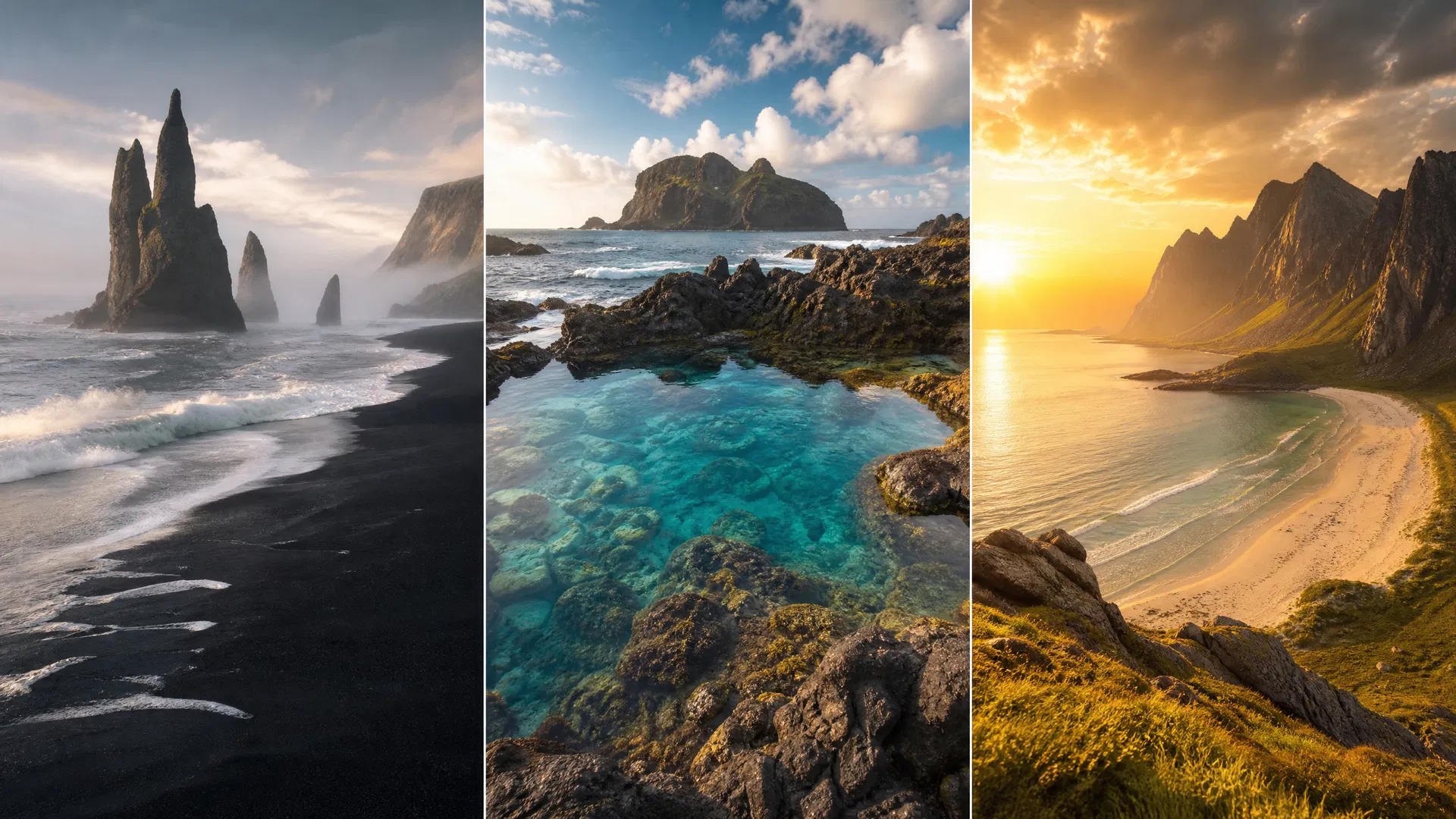
Tjørnuvík beach is a black sand beach at the northern end of Streymoy island, enclosed by 600-meter basalt cliffs on three sides and the open North Atlantic on the fourth. The village behind it has twelve permanent residents. Viking graves have been found in the dunes — the beach has been inhabited since the first Norse settlers arrived in the 9th century, which means it has been exactly this dramatic for at least 1,200 years. From the shoreline, two freestanding sea stacks rise from the water offshore: Risin and Kellingin, the Giant and the Witch, who according to Faroese legend were sent from Iceland to steal the islands and were turned to stone by the rising sun before they could complete the task. The legend is the correct response to the view. There is no rational explanation for why this particular arrangement of rock and water and sky looks the way it does. The mythology is more honest than the geology.
The Faroe Islands are not a beach destination in any conventional sense. The water temperature rarely exceeds 12°C. The weather changes every twenty minutes — sun, horizontal rain, fog, sun again, all before lunch. The beaches are black basalt, not white sand. None of this is a problem. It is the point. The Faroe Islands are the only place in the Atlantic where you can stand on a beach that looks like the edge of the world and feel, with complete conviction, that the world might actually end just beyond the horizon. That specific feeling — the combination of geological drama, Viking history, and North Atlantic weather — does not exist anywhere else.
The practical details that most guides miss: the Sørvágsvatn lake illusion — the lake that appears to float above the ocean due to a specific camera angle from the Trælanípa cliffs — is 45 minutes from Tjørnuvík by car and is the most photographed optical illusion in the North Atlantic. The puffin colonies on Mykines island are accessible by ferry from Sørvágur between May and August and contain the most concentrated puffin population in the North Atlantic. The specific combination of these three things — the Tjørnuvík beach, the Sørvágsvatn illusion, and the Mykines puffins — is available only in the Faroe Islands and only between May and August. The rest of the year the islands are magnificent in a different, more austere way. Both versions are worth the flight.
The Azores: The Beach Formed by Yesterday's Volcano
The Azores are nine volcanic islands in the middle of the Atlantic Ocean, equidistant between Europe and North America, and the beaches here are not beaches in any sense that a Caribbean resort would recognize. The Azores adventure guide covers the full geography, but the specific beach experience that justifies the flight is this: the natural lava pools at Biscoitos on Terceira island, where the Atlantic Ocean fills volcanic rock formations at high tide and leaves behind pools of crystal-clear seawater at low tide, heated slightly by the geothermal activity beneath the island. You are swimming in water that is warmer than the surrounding ocean because the island is still cooling from its last eruption. The geological process that created the pool is still active. This is not a metaphor. The Azores sit on the Mid-Atlantic Ridge — the boundary between the Eurasian and North American tectonic plates — and the islands are the visible surface expression of the same volcanic activity that is slowly widening the Atlantic Ocean by two centimeters per year.
The beach at Praia da Varadouro on Faial island is a black pebble beach at the base of a caldera that last erupted in 1957, adding a new peninsula to the island's western coast. The lava field from that eruption is still visible from the beach — a frozen black landscape that ends abruptly at the waterline, where the Atlantic has been slowly dissolving it for sixty years. Swimming at Praia da Varadouro means swimming at the edge of a geological event that happened within living memory. The fishermen who watched the eruption from their boats are still alive. Their grandchildren run the cafés on the beach.
The Flores island pools at Poço da Ribeira do Ferreiro are the most visually extraordinary swimming experience in the Azores — a series of natural pools fed by a waterfall that drops 30 meters from the volcanic plateau above, surrounded by hydrangeas that grow wild across the entire island in shades of blue and purple that are the product of the volcanic soil chemistry. The hydrangeas are not planted. They are the natural vegetation of an island that has been depositing volcanic minerals into the soil for millions of years. The specific blue of the Flores hydrangeas exists because of the specific mineral composition of the Flores basalt. It cannot be replicated in a garden. It requires the island.
Raja Ampat, Indonesia: The Beach Above the World's Most Biodiverse Ocean
Raja Ampat's 7-day diving guide documents the full experience, but the single fact that justifies the flight is this: Raja Ampat contains more species of fish, coral, and marine invertebrates than anywhere else in the world's oceans. Not more than nearby destinations. More than anywhere. The 1,500 islands of this West Papua archipelago sit at the center of the Coral Triangle — the convergence zone of the Pacific and Indian Ocean currents — and the specific water chemistry, temperature, and current patterns here have produced a marine ecosystem of a complexity that exists nowhere else on the planet. The house reef off the Arborek village jetty, accessible by swimming from shore without scuba equipment, contains coral formations that would be the centerpiece of a marine reserve anywhere else on earth. Here it is the warm-up before breakfast.
The beaches of Raja Ampat are not the point. The beaches are beautiful — white sand, turquoise water, limestone karst formations rising from the sea — but they are the frame around the actual experience, which is underwater. The Dampier Strait between Waigeo and Batanta islands produces the strongest drift diving in Raja Ampat and concentrates the marine life that makes the archipelago's reputation. Cape Kri, the dive site at the tip of the strait, holds the world record for fish species counted in a single dive: 374 species in one hour. That number is not a record in the sense of a competitive achievement. It is a number that describes the density of life in the water at that specific location. Standing on the beach above Cape Kri, looking at the water, you are looking at the most species-dense marine environment on earth. The beach is the viewing platform. The ocean is the destination.
The bioluminescent plankton at Gam Island beach is the competitive gap that almost no mainstream guide covers: on a moonless night, wading into the water at Gam produces blue-green light around every movement of your body. The plankton responds to physical disturbance by emitting bioluminescence — the same chemical process that makes deep-sea creatures glow. At Gam, the plankton concentration is high enough that the effect is visible to the naked eye, not just in long-exposure photographs. You wade into darkness and the water lights up around your hands. This experience requires a moonless night, a specific island in West Papua, and a willingness to wade into the dark ocean. It cannot be replicated anywhere closer to home.
The Skeleton Coast, Namibia: The Beach Where the Desert Has Always Won
Most beaches exist at the boundary between land and water. The Skeleton Coast exists at the boundary between three things: the Namib Desert — the oldest desert on earth, 55 million years old — the cold Benguela Current of the South Atlantic, and the fog that the current generates when it meets the desert air. The result is a coastline unlike anything else on earth: rust-colored sand dunes that descend directly into the ocean, fog so dense that Portuguese sailors called this stretch of coast "the Gates of Hell," and a marine ecosystem that is extraordinarily rich precisely because the cold current that makes the coast so inhospitable also brings the nutrients that support one of the largest seal colonies in the world.
The Namibia safari and road trip guide covers the full overland experience, but the specific beach moment that justifies the flight is Cape Cross: 100,000 Cape fur seals on a beach that is also a desert. The seals are not there because the beach is pleasant. They are there because the cold Benguela Current delivers enormous quantities of fish to this specific stretch of coast, and the seals have been exploiting this resource for longer than humans have been recording it. The Portuguese navigator Diogo Cão erected a stone cross at Cape Cross in 1486 — the first European marker on the Namibian coast — and the seals were already there. They were there before the Portuguese. They will be there after us.
The specific experience of standing on the Skeleton Coast is the experience of a landscape that is indifferent to human presence in a way that most landscapes are not. The fog rolls in from the ocean and reduces visibility to 20 meters. The seal colony produces a noise that is audible from a kilometer away. The dunes behind the beach are the color of dried blood. There are whale bones on the sand — the remnants of the whaling industry that operated here in the 19th century, and before that, the natural strandings that gave the coast its name. The Eduard Bohlen shipwreck, stranded 500 meters inland from the current shoreline because the Namib Desert has grown seaward since 1909, is visible from the beach as a rusted hull half-buried in sand. The desert is winning. It has always been winning. The beach is a temporary truce.
Palawan, Philippines: The Lagoon Inside the Mountain
El Nido, Palawan is the most photographed destination in the Philippines, and the photographs do not exaggerate. The limestone karst formations that rise from the Bacuit Bay are 300 meters tall, their bases undercut by wave action into mushroom shapes, their surfaces draped in jungle vegetation that ends abruptly at the waterline. Between the karst formations, the water is a specific shade of turquoise that is the product of the white limestone sand on the sea floor reflecting light through the shallow water. This color does not exist in deep water. It requires the specific combination of shallow depth, white substrate, and direct tropical sunlight that the El Nido lagoons provide.
The Secret Lagoon is the competitive gap that the photographs miss: a beach enclosed entirely within a limestone karst formation, accessible only through a narrow crack in the rock wall at low tide. You swim through the crack — the passage is wide enough for one person at a time — and emerge into a circular lagoon that is completely hidden from the outside. The lagoon has its own microclimate. The karst walls block the wind. The water is warmer than the surrounding bay. The coral inside the lagoon is undisturbed because the access filter — the crack in the rock — prevents the volume of visitors that damages the more accessible reefs. The Secret Lagoon is the most literal expression of the El Nido experience: the landscape rewards the people who are willing to swim through a gap in a rock wall to find what is on the other side.
The Palawan couples guide covers the romantic dimension of the El Nido experience, but the practical detail that most guides omit is this: Tour A — the island-hopping route that includes the Big Lagoon, Small Lagoon, Secret Lagoon, and Shimizu Island — should be booked for the earliest available departure (7:00 AM) to arrive at the lagoons before the 10:00 AM rush. The Big Lagoon at 7:30 AM, with the morning light on the karst walls and no other boats in the water, is a different experience from the Big Lagoon at 11:00 AM with forty boats anchored in the same space. The lagoon is the same. The experience is not.
The Lofoten Islands, Norway: The Beach Where the Sun Refuses to Leave
The Lofoten midnight sun guide documents the full experience, but the single fact that justifies the flight is this: in late June, the sun does not set in the Lofoten Islands. For approximately ten weeks, from late May to late July, the sun is above the horizon continuously. You can swim at midnight. You can hike to a mountain viewpoint at 2:00 AM and the light on the water below is golden. You can sit outside a rorbuer fishing cabin at 11:00 PM eating fresh cod and the sky is the color of late afternoon in July. The midnight sun is not a novelty. It is a complete reorganization of how time works, and the Lofoten Islands are the most dramatic place on earth to experience it because the specific geography — 600-meter granite peaks rising directly from the Norwegian Sea — amplifies the low-angle midnight light in a way that flat Arctic landscapes cannot.
The Kvalvika beach is the correct Lofoten beach for the same reason that the Secret Lagoon is the correct Palawan beach: it requires effort to reach. The Kvalvika trailhead is at Fredvang. The hike is 4.5 kilometers each way with 400 meters of elevation gain over the Ryten mountain ridge. The beach at the bottom is white sand, enclosed by mountain walls, with the Norwegian Sea beyond. The access filter — the mountain — keeps it empty. Swimming in the Norwegian Sea at Kvalvika in late June, with the midnight sun still above the horizon and no other person visible in either direction, is the experience that the Lofoten Islands are built around. The water is cold — 14 to 16°C in July — but it is swimmable, and the shock of the cold water after the hike is part of the experience.
The midnight swim at Utakleiv beach is the accessible version of the same thesis: the beach faces northwest, the midnight sun is visible from the water, and the local Norwegian population swims here at midnight in late June as a genuine summer ritual. You will not be alone in the water at midnight at Utakleiv. You will be swimming with Norwegians who have been doing this their entire lives, for whom the midnight sun swim is not a tourist experience but a seasonal fact of life. That normality — the absence of the tourist-destination quality that most extraordinary places acquire — is itself part of what makes the Lofoten Islands worth the flight.
Why the Obvious Choices Don't Appear
The Maldives is the most famous long-haul beach destination in the world. It is extraordinary. It is not on this list. The specific Maldives experience — overwater bungalows, turquoise lagoons, white sand — while genuinely beautiful, is resort-dependent rather than geologically irreplaceable. Remove the resort infrastructure and the Maldives is a beautiful low-lying atoll. Remove the midnight sun and the Lofoten Islands are still irreplaceable. The Maldives is worth the flight for the specific resort experience. This list is about irreplaceable natural phenomena, not resort experiences.
Bora Bora produces a specific overwater bungalow experience that is genuinely beautiful and genuinely expensive. It doesn't appear here for the same reason as the Maldives — the experience is constructed rather than geological. The lagoon is real. The irreplaceability is manufactured. The Amalfi Coast is extraordinary and accessible from most of Western Europe without a long-haul flight. The thesis is specifically about destinations that justify the flight — the transatlantic or transpacific commitment. The Amalfi Coast is worth the drive from Rome. It is not the same category of commitment as flying to West Papua.
The exclusion argument is the thesis defense. Every destination that doesn't appear here was excluded because it fails the irreplaceability test, not because it fails the beauty test. The world is full of beautiful beaches. This list is about the ones that are specifically, irreducibly themselves.
Choosing Your Beach: A Planning Guide
These six destinations are not interchangeable. They serve different travelers with different motivations. Before booking, identify which dimension of the irreplaceability thesis matters most to you.
The geological phenomenon seeker — Faroe Islands or Azores. The Faroe Islands offer the most dramatic coastal geology in the North Atlantic. The Azores offer the most accessible volcanic beach experience in Europe. From London: Faroe Islands is 3 hours direct to Vágar; Azores is 3.5 hours direct to Ponta Delgada. From New York: Faroe Islands requires a connection through Copenhagen or Reykjavík (9–11 hours total); Azores is 5 hours direct to Ponta Delgada. From Sydney: both require a European connection (22–26 hours total). For Australians, the geological argument is strongest for the Azores given the shorter total routing.
The marine biology obsessive — Raja Ampat, no competition. Nothing else on this list or any other list offers the marine biodiversity of the Coral Triangle. From London: 22–24 hours via Singapore or Jakarta. From New York: 24–28 hours via Tokyo or Singapore. From Sydney: 10–12 hours via Jakarta or Bali. For Australians, Raja Ampat is the most accessible destination on this list and the strongest argument for the flight.
The solitude maximalist — Skeleton Coast or Lofoten Islands. The Skeleton Coast offers the most complete absence of other tourists of any destination on this list. The Lofoten Islands offer solitude that is seasonal and earned — the Kvalvika hike filters the crowds. From London: Namibia is 11 hours direct to Windhoek; Lofoten is 3.5 hours to Bodø plus a ferry. From New York: Namibia is 15–17 hours via Johannesburg; Lofoten is 9–11 hours via Oslo. From Sydney: Namibia is 14–16 hours via Johannesburg; Lofoten is 22–24 hours via a European hub.
The wildlife encounter hunter — Skeleton Coast. Cape Cross's 100,000 seals are the most concentrated wildlife experience available on any beach on earth. The October through December breeding season, when the pups are born and the colony is at its most active, is the correct timing. The specific smell and sound of the colony — audible from a kilometer, overwhelming at 10 meters — constitutes a sensory experience that no photograph or description prepares you for.
The midnight sun swimmer — Lofoten Islands, late June. The window is specific: late May through late July. The peak is the third week of June, when the sun is highest and the water temperature has had the most time to warm. Book accommodation in a rorbuer in Nusfjord or Henningsvær for the correct experience. The fishing villages are the frame. The midnight light on the water is the painting.
Combining destinations — the Faroe Islands and Iceland are the most natural pairing on this list, separated by 315 kilometers of North Atlantic and connected by regular ferry service. The Azores are a logical stopover on transatlantic routes between North America and Europe. Palawan and Raja Ampat are both in Southeast Asia but require separate routings — Palawan via Manila, Raja Ampat via Sorong in West Papua. The Skeleton Coast and Lofoten Islands share no logical routing and are best treated as separate trips.
Trip length: the Faroe Islands rewards 5–7 days minimum to see the major islands. The Azores rewards 7–10 days to cover more than one island. Raja Ampat rewards 10–14 days minimum — the liveaboard experience requires at least a week to reach the most remote dive sites. The Skeleton Coast is best combined with a broader Namibia itinerary of 10–14 days. Palawan rewards 5–7 days in El Nido plus 2–3 days in Coron for the wreck diving. The Lofoten Islands reward 5–7 days in summer for the midnight sun experience.
The Selection Principle
Every destination on this list shares a single characteristic: the experience it offers is the product of a specific geography that cannot be replicated elsewhere. The Faroe Islands' basalt cliffs and Viking beaches require the North Atlantic. The Azores' volcanic pools require the Mid-Atlantic Ridge. Raja Ampat's marine biodiversity requires the Coral Triangle. The Skeleton Coast's desert-meets-ocean landscape requires the Benguela Current and the Namib. Palawan's enclosed lagoons require the specific karst geology of the Bacuit Bay. The Lofoten midnight sun requires the Arctic Circle and a specific season.
None of these things can be approximated. You cannot find a beach that is "like" Tjørnuvík closer to home. You cannot find a marine ecosystem that is "almost as biodiverse" as Raja Ampat within a shorter flight. You cannot find a midnight sun experience at a lower latitude. The irreplaceability is the point. These are not the best beaches in the world in the sense of the most comfortable, the most accessible, or the most photographed. They are the beaches that are most specifically themselves — the beaches where the experience you have is available only there, only in that form, only because of the specific geological and geographical conditions that produced them.
The Faroes exist. The Azores persist. Raja Ampat lives. The Skeleton Coast remains. Palawan opens. Lofoten glows. Six verbs. Six reasons to book the flight. The passport stamp is not the goal. The goal is the thing the passport stamp gets you to.