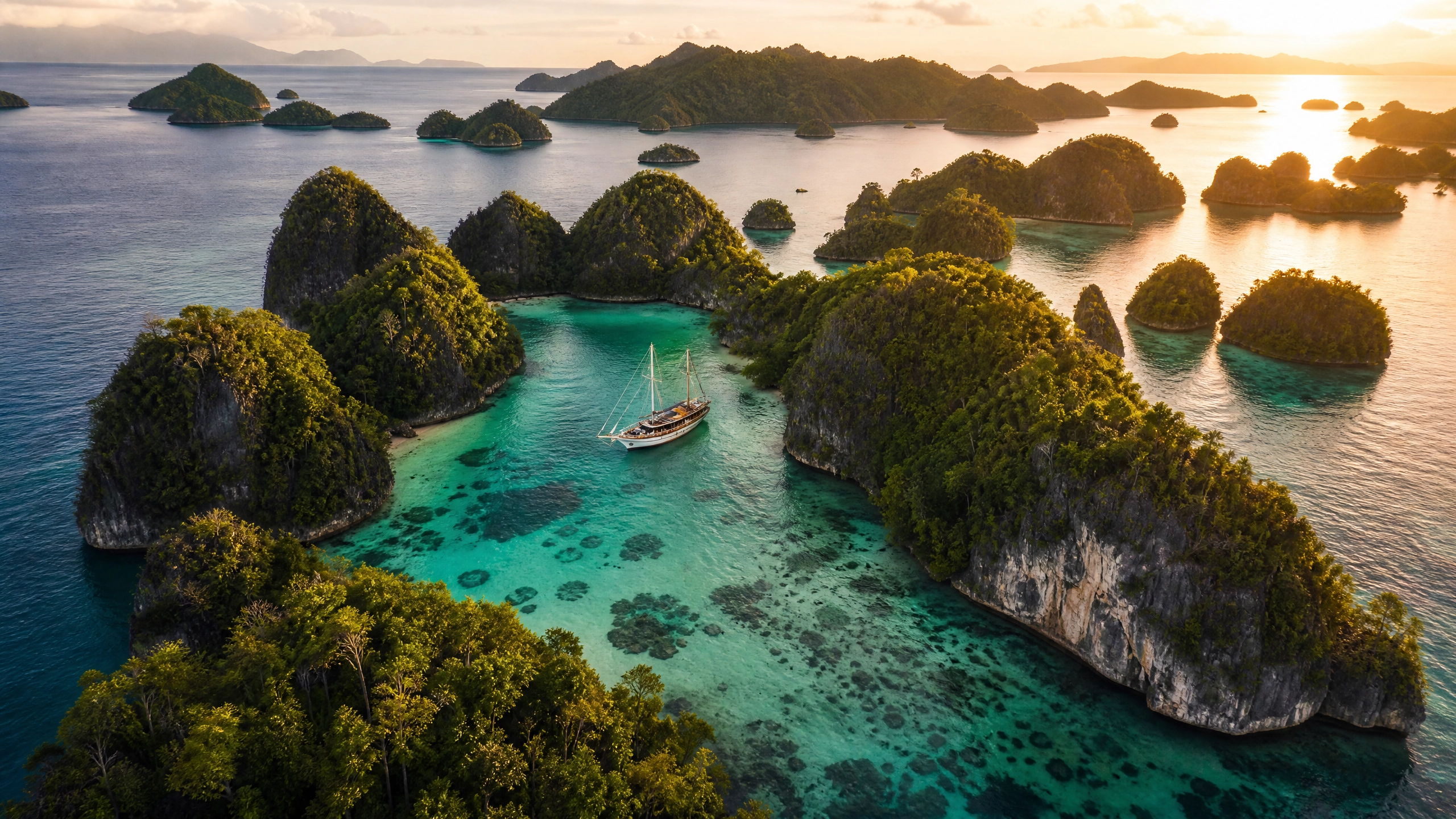
Raja Ampat 7-Day Itinerary: Ultimate Diving & Snorkeling Guide
The world's highest marine biodiversity, Pianemo's karst lagoon viewpoint, Arborek's manta ray cleaning station, and bioluminescent plankton at Gam Island.
- Duration: 7 Days
- Estimated Budget: $2,500–$6,500
- Best Time to Visit: October to April for calmer seas and peak manta ray activity
- Destination: Raja Ampat, Indonesia
Drifting over the sheer, pulsating drop-offs of Cape Kri reveals why Raja Ampat sits unchallenged at the apex of global marine biodiversity. This seven-day diving and snorkeling itinerary navigates the legendary currents of the Dampier Strait, the labyrinthine karst peaks of Pianemo, and the untouched coral gardens of the Coral Triangle.
Domine Eduard Osok Airport in Sorong serves as the mandatory mainland gateway where passengers trade commercial aviation for high-speed marine transit out toward the remote western tip of New Guinea. Navigating this industrial port town requires a pre-booked local driver to bypass chaotic terminal crowds straight down to the oceanfront pier for the morning passenger vessel. Travelers settling into community-run overwater bungalows on remote shores find themselves immediately immersed in traditional coastal life, far removed from standard luxury resort bubbles. The local culinary landscape centers heavily on daily catches from local fishermen, seasoned simply with yellow spice paste and served alongside heavy, sticky cassava cakes known as papeda. Exploring these outer territories demands a deep respect for indigenous marine tenure systems, where traditional owners manage local conservation fees and reef access to protect fragile ecosystems.
Should you choose a land-based eco-lodge like Papua Paradise Eco Resort or a mobile liveaboard vessel for your week-long expedition? Here is the reality: shore-based lodges offer spacious overwater bungalows and relaxed house-reef access, but they limit your daily cruising radius to nearby channels. Liveaboard vessels, conversely, sacrifice room space to chase distant outer pinnacles and remote atolls that are entirely unreachable from static island bases. If your priority is deep-water pelagic encounters and heavy current drift diving across changing coordinates every single night, a floating vessel is mandatory. If you prefer unpacking your dive gear once, sleeping on solid land, and enjoying leisurely surface intervals between house-reef muck dives, a northern island resort or community homestay wins easily. Neither option serves as a universal substitute, so matching your vessel choice to your primary underwater wishlist dictates the absolute success of your voyage.
Ocean enthusiasts spend their mornings descending along vertical coral walls where schooling barracuda, pygmy seahorses, and oceanic manta rays thrive in nutrient-rich upwellings. Afternoons transition toward navigating towering limestone monoliths via traditional wooden outriggers, scouting hidden lagoons framed by dense jungle foliage and hanging vines. As twilight approaches, guests gear up for specialized nocturnal sessions, tracking fluorescent organisms and hunting for walking sharks among shallow seagrass beds. The rhythm of these remote atolls means syncing every major activity with tidal movements, ensuring divers enter the water precisely during peak slack water to avoid dangerous down-currents. Evenings unfold quietly under unpolluted equatorial stars, sharing stories over plates of freshly grilled reef fish at family-run village warungs while salt dries on sun-warmed skin.
Gateway to the Coral Triangle: Sorong Arrival, Ferry Crossing, and First Immersion at Waisai
Land at Domine Eduard Osok Airport (SOQ) in Sorong, where your pre-arranged driver meets you for a swift transfer to the Pelabuhan Rakyat ferry terminal.
Sorong is the literal and logistical springboard for entering the Raja Ampat archipelago. A pre-arranged transfer eliminates airport chaos and secures your timeline.
Clear ferry terminal procedures, secure your physical tickets, and handle your official marine park registration at the port checkpoint.
Getting your paperwork and tickets squared away early prevents last-minute boarding panics. The port can be a sensory overload of local vendors and travelers.
Board the Express Bahari fast ferry for the scenic two-hour open-water crossing across the Dampier Strait toward Waisai.
This crossing offers your first dramatic glimpse of Raja Ampat’s iconic emerald karst islands rising abruptly from turquoise water. It is a classic rite of passage for every traveler entering the region.
Arrive at Waisai harbor, meet your resort transfer boat, and complete your check-in process at your island base.
Transitioning from the public ferry to a smaller resort speedboat marks your final step into remote island time. It sets the stage for a smooth, personalized stay.
Suit up for a relaxed, introductory house-reef snorkel right off the resort pier to test your gear and shake off travel fatigue.
Raja Ampat house reefs are among the richest on Earth, often rivaling destination sites elsewhere. It lets you acclimate to warm tropical water and current flows safely.
Leif's Tip: Do not overpack heavy clothes for the island transfers; keep a lightweight dry bag handy on your lap during the speedboat ride from Waisai to keep your electronics safe from sea spray.
Between coordinating domestic flight connections through eastern Indonesia, aligning strict ferry timetables out of Sorong harbor, and decoding unpredictable equatorial weather windows, planning a voyage to these remote atolls can feel overwhelming before you even arrive. The part of the region that catches independent travelers completely off guard is not the underwater current management, but the sheer logistical friction of moving heavy dive gear across multiple municipal and maritime boundaries. Choosing between an independent community homestay on a secluded beach and a fully equipped dive resort or liveaboard vessel requires precise insider knowledge of local infrastructure and marine access rights. Misjudge your transit connection by a single morning, and you risk missing the sole daily ferry, forcing an expensive last-minute speed boat charter or a wasted night stranded in port. That intricate web of moving parts is precisely where expert planning transforms a logistical nightmare into a seamless, high-performance expedition.
When you are standing on a humid dock in Sorong trying to confirm whether your gear bags made the inter-island transfer while local scheduling shifts without warning, your Leif itinerary already accounts for the backup transport protocol. Meridian Adventure or Papua Paradise bookings are mapped out down to the exact boat departure time, ensuring your transition from mainland asphalt to overwater bungalow happens without a single panicked phone call. If you decide to swap a heavy northern transit day for a protected mangrove drift due to shifting winds, the platform instantly recalculates your tidal windows and highlights certified local guides who know every inch of the reef. Arborek village homestay logistics, local conservation fee checkpoints, and remote cash budgeting requirements are all pre-vetted so you never find yourself stranded without local currency or valid permits. Every tide table, certification threshold for high-flow channels like Cape Kri, and village etiquette protocol is integrated right into your daily flow.
Arriving across these glassy tropical waters with every complex maritime transfer, accommodation style, and tide-dependent dive schedule locked into place means you can step off the boat and dive straight into pristine coral gardens without hesitation. Instead of second-guessing local boat captains or wasting precious vacation hours negotiating village access fees in broken Indonesian, you will move fluidly through some of the richest marine ecosystems on the planet. The difference is standing on the bow of a wooden outrigger at dawn, watching the mist clear over towering karst islands while your gear is already prepped and your guide reads the surface currents like an open book. Your week in the heart of the Coral Triangle becomes an uninterrupted masterclass in underwater exploration, leaving you free to focus entirely on the kaleidoscopic marine life drifting just beneath your fins. Open up Leif, secure your custom logistics today, and step into the ultimate remote diving adventure with total, unshakeable confidence.
Best Time to Visit Raja Ampat, Indonesia
October to April offers the calmest sea conditions, optimal visibility, and the peak of the manta ray aggregation seasons in Dampier Strait.
July to September brings stronger winds, rougher crossings to outer islands like Wayag or Misool, and significant wave action, though diving remains operational in sheltered corners.
The shoulder months of May and June see fewer crowds and excellent whale shark spotting potential around fixed platforms, but surface chop can be unpredictable.
Avoid traveling strictly based on mainland Indonesian weather patterns, as Raja Ampat's microclimate features sudden equatorial downpours year-round alongside intense tropical sun.
Getting Around Raja Ampat, Indonesia
Book your domestic flight into Domine Eduard Osok Airport (SOQ) in Sorong via major hubs like Jakarta, Makassar, or Manado, ensuring arrival well before the afternoon public ferry schedules.
Take the public Sorong-Waisai fast ferry for the roughly two-hour crossing to Waigeo, making sure your resort or homestay has a pre-arranged speedboat transfer waiting at the Waisai pier.
Decide definitively between a land-based resort/homestay setup (requiring daily speedboat hops) and a liveaboard structure (handling the long-range transit to Misool and Wayag) prior to arrival, as mixing them mid-trip wastes precious days.
Prepare for rigorous open-water wet landings and transfers between small skiffs and wooden jetties, requiring physical agility and waterproof gear storage for all electronics.
What to Pack
- A 3mm full-length wetsuit or shorty to protect against stinging hydroids, sharp coral, and the thermoclines found in deep-channel dives.
- Reef-safe sunscreen, polarized sunglasses, and a wide-brimmed hat to combat the punishing equatorial UV glare reflecting off shallow white-sand flats.
- An underwater camera setup with external strobes or a high-end action camera with a red filter to capture the vibrant, high-biomass reef walls.
- A dry bag (minimum 20L to 30L) to safeguard your passport, phone, and cash during soaking wet speedboat transfers across choppy straits.
- High-density insect repellent and lightweight, quick-dry long sleeves for protection against aggressive mosquitoes and sandflies during jungle and village walks.
- A personal medical kit including motion sickness pills for rough ferry and speedboat crossings, antibiotic ointment for coral scratches, and broad-spectrum anti-diarrheals.
- A sturdy pair of reef booties or amphibious water shoes for walking over razor-sharp limestone karst on island viewpoints and rough jetty ladders.
Money-Saving Tips
- Bring substantial physical Indonesian Rupiah (IDR) cash in pristine, high-denomination notes from major mainland hubs, as ATMs in Sorong are unreliable and outer islands have zero electronic banking.
- Opt for locally run community homestays on islands like Arborek or Gam instead of luxury dive resorts if you want to drastically cut accommodation costs while experiencing authentic Papuan village life.
- Share private charter speedboats with other independent travelers if you are staying land-based, splitting the exorbitant fuel costs for distant trips to Pianemo or Fam.
- Eat local meals at village warungs serving fresh grilled fish, rice, and local produce rather than relying exclusively on imported Western items at high-end resort restaurants.
Local Insights
- Respect local indigenous customs by securing permission before walking through village territory, and always wear a sarong or cover up shoulders when exploring outside beach areas.
- Support the local community-based conservation initiatives directly by purchasing your mandatory marine park tag and tipping local Papuan boat captains and dive guides generously.
- Sample traditional Papuan cuisine like papeda (a sticky, gelatinous sago starch dish) paired with yellow fish soup, recognizing that remote island kitchens operate on supply boats rather than strict menus.
- Learn a few words of Bahasa Indonesia to bridge the communication gap with village elders and homestay hosts who rarely speak English, enriching your cultural exchange immensely.
Frequently Asked Questions
How do I actually get to Sorong, and what is the best way to handle the ferry to Waisai?
You fly into Domine Eduard Osok Airport in Sorong (SOQ), typically via Jakarta, Makassar, or Manado. From the airport, a pre-arranged taxi takes you to the Sorong passenger harbor for the public express ferry to Waisai, which runs twice daily and takes about two hours. VIP tickets give you air-conditioned comfort, but always book your tickets a day in advance through your resort or local handler to avoid sold-out sailings.
What dive certification level and experience with currents do I need for this trip?
Many of the premier sites in the Dampier Strait—such as Cape Kri and Sardine Reef—experience powerful, unpredictable rips and down-currents. An Advanced Open Water certification with proven drift-diving experience and a minimum logged dive threshold is mandatory for most reputable operators. If you are a novice, stick to protected house reefs or request shallow coral gardens until you build confidence in heavy water.
How do the marine park entry fees work and who collects them?
Every visitor to the region must purchase the annual Raja Ampat Environmental Services Fee tag, which costs IDR 1,000,000 for international travelers. This pass is usually checked upon arrival in Waisai or directly by your resort/liveaboard operator. The funds directly support local village communities, marine patrols, and ongoing reef conservation initiatives across the archipelago.
When is the best time of year to visit for diving and snorkeling?
The primary diving season runs from October through April, when sea conditions are calmest, visibility peaks, and surface winds are minimal. While diving is technically possible year-round, the monsoon months between July and August bring heavy swells and rough crossings, particularly for outer-island transits toward Wayag or Misool.
Can non-divers or snorkelers still experience world-class marine life?
Absolutely, as the shallow reef flats and pristine house reefs surrounding islands like Arborek and Gam offer some of the highest fish biomass on Earth visible from the surface. Snorkelers can effortlessly spot blacktip reef sharks, massive schooling surgeonfish, and vibrant soft corals without needing deep technical training. However, certain open-ocean pinnacle sites with heavy currents are strictly reserved for scuba divers.
How should I handle money, cash, and ATMs in Sorong and the islands?
ATMs are available in Sorong, but they frequently run out of cash or fail with international cards, so you should withdraw maximum Indonesian Rupiah before heading to the harbor. Once you leave Sorong, there are virtually no functioning ATMs or credit card machines on the outer islands or homestays. Bring more cash than you think you need in small denominations to cover local crafts, village fees, and extra tips.
Is a seven-day trip long enough to see the whole archipelago?
Seven days is enough to experience either the Dampier Strait and Pianemo regions or a dedicated liveaboard circuit, but it is physically impossible to cover both northern Wayag and southern Misool in one week. Trying to cram every iconic landmark into a single week leads to exhaustion and endless transit hours. It is far better to focus intensely on one specific geographic zone to truly appreciate its underwater health.