Kyoto, Japan: The City That Chose Itself
Destination: Kyoto, Japan
Category: Destination Guides
Kyoto does not ease you in. It does not offer a gentle introduction or a soft landing. You step off the shinkansen at Kyoto Station — a cathedral of glass and steel that feels, deliberately, like a provocation — and within twenty minutes you are standing in front of a 1,200-year-old temple, watching incense smoke curl into a sky that has not changed since emperors walked these streets. There is no transition. There is no buffer. Kyoto simply is, all at once, everything it has always been.
This is a city that served as Japan's imperial capital for over a thousand years, from 794 until 1868, when Emperor Meiji moved the court to Tokyo. In that millennium, Kyoto became the crucible of Japanese civilization: the place where Zen Buddhism took root, where the tea ceremony was codified, where Noh theater was born, where the geisha tradition was perfected into an art form so refined it borders on the sacred. When the rest of Japan was burning and rebuilding and modernizing, Kyoto was preserving. When American bombers were targeting Japanese cities in the final months of World War II, Secretary of War Henry Stimson personally removed Kyoto from the target list, reportedly because he had honeymooned there and understood what would be lost. Seventeen UNESCO World Heritage Sites survived as a result. You walk among them now.
But Kyoto is not a museum. That is the first thing to understand, and the most important. It is a living city of 1.5 million people, home to Nintendo and Kyocera and more Nobel Prize winners per capita in the sciences than almost anywhere on earth. Students crowd the coffee shops near Doshisha University. Salarymen eat ramen at midnight in Pontocho. Grandmothers tend immaculate gardens behind walls you will never see past. The ancient and the contemporary do not coexist here in uneasy tension — they have simply merged, the way a river merges with the sea, until you cannot tell where one ends and the other begins.
The City That Chose Itself
Most great cities were shaped by geography — a harbor, a river delta, a mountain pass. Kyoto was shaped by philosophy. Emperor Kanmu chose this basin in the Yamashiro mountains in 794 because its topography matched the principles of Chinese geomancy: mountains to the north, east, and west for protection; a river to the south for prosperity. He called it Heian-kyō, the Capital of Peace and Tranquility. The name Kyoto simply means "capital city." For a thousand years, it needed no other description.
That deliberateness pervades everything. The grid of streets laid out in 794 still underlies the city today. The neighborhoods that grew up around the imperial court — the silk weavers of Nishijin, the potters of Kiyomizu, the tea masters of Uji — have been doing the same things in the same places for so long that the craft has become inseparable from the place. A Nishijin-ori textile is not just a product; it is a geography. A Kiyomizu-yaki ceramic carries the clay of the eastern hills in its glaze.
This is the Kyoto that most visitors sense but cannot quite articulate: the feeling that everything here was made with intention, that nothing is accidental, that the city itself is a kind of argument about how human beings should live. Slowly. Carefully. With attention to beauty in small things.
The Neighborhoods: A City of Distinct Worlds
Kyoto is not a city you experience as a whole. It is a collection of distinct districts, each with its own character, its own pace, its own reason for existing. Understanding them is the difference between a good trip and an extraordinary one.
Gion is the neighborhood that appears in every photograph of Kyoto, and for good reason. The preserved machiya townhouses along Hanamikoji Street, the stone-paved lanes of Shirakawa, the paper lanterns glowing amber at dusk — it is genuinely one of the most beautiful streets in the world. It is also, in 2025, genuinely overcrowded during peak hours. The honest advice is this: Gion at 7 AM on a Tuesday in November is a completely different experience from Gion at 2 PM on a Saturday in April. The bones of the neighborhood are extraordinary. Time your visit accordingly. And if you see a geiko or maiko — a fully trained geisha or her apprentice — walking to an engagement, do not follow her, do not photograph her without permission, and do not touch her costume. The Gion district has posted formal notices asking tourists to stop doing all three. Respect the neighborhood and it will reward you with something that feels, briefly, like the Kyoto of a hundred years ago.
Higashiyama is the hillside district that climbs east from Gion toward Kiyomizudera Temple, and it is arguably the most atmospheric walk in Japan. The stone-paved Ninenzaka and Sannenzaka lanes wind through preserved Edo-period architecture, past pottery shops and matcha cafes and incense merchants who have been selling the same blends for generations. At the top, Kiyomizudera's famous wooden stage juts out over the hillside on a framework of 139 zelkova pillars assembled without a single nail. The view from the stage — over the tiled rooftops of eastern Kyoto to the mountains beyond — is one of those views that makes you understand why people have been making pilgrimages here since the 8th century.
Arashiyama sits at the western edge of the city where the Oi River bends through bamboo-covered mountains, and it operates on a completely different register from the rest of Kyoto. The bamboo grove at Sagano is the image most people carry in their heads when they think of Japan — tall green stalks filtering the light into something otherworldly, the sound of wind through the canopy like a distant ocean. Tenryu-ji, the Zen garden at the heart of Arashiyama, is considered one of the finest examples of borrowed scenery garden design in Japan: the mountains behind it have been deliberately incorporated into the composition, so that the garden extends, visually, into the landscape beyond its walls. Go early. The grove at 6:30 AM, before the tour groups arrive, is a genuinely transcendent experience.
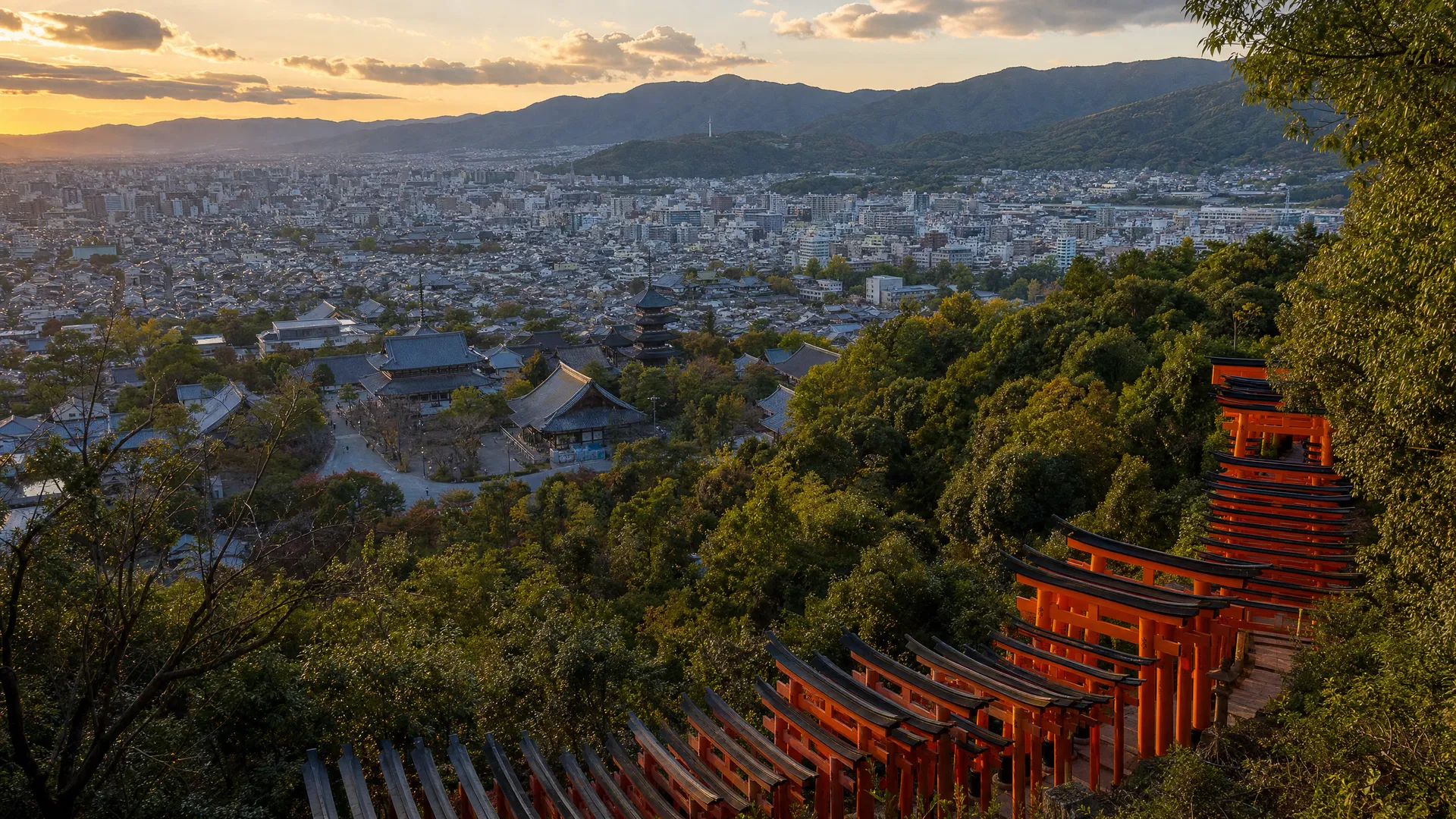
Fushimi is the southern district that most visitors treat as a day trip, but it deserves more than that. Fushimi Inari Taisha — the shrine of ten thousand torii gates that winds up the forested slopes of Mount Inari — is the most-visited site in Kyoto, and for good reason. The lower gates, near the entrance, are always crowded. But the trail continues for four kilometers up the mountain, and most visitors turn back within the first thirty minutes. Push on. The upper sections of the trail, past the second and third summits, are quiet enough that you can hear your own footsteps on the packed earth. The gates thin out, the forest closes in, and you begin to understand that this is not a tourist attraction — it is a sacred mountain that has been accumulating offerings for twelve centuries.
Nishijin is the weaving district in northwestern Kyoto, and it is the neighborhood that most tourists miss entirely. This is where Kyoto's famous silk textiles have been produced since the 15th century, in workshops where the clatter of hand looms fills narrow streets lined with machiya that have been in the same families for ten generations. The Nishijin Textile Center offers demonstrations, but the real experience is wandering the side streets in the early morning, when the workshops are open and the weavers are at their looms. It is the most honest neighborhood in Kyoto — a place where the traditional economy is not a performance for visitors but simply the way things are done.
Pontocho is a single narrow alley running parallel to the Kamo River, barely wide enough for two people to pass, lined with restaurants and bars that spill onto wooden decks over the water in summer. It is where Kyoto eats and drinks at night, and it is where the city's formal reserve relaxes into something warmer. The restaurants range from century-old kaiseki establishments to standing ramen bars, and the alley has a way of making everyone feel like a local, at least for an evening.
The Experiences That Define Kyoto
Fushimi Inari at Dawn. Set your alarm for 5 AM. Take the first train south. You will arrive at the base of the mountain as the light is just beginning to filter through the cedar forest, the torii gates glowing orange in the mist. For the first hour, you may have the lower trail nearly to yourself. This is the Fushimi Inari that exists in the imagination — sacred, quiet, genuinely otherworldly. By 9 AM, the crowds will arrive. You will already be on your way back, carrying something that cannot be photographed.
A Traditional Ryokan Stay. Kyoto has more traditional ryokan inns than anywhere else in Japan, and staying in one is not simply an accommodation choice — it is an immersion in a way of life. You sleep on a futon laid on tatami mats. You wear a yukata cotton robe. You soak in an onsen bath before a multi-course kaiseki dinner that arrives in lacquered boxes, each dish a small composition of seasonal ingredients. The omotenashi — the Japanese concept of wholehearted hospitality — is not a marketing term here. It is the organizing principle of the entire experience. Budget ryokan start around ¥8,000 per person per night including dinner and breakfast. The finest establishments in Higashiyama charge ¥80,000 and above, and they are worth every yen. Our Kyoto honeymoon guide covers the best ryokan options for couples in detail.
A Kaiseki Meal. Kaiseki is the haute cuisine of Japan — a multi-course meal built around the seasons, where the menu changes monthly and every ingredient is chosen to reflect what is growing, blooming, or ripening at that precise moment in the Kyoto calendar. A kaiseki meal in Kyoto is not just dinner; it is a philosophical statement about the relationship between food, time, and place. Lunch kaiseki at a mid-range establishment costs around ¥3,000–¥5,000 and is one of the great bargains in world gastronomy. Our Kyoto food guide maps the best options across every budget.
The Philosopher's Path in Autumn. The Tetsugaku-no-Michi — the Philosopher's Path — is a two-kilometer canal-side walkway that connects Ginkakuji (the Silver Pavilion) to Nanzenji Temple, lined with hundreds of cherry trees. In spring it is famous for sakura. In autumn it is, arguably, even more beautiful: the maple trees turn crimson and gold, the canal reflects the colors, and the path is quiet enough that you can understand why the philosopher Nishida Kitaro walked it every day while working out the foundations of modern Japanese philosophy. Our Kyoto couples guide builds an entire day around this walk.
Zazen Meditation. Several Zen temples in Kyoto offer zazen — seated meditation — sessions open to foreign visitors, typically in the early morning. Kennin-ji, the oldest Zen temple in Kyoto, offers sessions most mornings. You sit in silence on a cushion in a room that has been used for meditation for eight centuries, and a monk walks the rows with a flat wooden stick — the kyosaku — which he will use to strike your shoulders if you request it, a practice believed to sharpen concentration. It is not comfortable. It is one of the most clarifying experiences available to a traveler anywhere in the world. Our Kyoto solo travel guide includes a full morning zazen itinerary.
Nishiki Market. Nishiki-koji — "Nishiki Market" — is a 400-meter covered arcade running through the heart of central Kyoto, so narrow and so packed with food stalls that it has been called "Kyoto's Kitchen" since the Edo period. Here you will find pickled vegetables in colors you did not know vegetables came in, fresh tofu made that morning, skewered octopus balls, matcha soft-serve, grilled mochi, and the particular Kyoto specialty of yudofu — silken tofu simmered in kombu broth. Go hungry. Go slowly. Go twice.
When to Go: The Honest Seasonal Breakdown
| Season | Months | What's Happening | Crowds | Verdict |
|---|---|---|---|---|
| Cherry Blossom | Late March–Early April | Sakura at Maruyama Park, Philosopher's Path, Arashiyama | Extreme | Worth it if you book 6+ months ahead |
| Late Spring | May | Lush green, mild temperatures, fewer crowds | Moderate | Excellent — underrated |
| Summer | June–August | Gion Matsuri festival (July), fireflies, Kyoto cuisine at peak | High, humid | July festival is unmissable; August is brutal heat |
| Autumn Foliage | Mid-November–Early December | Maple leaves at Tofukuji, Eikan-do, Arashiyama | Very High | Rivals cherry blossom season in beauty |
| Winter | December–February | Snow on temple rooftops, quiet streets, best ryokan rates | Low | Deeply underrated — the most atmospheric Kyoto |
| Late Winter | Late February–March | Plum blossoms at Kitano Tenmangu, pre-sakura calm | Low-Moderate | Hidden gem season |
The honest answer: November and early December are the finest months to visit Kyoto. The autumn foliage is spectacular, the light is golden, and the crowds — while still significant — are more manageable than cherry blossom season. The second-best window is late May, after the Golden Week holiday crowds have dissipated and before the summer heat arrives. Winter Kyoto — snow on the moss at Saihoji, ice on the stone lanterns at Fushimi Inari — is a secret that the crowds have not yet discovered.
The Kyoto Nobody Talks About
The most honest thing you can say about Kyoto in 2025 is that it is dealing with an overtourism problem that the city government has been struggling to address for a decade. Gion has posted signs asking tourists not to enter private alleys. Fushimi Inari has considered limiting access to the lower trail. The bamboo grove at Arashiyama has erected barriers to prevent people from wandering off the path. These are not signs of a city that has given up — they are signs of a city that cares enough about what it has to fight for it.
The response, as a visitor, is not to avoid Kyoto. It is to visit differently. Go early. Go to the less-visited temples — Fushimi's sake district, the moss garden at Saihoji (which requires advance reservation and a written application), the stone Buddha carvings at Otagi Nenbutsuji in the far northwest, where a local sculptor spent thirty years carving 1,200 unique figures into the hillside. Go in winter. Eat at the standing ramen bar, not the tourist-facing kaiseki restaurant on the main street. Take the local bus instead of the tourist shuttle. Learn three words of Japanese. The city will open to you in proportion to the effort you bring.
Our Kyoto budget guide is built entirely around this philosophy — seeing the real city on ¥7,000 a day without sacrificing the experiences that matter.
Getting There and Getting Around
Kyoto sits at the heart of the Kansai region, connected to Tokyo by the Tokaido Shinkansen — a 2 hour 15 minute journey on the Nozomi express. The Japan Rail Pass covers this route and is worth purchasing for any trip of more than a few days. From Osaka, Kyoto is 15 minutes by shinkansen or 30 minutes on the cheaper Hankyu or Keihan private lines.
Within Kyoto, the bus network is comprehensive and covers every major attraction, but it can be slow in traffic. The subway has two lines that intersect at Karasuma Oike and cover the main north-south and east-west corridors. For Arashiyama, the Sagano Scenic Railway — a tourist train that runs through the Hozu River gorge — is worth the ticket price as an experience in itself. For Fushimi Inari, the JR Nara Line from Kyoto Station takes eight minutes.
Cycling is, for many visitors, the best way to experience the city. The streets are flat, the distances between neighborhoods are manageable, and a bicycle gives you the freedom to turn down an unmarked lane on a whim — which is, more often than not, where Kyoto's best moments are found.
The Kyoto Guides: Every Way to Experience the City
The depth of Kyoto's guide library on Ask Leif reflects the depth of the city itself. Whatever your travel style, your travel companion, or your budget, there is a curated itinerary built specifically for how you want to experience it.
For couples and honeymooners, the 4-day Kyoto honeymoon guide builds an itinerary around ryokan stays, private tea ceremonies, and the Philosopher's Path at dawn — the kind of trip that becomes a reference point for everything that comes after. The 5-day couples guide extends this with the Arashiyama bamboo grove, Nishiyama neighborhood, and a Nishiki Market food walk that covers every essential flavor of the city.
For families, both the 4-day family guide and the 5-day family guide are built around the experiences that genuinely work with children — Fushimi Inari's torii gates at dawn (kids love the tunnel effect), the Toei Uzumasa Film Park where samurai dramas are still filmed, hands-on wagashi sweet-making classes, and the Arashiyama bamboo grove before the crowds arrive.
For solo travelers, the 5-day solo guide is built around the experiences that are most powerful when experienced alone — zazen meditation at dawn, solo ryokan stays, the upper trail of Fushimi Inari in silence. The 4-day solo guide focuses on the Zen temple circuit and the machiya guesthouse experience that gives solo travelers the most authentic neighborhood immersion.
For budget travelers, the 4-day budget guide demonstrates that Kyoto on ¥7,000 per day is not only possible but, in some ways, the best way to see the city — free temple grounds, cheap kaiseki lunch sets, and the understanding that the most beautiful things in Kyoto cost nothing at all.
For those who want to go deeper into the food, the 4-day food guide is a kaiseki-to-street-food journey through the city's culinary landscape — from the Nishiki Market morning walk to a multi-course kaiseki dinner to the ramen counter at midnight in Pontocho.
For the adventurous, the 5-day adventure guide takes the city vertical — the Fushimi Inari summit trail, the Kurama Mountain hike, the Kibune River gorge, and the off-the-beaten-path temples that require a full day of hiking to reach.
And for those who want to combine Kyoto with Osaka — two cities that are thirty minutes apart by train and could not be more different in character — the 7-day Osaka-Kyoto combo guide builds an itinerary that uses each city to illuminate the other: Osaka's chaotic, delicious energy as a counterpoint to Kyoto's deliberate calm.
One Last Thing
There is a concept in Japanese aesthetics called mono no aware — the bittersweet awareness of impermanence, the poignant recognition that beautiful things do not last. It is the feeling you have watching cherry blossoms fall. It is the feeling you have watching the last light leave the torii gates at Fushimi Inari. It is, perhaps, the feeling that Kyoto was built to produce.
You will leave Kyoto wanting to come back. This is not a failure of the trip. It is the point. The city is too large, too layered, too alive to be contained in a single visit. The temples you did not reach, the alley you turned away from, the meal you did not order — they are waiting. Kyoto is patient. It has been waiting for visitors for twelve hundred years. It will wait for you.