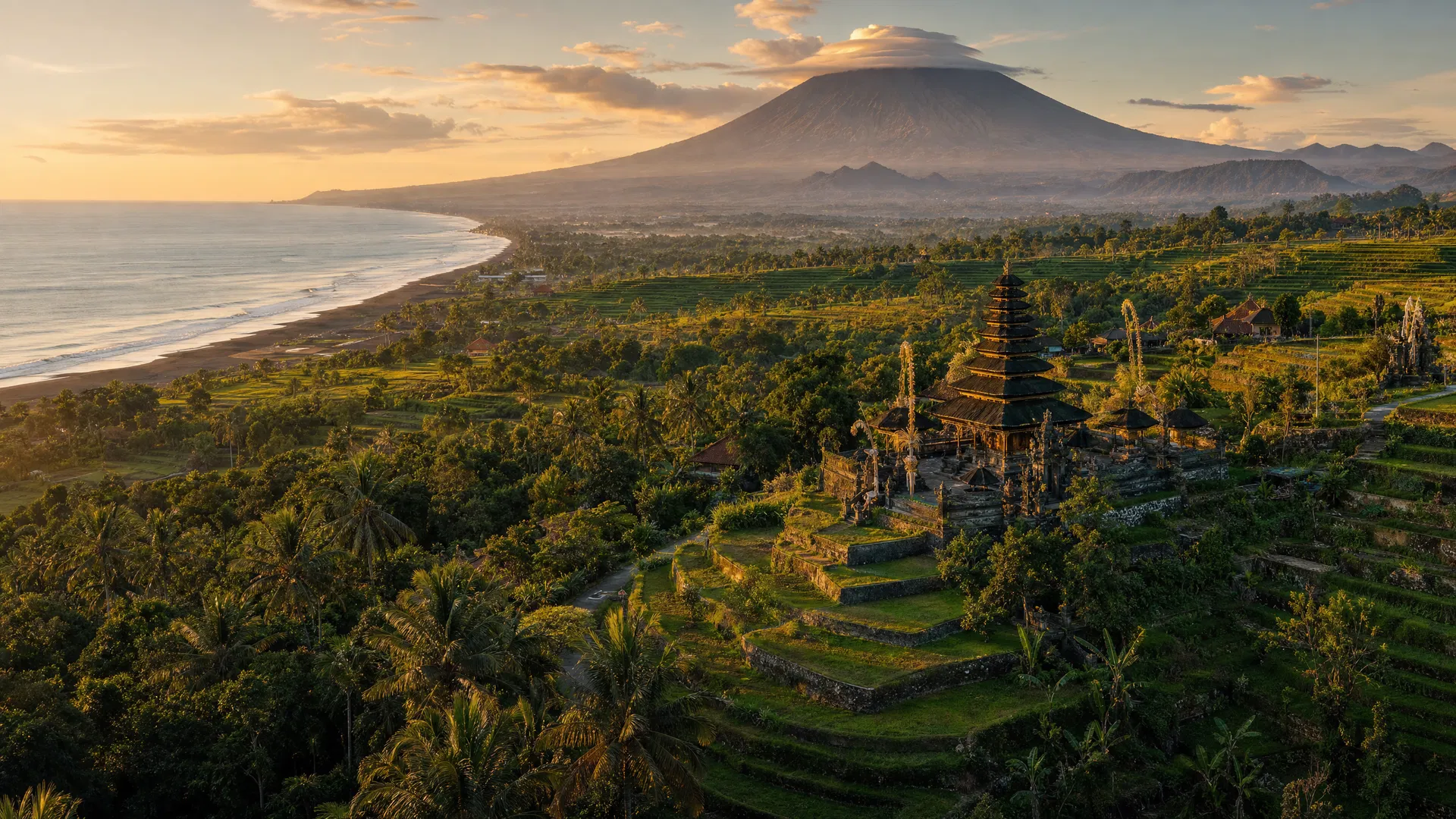
Bali, Indonesia: The Honest Guide to the Island of the Gods
Destination: Bali, Indonesia
Category: Destination Guides
There is a moment that happens to almost everyone who visits Bali for the first time. It usually occurs somewhere between landing at Ngurah Rai International Airport and arriving at your villa — that specific instant when the warm, jasmine-scented air hits you, a woman in a kebaya walks past balancing a tower of fruit offerings on her head, and the distant sound of gamelan music drifts across a rice terrace. You realize, with a certainty that surprises you, that you are somewhere genuinely unlike anywhere else on earth.
Bali is one of the most written-about destinations in the world, and yet it remains stubbornly difficult to explain. It is a small island — roughly the size of Delaware — that contains multitudes: ancient Hindu temple culture in a predominantly Muslim country, world-class surf breaks beside rice paddies that have been farmed the same way for a thousand years, five-star resorts next to warung shacks serving the best food you'll eat for two dollars. It is simultaneously overrun with tourists and capable of making you feel like the only person who has ever discovered it.
This is the honest guide to Bali — the one that tells you which parts of the island to prioritize, which to skip, what the Instagram version leaves out, and how to experience the real thing.
The Island of the Gods: What Makes Bali Different
Bali is the only Hindu-majority island in Indonesia, a country of 270 million people that is 87% Muslim. That distinction is not a footnote — it is the entire explanation for why Bali feels the way it does. Balinese Hinduism is not the same as Indian Hinduism; it is a syncretic blend of Hindu cosmology, Buddhist influences, and indigenous animist beliefs that has evolved in isolation for centuries, producing a culture of extraordinary visual richness and spiritual depth.
The evidence is everywhere and constant. Every morning, Balinese women place canang sari — small palm-leaf offerings filled with flowers, incense, and food — at doorways, on shrines, at the base of trees, on the hoods of cars. There are an estimated 20,000 temples on the island. The Balinese calendar runs on a 210-day cycle called the Pawukon, meaning that religious ceremonies and festivals occur with a frequency that can feel overwhelming to outsiders but is simply the rhythm of daily life to locals.
This spiritual infrastructure is not a performance for tourists. It is the operating system of Balinese society, and understanding it — even superficially — transforms the experience of being here. When you see a procession of white-clad worshippers carrying offerings to a seaside temple at sunset, you are not watching a cultural show. You are witnessing something that has been happening in that exact spot, in that exact form, for generations.
The Five Balis: A Regional Breakdown
One of the most common mistakes first-time visitors make is treating Bali as a single place. It is not. The island is divided into distinct regions, each with its own character, crowd, and purpose. Choosing the right base — or the right combination of bases — is the most important planning decision you will make.
Seminyak: The Sophisticated South
Seminyak is where Bali grew up. What was once a quiet fishing village is now the island's most polished neighborhood — a dense grid of designer boutiques, rooftop bars, high-end restaurants, and beach clubs that have set the global standard for the genre. Ku De Ta (now KUDETA) and Potato Head Beach Club essentially invented the concept of the Bali beach club experience that has since been replicated across Southeast Asia.
The beach here is wide and dramatic, with powerful surf and spectacular sunsets that draw crowds every evening to the strip of sand at Petitenget. The dining scene is genuinely world-class — Merah Putih, Sarong, and Mamasan have been consistently ranked among Asia's best restaurants, and the concentration of quality per square kilometer rivals any city in the region.
Seminyak is best for: couples, first-timers who want comfort and convenience, anyone who wants to eat and drink extremely well.
Canggu: The Nomad's Village
A decade ago, Canggu was a sleepy surf village north of Seminyak. Today it is the spiritual capital of the global digital nomad movement — a place where co-working spaces, specialty coffee shops, and vegan cafes have colonized what were once rice fields. The main drag of Batu Bolong is lined with the kind of establishments that could exist in Brooklyn or Melbourne, except that they're surrounded by rice paddies and the surf break at Echo Beach is a five-minute walk away.
Canggu has a reputation for being overrun and over-hyped, and in peak season, that reputation is not entirely undeserved. But it also has genuine energy — a creative, transient community of surfers, entrepreneurs, and artists who have built something that feels, at its best, like a village that accidentally became cool. The nightlife at Old Man's and the Sunday market at Deus Ex Machina are legitimately fun.
Canggu is best for: solo travelers, digital nomads, surfers, anyone under 35 who wants to feel like they're in the right place at the right time.
Ubud: The Cultural Heart
Ubud sits in the center of the island, about 45 minutes north of the coast, in the foothills of the volcanic interior. It is where the rice terraces are, where the traditional arts — painting, woodcarving, silversmithing, batik — are practiced and sold, and where the spiritual dimension of Bali is most concentrated and accessible.
The town itself has been somewhat overwhelmed by tourism — the main street of Monkey Forest Road is now a gauntlet of souvenir shops and restaurants — but the surrounding countryside remains extraordinary. The Tegallalang rice terraces north of town are justifiably famous. The Sacred Monkey Forest Sanctuary is genuinely magical despite the crowds. The cooking classes, yoga retreats, and traditional healing ceremonies available here are the best on the island.
Ubud is also the gateway to Bali's most spectacular waterfalls — Tegenungan, Kanto Lampo, and Tibumana — and to the volcanic landscapes of Mount Batur, whose pre-dawn summit hike rewards with one of the most dramatic sunrises in Asia.
Ubud is best for: culture-seekers, wellness travelers, couples on honeymoon, anyone who wants to understand what Bali actually is beneath the beach clubs.
Uluwatu: The Clifftop South
The Bukit Peninsula — the limestone plateau that forms the southern tip of Bali — is a different island entirely. The landscape is arid and dramatic, with sheer white cliffs dropping straight into the Indian Ocean and surf breaks that rank among the best in the world. Uluwatu, Padang Padang, Bingin, and Balangan are the names that serious surfers know; for everyone else, they are simply some of the most beautiful beaches on earth, accessible via steep staircases carved into the cliff face.
The Uluwatu Temple — Pura Luhur Uluwatu — sits on a promontory 70 meters above the sea and is one of Bali's six key temples, believed to protect the island from evil spirits. The nightly Kecak fire dance performed at sunset on the cliff edge, with the ocean as backdrop, is one of the most visually spectacular performances in Southeast Asia.
Uluwatu is best for: surfers, couples seeking dramatic scenery, anyone who wants to escape the crowds of the south.
Nusa Penida: The Wild Island
Technically a separate island 45 minutes by fast boat from Sanur, Nusa Penida has become one of the most photographed places in Southeast Asia — primarily for Kelingking Beach, whose T-Rex-shaped cliff is now one of the most recognizable images in travel photography. The island is raw, underdeveloped, and genuinely wild in a way that Bali proper no longer is. The roads are terrible, the infrastructure is basic, and the snorkeling with manta rays at Manta Point is some of the best in the world.
Nusa Penida is best for: day trips from Bali, adventurous travelers, underwater photographers, anyone who wants to see what Bali looked like twenty years ago.
What to Eat in Bali (And Where to Find It)
Balinese food is one of the great underrated cuisines of Asia, and the tragedy of most tourist visits is that visitors spend their entire trip eating at Instagram-friendly cafes serving smoothie bowls and avocado toast when extraordinary local food is available for a fraction of the price at every warung on the island.
Babi Guling is the dish you must eat in Bali. A whole spit-roasted pig seasoned with turmeric, lemongrass, galangal, and a complex spice paste, served with crispy skin, lawar (a minced meat and vegetable salad), and steamed rice — it is one of the great pork dishes of the world. Ibu Oka in Ubud is the most famous purveyor; arrive before noon because it sells out. Warung Babi Guling Pak Malen in Seminyak is the local favorite.
Nasi Campur is the everyday meal of Bali — steamed rice surrounded by small portions of various dishes, chosen from whatever the warung has prepared that morning. It is the Indonesian equivalent of a prix-fixe lunch, and at its best (at places like Warung Ibu Oka or any roadside stall in Ubud) it is extraordinary.
Sate Lilit is Bali's distinctive take on satay — minced fish or pork mixed with coconut, lime leaves, and spices, wrapped around a lemongrass stalk and grilled over charcoal. It appears on every menu from street stalls to five-star restaurants, and the quality differential between the two is smaller than you'd expect.
Lawar is the ceremonial dish of Bali — a mixture of minced meat, vegetables, grated coconut, and spices that is traditionally prepared for temple ceremonies. The version made with fresh blood (lawar merah) is an acquired taste; the vegetable version (lawar putih) is universally approachable and deeply flavorful.
For the coffee obsessives: Bali has one of the most developed specialty coffee cultures in Southeast Asia, centered on Canggu and Ubud. Revolver Espresso in Seminyak is credited with starting the movement; Seniman Coffee in Ubud is the current benchmark. And yes, Kopi Luwak — the civet-processed coffee — is available everywhere, but the ethical sourcing issues are real and the quality rarely justifies the price.
The Temple Circuit: Bali's Spiritual Landmarks
Bali has roughly 20,000 temples, which means that choosing which ones to visit requires some curation. The following are the ones that genuinely reward the effort:
Tanah Lot is the most photographed temple in Bali — a sea temple built on a rocky outcrop that becomes an island at high tide. It is extremely crowded at sunset, but the image of the temple silhouetted against the orange sky is one of those travel photographs that earns its cliché status.
Pura Luhur Uluwatu on the clifftop above the Indian Ocean is more dramatic and less crowded than Tanah Lot, particularly if you arrive for the Kecak dance at sunset. Keep your belongings secure — the resident monkeys are notorious thieves.
Tirta Empul near Tampaksiring is a water temple built around a sacred spring, where Balinese Hindus come to purify themselves in the holy water. Visitors are welcome to participate in the purification ritual, which involves moving through a series of fountains while making offerings and prayers. It is one of the most genuinely moving cultural experiences available in Bali.
Besakih Temple — the "Mother Temple" on the slopes of Mount Agung — is the largest and holiest temple complex in Bali, comprising over 80 individual temples spread across the volcanic mountainside. The approach through cloud forest is spectacular; the temple itself requires a local guide and appropriate temple dress.
Pura Taman Ayun in Mengwi is a royal water temple surrounded by a moat, considered one of the most beautiful temple complexes on the island and significantly less crowded than the major tourist sites.
Practical Bali: The Things Nobody Tells You
The traffic is genuinely bad. The south of Bali — Seminyak, Kuta, Legian, Canggu — has traffic that can make a 5km journey take 45 minutes during peak hours. Plan accordingly, travel by motorbike if you're comfortable doing so, and don't schedule anything time-sensitive in the south without a generous buffer.
Nyepi will shut down the entire island. The Balinese New Year (Nyepi) is a Day of Silence observed island-wide, typically in March. For 24 hours, no one is permitted outside, the airport closes, and the internet is restricted. If you are in Bali on Nyepi, you will be confined to your accommodation. This is either a profound cultural experience or a logistical nightmare, depending on your perspective — but it is non-negotiable.
The exchange rate matters more than you think. Bali operates almost entirely on cash, and the difference between using an ATM and exchanging money at a reputable money changer (look for Authorized Money Changer signs) can be 10-15%. Avoid the money changers on Poppies Lane in Kuta — the "too good to be true" rates involve sleight of hand that has been robbing tourists for decades.
Dress codes at temples are real and enforced. You will need a sarong and sash to enter any temple. Most temples provide them for rent at the entrance, but carrying your own is more hygienic and shows respect. Shoulders should be covered; legs should be covered below the knee.
The motorbike situation. Renting a scooter is the most efficient way to navigate Bali, and millions of tourists do it every year. The roads are chaotic, the traffic rules are suggestions, and the accident rate for tourists is significant. If you are not an experienced rider, consider hiring a driver instead — a full day with a private driver costs approximately $40-60 USD and is one of the best value travel experiences on the island.
Water and food safety. Do not drink tap water. Bottled water is available everywhere and cheap. Street food is generally safe if the stall is busy and the food is freshly cooked — busy warung with high turnover are almost always fine; quiet tourist-facing restaurants with laminated menus in four languages are sometimes not.
When to Go
Bali's climate divides into two seasons: dry (April through October) and wet (November through March). The dry season, particularly July and August, brings the largest crowds and highest prices — but also the most reliable weather. April, May, and September are the sweet spots: dry weather, lower prices, and significantly fewer tourists.
| Season | Months | Weather | Crowds | Notes |
|---|---|---|---|---|
| Peak Dry | July–August | Excellent | Very High | Book accommodation 3+ months ahead |
| Shoulder Dry | April–May, Sept–Oct | Excellent | Moderate | Best overall value |
| Wet Season | Nov–March | Rain (afternoons) | Low | Cheapest prices; rain usually brief |
| Nyepi | March (varies) | N/A | N/A | Island shuts down for 24 hours |
The wet season is more nuanced than the simple "avoid it" advice suggests. Rain typically falls in heavy afternoon showers that last 1-2 hours, after which the air cools and the light turns extraordinary. The rice terraces are at their greenest, the waterfalls are at their most powerful, and the crowds are at their thinnest. For travelers who can tolerate some unpredictability, the wet season offers a version of Bali that is genuinely different from the peak-season experience.
How Long Do You Need?
The honest answer is that Bali rewards time. A week is the minimum to experience more than one region properly. Ten days allows you to do the south coast, Ubud, and a day trip to Nusa Penida without feeling rushed. Two weeks is the ideal — enough time to slow down, find your rhythm, and discover the Bali that exists beyond the itinerary.
The most common mistake is trying to cover too much. Bali is not a checklist destination. The best experiences here — a sunrise over the rice terraces, an afternoon at a temple ceremony you stumbled upon, a dinner at a warung where the owner speaks no English but the food is extraordinary — are not on any itinerary. They happen when you stop moving and start paying attention.
Plan Your Bali Trip with Ask Leif
Whether you're planning a romantic escape to Ubud's jungle villas, a family adventure across the island's temples and beaches, or a solo surf-and-culture journey through Canggu and Uluwatu, Ask Leif builds your personalized Bali itinerary in 60 seconds — then stays with you to answer every question along the way.
Explore our Bali travel guides built for every type of traveler:
- Bali 7-Day Honeymoon Guide — Rice Terraces, Private Villas & Uluwatu Sunsets
- Bali 7-Day Family Guide — Temples, Beaches & Tropical Adventures for Kids
- Bali 7-Day Couples Guide — Canggu, Tegallalang & Nusa Lembongan
- Bali 7-Day Solo Travel Guide — Surf, Temples & Digital Nomad Life
- Bali 7-Day Food Guide — Warungs, Seminyak Restaurants & Canggu Cafes
- Bali 5-Day Budget Guide — Bali on $25/Day
- Bali 5-Day Solo Guide — Ubud Yoga, Surf Lessons & Temple Circuit
- Bali 5-Day Adventure Guide — Volcano Hike, Rafting & Cliff Jumping
- Bali 10-Day Complete Itinerary — Ubud, Seminyak, Uluwatu & Nusa Penida
Ready to go? Start planning your Bali trip →