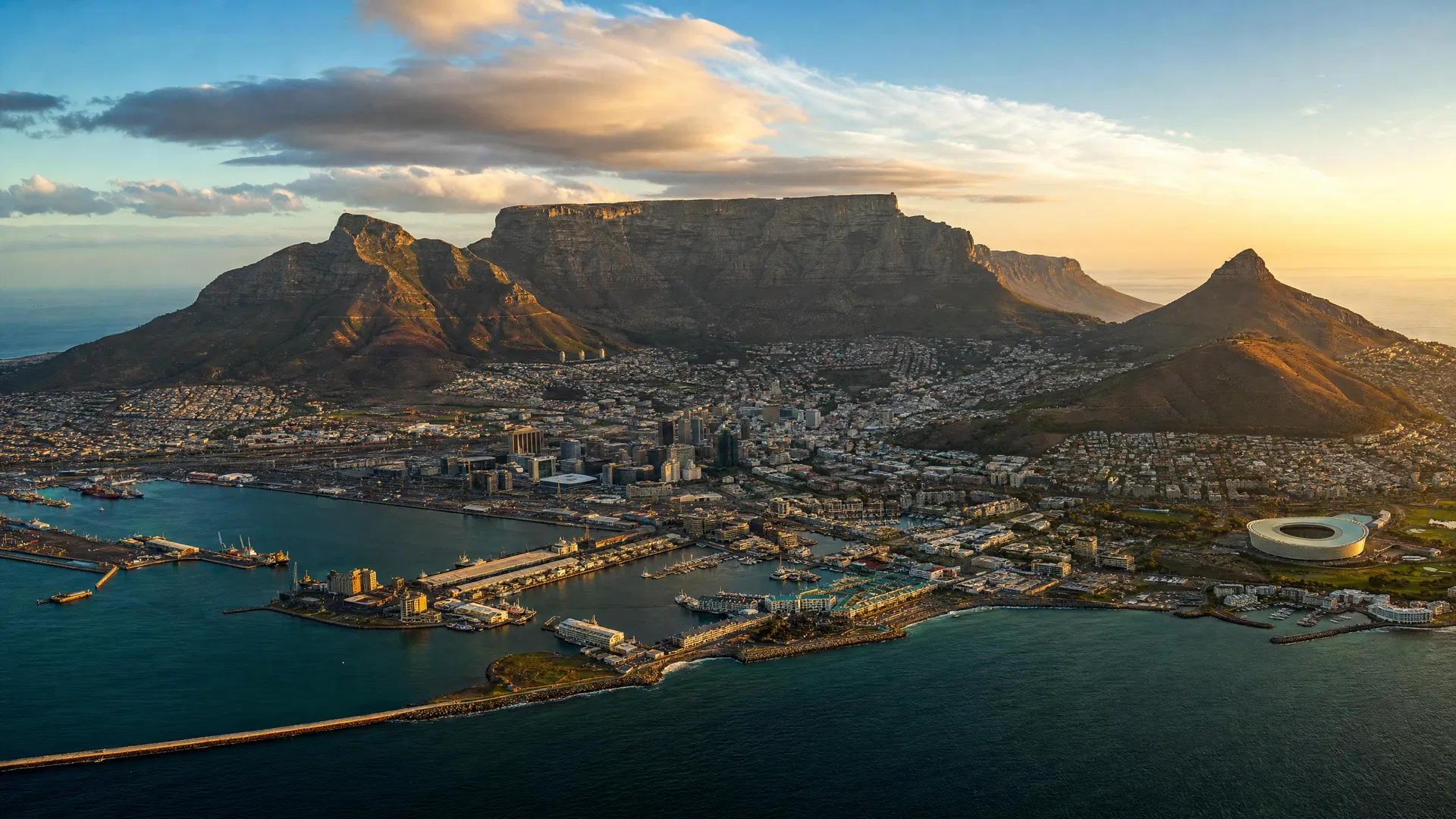
Cape Town, South Africa: The City That Has No Equal
Destination: Cape Town
Category: Destination Guides
Cape Town, South Africa: The City That Has No Equal
There is a moment — and every person who has ever stood at the top of Lion's Head at sunset knows exactly the moment I mean — when Cape Town stops being a place you're visiting and becomes a place that has claimed you. The Atlantic turns molten gold below. Table Mountain goes purple at the edges. The city glitters between the mountains and the sea. And somewhere in your chest, something shifts. You think: I need to come back here.
That feeling is not accidental. It is the product of a city that is, by almost every measure, unlike anywhere else on earth. Cape Town is the place where two oceans meet, where a mountain rises from the center of a city, where you can eat one of the finest meals of your life for less than forty dollars, where penguins waddle across a beach forty minutes from downtown, and where the wine is world-class and the sunsets are criminal. Nelson Mandela called it "South Africa's gift to the world." He was not exaggerating.
This is the complete guide to Cape Town — the experiences that will define your trip, the neighborhoods worth knowing, the food worth eating, the hikes worth the burn, and the honest truths that most travel guides leave out.
Why Cape Town Hits Different
Most great cities are great because of what humans built. Cape Town is great because of what the earth built, and what humans had the good sense to build around it.
The city sits on a narrow peninsula jutting south into the cold South Atlantic, with Table Mountain as its spine and the Cape of Good Hope as its dramatic southern punctuation mark. To the west, the Atlantic seaboard beaches — Clifton, Camps Bay, Llandudno — face the open ocean with a ferocity that makes them wild and beautiful and cold. To the east, the warmer False Bay side offers calmer waters, whale sightings from shore, and the surreal colony of African penguins at Boulders Beach. In between, the mountain and its national park create a wilderness corridor that runs the length of the peninsula, accessible within minutes from the city center.
Then there is the human layer: a city shaped by centuries of collision between indigenous Khoikhoi and San peoples, Dutch colonizers, enslaved people from Malaysia, Madagascar, and India, British settlers, and the vast African interior. The result is a culture that is genuinely its own — Cape Malay cuisine, Afrikaans street slang, the painted houses of Bo-Kaap, the braai culture that transcends every social divide, the jazz that drifts out of Long Street bars on a Friday night. Cape Town is not Africa-lite for nervous Western tourists. It is a fully realized, deeply layered city that rewards curiosity.
Time Out named it the sixth best city in the world in 2026. It was number one the year before. The ranking dropped, locals will tell you, because the judges had never actually been there.
The Neighborhoods Worth Knowing
The City Bowl and CBD is where Cape Town's energy concentrates — Long Street with its backpacker bars and late-night restaurants, Kloof Street with its café culture and independent boutiques, and the V&A Waterfront anchoring the harbor with restaurants, the Two Oceans Aquarium, and the ferry to Robben Island. The CBD is walkable during the day, but like any major city, common sense applies after dark.
Bo-Kaap sits on the slopes of Signal Hill in a blaze of color that has become one of the most photographed neighborhoods in Africa. The cobblestone streets and candy-colored houses — cobalt, lime, fuchsia, tangerine — are the visual legacy of Cape Malay culture, the descendants of enslaved people brought from Southeast Asia and the Indian Ocean islands by the Dutch East India Company. The Auwal Mosque, South Africa's oldest, stands here. The smell of koeksisters frying and the call to prayer from the minarets are the soundtrack. Come early morning before the tour buses arrive, and walk slowly.
De Waterkant bridges Bo-Kaap and the CBD with a village-like cluster of Victorian cottages, wine bars, and design studios. It is Cape Town's LGBTQ+ neighborhood and one of its most relaxed — good coffee, good people-watching, and a pace that feels deliberately unhurried.
Woodstock is where Cape Town's creative class landed when the city center became too expensive. The Old Biscuit Mill hosts the Neighbourgoods Market every Saturday morning — a genuinely excellent food market that draws the city's best small producers, chefs, and artisans. Come hungry. The surrounding streets have Cape Town's best street art, independent galleries, and the kind of restaurant scene that gets written up in international food magazines.
Camps Bay and the Atlantic Seaboard is where the money lives and where the sunsets are best. The beach is backed by the Twelve Apostles mountain range, the restaurants along the strip are expensive and worth it for the setting, and the vibe on a warm evening is as close to the French Riviera as Africa gets. Clifton's four beaches — sheltered coves numbered 1 through 4 — are where locals actually swim. The water is cold. Nobody cares.
Kalk Bay and Simon's Town on the False Bay side are the Cape Town that tourists often miss. Kalk Bay is a fishing village turned arts community, with antique shops, independent bookstores, and the kind of lunch spots that get discovered by food writers and then quietly remain excellent for decades. Simon's Town is the naval base town that also happens to be the gateway to Boulders Beach. The train from Cape Town to Simon's Town along the False Bay coastline is one of the most scenic rail journeys in Africa.
The Experiences That Define a Cape Town Trip
Table Mountain
Table Mountain is one of the New Seven Wonders of Nature, and it earns the designation. The flat-topped massif rises 1,086 meters above the city and is visible from 200 kilometers out to sea. On clear days, the summit offers views across the Cape Peninsula, False Bay, Robben Island, and on exceptional days, the distant outline of the Hottentots Holland mountains.
You can take the rotating cable car (book ahead — queues are brutal in peak season) or hike up via one of several trails. The Platteklip Gorge route is the most popular: two hours up, straightforward, and genuinely spectacular. The India Venster route is more scenic and slightly more technical. The Skeleton Gorge route through Kirstenbosch is the most dramatic — a full day, through forest and fynbos, emerging at the summit feeling like you earned it.
One critical note: Table Mountain makes its own weather. The famous "tablecloth" — the cloud that pours over the summit like a white waterfall — can roll in within minutes. Check the forecast obsessively, and if the cable car is closed due to wind, take the hint. The mountain will be there tomorrow.
Lion's Head
If Table Mountain is the landmark, Lion's Head is the experience. The conical peak rises between the city and the Atlantic seaboard, and the circular hike to its summit — roughly two hours round trip — involves chains, ladders, and scrambling that makes it feel like an adventure rather than a tourist attraction. The views from the top are, if anything, better than Table Mountain: you see the mountain itself, the full sweep of the Atlantic, Camps Bay below, and the city spread out to the north.
Hike it at sunset. Bring wine. Find a rock. Watch the sun drop into the Atlantic. This is the single best free thing you can do in Cape Town.
Cape Point and the Peninsula Drive
The Cape Peninsula drive is a full day and one of the most spectacular coastal drives in the world. The route south from the city passes through Hout Bay (stop for the harbor and the fish market), over Chapman's Peak — a cliff-hugging road carved into the mountainside above the Atlantic — through the fishing villages of Noordhoek and Kommetjie, and down to Cape Point at the southern tip of the peninsula.
Cape Point is not technically the southernmost point of Africa (that is Cape Agulhas, further east), but it is the most dramatic: sheer cliffs dropping hundreds of meters into churning ocean, the old lighthouse perched above, and the raw sense of standing at the edge of something. The Cape of Good Hope sign is the obligatory photograph. The funicular up to the lighthouse is worth it for the view.
On the return, stop at Boulders Beach.
Boulders Beach and the African Penguins
There is something genuinely surreal about sharing a beach with a colony of African penguins. Boulders Beach, near Simon's Town, is home to roughly 3,000 of them — a population that established itself here in 1982 and has been growing ever since. The penguins are entirely unbothered by human presence, waddling past sunbathers, nesting under bushes, and occasionally attempting to steal someone's lunch.
The best time to visit is early morning, when the light is soft and the crowds are thin. March through May is breeding season, when the chicks are visible. The penguins are at their most active in the cooler morning hours. Arrive before 9am if you can.
Robben Island
Robben Island is a forty-minute ferry ride from the V&A Waterfront and one of the most significant historical sites in Africa. This is where Nelson Mandela spent eighteen of his twenty-seven years of imprisonment. The tours are led by former political prisoners, which gives the experience a weight and intimacy that no museum exhibit can replicate. Standing in Mandela's cell — a space barely large enough to lie down — and hearing the story from someone who lived it is not something you forget.
Book well in advance. Tours sell out weeks ahead in peak season.
The Cape Winelands
Stellenbosch and Franschhoek are forty-five minutes from Cape Town and constitute one of the world's great wine regions. Stellenbosch is the larger town — a university city with Cape Dutch architecture, excellent restaurants, and hundreds of wine estates ranging from grand historic farms to boutique natural wine producers. Franschhoek is smaller, more polished, and frankly more beautiful: a valley ringed by mountains, settled by French Huguenot refugees in the 17th century, with a main street of galleries, cheese shops, and restaurants that would not look out of place in Burgundy.
The Franschhoek Wine Tram is a genuinely fun way to hop between estates without driving. A full day in the winelands — morning in Stellenbosch, afternoon in Franschhoek, dinner at La Petite Colombe or Foliage — is one of the great day trips in the world.
Do not drive after wine tasting. Uber is cheap and the police checkpoints are real.
The Food Scene
Cape Town has quietly become one of Africa's most exciting food cities, and the international food press has noticed. The city's culinary identity is built on three pillars: Cape Malay cooking, the braai tradition, and a new generation of chefs who are doing genuinely creative things with local ingredients.
Cape Malay cuisine is the food of Bo-Kaap: fragrant, spiced, and unlike anything else in Africa. Bobotie — a baked minced meat dish with an egg custard topping, flavored with turmeric, curry leaves, and dried fruit — is the national dish of South Africa and its spiritual home is here. Koeksisters (syrup-drenched fried dough), samoosas, and denningvleis (tamarind lamb stew) are the supporting cast. The Bo-Kaap Kombuis and Biesmiellah restaurant are the places to eat this food properly.
The braai is not a barbecue. This distinction matters to South Africans and you should respect it. A braai is a social institution, a ritual, a reason to gather. The wood matters (hardwoods, not charcoal, for the real thing). The timing matters. The conversation around the fire matters. If a local invites you to a braai, go. Bring wine. Arrive on time. Do not offer to help unless asked.
The new wave is centered in Woodstock and the CBD. The Neighbourgoods Market at the Old Biscuit Mill on Saturday mornings is the best single introduction to what Cape Town's food scene is doing: small producers, experimental ferments, wood-fired breads, charcuterie, and the kind of coffee that makes you reconsider everything you thought you knew about coffee. Restaurants like Salsify at the Roundhouse (consistently ranked among South Africa's top five), The Test Kitchen (when it reopens), and Fyn (Japanese-South African fusion in a rooftop setting above the city) represent the serious end of the dining scene.
For something more casual, Kalk Bay's Harbour House for fish and chips with a harbor view, the Olympia Café for breakfast, and any of the Long Street spots for late-night eating after the bars close.
The Honest Safety Picture
Cape Town has a complicated reputation, and it deserves an honest treatment rather than either dismissal or catastrophizing.
The city has significant inequality, and crime — particularly in townships and certain areas of the CBD after dark — is a real concern. The areas that tourists visit are generally safe during the day: the V&A Waterfront, Camps Bay, the Atlantic seaboard beaches, Bo-Kaap, Woodstock, Kalk Bay, and the winelands all see large numbers of visitors without incident. The key rules are the same as any major city: be aware of your surroundings, don't display expensive equipment unnecessarily, use Uber rather than walking long distances at night, and ask locals or your accommodation for current advice on specific areas.
The townships — Langa, Khayelitsha, Gugulethu — are home to the majority of Cape Town's population and are not inherently dangerous, but visiting without a local guide is not recommended. Several excellent township tour operators run responsible, community-benefiting tours that give genuine insight into daily life in these communities. This is worth doing. It is a more complete picture of the city.
The water is safe to drink. The sun is strong — SPF 50, always. The wind (the Cape Doctor, as locals call the persistent southeasterly) is relentless in summer and will destroy your beach umbrella and your patience in equal measure. Pack a windbreaker regardless of the season.
When to Go
Cape Town's seasons are the inverse of the northern hemisphere. Summer runs December through February — hot, dry, and busy, with the Cape Doctor wind at its most persistent. This is peak season: the beaches are at their best, the days are long, and the city is at full energy. It is also the most expensive time to visit and the most crowded.
The shoulder seasons — March to May and September to November — are the best time to visit for most travelers. The weather is warm and settled, the crowds thin, and the prices drop significantly. March and April in particular are exceptional: the summer heat has softened, the wind has eased, and the light is extraordinary.
Winter (June to August) is mild by most standards — rarely below 8°C — but wet and grey. The upside: whale season. Southern right whales arrive in False Bay from June through November to calve, and they can be spotted from shore at Hermanus (a two-hour drive) or even from the cliffs at Cape Point. Seeing a whale breach from a clifftop above the ocean is one of those experiences that recalibrates your sense of scale.
| Season | Months | Weather | Crowds | Highlights |
|---|---|---|---|---|
| Summer | Dec – Feb | Hot, dry, windy | Peak | Beaches, long days, festivals |
| Autumn | Mar – May | Warm, settled | Moderate | Best overall weather, lower prices |
| Winter | Jun – Aug | Cool, wet | Low | Whale watching, winelands |
| Spring | Sep – Nov | Warming, wildflowers | Moderate | Fynbos blooms, whale season continues |
Plan Your Trip with Ask Leif
Cape Town rewards depth. A weekend scratches the surface. A week lets you breathe. Two weeks and you start to understand why people move here.
We've built a full suite of Cape Town itineraries to match every kind of traveler and every length of trip:
Cape Town for Couples: A Romantic 4-Day Itinerary — Table Mountain, Camps Bay sunsets, a winelands day trip, and Cape Point. The essential Cape Town experience, built for two.
Cape Town Family Adventure: 5-Day Itinerary with Penguins & Whales — Boulders Beach, the Two Oceans Aquarium, Cape Point, and whale watching from Hermanus. Everything that makes Cape Town extraordinary for families.
Cape Town Solo Travel: 5-Day Safety-Smart Itinerary & Honest Guide — The honest safety picture, the best solo-friendly neighborhoods, a winelands day trip, and Table Mountain hikes. Built for travelers going it alone.
Cape Town on a Budget: 5-Day Guide to R800/Day Adventures — Free Table Mountain hike, Bo-Kaap, Cape Point, and Boulders penguins on a budget that actually works. Cape Town is more affordable than you think.
Cape Town Food & Wine: A 4-Day Culinary Journey for Gourmands — Braai culture, Bo-Kaap Cape Malay cooking, the Neighbourgoods Market, and a full winelands day. For the traveler who plans trips around meals.
7-Day Cape Town & Garden Route Adventure — Cape Town as the launchpad for one of the world's great road trips: east along the Garden Route through Hermanus, Knysna, the Tsitsikamma Forest, and the dramatic Storms River Mouth.
The City That Stays With You
There is a reason people who visit Cape Town talk about it the way they do — with a slightly dazed quality, as if they are still processing something. It is not just the beauty, though the beauty is real and relentless. It is the particular combination of things that should not coexist but do: wilderness and sophistication, history and forward momentum, the weight of apartheid's legacy and the lightness of a city that has decided, defiantly, to be joyful.
Cape Town will challenge you. It will feed you extraordinarily well. It will put you on top of a mountain and show you two oceans at once. It will give you a sunset that makes you feel briefly, embarrassingly grateful to be alive.
Go. And when you come back — because you will come back — you'll already know where you want to start.