Kenya Made Safari Famous. These Six Destinations Show How Much Bigger the Wild Is.
Destination: Africa
Category: comparison
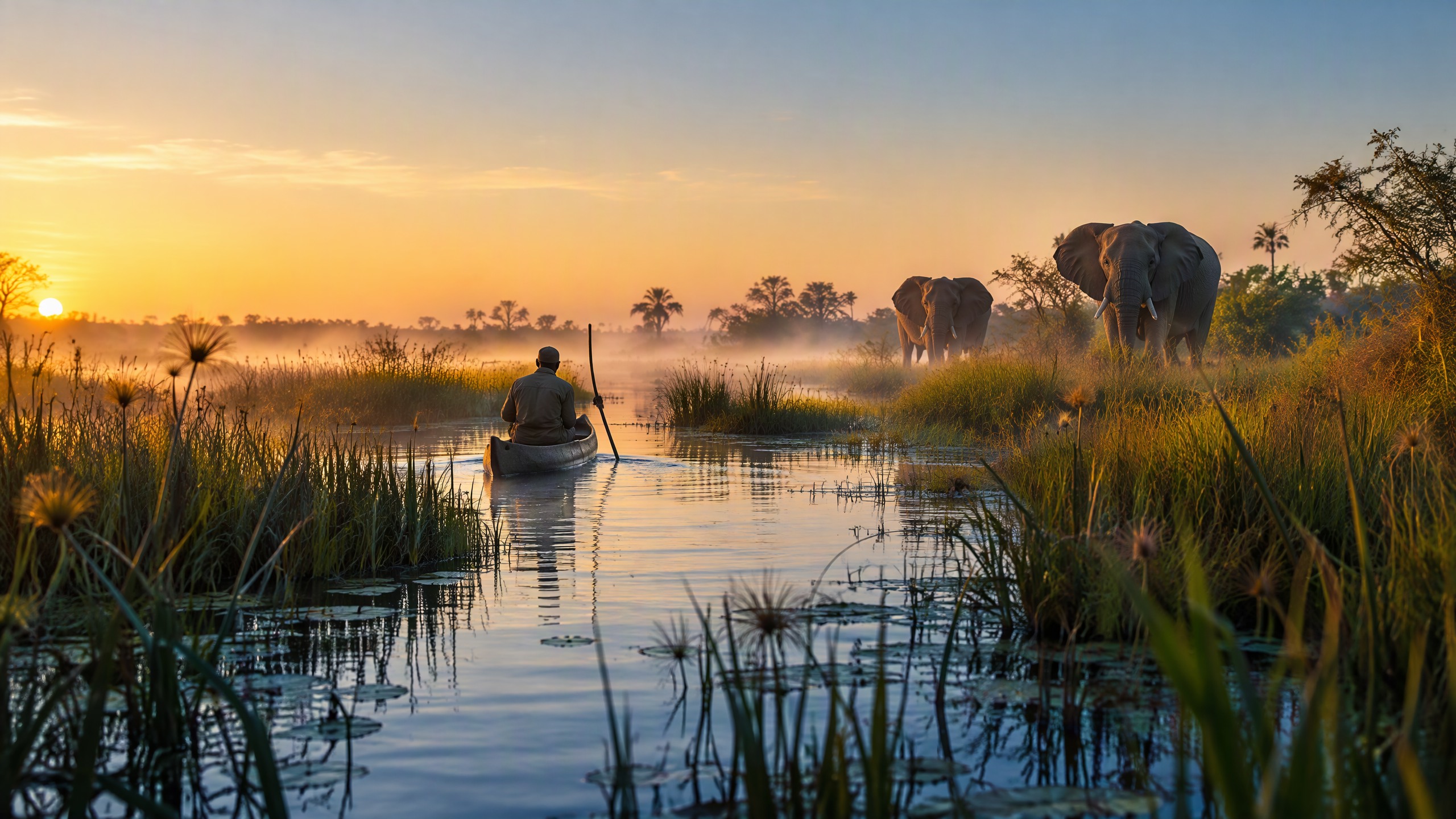
At first light in Botswana’s Okavango Delta, a mokoro slips between papyrus banks without the sound that usually arrives first on safari: an engine. The guide’s pole enters the water, lifts, enters again. A reedbuck disappears into grass. An elephant stands at the channel edge and looks up because it has heard people, not because it has learned to disregard another Land Cruiser. For travelers searching for the best safari destinations beyond Kenya, the encounter contains the one thing the best-known circuits can struggle to preserve at peak season: mutual awareness.
Kenya earned its place in the imagination. The Masai Mara made the safari legible to the world, and the country’s conservation work, guiding culture, and enduring landscapes deserve more respect than the lazy impulse to call a popular place overdone. But popularity can turn a travel category into a product. A checklist arrives before the landscape. The vehicle becomes the default point of view. The lodge becomes a credential. The animals become proof that the itinerary worked.
The best safari destinations beyond Kenya are not alternatives for people who have already exhausted the Mara. They are places where the relationship between wildlife, landscape, ecosystem, and human history still supplies the reason to go. Botswana makes scarcity a conservation policy. Zambia puts the traveler back on foot. Rwanda creates an encounter for which the word safari is almost too small. Zimbabwe makes recovery visible. South Africa removes a practical barrier without shrinking the wild. Ethiopia offers species that evolution made nowhere else. The wildlife is not the product being delivered. It is the argument each place makes.
That argument excludes two obvious names. Tanzania’s Serengeti and Ngorongoro Crater remain extraordinary, and their migration belongs in any serious understanding of East African wildlife. They do not belong in this particular curation because the Kenya–Tanzania vehicle circuit is precisely the established model this post is interrogating. Uganda’s Bwindi forest delivers a profound gorilla trek, but including both Uganda and Rwanda would repeat one primate category rather than widen the definition of safari. This is not a ranking of the Big Five. It is a search for the conditions that make an encounter irreducible.
The Best Safari Destinations Beyond Kenya Need a Different Test
A safari becomes less interesting when it can be reduced to what a guide can promise before the flight is booked. The right question is not whether you will see lion, leopard, elephant, buffalo, and rhino. It is how the place asks you to see anything at all. Do you approach by silent canoe, on foot, through a volcanic forest, beside a solar-pumped waterhole, in your own rented vehicle, or across a high plateau where the predator exists only because the plateau has held it apart from the rest of the world?
The six destinations below answer that question differently. They also ask different things from the traveler: budget discipline in Botswana, physical attentiveness in Zambia, preparation for altitude in Rwanda, historical honesty in Zimbabwe, practical self-direction in South Africa, and patience with distance in Ethiopia. A great safari does not make those differences disappear. It lets them determine the day.
Botswana: The Country That Chose Quality Over Quantity
Botswana limits because the encounter changes when a country treats fewer vehicles as part of the conservation outcome, not an inconvenience to be solved. Its high-value, lower-volume tourism strategy has long made a specific promise: wildlife areas cannot be managed as though every additional guest is neutral. The result is not a claim that Botswana is empty or effortless. It is a different baseline, especially in the Okavango, where water, grass, floodplain, and movement decide more of the day than a fixed game-drive schedule does.
The mokoro is the clearest proof. These low, pole-propelled canoes are connected to the wetland knowledge of the Bayei people, who have navigated the Delta’s channels for generations. At dawn, the absence of an engine changes the scale of attention. You notice the papyrus shifting before you identify what moved it; a frog’s call feels close enough to locate; an elephant at the waterline has room to decide how much of you it wants to acknowledge. A seven-day Okavango Delta safari works when it protects time for this, rather than treating the mokoro as a decorative hour between drives.
Chobe delivers the opposite form of density. On the river at late afternoon, elephants descend toward the water from Botswana’s bank while hippos, crocodiles, and waterbirds hold their own lines around them. The spectacle does not need a narrator calling it a Big Five moment. It is a river system functioning at close range. A Chobe family safari guide can help make the river portion central, especially for travelers who need a gentler rhythm than two game drives a day.
Then there is the Central Kalahari, where the Botswana argument becomes solitude rather than water. Its self-drive and camping possibilities require genuine preparation—recovery gear, water, fuel planning, and the willingness to have no immediate backup plan—but they preserve a form of wilderness that more managed safari circuits cannot replicate. Botswana is not the choice for the cheapest African wildlife trip. It is the choice for someone who understands that the absence of another vehicle can be the most valuable thing in the frame. A Moremi wildlife-photography safari adds the useful counterpoint: the Delta can be intimate and visually immense without becoming a performance.
The flood itself is part of the curation. Water reaches the Okavango from Angola months after rains have fallen there, spreading across Botswana during the dry season instead of following the calendar a visitor might expect. That reversal changes what a good itinerary looks like: floodplain camps, island walks, and channel excursions can be more important than packing every day with a morning and afternoon drive. Botswana asks the traveler to plan around a moving ecosystem, not a brochure’s most reliable animal image. That is a harder request than a checklist and a far better reason to go.
Zambia: The Walking Safari’s Original Home
Where Botswana limits the vehicle, Zambia asks what happens when the vehicle stops being the traveler’s primary relationship to the bush. South Luangwa is the original home of the walking safari tradition associated with Norman Carr, who began reshaping safari practice there in the mid-twentieth century. His insight still feels radical: the point was not to bring people closer to large animals at any cost. It was to restore the human body to the ecosystem it had been observing from above.
On foot, the guide’s attention becomes the itinerary. A fresh elephant track is not a promise that you will find an elephant; it is evidence of direction, weight, timing, and distance. Impala alarm calls are not ambient noise; they are information. The temperature of dung, the way a branch has broken, the sudden quiet of birds—these details move the traveler from passenger to student. Good walking safaris are conducted by licensed guides with strict safety protocols. The intimacy comes from reading the bush, not from testing how close someone can stand to danger.
South Luangwa’s other lesson arrives after dark. The Luangwa Valley is known for leopard, and carefully regulated night drives let a traveler see the ecosystem after the light has changed rather than pretending the day ends at sundown. The right camp will not chase a sighting to manufacture a photograph. It will stop, cut the engine when appropriate, and let the guide explain why a spotlight is used with restraint. Zambia belongs on this list because it turns observation into a skill, not a receipt.
The Lower Zambezi extends that lesson to water. Canoeing past a hippo pod or an elephant group drinking at the river edge places the traveler low and quiet, but the feeling is different from the mokoro. The Zambezi is broad, muscular, and shared with the far bank of Zimbabwe; current, wind, and distance are part of the read. A Victoria Falls adventure guide spanning Zambia and Zimbabwe makes a useful logistics anchor for travelers who want a short extension after the river or Luangwa, though the walking safari deserves its own unhurried days. Choose Zambia over a conventional game-drive-first itinerary when learning to notice matters more than maximizing the daily species count.
The best Zambian camps understand that a walking day has its own tempo. You leave before heat builds, pause for tea where the guide can read fresh signs, return for a long lunch, and go out again when the light changes. There is no virtue in filling every minute. The route becomes a conversation between the guide’s experience, wind direction, seasonal water, and the group’s fitness. That humility is the core product Zambia refuses to package too neatly: you are not promised the bush; you are taught how to enter it.
Rwanda: The Safari at the Distance of a Breath
Where Zambia returns the human body to the ground, Rwanda narrows the distance between human and animal until the usual safari vocabulary begins to fail. Volcanoes National Park does not offer a game drive. It offers a climb into a volcanic forest with a small, regulated group and one hour with a habituated mountain-gorilla family. The encounter is limited because it must be. Eight visitors, a guide, trackers who located the group before dawn, and a set amount of time are not inconveniences surrounding the experience; they are the ethics that make the encounter possible.
The emotional force of gorilla trekking is often described too cheaply as eye contact. The more interesting truth is that the forest does not stage a revelation. A silverback may turn away. Juveniles may tumble through the vegetation. A mother may keep eating, almost indifferent to the humans allowed briefly into her world. The visitor’s work is to remain quiet enough to understand that access is not possession. Rwanda’s permit is expensive, and that price should never be presented as a luxury badge. It is part of a conservation and community-financing model whose value depends on where revenue goes and how responsibly the visit is conducted.
The physical reality matters. A gorilla family might be found after a shorter climb near the park boundary or after hours on steep, muddy terrain at altitude. Hire porters through the local system if you need help; the practical support is meaningful employment, and there is no honor in arriving exhausted enough to stop paying attention. A Rwanda gorilla-trekking itinerary is most useful when it leaves slack around the trek rather than treating it as a morning appointment between airport transfers.
Nyungwe Forest gives Rwanda a different primate counterpoint. Chimpanzee tracking can require a much faster pace through dense forest because chimpanzees move and vocalize across the canopy on their own terms. That contrast is why Rwanda, rather than Uganda, carries this category here. Rwanda makes the narrowest and most structured mountain-gorilla argument, then complicates it with a forest where the traveler has far less control over the encounter. Choose Rwanda when the definition of safari needs to include another intelligence in shared space, not simply an animal seen at a distance.
Rwanda also rewards a traveler who puts the trek in a fuller landscape. The road between Kigali and Musanze is short enough to make the country feel compact, but the cultivated hills, volcanic silhouettes, and small agricultural communities make clear that protected forest is not separate from human life. Build in time to listen to a guide explain the park boundary, the community projects around it, and why a gorilla permit cannot be evaluated solely by the hour on the trail. Rwanda belongs here because its restrictions make the ethics of access impossible to ignore.
Zimbabwe: The Safari That Makes Recovery Visible
If Rwanda makes conservation feel intimate, Zimbabwe makes it historical: the wildlife encounter sits inside a country whose parks, communities, infrastructure, and political memory have all endured pressure. That is not a reason to reduce Zimbabwe to a crisis narrative. It is a reason to reject the polished fiction that conservation happens outside economics, colonial histories, land questions, and public institutions. Here, the systems keeping animals alive are often visible in the landscape.
Hwange National Park is the clearest example. In a dry-season landscape where natural surface water is uneven, maintained waterholes shape where animals can gather and where travelers can sit without pursuing them. At Nyamandhlovu Pan, the discipline is to wait. Elephants arrive on their own timetable, dust rising behind them, calves caught between urgency and caution. The waterhole does not make the encounter artificial; it reveals how much conservation can depend on unglamorous infrastructure—pumps, maintenance, rangers, fuel or solar power, and people who keep the system running through hard years.
Mana Pools provides the opposite texture: a floodplain where walking and canoeing make the visitor newly responsible for their own composure. Its reputation comes from a rare combination of river, forest, elephant, and space, but it is not a place to romanticize risk. Follow park guidance, use experienced operators where required, and recognize that an elephant standing on its hind legs to browse an albida tree is not an invitation to approach. The moment is powerful because the animal is behaving as itself.
A Botswana-and-Victoria-Falls adventure itinerary provides a practical bridge into the region, but Zimbabwe should not be treated only as a falls add-on. Victoria Falls has its own force, while nearby Zambezi National Park offers a quieter lesson in how water, woodland, and wildlife can sit alongside one of the continent’s most visited spectacles. Choose Zimbabwe when safari needs to retain the record of what it took to keep a wild place functioning, rather than presenting a finished landscape without a past.
This is also a place to think carefully about timing. Hwange’s dry months concentrate animals around dependable water, while the rains alter both access and the texture of the landscape. Neither is automatically better. The dry season teaches patience at a pan; the green season can make birds, grass, and distance part of the story again. Travelers who choose Zimbabwe for recovery should leave room for the fact that recovery is ongoing work, not a happy ending placed on a park sign.
South Africa: The Safari That Opens the Door Wider
Where Zimbabwe makes the labor of conservation visible, South Africa opens safari to travelers for whom a malaria-free option, self-drive control, or a broader trip is the difference between going and staying home. The country does not make safari simpler by making it shallow. It changes the practical terms of access.
The Eastern Cape is the essential correction to the assumption that malaria risk is unavoidable. Reserves around Addo, Kariega, and Shamwari make it possible to build a Big Five-oriented wildlife trip without the same prophylaxis decisions as Kruger-adjacent areas. That matters for families, pregnant travelers, people managing medication interactions, and anyone whose medical situation should not be subordinated to a travel fantasy. The point is not that a malaria-free reserve is risk-free—wildlife, weather, and road conditions still require judgment. The point is that a barrier has been removed without asking the traveler to abandon real habitat and serious conservation work.
Addo’s elephant herds are its own argument. The park’s dense coastal thicket, open areas, and water points create a different visual world from East Africa’s grasslands. Watch a herd settle around water in the late afternoon and the category “elephant sighting” becomes inadequate; social order, calf protection, dust bathing, and the decision to leave are all happening at once. South Africa’s safari value lies partly in that regional variety, not simply its familiar names.
Kruger offers the opposite freedom: self-drive. Enter through Phabeni Gate before the road has filled, move slowly toward Skukuza, and accept that you may spend forty minutes with nothing more dramatic than a hornbill and an empty bend in the road. That waiting is the point. A Kruger self-drive safari guide can give the independent traveler enough structure without turning every hour into a chase. Pairing it with a Cape Town and Garden Route itinerary makes South Africa the most complete one-country choice on this list: wildlife, coast, vineyards, and cities without requiring a separate continental logic. Choose it when the safari must fit inside a wider trip and still remain fully itself.
The self-drive option also restores the pleasure of not knowing. You decide when to stop for a kudu crossing, when to pull into a hide, and when to leave a crowded sighting because the road ahead has become more interesting. It requires restraint: stay in the vehicle where rules require it, respect speed limits, never crowd animals, and do not mistake access for entitlement. South Africa opens the door wider because it lets a traveler take responsibility for their own attention rather than outsourcing every decision to a convoy.
Ethiopia: The Wildlife Evolution Produced in Isolation
If South Africa opens the safari map through practical access, Ethiopia isolates it again, taking the traveler to highlands where evolution produced animals with no equivalent elsewhere. The Ethiopian wolf is not a substitute for a lion. The gelada is not a lesser gorilla. They are evidence that the most consequential wildlife encounter can be the one no Big Five checklist has trained a traveler to want.
On the Sanetti Plateau in Bale Mountains National Park, Ethiopian wolves hunt giant mole rats across open, wind-swept ground. The scene is quiet enough to feel nearly miniature until the animal rises, listens, and pounces. The wolf’s survival is precarious; disease from domestic dogs, habitat pressure, and fragmented populations make this less a trophy encounter than a reason to support operators and park systems that take conservation seriously. Go at dawn with a guide who understands the plateau, stay on established routes, and let the animal’s ordinary hunting behavior be enough.
The Simien Mountains offer a second, radically different social world. Geladas gather in large, grass-grazing bands along escarpments, their daily movement tied to cliffs where they sleep and high meadows where they feed. Watching them emerge in early light is not dramatic because a predator has been manufactured into a scene. It is dramatic because a primate society is moving through the landscape it shaped its life around. The red chest patch, the infants clinging to females, the near-constant grooming, and the sound of the herd make a form of wildlife observation that has little to do with a vehicle line.
An Ethiopia cultural-and-wildlife adventure guide is a starting point, not a replacement for careful local planning. Ethiopia’s living cultures must never be treated as a companion attraction to animals or as material for someone else’s itinerary. The strongest trip holds both truths: the highlands are biologically singular, and the people who live in and around them are not scenery. Choose Ethiopia when the question is not how many famous animals a day can contain, but how much a single landscape can explain about isolation, adaptation, and responsibility.
Altitude changes the entire rhythm. The Bale and Simien highlands are not a warm-weather shortcut to wildlife; weather can move fast, roads can be slow, and the body needs time to adjust. Bring layers, plan conservatively, and choose guides who can explain both natural history and current conservation pressure without turning either into a spectacle. Ethiopia makes the sharpest final argument in this post because it asks the traveler to value the unfamiliar animal before it has been made famous by the global safari industry.
How to Choose Among the Best Safari Destinations Beyond Kenya
Choose Botswana if the budget can support fewer beds, longer stays, and the value of quiet water or space between vehicles. Give it at least six or seven nights; the Delta, Chobe, and Kalahari make different claims and deserve more than a sampler.
Choose Zambia if you want the guide’s reading of tracks, wind, and alarm calls to become the core of the trip. Five to eight nights in South Luangwa or a combination with the Lower Zambezi will feel fuller than chasing multiple parks in a week. Walking safaris require a level of mobility and comfort with uncertainty that should be assessed honestly before booking.
Choose Rwanda if one profound primate encounter matters more than variety. Plan four to six nights, protect a recovery day around the trek, and budget transparently for the permit, porter, guide, transport, and community-facing costs. It can combine with Uganda geographically, but do not add a second gorilla trek merely to make a map look ambitious.
Choose Zimbabwe if a landscape with conservation history and multiple modes of movement—waterhole waiting, river travel, walking where allowed—sounds more rewarding than a seamless luxury circuit. Pair Hwange with Mana Pools for a longer wildlife trip, or use Victoria Falls as the arrival or departure point without letting it consume the itinerary.
Choose South Africa if medical practicality, self-drive independence, family logistics, or a safari-plus-city route determines the choice. Seven to ten days lets an Eastern Cape reserve or Kruger breathe alongside Cape Town, the Winelands, or the Garden Route. Choose Ethiopia if endemic life is the priority and you can give the highlands the time, altitude adjustment, and local guide support they require.
These destinations can combine, but combination is not automatically depth. Botswana and Zimbabwe share the Zambezi and make sense across ten to fourteen nights. Zambia and Zimbabwe create a river-and-falls route if the days in South Luangwa remain protected. Rwanda and Ethiopia are better treated as separate commitments unless the traveler has enough time to avoid turning two fragile ecosystems into a sequence of flights. AskLeif can turn that decision—pace, season, physical needs, and the kind of encounter you are actually looking for—into a day-by-day itinerary rather than a generic safari checklist.
The Wild Is Bigger Than the Vehicle
Botswana limits. Zambia walks. Rwanda approaches. Zimbabwe recovers. South Africa opens. Ethiopia isolates.
Those verbs contain more truth than a list of animals. They describe six ways a place can make wildlife matter: by protecting silence, lowering the human body to the ground, regulating access, keeping infrastructure alive, widening practical access, or holding evolution apart long enough for a species to become its own answer.
Kenya made safari famous because it showed the world what was possible. These destinations matter because they refuse to let possibility become a script. The best encounter is not the one that completes the list. It is the one that makes the list feel suddenly too small.