Florence Doesn't Show You Everything at Once. That's the Point.
Destination: Florence, Italy
Category: Destination Guides
Florence is not a city that overwhelms you. It seduces you.
Other great cities announce themselves — New York with noise and scale, Rome with ruins around every corner, Tokyo with the sheer improbability of its density. Florence does something different. It draws you in slowly, street by street, courtyard by courtyard, until you realize, somewhere around the third day, that you have been walking in circles not because you are lost but because you cannot stop looking.
The city is small by the standards of great capitals — roughly 350,000 people, a historic center that can be crossed on foot in twenty minutes. But within that compact geography is concentrated a density of human achievement that has no parallel on earth. The Uffizi Gallery alone contains more masterpieces than most countries possess in their entirety. The Duomo — Brunelleschi's dome, the engineering marvel that changed architecture forever — rises above the terracotta rooftops with a confidence that still feels impossible five and a half centuries after its completion. The Ponte Vecchio, lined with jewelers' shops since the 16th century, crosses the Arno at the point where the river is narrowest and most beautiful.
But Florence is not a museum city. That is the mistake people make before they arrive. It is a living city, with a food culture of extraordinary depth, a craft tradition that has been unbroken since the Renaissance, neighborhoods that feel genuinely local, and a pace of life that is, by Italian standards, almost unhurried. Come for the art. Stay for everything else.
The Duomo: The Building That Changed the World
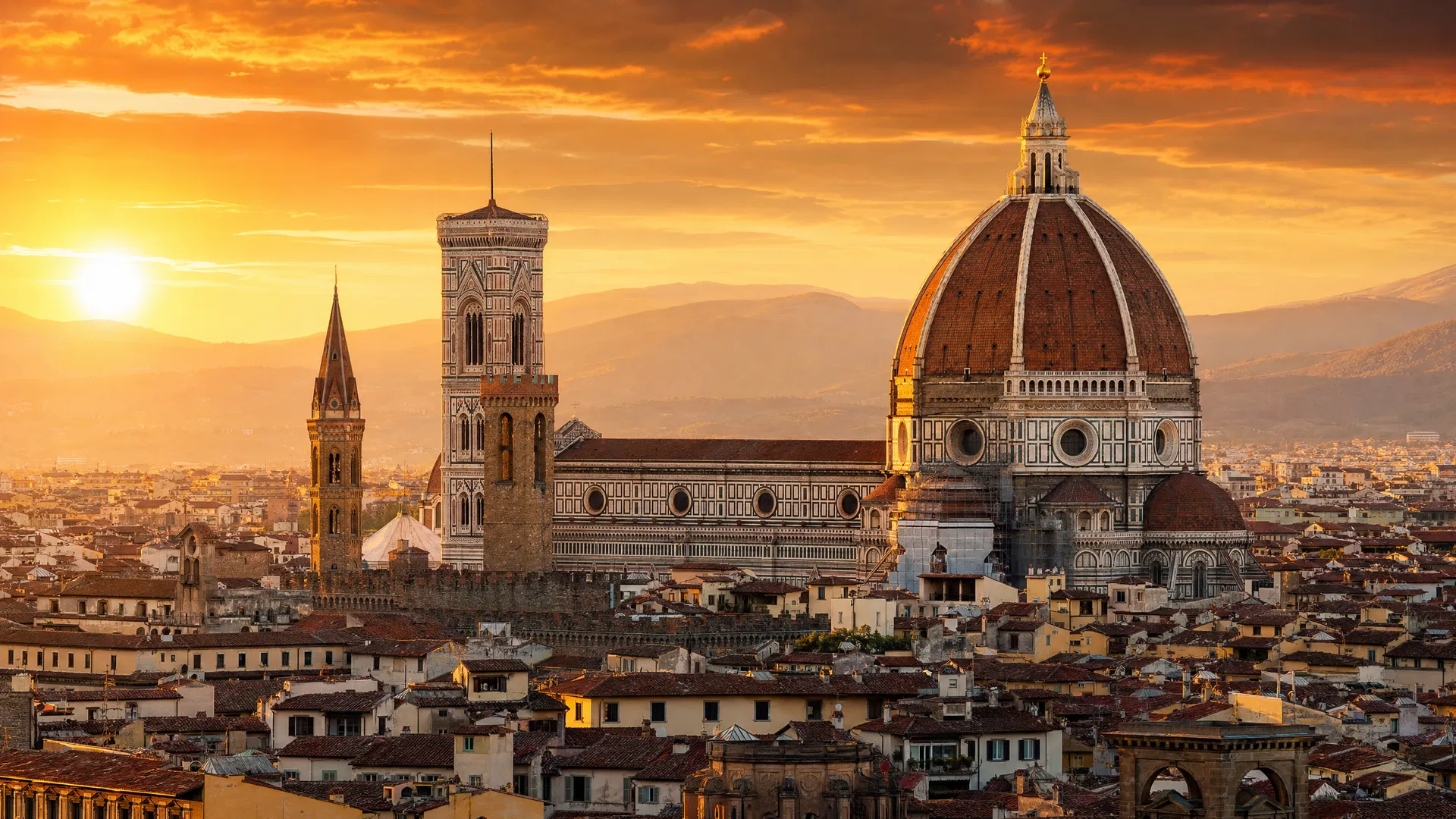
Everything in Florence orients itself around the cathedral. The Cattedrale di Santa Maria del Fiore — the Duomo — is visible from almost every point in the city, its terracotta dome rising above the roofline with the serene authority of something that has always been there and always will be.
The dome itself is the story. When Filippo Brunelleschi won the commission to complete the cathedral in 1418, the problem he was asked to solve had stumped every architect in Europe for over a century: how do you build a dome 44 meters wide, 55 meters above the ground, without the wooden centering that was standard practice? Brunelleschi invented a new method — a double-shell construction with herringbone brickwork and a self-supporting structure that distributed weight in ways that had never been attempted before. He essentially invented the Renaissance in the process of solving an engineering problem.
Climbing the dome — 463 steps, no elevator — is one of the most rewarding physical experiences in European travel. The views from the top are extraordinary, but the real revelation is the climb itself: you pass between the inner and outer shells of the dome, walking along the same passages that Brunelleschi's workers used, close enough to touch the frescoes on the inner ceiling, close enough to understand, viscerally, what was built here and how.
The Baptistery of San Giovanni, across the piazza from the Duomo, contains Lorenzo Ghiberti's bronze doors — the "Gates of Paradise," as Michelangelo called them — whose ten gilded panels depicting scenes from the Old Testament are among the supreme achievements of Renaissance sculpture.
The Uffizi: The Greatest Art Museum in the World
This is not hyperbole. The Uffizi Gallery contains, within a single building, a concentration of Renaissance masterpieces that no other institution on earth can match. Botticelli's Birth of Venus and Primavera. Leonardo da Vinci's Annunciation. Michelangelo's Doni Tondo. Raphael's Madonna of the Goldfinch. Titian's Venus of Urbino. Caravaggio's Sacrifice of Isaac. These are not secondary works. These are the paintings that define Western art history, and they are all here, in Florence, in a single building.
Book tickets in advance — the queues without reservations can run two to three hours in peak season. Arrive when the museum opens. Start at the beginning (the medieval rooms on the second floor) and work chronologically, so that by the time you reach Botticelli you have the context to understand what he was doing and why it mattered.
The Accademia Gallery is the other essential museum — home to Michelangelo's David, the most famous sculpture in the world, and a collection of unfinished Michelangelo works (the Prisoners) that are in some ways even more moving than the finished masterpiece. The 4-Day Florence City Break: An Art & Culture Lover's Itinerary is built specifically for visitors who want to go deep on the art — covering the major museums, the lesser-known gems, and how to structure your days to avoid the worst of the crowds.
The Oltrarno: Florence's Other Side
Cross the Ponte Vecchio to the south bank of the Arno and you enter a different Florence. The Oltrarno — literally "beyond the Arno" — is the neighborhood that Florentines actually live in, a dense tangle of medieval streets lined with artisan workshops, family-run trattorias, wine bars, and the kind of neighborhood life that the tourist-heavy north bank has largely lost.
The Pitti Palace dominates the neighborhood — a vast Renaissance palace that houses several museums, including the Palatine Gallery (with important Raphael and Titian works). The Boboli Gardens behind the palace are one of the finest formal gardens in Italy, a terraced landscape of fountains, grottos, and cypress alleys that climb the hill behind the palace to panoramic views of the city.
The artisan workshops of the Oltrarno are one of the city's great treasures. Florence has been a center of craft production since the Renaissance — leather goods, gold jewelry, paper marbling, bookbinding, silk weaving — and many of these traditions survive in workshops that have been operating for generations. The Florence Family Adventure: 4-Day Itinerary with Kids includes an Oltrarno artisan workshop visit as one of its centerpiece experiences.
The Food: Tuscany on a Plate
Florentine cuisine is one of the most self-confident in Italy, which is saying something. It does not apologize for its simplicity. It does not chase trends. It has been doing the same things for five hundred years and it knows they are right.
Bistecca alla fiorentina is the dish that defines the city's culinary identity — a massive T-bone steak from the Chianina cattle of the Val di Chiana, cut at least five centimeters thick, cooked over a wood fire to rare (and only rare; ordering it well-done is considered an insult), seasoned with nothing but salt, pepper, and a drizzle of olive oil. The best bistecca in Florence is served at Buca Mario (the city's oldest restaurant, open since 1886), Il Latini (a long-table institution where you share benches with strangers), and Trattoria Sostanza.
Lampredotto is the other essential Florentine food experience: the fourth stomach of a cow, slow-cooked in broth with tomatoes and herbs, served in a bread roll with salsa verde and hot sauce. It is sold from street carts called lampredottai — the most famous is Nerbone in the Mercato Centrale — and it is one of the great street foods of Europe.
Ribollita is the Tuscan bread soup — a thick, deeply flavored stew of cannellini beans, cavolo nero, stale bread, and vegetables, slow-cooked until everything has collapsed into a single, unified whole. The Mercato Centrale is the city's great covered market, whose ground floor is still a working food market and whose upper floor has been converted into an excellent food hall.
For those who want to explore Florence's food culture in depth, the Florence Food & Wine: A 4-Day Culinary Journey Through Tuscany's Capital is the definitive guide, covering the city's best restaurants, markets, cooking classes, and Chianti day trips.
Chianti and the Tuscan Countryside
Florence is the gateway to Tuscany, and the Tuscan countryside is one of the most beautiful landscapes on earth. The rolling hills of the Chianti Classico wine region — the corridor of vineyards, olive groves, and medieval hilltop villages between Florence and Siena — are accessible by car or bicycle in under an hour.
Greve in Chianti is the main town of the region, with excellent wine shops and a beautiful triangular piazza. Panzano in Chianti is home to Dario Cecchini, the most famous butcher in Italy. San Gimignano — the "medieval Manhattan," with its fourteen surviving towers — is 50 kilometers southwest of Florence and one of the most photographed skylines in Italy. Siena, the great rival city, is 75 kilometers from Florence and makes for a full day trip; the Piazza del Campo is one of the finest public spaces in Europe.
Piazzale Michelangelo: The View That Explains Everything
Every city has a viewpoint that makes you understand it. Florence's is Piazzale Michelangelo, a terrace on the hill south of the Arno that looks out over the entire city — the Duomo, the Palazzo Vecchio, the Uffizi, the Arno, the hills beyond — in a single, comprehensive panorama.
Go at sunset. The light turns the terracotta rooftops gold, the dome glows, and the city below arranges itself into a composition that looks exactly like a Renaissance painting — which, of course, is not a coincidence. The walk up through the Giardino delle Rose and the Giardino dell'Iris is one of the most pleasant walks in the city, particularly in May when the roses and irises are in bloom.
Florence for Couples
Florence's combination of extraordinary beauty, intimate scale, and world-class food and wine makes it one of the most romantic cities in Europe. The classic moves: a sunset aperitivo at a rooftop bar overlooking the Duomo. Dinner at a candlelit trattoria in the Oltrarno. A morning at the Uffizi before the crowds arrive. A walk across the Ponte Vecchio at dusk, when the jewelers' shops are lit from within and the Arno below catches the last light.
The Florence For Couples: A Romantic 4-Day Itinerary maps out four days of exactly this kind of experience — the iconic and the intimate, the grand gesture and the quiet corner, the city at its most seductive.
Florence on a Budget
Florence is one of the more expensive Italian cities, but its greatest pleasures are largely free or very cheap. The view from Piazzale Michelangelo costs nothing. The exterior of the Duomo costs nothing. Walking the streets of the Oltrarno costs nothing. Sitting in Piazza Santo Spirito with a glass of house wine costs two euros.
For food, the key is to eat where Florentines eat: the market stalls at Mercato Centrale, the lampredotto carts near Piazza del Mercato Nuovo, the neighborhood trattorias in the Oltrarno that serve a fixed-price lunch menu for 10–15 euros including wine. The Florence on a Budget: 4-Day Itinerary for Savvy Travelers (€70/Day) maps out exactly how to experience the city's highlights on a strict daily budget.
Florence for Solo Travelers
Florence is an excellent solo travel destination — safe, walkable, with a well-developed infrastructure for independent travelers and a culture that is genuinely welcoming to people traveling alone. The city's museums and churches are all easily navigated solo, and the Oltrarno's bars and restaurants have the kind of convivial atmosphere where it is easy to fall into conversation.
The Solo Florence: The Ultimate 4-Day Itinerary for Independent Explorers covers the solo experience in full — the best neighborhoods for solo exploration, the museums worth spending a full morning in, and how to meet people in a city that can feel closed to outsiders at first.
Florence Luxury: The City at Its Most Magnificent
Florence's luxury offering is extraordinary — and it is rooted in the same craft traditions that have defined the city for five centuries. The leather goods at Scuola del Cuoio are made by hand using techniques unchanged since the Renaissance. The jewelry on the Ponte Vecchio includes pieces by goldsmiths whose families have been working in Florence for generations. The private tours of the Uffizi and the Vasari Corridor offer access to parts of the museum that the general public never sees.
The Florence Luxury Travel Guide: 4-Day Uffizi Private Access, Michelin Dining & Chianti covers the full luxury experience — private museum access, Michelin-starred restaurants, the finest hotels, and the kind of Chianti day trip that involves a private vineyard tour and a lunch that lasts three hours.
When to Go
April through June is the sweet spot — warm but not hot, the city's gardens and surrounding countryside at their most beautiful, and the crowds manageable. May is particularly good: the Iris Garden and Rose Garden above Piazzale Michelangelo are in bloom, the light is extraordinary, and the city has not yet reached the peak-summer saturation.
September and October are the other ideal months — the summer crowds have thinned, the light has turned golden, the Chianti harvest is underway, and the food is at its best. October in Tuscany, with the truffle season beginning and the olive harvest approaching, is one of the great culinary seasons in Italy.
November through March is the low season — fewer tourists, lower prices, and a more authentic experience of the city. The weather is cool and sometimes rainy, but the museums are uncrowded, the restaurants are full of locals, and Florence in winter has a particular beauty — the fog on the Arno, the Christmas lights in Piazza della Repubblica, the smell of roasting chestnuts from street vendors.
Getting There and Getting Around
Florence Santa Maria Novella is the city's main train station, served by high-speed trains from Rome (1.5 hours), Milan (1.75 hours), Venice (2 hours), and Naples (3 hours). The train is almost always preferable to flying — the stations are central, the journey times are competitive, and the experience of arriving at Santa Maria Novella and walking out into the city is one of the great travel arrivals in Europe.
Within the city, walking is the primary mode of transport — the historic center is compact and largely pedestrianized, and almost everything worth seeing is within a 20-minute walk of everything else.
Plan Your Florence Trip with Ask Leif
Florence rewards the traveler who comes prepared — who knows which rooms of the Uffizi to prioritize, which trattoria in the Oltrarno has been serving the same ribollita since 1960, which viewpoint catches the best light at which hour. The city is small enough that a well-planned itinerary can cover an extraordinary amount of ground; it is deep enough that no itinerary will exhaust it.
Ask Leif builds your complete Florence itinerary in under a minute — day-by-day schedule, museum booking recommendations, restaurant picks, and Chianti day trip logistics, all tailored to your travel style, budget, and dates. Start with one of the guides above, or let the AI build something entirely custom for your trip.
The city is waiting. It has been waiting, patiently and magnificently, for five hundred years.