Chiang Mai Didn't Let Me Leave. I'm Still Not Sure I Want To.
Destination: Chiang Mai, Thailand
Category: Destination Guides
There is a moment — and every person who has spent more than a week in Chiang Mai knows exactly the one — when you sit down at a wooden table in the Old City, order a bowl of khao soi that costs less than two dollars, and realize with quiet, unsettling certainty that you are not going to leave when you planned to.
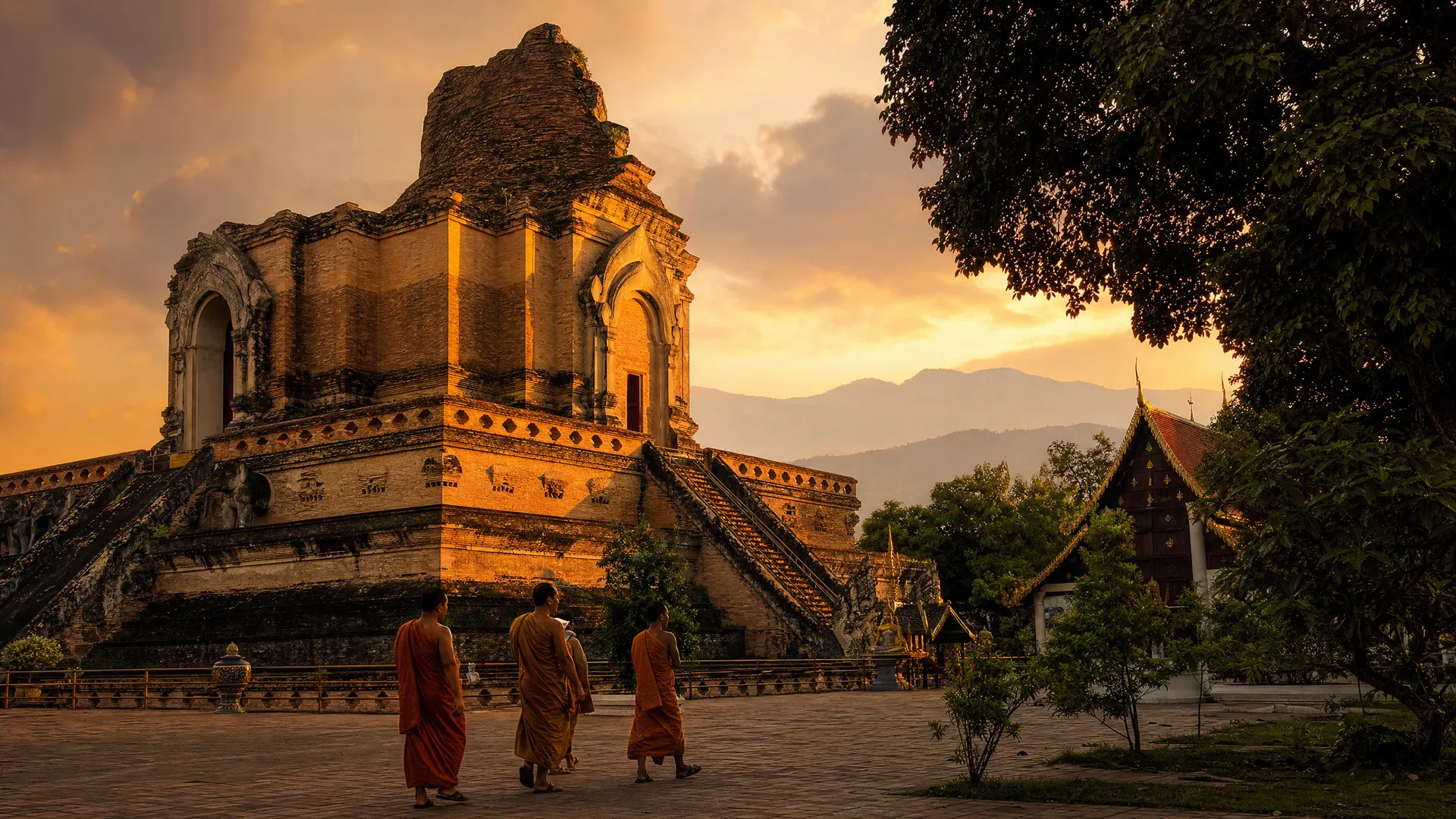
It happens differently for everyone. For some it's the morning light hitting the moat at 6am, the city still cool and unhurried while monks in saffron robes collect alms on streets that haven't changed in centuries. For others it's the first bite of sai oua — the herbed northern Thai sausage that tastes like someone compressed an entire herb garden into a single link — from a vendor at the Saturday Walking Street who has been standing in the same spot for thirty years. For digital nomads, it's the moment they open their laptop at a cafe in Nimman, order a flat white for 60 baht, and realize they're more productive here than they've ever been anywhere else on earth.
Chiang Mai is the city that ruins your timeline. And it does it without apology.
The City That Chose a Different Speed
Bangkok gets the headlines. Phuket gets the Instagram posts. But Chiang Mai — nestled in a valley in northern Thailand, ringed by mountains, cooled by altitude, and anchored by a 700-year-old walled city — gets the people who actually stay.
The numbers tell part of the story: Chiang Mai is consistently ranked among the top three digital nomad destinations in the world. It has more Buddhist temples per square kilometer than almost any city on earth — over 300 within the city limits alone. It hosts one of Southeast Asia's most celebrated food scenes, a culinary tradition so distinct from central Thai cooking that northern Thai cuisine is effectively its own category. And it sits at the gateway to some of the most dramatic mountain trekking in the region, with Doi Inthanon National Park — Thailand's highest peak — just 90 minutes from the city center.
But statistics don't explain Chiang Mai. What explains Chiang Mai is the pace. This is a city that has never been in a hurry. The Old City, enclosed within its ancient moat and crumbling brick walls, operates on a rhythm that feels almost medieval — temples open at dawn, markets appear at dusk, and the space between is yours to fill however you choose. There is no pressure here. No relentless forward momentum. Just a city that has figured out, over seven centuries, exactly what it wants to be.
The Old City: Where Chiang Mai's Soul Lives
The ancient walled quarter at the heart of Chiang Mai is one of the most walkable, livable urban spaces in Southeast Asia. Roughly 1.5 kilometers square, bounded by the moat on all sides, the Old City contains dozens of temples, hundreds of guesthouses and boutique hotels, and a density of excellent restaurants that would embarrass cities ten times its size.
Wat Chedi Luang is the anchor — a 14th-century temple complex whose central chedi once stood over 80 meters tall before an earthquake in 1545 brought the upper section down. What remains is still staggering: a massive, moss-covered tower surrounded by guardian nagas, the whole complex suffused with the kind of quiet reverence that makes you lower your voice automatically. The temple hosts a "monk chat" program where visitors can sit with resident monks and ask questions about Buddhism, Thai culture, or anything else — one of the most genuinely enriching experiences available in the city, and it costs nothing.
Wat Phra Singh is the other essential Old City temple, home to the Phra Singh Buddha image — one of the most revered in northern Thailand — and a collection of beautifully preserved Lanna-style wooden buildings whose painted murals depict daily life in 19th-century Chiang Mai with extraordinary detail. Come early morning, when the light is soft and the crowds are thin, and you'll have the complex largely to yourself.
For those who want to go deeper into Chiang Mai's temple culture, the Chiang Mai 5-Day Itinerary: Temples, Elephants & Doi Inthanon Adventure builds a full week around the city's spiritual and natural highlights, from the Old City temples to the summit of Doi Inthanon.
Doi Suthep: The Temple Above the City
No visit to Chiang Mai is complete without the pilgrimage up Doi Suthep mountain to Wat Phra That Doi Suthep, the gilded temple that watches over the city from 1,073 meters above sea level. The legend of its founding involves a sacred relic, a white elephant, and a trumpet — which tells you something about the kind of city this is.
The temple itself is extraordinary: a gleaming complex of gold chedis, intricate murals, and panoramic views over the valley below. The 306-step naga staircase that leads to the entrance is both the most photographed approach and, on a clear morning, one of the most genuinely beautiful walks in Thailand. Go at sunrise if you can manage it — the city below is still wrapped in mist, the monks are chanting inside the temple, and the whole experience has a quality of unreality that no photograph has ever quite captured.
The Chiang Mai for Couples: 5-Day Romantic Nimman & Doi Inthanon Escape includes a Doi Suthep sunset visit paired with an evening in the Nimman neighborhood — one of the most romantic sequences available in the city.
The Elephant Question: Doing It Right
Chiang Mai is the elephant sanctuary capital of Southeast Asia, and the ethics of elephant tourism here matter enormously. The short version: avoid any venue that offers riding, circus performances, or painting demonstrations. These activities require training methods that cause significant harm to the animals.
The good news is that Chiang Mai has some of the best ethical elephant sanctuaries in the world — places where rescued elephants live in large forested environments, where visitors walk alongside them, feed them, and observe their natural behaviors without any exploitation involved. Elephant Nature Park, founded by Lek Chailert, is the most famous and arguably the gold standard. Elephant Jungle Sanctuary and Ran-Tong Save & Rescue Elephant Centre are also well-regarded.
A half-day at any of these sanctuaries is one of the most moving experiences available in Southeast Asia. Watching a 60-year-old elephant who spent decades in the logging industry finally roam freely through a forest, eating watermelons and splashing in a river, is the kind of thing that stays with you.
Both the Chiang Mai Family Adventure: 5-Day Itinerary with Elephants & Cooking and the Chiang Mai Family Vacation: 4-Day Temples, Elephants & Jungle Adventure include ethical elephant sanctuary visits as centerpiece experiences — highly recommended for families traveling with children.
Northern Thai Food: A Cuisine That Deserves Its Own Trip
Let's be direct: northern Thai food is one of the great underappreciated cuisines of the world, and Chiang Mai is where you eat it in its most authentic form.
Khao soi is the dish that gets all the attention, and the attention is deserved. This is a curry noodle soup of Burmese-Chinese origin, built on a rich coconut-milk curry broth, served with both soft boiled egg noodles and crispy fried noodles on top, and accompanied by pickled mustard greens, shallots, lime, and chili oil. Every khao soi shop in Chiang Mai has its own recipe, its own balance of spice and coconut, its own particular depth of flavor. Eating your way through the city's khao soi options is a legitimate activity that could occupy several days. Khao Soi Khun Yai, Khao Soi Lung Prakit Kad Kom, and the stalls at Warorot Market are all essential stops.
But khao soi is just the beginning. Sai oua (northern Thai herbed sausage) is fragrant with lemongrass, galangal, kaffir lime leaf, and dried chilies. Nam prik noom is a roasted green chili dip served with sticky rice and raw vegetables that is simultaneously simple and addictive. Gaeng hang lay is a slow-cooked pork belly curry with Burmese influences, rich with ginger and tamarind. Khanom jeen nam ngeow is a tomato-based noodle soup with pork ribs and dried chilies that tastes like nothing else in Thailand.
The markets are where all of this comes together. Warorot Market (Kad Luang) is the city's oldest and most authentic market — a sprawling covered complex near the river where locals shop for everything from fresh produce to silk fabric to dried chilies in quantities measured by the kilogram. The food stalls on the ground floor serve some of the best and cheapest northern Thai food in the city. Talat Pratu Chiang Mai is the morning market of choice for many residents, open from around 6am and packed with vendors selling fresh-made dishes, grilled meats, and tropical fruits.
For those who want to go deep on northern Thai cuisine, the Chiang Mai Food Guide: 4 Days of Northern Thai Cuisine & Markets is a comprehensive culinary itinerary that covers the city's markets, restaurants, and cooking class scene in exhaustive, delicious detail.
The Cooking Class Scene: Learn to Make It Yourself
Chiang Mai has one of the most developed cooking class scenes in Southeast Asia, and for good reason: the ingredients are extraordinary, the techniques are learnable, and the experience of making your own khao soi from scratch — grinding your own curry paste in a stone mortar, watching the coconut milk separate in the wok — is one of those travel experiences that translates directly into your life back home.
Most classes begin with a market visit to source ingredients, which doubles as a food tour of Chiang Mai's wet markets. Thai Farm Cooking School, Zabb E Lee, and Asia Scenic Thai Cooking are consistently well-reviewed. Half-day classes typically run 1,000–1,500 baht and include 4–6 dishes plus a recipe booklet. Full-day classes go deeper into curry paste preparation and regional specialties.
The Chiang Mai Couples Retreat: 4-Day Food, Temples & Elephant Sanctuary Deep Dive builds a couples itinerary around cooking classes, market visits, and temple exploration — one of the most satisfying ways to experience the city together.
Nimman: The Neighborhood That Grew Up
Nimmanhaemin Road — universally shortened to "Nimman" — is Chiang Mai's most cosmopolitan neighborhood, a tree-lined boulevard and its surrounding sois (side streets) packed with boutique hotels, specialty coffee shops, design stores, art galleries, and restaurants that range from excellent northern Thai to Japanese ramen to wood-fired pizza.
Nimman is where Chiang Mai's creative class lives and works. It's also where the city's digital nomad community concentrates — the coffee shops here have fast WiFi, abundant power outlets, and a tolerance for people who nurse a single Americano for four hours while working on their laptops. Ristr8to is the city's most celebrated specialty coffee bar, a tiny, precise operation that takes its espresso as seriously as any cafe in Melbourne or Tokyo. Graph Cafe, Ponganes Espresso, and Roast8ry are also excellent.
The weekend Nimman Walking Street (Saturday evenings) transforms the neighborhood into an outdoor market of local designers, street food vendors, and live music — a more curated, less touristy version of the Night Bazaar, and one of the most pleasant ways to spend a Saturday evening in the city.
The Night Bazaar and Walking Streets: Markets After Dark
Chiang Mai's evening markets are a world unto themselves. The Night Bazaar on Chang Klan Road is the most famous — a sprawling complex of covered stalls selling everything from hill tribe textiles to counterfeit goods to genuinely beautiful handmade crafts. It's touristy, yes, but it's also enormous and genuinely fun to wander, particularly the outdoor food court where you can eat grilled meats and papaya salad while watching traditional Thai dance performances.
The Sunday Walking Street on Wualai Road is the more authentic experience — a weekly market that closes an entire street to traffic and fills it with local vendors selling handmade jewelry, ceramics, clothing, and food. The atmosphere is festive and unhurried, the prices are better than the Night Bazaar, and the food stalls are exceptional. Arrive around 5pm as the market is setting up and stay until 9 or 10pm when the energy peaks.
Doi Inthanon: Thailand's Rooftop
An hour and a half south of Chiang Mai, Doi Inthanon National Park is Thailand's highest point (2,565 meters) and one of the most biodiverse areas in the country. The park contains waterfalls, cloud forest, hill tribe villages, and a pair of royal chedis built to honor the King and Queen that sit at 2,200 meters elevation surrounded by manicured gardens and mist.
The drive up the mountain passes through dramatic changes in vegetation — from tropical lowland forest to temperate cloud forest — with viewpoints overlooking valleys that disappear into haze. The summit area is genuinely cold by Thai standards (bring a layer), and the bird life is extraordinary: Doi Inthanon is one of the best birding destinations in Southeast Asia, with species found nowhere else in Thailand.
Wachirathan Waterfall and Siriphum Waterfall are the most impressive of the park's many cascades, both accessible via short walks from the main road. The Ang Ka Nature Trail near the summit is a 360-meter boardwalk through cloud forest that feels like walking through a fairy tale — moss-draped trees, orchids, and a silence broken only by birdsong.
The Chiang Mai 5-Day Itinerary dedicates a full day to Doi Inthanon, covering the royal chedis, the waterfalls, and the summit — the most comprehensive way to experience the park.
Muay Thai: The Art of Eight Limbs
Chiang Mai is one of the best cities in the world to train Muay Thai, whether you're a complete beginner looking for a single session or a serious practitioner wanting to immerse yourself for weeks. The city has dozens of gyms ranging from tourist-friendly introductory classes to serious training camps that work with professional fighters.
Lanna Muay Thai is the most famous — a full training camp that has produced professional fighters and offers everything from beginner classes to multi-week residential programs. Santai Muay Thai and Charn Chai Muay Thai are also well-regarded. A single training session typically costs 400–600 baht and includes gloves, wraps, and instruction.
The Chiang Mai Solo Travel Guide: 4 Days of Digital Nomad Life, Muay Thai, and Temples builds a solo itinerary around the gym, the temples, and the cafe scene — the quintessential Chiang Mai solo experience.
The Digital Nomad Life: Why Chiang Mai Became the Template
Chiang Mai didn't invent the digital nomad lifestyle, but it may have perfected the conditions for it. The combination of fast and reliable internet, extremely low cost of living, excellent food, a warm climate, a large and welcoming expat community, and a city that is genuinely beautiful and interesting to live in has made Chiang Mai the reference point against which every other digital nomad destination is measured.
The numbers are compelling: a comfortable private room in a guesthouse or apartment runs 8,000–15,000 baht per month. Three meals a day of excellent local food costs 300–500 baht. A coworking space membership at CAMP, Yellow, or MANA runs 1,500–3,000 baht per month. Total monthly expenses for a comfortable nomad lifestyle: roughly $800–1,200 USD, depending on accommodation and lifestyle choices.
The Chiang Mai Solo Travel: 5-Day Digital Nomad Hub, Temples & Elephants is the essential guide for anyone planning to combine work and travel in the city — covering the best coworking spaces, neighborhoods, and how to structure your days between productivity and exploration.
Budget Chiang Mai: Living Well for Almost Nothing
Chiang Mai is one of the most affordable cities in Southeast Asia for travelers who want to live well rather than just survive cheaply. The distinction matters: this is not a city where budget travel means sacrificing quality. It means eating extraordinary food at street stalls, staying in beautifully designed guesthouses, and spending your money on experiences rather than overhead.
A realistic daily budget for comfortable travel: 800–1,200 baht ($22–35 USD). This covers a private room in a good guesthouse, three meals of excellent local food, a temple entrance fee or two, and a coffee at a specialty cafe. Stretch to 1,500–2,000 baht and you're eating at the city's best restaurants, taking occasional tuk-tuks, and doing a cooking class or temple tour.
The Chiang Mai on a Shoestring: Your 4-Day Budget Travel Guide maps out exactly how to experience the city's highlights on a strict budget — including the free temples, the cheapest khao soi shops, and how to navigate the city without spending on taxis.
When to Go
November through February is the golden season — cool, dry, and clear, with temperatures in the Old City dropping to a genuinely pleasant 15–20°C at night. This is peak season, and accommodation prices reflect it, but the weather is so good that it's worth every baht.
March and April bring the smoke season — agricultural burning in the surrounding hills fills the valley with haze that can be genuinely unpleasant for people with respiratory sensitivities. This is also when Songkran (Thai New Year, mid-April) transforms the city into a week-long water fight of extraordinary scale and joy. If you can handle the smoke and want to experience Songkran, this is one of the most memorable festivals in Southeast Asia.
May through October is the rainy season — afternoon showers, lush green landscapes, and significantly fewer tourists. The rain typically comes in short, intense bursts rather than all-day downpours, and the city is beautiful in the wet season. Accommodation prices drop substantially, and the crowds at major temples thin out considerably.
Loi Krathong and Yi Peng (November full moon) is Chiang Mai's most magical festival — thousands of paper lanterns released simultaneously into the night sky, floating upward in a river of light that is one of the most beautiful things you will ever see. If your dates are flexible, plan around this.
Getting There and Getting Around
Chiang Mai International Airport (CNX) is served by direct flights from Bangkok (1 hour, multiple daily), Singapore, Kuala Lumpur, Hong Kong, and a growing number of international destinations. From Bangkok, the overnight train is a genuinely lovely option — a 12-hour journey through the Thai countryside on a sleeper train that costs a fraction of the flight and arrives at Chiang Mai's beautiful colonial-era railway station.
Within the city, red songthaews (shared pickup trucks with bench seats) are the primary local transport — flag one down, tell the driver where you're going, and negotiate a price (typically 30–50 baht for most Old City destinations). Grab (Southeast Asia's Uber) works well and is often cheaper than negotiating with tuk-tuk drivers. For day trips to Doi Inthanon or Doi Suthep, renting a scooter (200–300 baht per day) gives maximum flexibility, though the mountain roads require confidence on two wheels.
Plan Your Chiang Mai Trip with Ask Leif
The best Chiang Mai trip is the one built around what you actually want — and Chiang Mai has enough depth to satisfy almost any travel style. Whether you're here for the temples and culture, the food and cooking classes, the elephant sanctuaries, the digital nomad infrastructure, or the mountain trekking, the city rewards specificity.
Ask Leif builds your complete Chiang Mai itinerary in under a minute — day-by-day schedule, accommodation recommendations, restaurant picks, and practical logistics, all tailored to your travel style, budget, and dates. Start with one of the guides above, or let the AI build something entirely custom for your trip.
The city is waiting. And it's in no hurry.