Europe vs Southeast Asia for First-Time Travelers: One Teaches You to Move. The Other Teaches You to Let Go.
Destination: Europe & Southeast Asia
Category: comparison
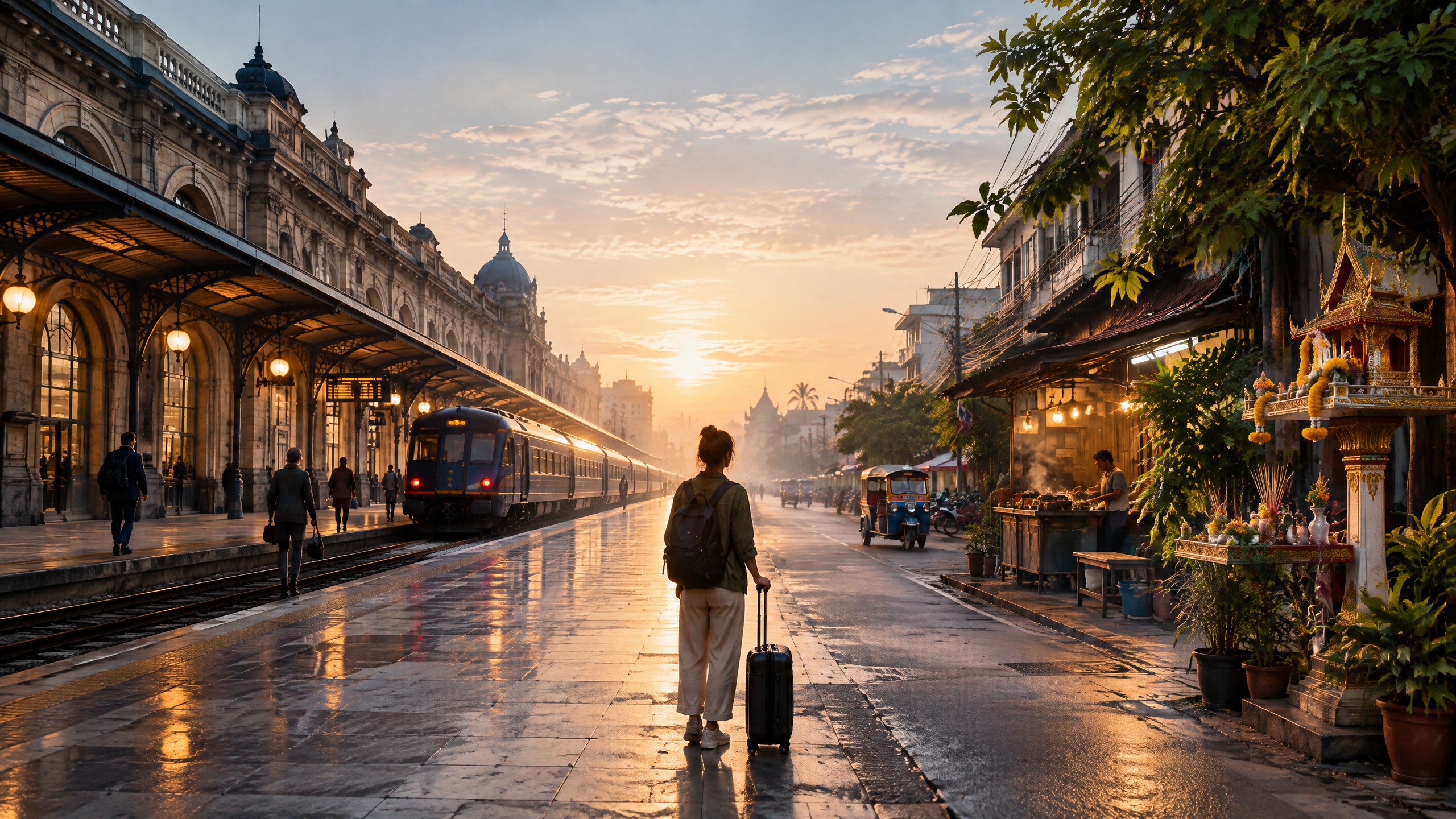
At 7:45 on a Tuesday morning, a first-time traveler can walk into Roma Termini, find a platform on the departure board, buy an espresso, board a train, and be in Florence before lunch. Europe vs Southeast Asia for first-time travelers begins with that difference in what a place asks of you. The station will ask almost nothing unfamiliar of them. The signage is legible. Their card works. The platform system feels like an intensified version of systems they already know. Even the anxiety has a recognizable shape: read the board, watch your bag, make the connection.
At 7:45 on a Tuesday morning in Bangkok, another first-time traveler may be standing beside a spirit house outside a convenience store, watching someone set down marigolds, incense, and a small bottle of sweet drink before continuing to work. The gesture takes seconds. It is not explained. It is not aimed at the visitor. Yet it communicates an entire relationship among place, luck, obligation, and the unseen that no itinerary app can translate in time for breakfast.
Europe versus Southeast Asia for first-time travelers is not fundamentally a decision about safety, price, or comfort. It is a decision about what you want your first international trip to do to you. Europe teaches you to move through a world whose references may already live in your books, films, classrooms, maps, and imagination. Southeast Asia teaches you to let go of the assumption that those references are the center of the map. Neither is the more sophisticated choice. One offers the exhilaration of recognition; the other offers the exhilaration of discovery.
The usual comparison turns this into a scorecard: Europe is expensive but easy, Southeast Asia is cheap but “more adventurous.” That is true enough to be misleading. A first international trip is not a product comparison. It is the moment you discover whether travel makes you more alert by confirming what you have long wanted to see, or by placing you inside a daily logic you could not have predicted. The right answer depends on which kind of newness you need.
Latin America is intentionally outside this comparison, not because it is a lesser third option but because it deserves a comparison of its own. Its languages, colonial histories, urban rhythms, and geographic range create a different first-timer question. This is the more common fork in the road: the Europe trip many travelers already understand in outline, or the Southeast Asia trip that asks them to revise the outline.
Europe vs Southeast Asia for First-Time Travelers Begins With the Kind of Newness You Want
Europe gives a first-time traveler the thrill of recognition made physical. Southeast Asia gives them the thrill of encountering an order of life whose meanings cannot arrive in advance. That difference is neither a moral hierarchy nor a measure of courage. It is a choice about attention.
Europe: The Place Where Your Reference Points Become Real
Europe teaches the first-time traveler to move by making familiar cultural references tangible. The Colosseum, the Eiffel Tower, Venice’s canals, Renaissance paintings, café terraces, cathedral squares—many Western travelers have been introduced to them long before landing. That prior knowledge does not cheapen the experience. It gives Europe its particular force. The first sight of the Pantheon’s oculus or the Colosseum’s arcades produces a strange calibration: something imagined for years finally acquires weather, scale, sound, and crowds.
Rome is the clearest proof. The city asks a traveler to hold several time scales at once: the Forum as an archaeological field, the Trevi Fountain as a working piece of civic theater, a bar serving cornetti to commuters before the sightseeing day begins. Walk from the Largo di Torre Argentina—where Julius Caesar was killed and cats now occupy the ruins—to the Teatro Marcello and the Jewish Ghetto, and history stops being a chapter sequence. It becomes a landscape through which people still take out the trash, meet for coffee, and rush to work.
For a first visit, a five-day Rome itinerary helps turn that density into a legible route, while this Rome food guide keeps the city’s markets, trattorie, and daily eating culture inside the historical experience rather than after it. Europe rewards planning because its inheritance is so concentrated. Reservations matter. Timed-entry tickets matter. Train platforms matter. The pleasure is not in being tested by chaos; it is in discovering how much freedom a well-understood system can give you.
That is why Europe is right for the first-timer who wants the world to become more coherent. It does not merely show you famous things. It lets you locate yourself among the ideas and images that have already shaped you. Southeast Asia will make a different demand: not recognition, but the willingness to be briefly without a reference point.
Southeast Asia: The Place Where You Learn to Release the Script
Where Europe turns prior knowledge into movement, Southeast Asia teaches the first-time traveler to let go of the script they did not know they were carrying. Thailand is often called easy for beginners, and it is—if “easy” means that the traveler infrastructure is generous. Yet the deeper value of Bangkok and Chiang Mai is not that they protect the visitor from difference. It is that they make difference ordinary enough to live alongside.
Start with the spirit house. The san phra phum outside a shop, hotel, office building, or home is not a decorative local marker. It is a compact expression of a spiritual ecology in which a place has presences to be respected. The flowers, incense, fruit, and sweet drinks are renewed within the flow of regular work. A traveler does not need a lecture to feel the distance between that practice and the secular default of many Western streets. They only need to notice it, repeatedly, without demanding that it become a performance for them.
Bangkok then expands the lesson through density. On the Chao Phraya, express boats carry office workers, students, monks, and visitors past temples and warehouses; the river is transit, not scenery. In Talat Noi, Chinese-Thai merchant history is written into shophouses, shrines, and repair garages. At Wat Pho, the reclining Buddha is not merely a large object to photograph but a working religious space with rules of dress and comportment. A five-day Bangkok itinerary offers a stable first structure and makes clear why a bowl of noodles on a plastic stool is often not the lower-priced version of a restaurant meal but the principal expression of the cuisine.
Then go north. Chiang Mai slows the sensory speed without reducing the difference. The early-morning alms round is a practice of merit, not a visitor activity; watch with distance, dress respectfully, and never block its path for a photograph. At Warorot Market, northern sausage, fermented pork, herbs, and textiles reveal a regional food culture that is not a scaled-down Bangkok. A Chiang Mai food and temples guide can make those two cities intelligible as one first trip rather than two unrelated stops.
Thailand, rather than Bali, carries this section because it makes the first-timer encounter both a vast modern city and a distinct northern regional culture. Bali is powerful, but its visitor economy can make the traveler feel accommodated before they have learned to notice. Bangkok and Chiang Mai are more useful evidence: they are navigable, hospitable, and still insistently themselves. Europe taught you to move through a familiar inheritance. Thailand teaches you that navigation can coexist with not knowing the meaning of everything you see.
Europe: The Budget Is Not as One-Sided as the Internet Says
If Thailand proves that discovery need not be difficult, Central Europe proves that Europe is not automatically the expensive alternative. The Europe-versus-Southeast Asia budget comparison usually pits Paris, London, or Amsterdam against Bangkok, then declares the result settled. It is not. Prague and Budapest offer long urban days—public squares, imperial buildings, late-night food, river views, thermal baths, dependable transport—without requiring a Western Europe budget.
Budapest makes the case especially well. A morning at the Széchenyi thermal baths, a tram ride along the Danube, and a walk from the Central Market Hall toward the Jewish Quarter place a first-time traveler inside a city that gives value through public life rather than through expensive add-ons. The No. 2 tram is more than cheap transport; it is an orientation tool, tracing the riverfront past Parliament, the Chain Bridge, and Castle Hill. You do not need to buy the city’s prestige in order to feel its scale. A four-day Budapest itinerary puts those elements in a usable sequence and helps avoid treating goulash as the only edible idea in town.
Prague provides the counterweight. Its astronomical clock draws crowds, but the more revealing first-timer experience is walking out toward Vinohrady or Karlín, riding the tram as residents do, then returning to the center after the day groups have thinned. The city’s cost advantage is real, though not unlimited: central accommodation and the most visible restaurants can still inflate a budget. The smarter comparison is not “Europe can be as cheap as Southeast Asia.” It cannot, consistently. It is that a careful European route can be far more attainable than the standard capital-city comparison allows. A Prague itinerary is a practical start and a more grounded reason to explore beyond the old town.
Southeast Asia will soon show why low cost has a different meaning there. Budapest and Prague make Europe’s answer honest: the continent asks more of a daily budget, but the gap narrows sharply when you choose cities whose quality of life has not yet been priced like a global luxury brand.
Southeast Asia: Cheap Does Not Mean Settling for Less
Where Central Europe shows that value can make recognition attainable, Vietnam shows that Southeast Asia changes the relationship between price and quality altogether. In Hanoi, a low bill often reflects the local form of eating, not the inferior version of something better. The traveler who sits down for phở at a neighborhood shop in the morning is not “saving money” by declining a premium alternative. They are participating in the dish at the scale and pace at which the city eats it.
That point matters for a first-timer because it removes a subtle anxiety. In many expensive destinations, budget travel can feel like a degraded version of the intended experience: dorm beds instead of good rooms, convenience food instead of restaurants, long detours instead of direct transport. Vietnam often reverses that logic. A plastic stool on a pavement, a bowl of bún chả, a cup of iced coffee, and a walk through the Old Quarter can be the day’s high point, not the compromise that makes the “real” trip affordable.
Hanoi’s food culture also teaches attention. At Chợ Đồng Xuân, the market’s wholesale scale explains the city’s appetite better than a polished tasting menu can. In the narrow lanes around the Old Quarter, the hour matters: breakfast has its own foods, lunch has its own rhythm, and a dish may disappear because its maker has sold out. A Hanoi food guide helps a first visit approach that rhythm with enough confidence to enjoy it. Hoi An provides the softer counterpoint: the central market, a bowl of cao lầu, and a bicycle ride out toward Cam Kim make the city’s commercial history feel lived rather than displayed. This Hoi An food guide is a useful bridge between the two.
Vietnam, rather than a generic “Southeast Asia on $30 a day,” earns this section because it makes abundance feel specific. Thailand’s spirit houses changed the traveler’s assumptions about daily belief. Hanoi and Hoi An change their assumptions about what value means. Prague and Budapest prove that Europe can be accessible; Vietnam proves that inexpensive can be the fullest version of the experience.
Europe: Its Safety Advantage Is Real, but Mostly About Friction
If Vietnam makes value feel like participation, Europe makes safety feel like a reduction in logistical friction rather than an absence of ordinary urban risk. Most first-time travelers do not need a lecture about whether Europe is safe. They need an honest account of what vigilance looks like: keep a hand on your bag in crowded stations, ignore clipboard distractions and bracelet scams near major attractions, use the official taxi queue or transit app, and do not let your first night’s jet lag make every decision for you.
Rome is a sensible place to learn those habits because the risks are mostly legible. Pickpocketing on a packed metro carriage is irritating, not exotic. So is an overpriced taxi from an airport, or a restaurant whose menu becomes less generous once a traveler sits down. The normal rules of a major city apply. A European first trip lets a nervous traveler practice independence inside infrastructure that meets them halfway: rail stations with clear boards, metro maps, broadly accepted cards, and a high probability of finding someone who can help in English.
Pompeii sharpens the larger recognition argument. Walk its streets early enough to hear footsteps before the big tour groups arrive, and the ancient city becomes a physical correction to every simplified image of Rome. It is not only villas and tragedy; it is bakeries, painted election notices, drains, workshops, and the evidence of ordinary lives stopped in place. Pairing Pompeii with a four-day Rome guide gives a first-timer an especially clear Europe experience: ease of movement in the present, then a past made materially unavoidable.
Southeast Asia does not lose on safety because it requires different habits. It requires different preparation. The comparison becomes useful when the traveler stops confusing unfamiliarity with danger.
Southeast Asia: Its Real Risks Are Concrete, Not Mysterious
Where Europe’s risks usually arrive as manageable urban friction, Cambodia teaches the first-time traveler that Southeast Asia’s risks are concrete, knowable, and less dramatic than the fear of unfamiliarity suggests. The important safety discussion in the region is not a vague warning about “being careful.” It is traffic, sun, heat, water, food hygiene, scams around a few high-traffic sites, and the fact that a first-time traveler should not rent a motorbike merely because it looks like the local answer to getting around.
Siem Reap makes the case through contrast. Angkor is immense enough to make a visitor feel they have arrived somewhere beyond their prepared imagination: towers rising above a moat before dawn, sandstone galleries, roots folded around walls at Ta Prohm, faces looking out from Bayon. But the practical experience is not chaotic. Hire a licensed driver or arrange transport through a reputable hotel, carry water, begin before the heat, wear clothing that works for active temples, and leave room for the site’s physical scale. A four-day Angkor Wat and Siem Reap itinerary gives the experience a pace that does not turn the complex into a sunrise photograph followed by exhaustion.
Health preparation belongs in the same honest frame. A traveler should consult a clinician or a qualified travel-health service well before departure, review current destination-specific vaccine guidance, obtain insurance that covers medical evacuation, and take heat and hydration seriously. Those are preparations, not reasons to avoid the trip. Cambodia is the right evidence here because Angkor turns the first-timer’s discovery response into something physical: a civilization at a scale many travelers have not learned to expect, reached through a route that can be well planned without being overprotected.
Europe made vigilance familiar. Cambodia makes preparation deliberate. The difference is not that one is safe and the other is unsafe. It is that the risks in Southeast Asia become easier to handle once they are named correctly.
Europe: It Teaches You to Trust the Network
If Cambodia teaches deliberate preparation, Europe teaches the first-time traveler what a supportive travel network feels like. A continental rail system, city transit, easy cross-border movement, and a dense concentration of walkable centers can make the first international trip feel less like an endurance test and more like an invitation to keep going. This is where Europe’s friction advantage is strongest—and where it is genuinely worth paying for if anxiety is likely to overwhelm curiosity.
The classic route is not a failure of imagination: London to Paris to Amsterdam to Berlin to Prague to Vienna to Budapest works because it teaches a traveler how to vary a trip while keeping the systems legible. The useful lesson, though, is not to cram all seven into ten days. Let a first trip be smaller. Choose Paris, Amsterdam, Berlin, Prague, and Budapest over two and a half weeks, or Italy alone over ten days. The ability to move easily should create time to linger, not permission to collect capitals.
Prague and Budapest are useful again because the connection between them is a three-ish-hour train ride with a clear change of emotional register. Prague’s Gothic density gives way to Budapest’s river scale and bath culture. Their respective itineraries can serve as modular stops even when the traveler is not taking a conventional couples trip; both cities make the rail-linked route legible at a human pace.
Southeast Asia offers a different kind of network. It is not less complete; it is built around the traveler who learns to accept a little more improvisation, a little more waiting, and a little more local texture in the movement itself.
Southeast Asia: It Teaches You to Accept the Journey as Part of the Day
Where Europe’s network makes moving feel almost invisible, Southeast Asia teaches the first-time traveler to let the movement become part of the trip. A night train, a ferry, a minivan, a longtail boat, a flight that leaves at a less convenient hour—these can look like inefficiencies from a European itinerary mindset. In practice, they ask a different question: can you let travel time become a place to watch, listen, and adjust rather than a flaw in the plan?
A first regional route does not need to imitate the old backpacker circuit across five countries. It should be shorter and more coherent. Bangkok to Chiang Mai is a strong first Thailand arc. Hanoi to Hoi An works as a Vietnam arc. Add Siem Reap only if you have at least two and a half weeks, not because the map permits it but because Angkor deserves recovery time and the transfers deserve respect. The most common first-timer error in Southeast Asia is not getting lost. It is assuming the region is a checklist because flights look cheap.
Bali is a useful final counterpoint, not because it should automatically be added to every Southeast Asia trip, but because it reveals another kind of logistical choice. Its offerings can make a traveler believe the island will arrange itself. It will not. Ubud, the coast, temples, traffic, ceremony, and rest need to be arranged around a real geography, especially in high season. A ten-day Bali itinerary helps preserve the island’s internal variety, while a Bali food guide anchors the trip in warungs, markets, and regional cooking instead of a generic beach holiday.
Europe teaches you to trust the network. Southeast Asia teaches you to stop treating the journey as dead time. That is why the choice is so revealing. One rewards confidence in systems. The other rewards your ability to stay receptive when the system asks you to slow down.
Europe vs Southeast Asia for First-Time Travelers: How to Choose
Choose Europe if you want your first international trip to deepen a conversation you have already been having with the world. You know the references but want to feel their scale. You value language accessibility, rail connections, dense city walking, and a lower cognitive load while you learn the mechanics of international travel. Europe is also the better fit when your trip is seven to fourteen days and you want every transfer to feel efficient. A realistic moderate budget varies sharply by route, but Central Europe can make a ten-day trip much more attainable than an itinerary built entirely around Paris, London, and Amsterdam.
Choose Southeast Asia if you want your first international trip to make the world larger. You are willing to prepare for different transport rhythms, weather, food practices, cash needs, and health guidance because you want the discovery those differences produce. A realistic daily budget can stretch much further in Thailand, Vietnam, and Cambodia, but do not use that advantage to overpack the route. Ten days is enough for one country or one carefully paired region; two and a half to three weeks is enough for Thailand plus Cambodia, or Vietnam plus Cambodia, with genuine time in each.
If your anxiety is high, do not use Southeast Asia as a test you have to pass. Choose the European trip and let its predictability give you a first successful experience abroad. If your curiosity is high and the anxiety is mostly about not knowing what to expect, do not let the word “easy” push you into a Europe itinerary that feels overly familiar. Choose Southeast Asia with the right pacing, insurance, health preparation, and a plan that leaves space to learn. When a trip needs both a firm structure and room for the unexpected, Leif can build the itinerary around the traveler rather than asking the traveler to adapt to a template.
The First Trip Is Not About Where You Go. It Is About What You Allow the World to Change.
Europe and Southeast Asia are not rival products on a shelf. Europe can make the traveler understand that the things they have inherited are more complicated, beautiful, and human than they knew. Southeast Asia can make the traveler understand that inheritance itself is only one version of the world.
Europe teaches you to move: through a station, across a border, into the physical reality of what you have long recognized. Southeast Asia teaches you to let go: of the need to understand immediately, of the assumption that your map was complete, of the idea that ease is the same as depth.
The honest answer is not Europe or Southeast Asia. It is which lesson you are ready to take first.