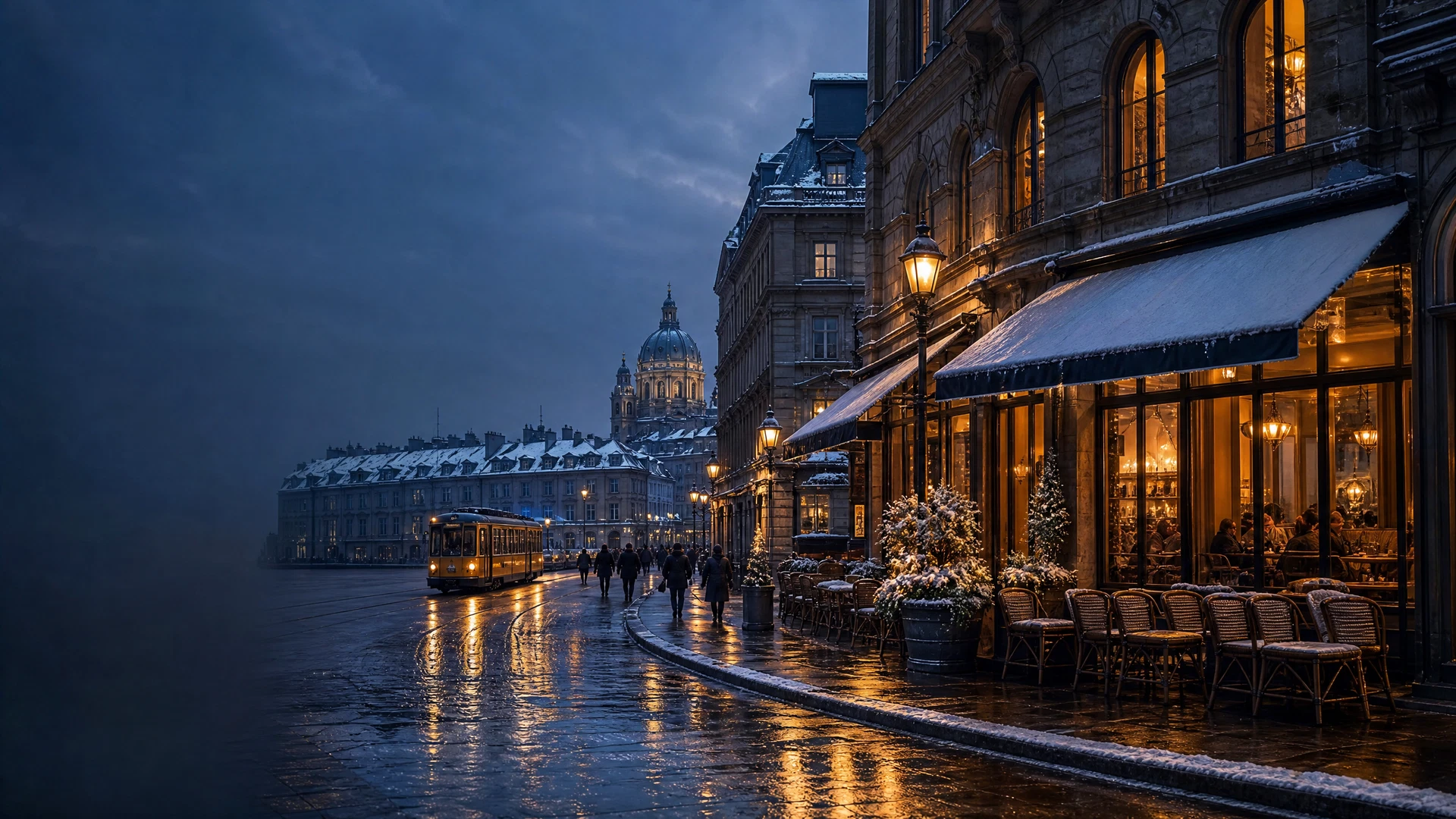
Winter Does Not Close These Cities. It Opens Them.
Destination: Global
Category: comparison
There is a particular kind of January afternoon when a city tells you whether it has any interior life. The sky has gone dark before the offices empty. The pavement is wet. The obvious places have closed early, the trees are bare, and every easy reason to be outside has disappeared. In most cities, this is the moment the visitor begins to negotiate with the weather: find heat, find a drink, wait for dinner, count the hours until the flight south.
But the cities worth visiting in winter are not cities that survive this test. They are cities that have spent centuries answering it. They have built rituals for the dark, food for the cold, rooms for the long conversation, music for the weeks after the decorations come down. Their winter lives are not leftover versions of summer. They are the reason to come.
That is the distinction this list makes. It is not about escaping to dependable sun, and it is not a plea to tolerate sleet for lower hotel rates. It is about six cities where winter changes the encounter so completely that a July visitor and a January visitor have not, in any meaningful sense, been to the same place. The cold becomes cultural material. The dark becomes architecture. The quieter streets become a way of seeing what the city has been trying to say all year.
The familiar winter advice usually stops at the Christmas market. It turns the season into a short commercial window—mulled wine, wooden stalls, a photograph under lights—and then acts as though January and February have nothing left to offer. That misses the better argument. In these cities, the weeks after Christmas are often when the performance recedes and the real winter calendar begins: the concert season, the ball season, the fog, the garden under snow, the return of residents to their own institutions, the meal built to hold back the dark.
Vienna, Edinburgh, Kyoto, New York, Copenhagen, and Marrakech belong together because each has made a different decision about winter. One organizes it. One darkens into its original setting. One contemplates it. One illuminates it. One warms it. One reveals itself through it. None is here because the crowds are smaller. That is the least interesting thing about them.
Vienna: Where Winter Is a Calendar, Not a Season
Vienna belongs among the cities worth visiting in winter because it treats the season as an appointment with its own cultural machinery, not as the blank space between spring and summer. The Habsburg capital spent centuries learning how to turn Central European cold into ceremony: first for a court that needed spectacle to express authority, then for a city that made music, museums, coffee, and formal sociability part of ordinary civic life. Winter remains the moment when those systems make the most sense.
The Christmas market at Rathausplatz deserves its reputation, but it is only the prologue. January and February are Vienna's stronger argument. The Vienna Philharmonic's New Year's Concert sets the tone at the Musikverein; the ball season continues through the weeks before Lent; and the Opernball turns the Vienna State Opera into a ballroom on the last Thursday before Ash Wednesday. It is a rare occasion when the city makes its old grammar visible rather than merely displaying it. A formal ticket can be expensive, but the standing-room gallery gives a visitor a view of the floor and its choreography without pretending the city belongs only to people in gowns and white tie.
The museum version of winter is quieter and, in many ways, more revealing. At the Kunsthistorisches Museum, Bruegel's Tower of Babel, Vermeer's The Art of Painting, and Benvenuto Cellini's salt cellar no longer compete with the summer procession of tour groups. The building's staircases, red stone, and painted ceilings have room to operate on you. A four-day Vienna city break is useful here because Vienna needs time for this unhurried sequence: a museum in the low afternoon light, then coffee, then an evening performance rather than another monument checked off before closing.
The coffeehouse is where the city makes the winter argument personal. Café Central is famous enough to require patience, yet a January morning there still explains something a warm-weather visit can blur. The marble tables, newspapers, bentwood chairs, and the long permission to stay are not decorative nostalgia. They are an answer to the weather. Order an Einspänner—the coffee topped with whipped cream, served in a glass—and watch the room absorb the cold brought in every time the door opens. The point is not to recreate Freud or Trotsky at a neighboring table. The point is to understand why a city of long winters produced a public room designed for thinking without urgency.
Even the Naschmarkt changes once summer photography season has gone. The market that began in 1916 remains open-air and exposed to the season; that is exactly why winter makes it feel less like a backdrop and more like a place where people are buying supper. Use the Vienna food guide to connect coffeehouses, market stalls, a proper schnitzel lunch, and a heuriger evening without forcing all of them into a single day.
Why Vienna rather than Prague for this particular list? Prague offers a more immediately theatrical winter image, and its first snow on Charles Bridge can stop anyone in their tracks. But Vienna is here because winter is built into the city's operating calendar. It does not ask visitors to admire a frozen façade. It asks them to enter an ongoing social season of concerts, balls, galleries, newspaper tables, and late dinners. Vienna does not become quieter in winter. It becomes more organized.
Edinburgh: Where the Dark Restores the Original Setting
Where Vienna organizes winter in gilded rooms, Edinburgh lets winter darken the city back toward the setting that made it intelligible in the first place. The grey stone, wet closes, steep lanes, wind off the Firth of Forth, and early night are not atmospheric accessories added for tourists. They are the conditions under which the Castle, the Royal Mile, and the Old Town's layered streets look like themselves.
In August, Edinburgh can be all velocity: Festival crowds, temporary stages, a city working at maximum public volume. Winter does the opposite. It returns scale to the Royal Mile. It lets you stand beneath Edinburgh Castle and feel the volcanic cliff doing its original work, rather than serving as a backdrop for a thousand simultaneous photographs. The haar—the North Sea fog that moves in from the Firth of Forth—can turn a familiar view into something stripped back and strange. It is one reason the city belongs in winter and not simply on a general list of historic European breaks.
Follow the surface of the city to its darker counterpart at Mary King's Close beneath the Royal Mile. The preserved seventeenth-century lanes are not better because darkness makes them spooky; they are better because cold, narrow passages, and low light restore a physical fact that a sunny summer visit can soften. People lived in compressed vertical streets here. The underground tour becomes less about the label of “hidden history” and more about understanding the pressure of the old city. A five-day Edinburgh travel guide gives this setting enough room beside the Castle, Old Town, whisky, and a day beyond the city center.
Hogmanay is the city's public answer to the darkest part of the year. From December 30 through January 2, the torchlight procession through the Old Town makes the medieval street grid legible by firelight. The point is not that thousands of torches make a good photograph. It is that the procession briefly restores a pre-electric relationship between a city and its streets. The New Year's ceilidhs extend that logic indoors: winter as an occasion to assemble, move, and see strangers become partners in a dance they may not know how to do yet.
Edinburgh has one of the rare urban hikes that gains something from the season. Arthur's Seat rises from Holyrood Park as a 251-meter volcanic plug, close enough to the center that the city remains visible while the ground begins to feel separate from it. On a clear winter morning, low sun cuts across the roofs and the water beyond them; on a foggier one, the summit can sit above a muted city. The Edinburgh adventure guide is the right companion when you want that contrast—the Royal Mile at night, then the physical reset of Arthur's Seat or a wider Highland day trip.
Edinburgh is not London with colder weather. London makes winter tolerable through abundance: more rooms, more shows, more choices. Edinburgh makes winter coherent through setting. Its stone, slope, fog, and old street plan have always assumed a climate that asks you to pay attention to the edge of light. That is why it comes after Vienna: one city gives winter a timetable; the other gives winter a landscape to inhabit.
Kyoto: Where Cold Creates Attention
If Edinburgh uses darkness to restore an original setting, Kyoto uses cold to remove everything that competes with attention. The ancient capital is already a city of deliberate thresholds—gate, path, garden, tea room, temple hall—but winter pares that structure back further. Fewer leaves, clearer air, shorter days, and the possibility of snow turn Kyoto's familiar beauty from a spectacle into a discipline.
This is not an argument that snow is guaranteed. Kyoto's snowfall is intermittent, which is precisely why the first proper fall of January or February matters. At Ryōan-ji, snow can erase the raked gravel of the rock garden until stones and moss become the only elements left in view. A place already built around reduction becomes even more severe. The experience is not a better Instagram frame. It is an altered way of seeing a garden whose central question has always been how little it needs to say.
Kinkaku-ji, the Golden Pavilion, makes a different winter composition. When snow settles on the pines around the Mirror Pond, gold, white, dark green, and still water appear as a contained set of decisions. Visit early, then let the rest of the day unfold without trying to collect every temple district. The Kyoto solo travel guide suits winter even if you are not traveling alone, because its pace privileges the lanes, temples, and machiya atmosphere that reward quiet attention over the fastest possible route.
Gion after dark is another reason not to reduce Kyoto winter to famous shrines. Paper lanterns cast warm light across cold streets, and the low-slung machiya townhouses have a gravity that humid summer evenings can blur. You should not arrive expecting a geisha encounter to be staged for you. Instead, walk slowly, accept that the district remains a working place, and notice how the cold asks people to move between inside and outside with purpose. Kyoto's winter character lives in those thresholds.
The food calendar turns the same lesson into lunch. Nishiki Market stretches for roughly 400 meters under cover and is often described as Kyoto's kitchen. In January, the ingredients point toward New Year preparation: mochi, osechi components, preserved foods, and seasonal fish. Winter asks less for a single famous dish than for a method of reading the city through what it keeps, cures, pounds, and serves warm. The Kyoto food guide can help place Nishiki alongside tofu, kaiseki, and the kind of meal that makes a cold evening feel intentional rather than inconvenient.
Kyoto earns its place over Nara or Osaka because winter intensifies the thing Kyoto does best: composure. Osaka has heat and appetite; Nara has open space and monumental quiet. Kyoto has an urban vocabulary of restraint, and cold makes that vocabulary audible. Where Edinburgh makes you feel winter against your face, Kyoto makes you notice what remains when the season removes ornament.
New York: Where Winter Switches the Lights On
Kyoto turns cold into concentration; New York turns the same cold into voltage. There may be no city where the transition from late afternoon to night is more central to the experience. In December, the sun goes down before five, and the half hour after sunset lays steel-blue light behind the Manhattan skyline as office windows begin their own illumination. Summer gives New York more daylight. Winter gives it a more decisive change of state.
Start with the Brooklyn Bridge before the city has fully announced itself. A 6 a.m. walk in December or January is not about claiming an empty landmark; New York is never entirely empty. It is about seeing the bridge as a route, not a viewing platform. The skyline has room around it, the East River carries the color of the morning, and you can cross at a walking pace rather than being folded into the summer shuffle. Pair it with the New York City culture and food itinerary, which gives the bridge its rightful place inside a bigger rhythm of neighborhoods, museums, meals, and evening rooms.
Central Park under a first snow makes an equally strong case. Frederick Law Olmsted and Calvert Vaux designed the park as a landscape with topography, routes, water, and alternating enclosure—not merely as a green square inside a dense city. Foliage hides some of that composition in July. Snow redraws it. The Ramble, the Mall, the lake edges, and the rise toward Belvedere Castle become newly legible. The park does not become a postcard; it becomes a piece of civic design you can finally read at its full scale.
Winter also returns New Yorkers to the institutions tourists associate with the city all year. The Metropolitan Opera season continues at Lincoln Center. The New York City Ballet's Nutcracker belongs to December, but January and February offer the more local cultural cadence: museum afternoons, gallery openings, and restaurants cooking for people who live here rather than for a one-night itinerary. Restaurant Week may sound like a discount mechanism, yet its useful side is practical: it gives a visitor a reason to make a reservation at a time when the city is again eating with itself.
Ice skating exposes the difference between fame and a lived winter ritual. Rockefeller Center is the image; Wollman Rink in Central Park gives you the wider setting, the trees, and the surrounding skyline. Choose the one that matches the day rather than treating either as a mandatory badge. The NYC budget guide is valuable in winter because it identifies how to spend selectively in an expensive city: one paid cultural anchor, a good meal where it counts, and the free walks that explain the place better than a stack of tickets.
New York makes this list instead of Chicago because it has a more complete answer to the early dark. Chicago in winter is direct, wind-driven, and architecturally magnificent, but New York changes gears at sunset. The grid lights up, venues fill, restaurants sharpen their focus, and the city becomes more itself through the contrast between cold pavement and heated interior life. Kyoto taught us how winter can quiet a city. New York proves it can also make a city flare.
Copenhagen: Where Warmth Is a Civic Practice
If New York illuminates winter through momentum, Copenhagen warms it through deliberate intimacy. This is the city that popularized hygge beyond its borders, then had to watch the idea become shorthand for expensive candles and soft blankets. The actual Danish practice is sturdier than that. It is a social decision to make dark months communal, domestic, well-fed, and worth sitting through together.
Daylight is scarce in Copenhagen from December through February. Around the winter low point, the city gets roughly seven hours of it. That limitation is not incidental to the restaurants, windows, candles, and long lunches; it explains them. Walk past the lit rooms after four in the afternoon and you are seeing a civic response to darkness. Copenhagen does not deny winter. It builds a better inside for it.
Tivoli Gardens is easiest to understand during its winter transformation, when lights, ice, stalls, gløgg, and æbleskiver turn the old amusement park into a collective answer to the night. It is not the only reason to come, and it should not become a substitute for the rest of the city. But it makes the thesis visible: light is not decoration here. It is infrastructure for morale. A four-day Copenhagen city itinerary creates space for Tivoli without letting it displace the canal districts, design museums, harbor walks, and neighborhood meals that make the city a winter choice rather than a holiday-only stop.
The food is even more revealing. At Torvehallerne, winter produce narrows toward kale, roots, preserved fish, and the long Danish knowledge of making a limited seasonal palette feel generous. A smørrebrød lunch—open-faced rye bread with cured, pickled, smoked, or carefully layered toppings—is a history of preservation presented as a meal with standards. Hallernes Smørrebrød makes an excellent first encounter because it refuses the idea that a sandwich is a casual thing. The Copenhagen solo guide is useful for a winter traveler precisely because Copenhagen rewards unhurried self-direction: a market lunch, an exhibition, a warm bar, a walk that ends when the weather tells you it has made its point.
For a quieter afternoon, walk through Assistens Cemetery in Nørrebro, where Hans Christian Andersen and Søren Kierkegaard are buried. Frost on markers and bare lime branches do not make death more theatrical; they make the cemetery feel integrated with the neighborhood around it. Copenhagen has a talent for putting serious things inside ordinary life—a philosopher, a bakery, a bicycle lane, a room full of friends—and winter makes that proximity easier to see.
Copenhagen earns its place over Stockholm because its answer to darkness is more socially concentrated. Stockholm can be cleaner, grander, and more sharply lit against water. Copenhagen puts you close to the answer: a candle on a table, a meal designed around preserved food, a public garden reworked for night, a small group sitting longer because the season has made staying in feel like the active choice. New York makes winter electric. Copenhagen makes it habitable.
Marrakech: Where Cool Weather Lets the City Tell the Truth
After Copenhagen shows how a northern city creates warmth, Marrakech reveals why a desert city needs winter to be fully inhabitable. December through February is not an escape from the season. It is the period when the medina can be walked for hours, the air clears over the Atlas Mountains, and the relationship between the city’s courtyards, kitchens, steam rooms, and open squares becomes physically comprehensible.
In summer, visitors often encounter Marrakech through a series of tactical retreats: shade, air-conditioning, a fast dash through a souk, another hotel pool. Winter changes the terms. Daytime temperatures commonly sit around the high teens to low twenties Celsius, while nights can feel genuinely cold. The difference gives you time. You can follow the alleys of the medina without treating every turn as an endurance test, then arrive at Djemaa el-Fna around dusk as the square moves from daylight commerce into steam, smoke, food, conversation, music, and performance.
The square should not be mistaken for a static show. It changes with the hour, the season, and the people using it. Go back more than once: once when stalls are assembling, once after dark, and once when you are not hungry enough to need it to entertain you. A five-day Marrakech culture and food guide helps make that return possible, keeping Djemaa el-Fna in proportion with the medina, gardens, food, and the smaller patterns that make a city more than its most famous square.
Winter explains the riad in a new way. A traditional courtyard house manages heat and light through inward-facing rooms, shade, water, and air moving vertically through its center. In the warmer months, that logic reads as relief from the sun. On a cold evening, with a fire or brazier warming the interior, it reads as domestic architecture built for temperature changes rather than a decorative hotel format. The Marrakech couples guide is particularly useful for assembling the right winter rhythm: a riad morning, the medina at its most walkable, an unhurried meal, then a hammam when the night begins to cool the stone again.
The hammam makes the most sense in winter for the least promotional reason: warmth is useful. Steam, soap, exfoliation, and rest belong to a longer urban practice, not a box to tick between shopping stops. Treat it with the same attention you would give a neighborhood restaurant—ask your riad or a local contact where to go, understand the norms, and let the experience belong to the day rather than forcing it to be an attraction.
Winter also changes the view beyond the city. The Atlas Mountains rise south of Marrakech with snow possible on their higher ground, making the horizon more than a hazy promise. An Imlil or Ourika Valley day can be valuable, but it needs honest planning: winter mountain travel can bring cold, changing road conditions, and a different level of preparation than a city afternoon. Marrakech belongs over Dubai because its winter does not manufacture climate-controlled comfort. It allows the actual city—the medina, square, courtyard, hammam, food smoke, and mountain horizon—to be experienced at human speed.
The Cities Worth Visiting in Winter Are Defined by What They Leave Out
The point of a winter city list is not to pretend other choices are wrong. Amsterdam can be exceptionally beautiful in low light, when canals hold reflections beneath narrow houses and the possibility of ice changes the surface of the city. But Amsterdam's winter argument is primarily visual. It asks you to look. The cities above ask you to participate in a more organized winter response: a ball, a ceilidh, a tea room, an opera season, a preservation-based lunch, a hammam that feels necessary because the night is cold.
Prague makes a stronger case than almost any European city for a snow-covered medieval silhouette. It also already has a substantial AskLeif destination post and guide cluster that give the city room to make its own argument. Including it here would repeat material rather than sharpen the winter thesis. Vienna earns the Central European place because its winter is a calendar and a set of institutions, not merely a magnificent view under snow.
Lapland belongs on any serious conversation about snow, silence, and northern light. It does not belong on this list because the central experience there is a natural phenomenon: aurora, Arctic dark, forest, ice, and the scale of the far north. This is a list about cities—places where weather changes streets, rooms, meals, social rituals, and cultural calendars. Winter sun escapes do not belong for the same reason. They avoid the very condition these six cities know how to transform.
How to Choose Between Cities Worth Visiting in Winter
Choose Vienna if you want winter to come with a schedule. It rewards travelers who will book a performance, give a museum the afternoon it deserves, and let dinner take its time. Choose Edinburgh if you want weather to be part of the narrative: stone, fog, a steep climb, firelight, and a city whose past becomes more convincing after dark.
Choose Kyoto when you need a quieter form of travel. It is not a place to rush through in pursuit of a snowfall that may not arrive. It is a place to arrange for first light at a garden, a long hot meal, a slow market walk, and the possibility that cold will make you pay closer attention. New York fits the traveler who wants the opposite energy: concerts, museums, bridge walks, restaurant tables, and the charge of a city whose interior life intensifies when the sun goes down early.
Choose Copenhagen when food and social atmosphere are the point. It is expensive compared with Marrakech or Edinburgh, but it repays a traveler willing to spend fewer days with greater attention: a proper lunch, a design museum, a long walk, an evening built around somewhere warm and full of people talking. Choose Marrakech when winter should open outward: the medina, the square, a courtyard at night, steam after a day on foot, and the Atlas line appearing cleanly beyond the city.
| City | Best winter window | Give it | Winter motivation |
|---|---|---|---|
| Vienna | January to February; ball season runs toward Lent | 4–5 days | Cultural programming, museums, coffeehouses, formal nights out |
| Edinburgh | Late December for Hogmanay; January to February for atmosphere | 3–4 days | Fog, stone, Old Town immersion, winter walks |
| Kyoto | January to February | 4–5 days | Gardens, seasonal food, cold-weather contemplation |
| New York City | December for light and performances; January to February for local rhythm | 4–6 days | Theater, museums, skyline walks, urban energy |
| Copenhagen | December to February | 3–4 days | Hygge as lived culture, food, design, early-evening atmosphere |
| Marrakech | December to February | 4–5 days | Walkable medina days, cool nights, hammam, Atlas visibility |
You can combine the European cities, but do it with a reason. Vienna and Copenhagen make sense for a traveler interested in how two capitals answer darkness through indoor public life—one imperial and ceremonial, one informal and communal. Edinburgh and Copenhagen work for a shorter northern pairing if you accept that the weather is part of the plan, not a variable to be defeated. Kyoto, New York, and Marrakech deserve their own trips; their winter selves are too complete to become a hurried extension of somewhere else.
The practical mistake is to pack for one abstract winter. These are six different versions of cold. Edinburgh wants waterproof layers and shoes that respect wet stone. Vienna wants one outfit that can carry you into a concert or a restaurant without apology. Kyoto asks for insulated walking shoes, quiet patience, and a plan that leaves room for weather. New York rewards the warm coat that lets you keep moving rather than surrendering to taxis. Copenhagen requires wind protection as much as insulation. Marrakech asks for layers: a warm day in sun can become a cold night in a courtyard quickly.
When the choice is between six cities that become more specific in winter, the itinerary should be built around the quality you want most—not around a checklist of sights. Leif can help put the right room, walk, museum, meal, and day-trip distance into the right order. But the decision comes first: decide whether you want winter organized, darkened, contemplated, illuminated, warmed, or revealed. Then let the city answer in its own language.
Winter Does Not Close These Cities. It Opens Them.
Summer makes cities easy to consume. The days are long, the terraces are full, the streets have enough light to excuse almost any plan. Winter is less forgiving. It asks whether a city has learned how to make meaning when the weather gives it less to work with.
These six have. Vienna turns the season into ceremony. Edinburgh lets darkness restore the drama built into its stone. Kyoto makes cold a form of attention. New York turns an early sunset into a switch that brings the city to life. Copenhagen treats warmth as something people make for one another. Marrakech gives back the physical city that heat has hidden.
That is why the season matters. Not because there are fewer people between you and the landmark, though there often are. Not because the rooms cost less, though sometimes they do. Winter arrives and the cities stop trying to please everyone at once. They return to the rituals, light, food, and habits that made them worth building in the first place.
Vienna organizes. Edinburgh darkens. Kyoto contemplates. New York illuminates. Copenhagen warms. Marrakech reveals.