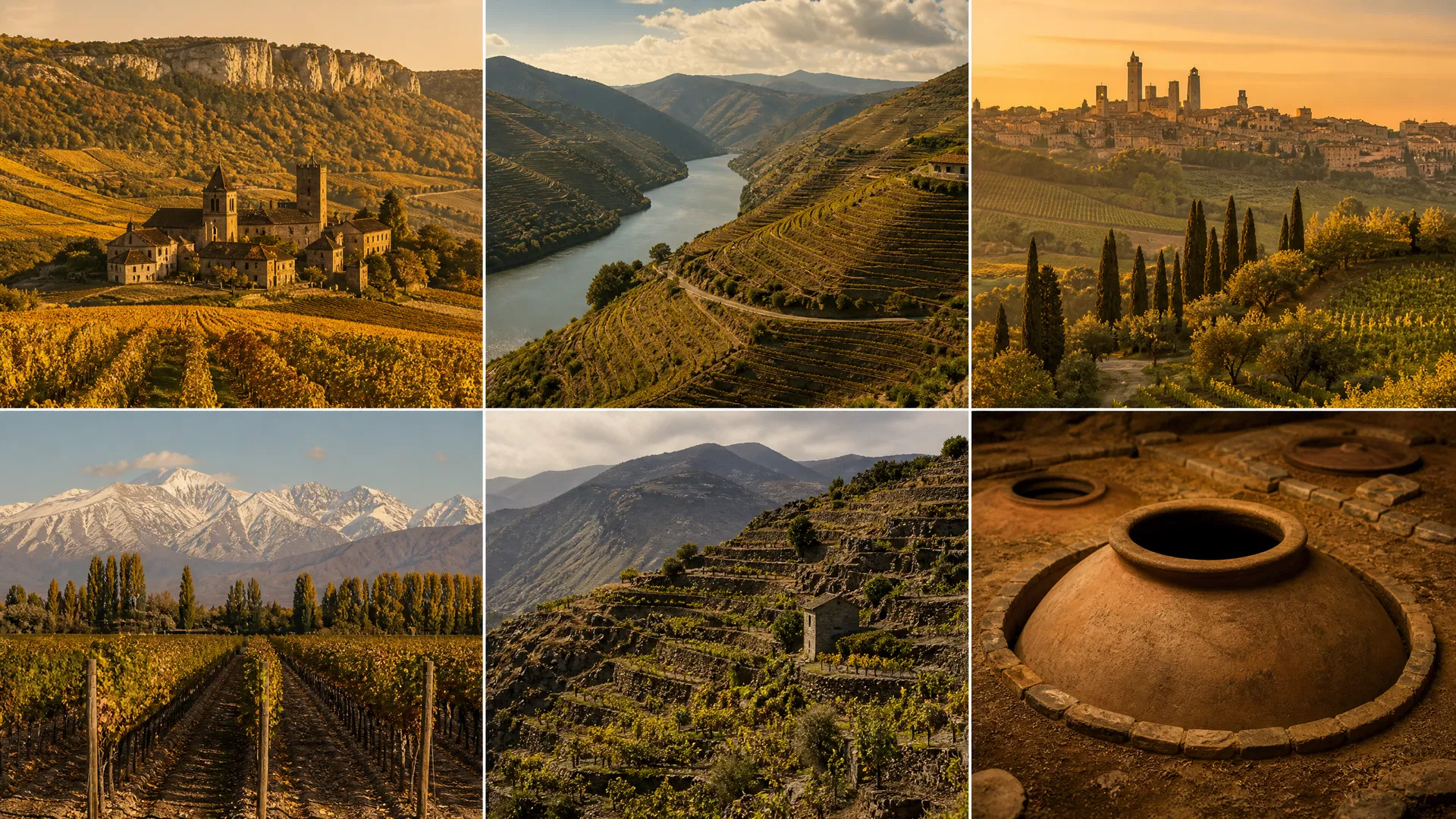
The Wine Destinations Where the Wine Is Not the Point. It's the Key.
Destination: Europe, South America, Caucasus
Category: Travel Inspiration
There is a specific kind of disappointment that arrives about forty minutes into a Napa Valley tasting experience. The wine is extraordinary — that part is not in question. The Cabernet Sauvignon is structured and serious and worth every dollar of the tasting fee. But somewhere between the second pour and the guided explanation of the estate's sustainability certification, you realize that the thing you are experiencing is not wine culture. It is wine as product, presented in a venue designed to sell it, surrounded by other people who are also there to buy it. The landscape outside the window is beautiful. The wine in the glass is excellent. And yet something is missing.
What is missing is the thing that wine is supposed to do when it exists inside a culture rather than as the culture itself. Wine, at its most essential, is not a beverage. It is a record — of a specific geology, a specific climate, a specific human decision made in a specific place over a specific number of centuries. When you drink a glass of Burgundy in the village where the grapes were grown, you are not consuming a product. You are reading a document. When you sit in a Tbilisi wine bar and order an amber wine fermented in a clay vessel buried underground for six months, you are not tasting a trend. You are drinking something that has been made the same way for 8,000 years, in a country that was making wine 6,000 years before France.
The destinations on this list were chosen by a single standard: not which regions produce the best wine — though all of them produce wine worth flying for — but which regions produce the most complete experience of what wine actually is when it exists inside a culture rather than as the culture itself. In these places, the wine is not the destination. It is the key that opens the destination.
Napa is not on this list. Neither is Bordeaux. Neither is Champagne. The exclusion of each is an argument, and the argument matters, and it appears at the end of this post.
Burgundy, France: The Wine That Is the Landscape
The Côte d'Or — the golden slope — is a single ridge of limestone hillside running 60 kilometers from Dijon to Santenay. It is not dramatic in the way that the Douro Valley is dramatic or the Andes are dramatic. It is a gentle slope, covered in vines, dotted with small stone villages, crossed by a road that passes through the names you have seen on wine lists your entire adult life: Gevrey-Chambertin, Vosne-Romanée, Nuits-Saint-Georges, Meursault, Puligny-Montrachet. The slope is the most valuable agricultural land in the world, measured by the price of the wine it produces. And the reason — the specific, geological, documentable reason — is that the limestone changes every few hundred meters, and the wine in each vineyard parcel reflects those changes with a specificity that has been recorded for 800 years.
This is what terroir actually means, before it became a marketing concept. The Cistercian monks who mapped the Burgundy vineyards in the twelfth century were not making an aesthetic argument. They were making a scientific observation: that the wine from this specific parcel of ground tasted different from the wine made fifty meters away, and that the difference was consistent, year after year, century after century. The wall surrounding the Romanée-Conti vineyard — 1.8 hectares, the most famous single vineyard in the world, the limestone cross at the entrance placed there by the monks of Saint-Vivant in the twelfth century — is not a boundary marker. It is a statement about the specificity of the earth inside it.
The correct way to understand Burgundy is not to drive through it. It is to cycle the Route des Grands Crus, the 60-kilometer cycling path that passes through every major appellation from Dijon to Santenay. At cycling pace, the landscape changes register the way the wine changes register — gradually, specifically, in ways that only become comprehensible when you slow down enough to notice them. The village of Gevrey-Chambertin, where Napoleon's favorite wine was produced and where the château he requisitioned for his personal cellar still stands on the village square, tells the full Burgundy story in a single commune: entry-level village wine, premier cru, grand cru, all grown on the same hillside, all tasting unmistakably different, all explaining why the monks built the walls where they built them.
In November, the Beaune Hospices auction — held every year since 1859, the oldest charity wine auction in the world — sets the benchmark price for the entire Burgundy vintage in a single afternoon. Attending it is not a wine experience. It is a history lesson about what happens when a culture decides that wine is worth preserving across centuries.
Burgundy is the destination where the wine is the landscape, made liquid. The key it opens is geology itself.
Plan your France trip: Paris 7-Day Itinerary | Paris for Couples | Solo Paris
The Douro Valley, Portugal: The Wine That Built an Empire on the Back of a River
Where Burgundy expresses the landscape in the most refined possible way, the Douro Valley built something with it. The Marquis of Pombal drew the boundaries of the Douro wine region in 1756, making it the oldest legally demarcated wine appellation anywhere on earth — 150 years before the French formalized the concept of appellation contrôlée. What he was protecting was not a tradition. It was an economy. The Port wine trade that the Douro Valley produced had funded the specific British-Portuguese commercial relationship that made Porto wealthy, given the British their most beloved fortified wine, and produced the wine lodge culture of Vila Nova de Gaia — the warehouses across the river from Porto where the barrels still age in the specific Atlantic-influenced microclimate that no other location can replicate.
The landscape that produces this wine is the most dramatic wine landscape in Europe. The schist terraces — carved by hand from the rock over centuries, so steep that mechanization was impossible until recent decades — climb the gorge of the Douro River at angles that make viticulture look like an act of defiance. The schist is the reason the wine tastes the way it does: the rock retains heat during the day and releases it at night, producing the extreme diurnal temperature variation that concentrates flavor in the Touriga Nacional grape in a way that has never been replicated anywhere else the grape has been planted. The same grape in Alentejo's flat plains produces a completely different wine. The terraces are not just scenery. They are the explanation.
The correct introduction to the Douro Valley is the train from Porto to Pinhão — the village at the heart of the valley, where the azulejo tile panels at the train station depict the grape harvest and the Port wine trade in blue and white ceramic that has been there since 1937. Arriving by train rather than car produces the correct first view: the valley opens below you as the train descends, the terraces stacked on both sides of the river, the quintas visible on the hillsides, the Douro running green and still at the bottom. It is the view that explains why someone decided to make wine here despite the difficulty.
At Quinta do Crasto — making wine continuously since 1615 — the foot-treading lagar tradition is still maintained for the flagship Port, not as a heritage performance but as a genuine winemaking decision. The September to October harvest window is when visitors can participate. The rabelo boats that historically transported Port barrels downstream to the lodges in Vila Nova de Gaia now carry tourists along the same route, through the five locks of the Douro's hydroelectric dams, past the terraces and the quintas, downstream toward the city that the wine built.
The Douro Valley is the destination where wine and geopolitics and geology and empire are most completely inseparable. The key it opens is history — specifically, the history of how a river and a grape and a trade agreement between two countries changed the shape of the world.
Plan your Portugal trip: Porto Solo Travel | Porto Food Guide | Porto for Couples | 10-Day Portugal Road Trip
Tuscany, Italy: The Wine That Is Indistinguishable From the Landscape It Comes From
Where the Douro built an empire, Tuscany achieved something rarer and more difficult: it made the wine and the landscape aesthetically inseparable. The cypress trees, the rolling hills, the medieval hilltop towns, the Sangiovese grape that expresses the specific Tuscan terroir in the Chianti Classico and the Brunello di Montalcino — all of these elements are so completely integrated that separating the wine from the landscape that produced it is like separating the color from a painting. Tuscany is not a wine region that happens to be beautiful. It is a place where wine and landscape have achieved the most complete aesthetic unity available anywhere in the world.
The Badia a Coltibuono — a Benedictine abbey founded in 1051 that has been making wine continuously for 900 years — is the correct single destination for understanding Tuscany's wine-landscape relationship. The monks who built the abbey chose the site for its elevation, its spring water, and its south-facing exposure. Nine centuries of continuous occupation by the same order means nine centuries of uninterrupted observation of what the land does in different vintages. The cooking school that operates in the abbey's kitchen is the correct introduction to the relationship between Tuscan wine and Tuscan food — not as a pairing exercise but as a single cultural argument about what it means to eat and drink in a place where both have been refined for a millennium.
The argument between Montalcino and Montepulciano — the two hilltop towns that produce Brunello and Vino Nobile respectively, each claiming the greatest Sangiovese expression — is itself a form of Tuscan wine culture. The Enoteca la Fortezza in Montalcino, built into the town's medieval fortress, offers the most historically concentrated single-room wine tasting experience in Italy: you are drinking Brunello in a room that was built to defend the town in the fourteenth century, surrounded by bottles that represent the full range of Montalcino producers, in a town that has been arguing about wine with its neighbor for five hundred years.
The Val d'Orcia — the UNESCO World Heritage landscape of rolling hills, cypress trees, and fortified farmhouses south of Siena — is best experienced at 6am, before the tourist traffic begins, when the morning mist sits in the valley floors and the vineyards emerge from it as the sun rises. The Antinori nel Chianti Classico winery, completed in 2012 and built into a Chianti hillside using gravity-fed architecture that makes the building invisible from the road, is the most precise contemporary statement about the relationship between Tuscan wine and Tuscan landscape: the winery disappears into the hill because the hill is the point.
Tuscany is the destination where wine and landscape have achieved aesthetic unity. The key it opens is beauty — specifically, the beauty of a place where human cultivation and natural landscape have been in conversation for so long that they have become the same thing.
Plan your Italy trip: Florence 5-Day Itinerary | Solo Florence | Venice Food & Wine
Mendoza, Argentina: The Wine That Proves Altitude Changes Everything
Where Tuscany achieved aesthetic unity over centuries, Mendoza achieved something in decades that France spent centuries trying to explain. The Malbec grape — a French variety that produced mediocre wine in Bordeaux and Cahors, where it was eventually abandoned in favor of Cabernet Sauvignon — was planted in the foothills of the Andes at altitudes between 900 and 1,500 meters and became something completely different. Not a better version of French Malbec. A different wine entirely.
The specific combination that makes Mendoza Malbec what it is: Andean altitude that produces intense ultraviolet radiation, concentrating phenolics and color in the grape skin. The Zonda wind — the dry warm air that descends from the Andes and produces 40-degree temperature swings between daytime high and nighttime low, concentrating flavor in the grape while simultaneously threatening to destroy the harvest in hours. The alluvial soils carried down from the Andes by the Mendoza River, so well-draining that the vines are forced to send roots deep into the earth to find water. The specific dry climate that allows organic viticulture without the fungal pressure that makes chemical intervention necessary in wetter regions.
The distinction between Mendoza's three main zones is the argument that separates serious wine tourism from casual tasting: Luján de Cuyo at 900–1,000 meters produces the most approachable and fruit-forward Malbec; Valle de Uco at 1,050–1,500 meters produces the most elegant and age-worthy version, with the specific mineral quality that the higher altitude and cooler temperatures produce. The difference between a Luján de Cuyo Malbec and a Valle de Uco Malbec from the same producer is the clearest single demonstration available of what altitude does to wine.
The Sunday asado is the cultural context that makes Mendoza wine comprehensible. The Argentine tradition of the Sunday asado — the slow-fire grill, the gathering of family and friends, the hours of eating and drinking that constitute the primary social ritual of Argentine life — is not a backdrop for the wine. The wine is part of the ritual. Malbec was adopted as the asado wine not because of a marketing campaign but because the wine's structure and fruit profile is the correct complement to the specific flavors that the asado produces. The pairing is culturally inseparable in a way that Napa's Cabernet Sauvignon and steakhouse pairing is not.
Mendoza is the destination where geography transformed a grape that Europe had largely abandoned into the most internationally celebrated South American wine. The key it opens is transformation — specifically, the proof that terroir is not a French concept. It is a geographical fact that operates anywhere the geography is specific enough.
Plan your Argentina trip: Buenos Aires 5-Day Adventure | Buenos Aires Food Guide | Buenos Aires for Couples
Priorat, Spain: The Wine That Made Itself From Almost Nothing
Where Mendoza transformed a grape through geography, Priorat transformed itself through human determination that borders on the irrational. In 1979, there were fewer than 600 hectares of vineyard remaining in this remote Catalonian mountain region — down from 5,000 hectares before the phylloxera epidemic of the late nineteenth century destroyed the European wine industry. The villages were emptying. The terraces were collapsing. The wine that remained was rough and anonymous, sold in bulk to be blended into cheaper bottles elsewhere.
Then five winemakers — René Barbier, Álvaro Palacios, Daphne Glorian, Carles Pastrana, and José Luis Pérez — arrived in the late 1980s and made wine together from a shared cellar before any of them had individual wineries. The 1989 vintage, produced from old vines grown in the llicorella soil — the black slate and quartz mixture unique to Priorat, so infertile and so well-draining that the vines send roots 15 meters into the rock to find water — announced Priorat to the international wine world. By the early 2000s, Priorat had become one of only two Spanish wine regions with the highest classification in the Spanish appellation system, alongside Rioja.
The llicorella is the key to understanding Priorat. The soil looks like a geological disaster — loose plates of black slate covering the hillsides, nothing growing between the vine rows, the landscape appearing hostile to any form of agriculture. The stress that this soil imposes on the vines is the reason the wine is what it is: low yields, concentrated flavor, the specific mineral quality that the slate imparts. The vineyards that look the most inhospitable produce the most expensive wine.
Above the wine zone, the medieval village of Siurana sits on a cliff above the valley. The Moorish castle from which the last Moorish ruler of Catalonia allegedly jumped rather than surrender to the Christian Reconquista in 1153 looks down over the llicorella vineyards below. The hiking trail from Siurana to the vineyards is the correct physical introduction to what the landscape looks like from above — the slate terraces visible from the cliff, the scale of the human determination required to make wine in this terrain comprehensible only from a distance.
Priorat is the destination where human determination recovered something that geography had made nearly impossible. The key it opens is resilience — specifically, the proof that the best wine regions are not always the easiest ones.
Plan your Spain trip: Barcelona 7-Day City Guide | Barcelona Food & Tapas | Seville Food & Tapas
Georgia: The Wine That Is 8,000 Years Old and Still Being Discovered
Where Priorat recovered from near-extinction in decades, Georgia never stopped. The qvevri — the clay vessel buried underground that has been used to ferment and age wine in Georgia for 8,000 years — is not a heritage technique preserved for tourism. It is the living winemaking tradition of a country that was making wine 6,000 years before France, in the Alazani Valley of Kakheti where the oldest wine vessels ever discovered were found dating to 6000 BC.
The qvevri process is unlike anything in the European wine tradition. The vessel is lined with beeswax before the grape must and skins are added. The skins remain in contact with the fermenting wine for up to six months — producing the amber color and tannin structure that gives Georgian white wines their distinctive character. The vessel is then sealed and buried underground, where the consistent temperature replaces the temperature-controlled cellar that European winemaking requires. The result is a wine that is white in grape variety but orange in color, tannic in structure, and complex in a way that has no equivalent in the European tradition.
The Rkatsiteli grape — cultivated in Georgia for 3,000 years — produces such different wine in qvevri versus European steel tank fermentation that it is effectively a different product. The same grape planted in New York's Finger Lakes produces a completely conventional white wine. In a Georgian qvevri, it produces something that sommeliers in Paris and Copenhagen and New York have been trying to explain to their customers for the past decade, with varying success.
Chateau Mukhrani — the 19th-century royal palace estate that produces both qvevri-fermented traditional wines and European-style wines from the same estate — is the correct single destination for understanding Georgia's dual wine identity. The estate was built by Prince Ivane Mukhranbatoni in 1873, modeled on French château architecture, producing wine in the European style for the Georgian aristocracy. After Soviet collectivization, the estate was used as a collective farm. After independence, it was restored and now produces both the traditional qvevri wines that represent Georgia's 8,000-year tradition and the European-style wines that represent Georgia's ambition to compete in international markets. Both arguments are made from the same estate, in the same valley, from the same grapes.
Georgia is the destination where wine's oldest traditions are also its newest discoveries. The key it opens is memory — specifically, the memory of what wine was before it became an industry.
Plan your Georgia trip: Tbilisi Food & Wine Guide | Tbilisi for Couples
The Exclusion Arguments
Why not Bordeaux? Bordeaux produces the most commercially important wine in the world and has the most developed wine tourism infrastructure in France outside Burgundy. It doesn't appear here because the Bordeaux wine destination experience is organized primarily around the château classification system — a hierarchy of prestige established in 1855 for a trade exhibition and largely unchanged since. The classification is more interesting to wine collectors than to travelers who want to understand what wine reveals about a place. Burgundy makes a more complete argument about the relationship between wine and landscape. Bordeaux makes an argument about the relationship between wine and status. That is a different thesis.
Why not Champagne? The chalk caves beneath Reims and Épernay are among the most dramatic wine production environments on earth — 28 kilometers of tunnels beneath the city of Reims, carved from the same chalk that gives Champagne its specific mineral quality. The Champagne wine destination experience is primarily about the method: riddling, disgorgement, dosage, the specific process by which still wine becomes sparkling. The process is fascinating. But the argument it makes is narrower than the other six destinations on this list. Champagne tells you what the winemaker did. The other six destinations tell you what the land is.
Why not Napa? Napa is the thesis, not the recommendation. The entire curatorial argument of this post is structured around what these six destinations offer that Napa doesn't — not better wine, but a different relationship between the wine and the place. Napa produces extraordinary wine in a destination that has organized itself around producing and selling extraordinary wine. That is a complete and coherent experience. It is also a specific kind of experience — one where the wine is the culture rather than the key to the culture. If that is what you want, Napa is the correct destination. If you want the key, these six destinations are where to find it.
Planning Your Wine Destination Trip
Which destination matches your travel motivation?
The geologist goes to Burgundy — to walk the Côte d'Or and understand why the wine changes every few hundred meters, to see the limestone cross at Romanée-Conti and understand what the monks were documenting. The historian goes to the Douro Valley — to take the train to Pinhão, to visit Quinta do Crasto during harvest, to understand how a river and a trade agreement between two countries shaped the modern wine world. The aesthete goes to Tuscany — to cycle through the Val d'Orcia at dawn, to drink Brunello in the Enoteca la Fortezza, to understand what happens when wine and landscape spend a thousand years in conversation.
The transformation seeker goes to Mendoza — to drive the altitude difference between Luján de Cuyo and Valle de Uco, to attend a Sunday asado, to understand what geography does to a grape that Europe had given up on. The underdog story lover goes to Priorat — to walk the llicorella terraces, to visit Clos Mogador, to understand how five winemakers with a shared cellar and a belief in a soil that looked like a geological disaster changed the Spanish wine industry. The ancient culture explorer goes to Georgia — to drink amber wine in a Tbilisi wine bar, to visit Chateau Mukhrani, to understand what wine was before it became an industry.
Harvest timing: Burgundy (September), Douro Valley (September–October), Tuscany (September–October), Mendoza (March–April, Southern Hemisphere), Priorat (September–October), Georgia (September–October). Mendoza's harvest in autumn rather than spring is the most common planning error — it is the Southern Hemisphere, and the seasons are reversed.
Budget range: Burgundy and Tuscany are the most expensive, with accommodation and restaurant prices reflecting the wine tourism infrastructure. The Douro Valley and Priorat are significantly more affordable, with the Douro in particular offering exceptional value for the quality of the experience. Mendoza is the most affordable of the six, with the Argentine peso making international travel in the country exceptional value. Georgia is the most affordable wine destination in Europe, with Tbilisi offering some of the best value for money of any European capital.
Ready to plan your wine destination trip? Ask Leif builds your complete itinerary in 60 seconds — including the specific vineyard visits, harvest timing, and local restaurant recommendations that make the difference between a wine trip and a wine experience.
Six Verbs
Burgundy expresses. The Douro built. Tuscany unified. Mendoza transformed. Priorat recovered. Georgia remembered.
Six wine arguments. Six destinations that cannot be replaced by any other on this list. Six keys to six different versions of what wine actually is when it exists inside a culture rather than as the culture itself.
The bottle is never the least interesting thing on the table. But in these six places, it is the thing that opens everything else.