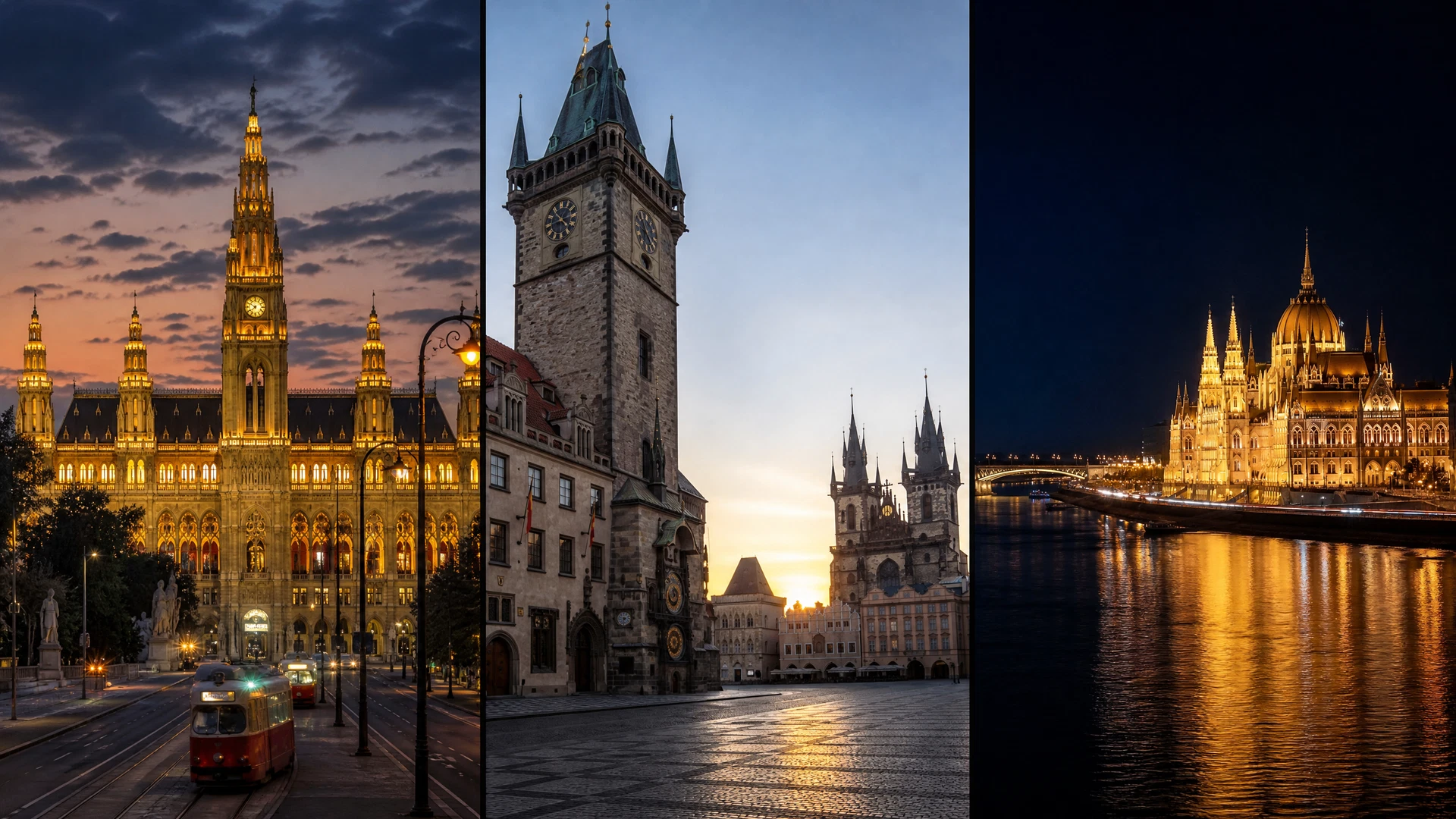
Vienna Processed. Prague Resisted. Budapest Defied. Here's What Each One Produced.
Destination: Prague, Budapest & Vienna
Category: comparison
On November 3, 1918, the Austro-Hungarian Empire ceased to exist. It had been the second-largest country in Europe, a multi-ethnic state of 52 million people spanning 12 nations and speaking 11 languages. It had three capitals — Vienna, the imperial seat; Budapest, the co-capital of the dual monarchy; Prague, the cultural and industrial heart of Bohemia. In the space of a few weeks in the autumn of 1918, the empire dissolved into its constituent nations, and three cities that had been designed to run a continental empire suddenly found themselves the capitals of countries that were fractions of what they had been built to govern.
What each city did next is the most interesting travel question in Central Europe.
The standard answer to the Prague versus Budapest versus Vienna question is accurate and completely misses the point. Vienna for music and museums. Prague for medieval architecture and beer. Budapest for thermal baths and nightlife. These descriptions are true. They are also the surface of something much more specific — three cities that inherited different pieces of the same catastrophic historical event and have spent the past 100 years processing, resisting, and defying their way to three completely different identities. Understanding what each city inherited from the wreckage of 1918 is the prerequisite for understanding why each one produces such a different travel experience. This post is that argument.
Vienna: What a Capital Does When It Loses Its Empire
The specific consequence of Vienna's inheritance is the most sophisticated available relationship between a city and its own past.
Vienna inherited everything. The specific Ringstrasse — the 5.3-kilometer boulevard that Emperor Franz Joseph I commissioned in 1857 as the replacement for the medieval city walls, lined with the specific Vienna State Opera, the specific Kunsthistorisches Museum, the specific Naturhistorisches Museum, the specific Austrian Parliament, the specific Vienna City Hall, and the specific Burgtheater — was built as an imperial argument in stone. The argument was that Vienna was the cultural capital of Europe. The Ringstrasse is not a street. It is a political project. Understanding it as a political project rather than an architectural one is the prerequisite for understanding what Vienna's architecture is actually doing.
In 1908, the Viennese architect Adolf Loos published an essay called "Ornament and Crime." It was a specific critique of the Ringstrasse's ornamental excess — the specific argument that decoration was a form of cultural regression, that the most sophisticated available architecture was the architecture that stripped itself of ornament entirely. The essay is the most important single document in the history of modernist architecture. It was written specifically in response to the specific most ornate urban project in 19th century Europe. Vienna produced both the Ringstrasse and the essay that argued against everything the Ringstrasse represented. That is the specific Viennese intellectual tradition in its most compressed form.
After 1918, Vienna became the capital of a country of 9 million people that had been designed to govern 52 million. The specific emotional consequence of this specific inheritance is the specific Viennese Weltschmerz — the world-weariness that is the most specifically Viennese emotional register, the specific coffeehouse culture where sitting alone for three hours with one coffee and one newspaper is not antisocial but the correct use of the space. The Viennese coffeehouse was added to the UNESCO list of Intangible Cultural Heritage in 2011 — the specific recognition that the specific institution of the specific Viennese café, where the specific melange (coffee with milk foam) comes with a specific glass of water that is refilled automatically for as long as the customer stays, is a cultural form as significant as any physical monument.
The specific Café Central on Herrengasse has been operating since 1876. Trotsky played chess here before World War I. The specific arched ceiling, the specific marble columns, the specific newspaper rack with the specific international papers — these are not decoration. They are the specific infrastructure of the specific intellectual tradition of sitting with an idea for as long as the idea requires. The specific Viennese waiter — slightly aloof, formally dressed, unhurried — is not cold. He is the specific embodiment of the specific Viennese professional relationship with the public: the specific argument that service is a craft and that a craft deserves to be performed without apology.
Vienna's food culture is the most specifically imperial available. The specific Wiener Schnitzel arrived from Milan with Field Marshal Radetzky, who served in the Italian campaign and brought the specific Milanese cotoletta back with him. The specific Gulasch arrived from Hungary with the Hungarian cattle drovers who moved livestock through Vienna. The specific Apfelstrudel arrived from the Ottoman Empire — the retreating Ottomans left behind coffee beans after the 1683 Siege of Vienna, and the specific Viennese coffeehouse tradition began with the specific coffee those beans produced. Viennese cuisine is the most specific available argument that the Austro-Hungarian Empire's primary achievement was not political but culinary — it absorbed the cuisines of 12 nations and produced something that belongs to all of them simultaneously.
The standing room tickets at the Vienna State Opera cost €5. The same performance in the stalls costs €300. The specific queue forms at the box office at 10am on the day of each performance. The specific Stehplatz behind the stalls is the specific most democratically accessible opera experience available anywhere — the same Vienna Philharmonic, the same stage, the same production, for €5. Vienna treats the traveler as a supplicant — not in a hostile sense but in the specific sense that the city has decided what it is and what it offers and is prepared to offer it at the highest possible standard to anyone willing to meet it on its terms.
The Vienna 4-Day Itinerary covers the specific Ringstrasse sequence — the specific order in which to walk the boulevard so that the architectural argument reveals itself progressively rather than all at once. The Vienna Food Guide covers the specific Naschmarkt stalls, the specific Würstelstand culture, and the specific Heuriger wine taverns in the Grinzing hills where the specific Grüner Veltliner is served in the specific open-air gardens that have been operating since the 18th century.
Prague: What a Culture Does When an Empire Tries to Erase It
Where Vienna inherited the imperial infrastructure and has spent a century processing what to do with it, Prague inherited something the empire tried to take away — and that survival is the most creative available response to inherited suppression.
The Habsburg Empire spent 300 years trying to Germanize Bohemia. The specific Czech National Revival of the 19th century was the specific cultural response to the specific Germanization project — the specific František Palacký who reconstructed Czech history from the archives, the specific Bedřich Smetana who composed Má vlast (My Homeland) as the specific musical argument for Czech national identity, the specific Alphonse Mucha who invented the specific Art Nouveau visual language that has become the most internationally recognized Czech aesthetic contribution. The specific Národní divadlo (National Theatre) was built in 1881 by public subscription — ordinary Czech citizens contributing what they could to fund the specific argument that Czech culture deserved its own stage. Two months after opening, it burned down. The specific second public subscription rebuilt it in 1883. The specific fact that Czech cultural determination survived even catastrophe is the specific most compressed available argument for what Prague's identity is.
Prague's architecture is the most accidentally preserved medieval urban fabric available in any major European city. The specific reason is the specific World War II decision by Hitler to spare Prague from bombing because he intended it to be the capital of the Greater Germanic Reich he was building. The specific irony: the city designated for absorption into the Third Reich survived the war intact while the cities that resisted were bombed. The specific medieval Jewish Quarter, the specific Charles Bridge, the specific Old Town Square with the specific astronomical clock, and the specific Prague Castle complex all survived because of the specific malevolent plans of the specific regime that ultimately lost the war it started. Prague's architecture is the most beautiful available argument for a deeply uncomfortable historical paradox.
The specific astronomical clock on the Old Town Square was built in 1410. It is the oldest working astronomical clock in the world. The specific mechanism shows the position of the sun and moon against the zodiac and the medieval cosmological model simultaneously. The specific hourly procession of the Apostles — twelve figures appearing in the two windows above the clock face as the hour strikes — is the most watched event in Prague. The specific skeleton that rings the bell is the specific most specific memento mori available in any European clock. Most visitors photograph the clock. Fewer understand that they are looking at a 615-year-old working astronomical instrument.
The specific Franz Kafka worked for the Workers' Accident Insurance Institute of the Kingdom of Bohemia for 14 years. During those 14 years — the specific bureaucratic employment that he found simultaneously necessary and suffocating — he wrote The Trial, The Castle, and The Metamorphosis. The specific relationship between the specific alienating labor and the specific literary imagination is the specific most available argument for why Prague produced Kafka rather than any other city. The specific Kafka Museum in Malá Strana presents the specific manuscripts and the specific photographs in the specific building that is the most honest available introduction to the relationship between Kafka and the Prague that made him possible.
Czech beer culture produced Pilsner Urquell in 1842. The specific reason: the Plzeň city fathers hired a Bavarian brewer named Josef Groll to solve the specific problem of their consistently bad beer. The specific soft water of Plzeň combined with the specific Saaz hops and the specific bottom-fermentation technique Groll brought from Bavaria produced the specific pale golden color that no previous beer had achieved. Every lager in the world traces its lineage to this specific 1842 experiment in this specific Bohemian city. Czech food is not sophisticated in the Viennese sense. The specific svíčková (beef sirloin in cream sauce with bread dumplings) and the specific vepřo-knedlo-zelo (roast pork with knedlíky dumplings and sauerkraut) do what they do without apology or ornamentation — the specific honesty of a culture forged in resistance rather than in imperial refinement.
The specific Prague that exists off the tourist circuit is as interesting as the tourist circuit. The specific Vinohrady neighborhood — Art Nouveau apartment buildings built in the 1890s–1910s, the specific most beautiful residential neighborhood in Prague, called the "Czech Buda" because it occupies the hillside above the Nusle Valley in the same relationship to Prague center that Buda occupies to Pest in Budapest. The specific Žižkov with the specific largest equestrian statue in the world — the Jan Žižka statue, a 9-meter bronze of the 15th-century Hussite military commander, mounted on a horse that weighs 16.5 tonnes. The specific Charles Bridge at 6am, before the crowds arrive, when the specific 30 Baroque statues are visible in the specific morning light and the specific Vltava is the specific grey-green that it is before the sun reaches it.
The Prague 4-Day Itinerary covers the specific Old Town walking sequence and the specific Malá Strana approach that gives you the castle from the correct angle. The Prague Food Guide covers the specific Lokál pub chain (the specific most honest available Czech pub experience, with the specific tank-fresh Pilsner Urquell), the specific Manifesto Market in Holešovice, and the specific Café Savoy on the Malá Strana embankment where the specific neo-Baroque interior is the specific most beautiful available café room in Prague.
Budapest: What a City Does When It Forces Its Way to Equal Status
Where Vienna processed its loss and Prague resisted its suppression, Budapest did something different and more defiant — it negotiated its way to co-equal status within the empire and then built the physical infrastructure to prove it deserved to be there.
The specific 1867 Ausgleich — the Compromise — was the specific negotiation by which the Hungarian nobility, led by the specific Ferenc Deák, extracted constitutional autonomy from the Habsburgs in exchange for accepting Habsburg sovereignty. The specific consequence of the Compromise was that Budapest became a co-capital rather than a provincial capital. The specific 50-year golden age that followed — 1867 to 1918 — produced the specific Budapest that exists today. Every major building in Budapest is a specific argument against the specific assumption that Budapest was less than Vienna.
The specific Hungarian Parliament building is the third largest parliament building in the world. It was built specifically to be larger than the Vienna Parliament. The specific Hungarian State Opera was built specifically to be as grand as the Vienna State Opera. The specific Keleti railway station was built specifically to demonstrate Hungarian engineering ambition. The specific Heroes' Square was built for the specific 1896 Millennial Exhibition celebrating 1,000 years of Hungarian presence in the Carpathian Basin. Budapest's architecture is the most specifically defiant available — every major building is a specific argument made in stone.
The specific Budapest Parliament building has a limestone problem. The specific Zoltán Balogh discovered in 1904 that the Süttő limestone used in the construction was too soft for the Danube climate. The specific ongoing restoration has been running since 1925 and will continue for the foreseeable future because the specific material deterioration is faster than the specific restoration capacity. The Parliament is simultaneously the most beautiful building on the Danube embankment and a building that has been under scaffolding for over a century. This is the most specifically Budapest available situation — the most ambitious argument made in the most impractical material.
Hungarian food culture is the most specifically paprika-defined available in any European national cuisine. The specific consequence of the specific Ottoman occupation that introduced the pepper to Hungary in the 16th century. The specific Hungarian chefs who transformed it into the national ingredient that defines gulyás, paprikás csirke, halászlé, and lecsó. The specific Kalocsa and Szeged regions producing the specific sweetness that makes Hungarian paprika different from Spanish pimentón — both have EU protected geographical indications, but the specific Hungarian varieties are the specific ones that define the specific flavor of the specific cuisine. The specific Központi Vásárcsarnok (Great Market Hall) — the specific 1897 iron-and-glass market hall, the most beautiful market building in Central Europe — is the most honest expression of what Budapest actually eats when it is not performing for tourists. The specific ground floor with the specific paprika vendors and the specific pick-up stalls serving the specific lángos (fried dough with sour cream and cheese) is the specific most democratic available Budapest food experience.
The specific Széchenyi thermal bath chess players are the most specifically Budapest available experience. The specific tradition of playing chess on floating boards in the outdoor thermal pool dates to the 1920s, when the specific regulars began bringing waterproof sets. The tradition has continued uninterrupted through the Communist period and the post-Communist transition. The specific 38-degree water, the specific neo-Baroque pool, the specific chess players, the specific steam rising in the specific cold morning air — this is the specific experience that no other city in Europe offers because no other city in Europe has the specific combination of the specific thermal geology and the specific chess culture and the specific neo-Baroque architecture that Budapest has.
The specific Szimpla Kert ruin bar opened in 2001 in an abandoned fabric factory in the seventh district — the specific former Jewish Quarter. The specific reason the ruin bar concept emerged in Budapest rather than in Prague or Vienna is the specific large stock of abandoned buildings in the seventh district that resulted from the specific 1944–1945 Holocaust that killed 500,000 Hungarian Jews and left the specific buildings empty. The specific origin story makes Szimpla Kert simultaneously the most creative and the most morally complex cultural institution in Central Europe. The specific building — the specific overgrown courtyard, the specific mismatched furniture, the specific art installations in the specific former factory rooms — is the specific most creative available use of urban decay in any European city.
The Budapest 4-Day Itinerary covers the specific Buda Castle sequence and the specific Pest embankment walk that gives you the Parliament from the correct angle at the correct hour. The Budapest Food Guide covers the specific Borkonyha wine kitchen (the specific Michelin-starred restaurant that serves the specific most sophisticated available Hungarian food without losing the specific paprika argument), the specific Gerbeaud café on Vörösmarty Square, and the specific specific ruin bar circuit in the seventh district.
The Architecture: Three Arguments Made in Stone
The three cities' architecture is the most compressed available expression of their three different relationships with the same historical event.
Vienna's Ringstrasse is the most comprehensive available expression of imperial ambition — a political project disguised as an urban planning decision. The specific sequence of neo-historical buildings — each one in a different historical style chosen to represent a different function (the Parliament in Greek Revival because democracy is Greek, the City Hall in Gothic Revival because civic government is medieval, the Burgtheater in Baroque because theatre is imperial) — is the specific most legible available argument that architecture can make a political claim. The specific Adolf Loos who published "Ornament and Crime" in 1908 as a critique of the Ringstrasse's excess is the specific most important single document in the history of modernist architecture — written specifically in response to the specific most ornate urban project in 19th century Europe.
Prague's architecture survived the 20th century's catastrophes more completely than any other major European city — preserved by the specific malevolent intentions of the specific regime that ultimately lost the war it started. The specific medieval Jewish Quarter, the specific Charles Bridge with its specific 30 Baroque statues, the specific Old Town Square with the specific 1410 astronomical clock — all intact. The specific irony of this preservation is the most uncomfortable available argument about the relationship between historical catastrophe and architectural survival.
Budapest's architecture is the most dramatically ambitious available in any city that was not a primary imperial capital. The specific Parliament building — larger than the Vienna Parliament, built specifically to make that argument — is the most defiant available piece of architecture in Central Europe. The specific Chain Bridge, the specific Heroes' Square, the specific Hungarian State Opera — all built during the 1867–1918 golden age as the specific argument that Budapest was the equal of Vienna. The specific limestone problem that has kept the Parliament under restoration for over a century is the specific most Budapest available consequence of the most Budapest available ambition.
The Music and the Culture: Three Different Inheritances
Vienna's musical legacy is the most concentrated available in any city in human history. The specific Mozart who composed 41 symphonies and died at 35 in the specific Vienna that didn't appreciate him while he lived. The specific Beethoven who went deaf in Vienna and continued composing the Ninth Symphony after the deafness because the music existed in him independently of his ability to hear it. The specific Brahms, Bruckner, Mahler, and Schoenberg who invented the 12-tone technique that changed the direction of Western music in the Vienna of 1908. The specific Vienna Philharmonic that only admitted its first permanent female member in 1997 and is simultaneously the most conservative major orchestra in the world and the most musically excellent. Vienna's musical legacy is not a heritage claim. It is the specific argument that a specific city at a specific moment produced more music of lasting significance than any other city before or since.
Prague's cultural legacy is the most specifically literary available in any Central European city. The specific Kafka who wrote The Trial and The Castle and The Metamorphosis in the specific Prague that he experienced as simultaneously his home and his prison. The specific Václav Havel who wrote absurdist plays in Communist Prague and then became the first president of the post-Communist Czech Republic. The specific Milan Kundera who wrote The Unbearable Lightness of Being in Paris exile — driven there by the Prague Spring and the Soviet invasion — and whose work is the most specific available literary argument for what the Central European experience of the 20th century felt like from the inside.
Budapest's cultural legacy is the most specifically musical in a different register from Vienna. The specific Béla Bartók who collected Hungarian and Romanian and Bulgarian folk music that the Western classical tradition had ignored and used the rhythmic and harmonic patterns of that folk music to produce the string quartets and the Concerto for Orchestra that are the most important bridge between the folk music tradition and the modernist classical tradition. The specific Franz Liszt who was simultaneously the most famous pianist in the 19th century world and the most Hungarian composer in a century trying to define what specifically Hungarian music sounded like. And then the specific ruin bars — the specific Szimpla Kert and the specific Instant and the specific Fogasház — that are the most energetically alive nightlife culture in Central Europe, the specific consequence of the specific abandoned buildings and the specific young population and the specific Hungarian hospitality culture that makes Budapest the most welcoming capital city in Europe.
How to Choose, How to Combine
The correct answer to the Prague versus Budapest versus Vienna question depends on what you are actually asking.
Vienna is right for you if you want to inhabit the most sophisticated available relationship between a city and its own past. If you want the Ringstrasse and the Kunsthistorisches and the standing room at the State Opera and the specific Café Central where you can sit for three hours with one coffee and one newspaper and feel the specific Viennese relationship with time. If you want to understand what a capital city becomes when it loses its empire and has a century to process the loss with the specific cultural institutions the empire left behind. The Vienna Culture & Couples Guide and the Vienna Budget Guide cover the specific access points — the specific museum pass, the specific standing room queue, the specific Heuriger wine tavern sequence in the hills above the city.
Prague is right for you if you want the most accidentally perfect medieval urban fabric available in any European city. If you want the specific Charles Bridge at 6am and the specific astronomical clock and the specific Kafka Museum and the specific craft beer in the specific Žižkov pub that has been serving the same Kozel since 1903. If you want the specific creative energy of a culture that maintained its specific identity through 300 years of Germanization and 40 years of Communism and emerged more specifically itself than when either project began. The Prague Solo Guide and the Prague Budget Guide cover the specific off-tourist-circuit neighborhoods — the specific Vinohrady, the specific Žižkov, the specific Holešovice with the specific DOX contemporary art center.
Budapest is right for you if you want the most energetically alive capital in Central Europe. The specific ruin bars, the specific thermal baths, the specific Great Market Hall, the specific Danube embankment at night when the Parliament and the Chain Bridge are lit and the city looks more beautiful than it has any right to look given what it has been through. The Budapest Solo Guide and the Budapest Budget Guide cover the specific seventh district circuit, the specific thermal bath sequence (Rudas for the locals, Széchenyi for the chess players, Gellért for the architecture), and the specific Great Market Hall timing that gives you the ground floor before the tourist groups arrive.
All three are right for you if you have two weeks. Base yourself in Vienna for four nights. Take the four-hour train to Prague for four nights. Take the two-and-a-half-hour train to Budapest for four nights. Come back understanding why the 1918 collapse of the Austro-Hungarian Empire is the single most important event for understanding the Central Europe that exists today. The AskLeif itinerary generator builds the specific day-by-day sequence for each city — including the specific train connections, the specific museum opening hours, and the specific neighborhood sequences that give you each city in the correct order.
The Honest Answer
Vienna, Prague, and Budapest are not interchangeable options for a Central European city break. They are three fundamentally different cities that happen to be within four hours of each other by train.
Vienna is the city that processes. It has the most sophisticated available cultural infrastructure, the most refined available food culture, the most concentrated available musical legacy. It is the city that has spent 100 years turning its imperial inheritance into something that belongs to everyone — the standing room tickets, the museum passes, the coffeehouse culture that is open to anyone willing to sit with a coffee for three hours and think. Vienna is the city for the traveler who wants to inhabit a specific relationship with the past.
Prague is the city that resists. It has the most accidentally preserved medieval urban fabric, the most specifically literary cultural legacy, the most honest available beer culture. It is the city that became more specifically itself the harder it was pushed to become something else — and that specific resilience is visible in every cobblestone of the Old Town and every page of every Kafka novel. Prague is the city for the traveler who wants to inhabit a specific relationship with creative survival.
Budapest is the city that defies. It has the most energetically alive nightlife, the most specifically defiant architecture, the most warmly hospitable culture. It is the city that forced its way to co-equal status and then built the physical infrastructure to prove it — and that specific defiance is visible in the Parliament that is larger than Vienna's and the ruin bars that turned the abandoned buildings of the Jewish Quarter into the most creative cultural spaces in Central Europe. Budapest is the city for the traveler who wants to inhabit a specific relationship with earned pride.
Vienna Processed. Prague Resisted. Budapest Defied.
In 1918, three cities inherited three pieces of the same vanished empire. Vienna inherited the imperial infrastructure and the cultural institutions and the specific melancholy of a capital that lost its empire and has been processing that loss with extraordinary sophistication ever since. Prague inherited the specific Bohemian culture that the empire tried to suppress and that survived the suppression more completely than anyone who knew the Habsburg project would have predicted. Budapest inherited the specific Hungarian identity that spent 400 years under Ottoman occupation and 170 years under Habsburg administration without ever losing the specific Magyar cultural confidence that makes it the most specifically itself of the three.
Vienna processed. Prague resisted. Budapest defied. Vienna refined. Prague created. Budapest built. Vienna mourns. Prague celebrates. Budapest lives.
Nine verbs. Three cities. One vanished empire. The specific reason none of them is interchangeable with any other city in Europe — and the specific reason all three belong on the same trip.