Vienna Doesn't Need to Impress You. It Already Knows It's Extraordinary.
Destination: Vienna, Austria
Category: Destination Guides
Vienna operates at a frequency that most cities have forgotten how to transmit. It is the frequency of unhurried pleasure — of a city that has been doing things beautifully for so long that it has stopped feeling the need to prove anything to anyone. You feel it the moment you sit down in a Kaffeehaus and realize that no one is going to rush you. You feel it when you walk through the Kunsthistorisches Museum and understand that the collection is so extraordinary that the building had to be designed to match it. You feel it in the evening, when the Staatsoper fills with people who have dressed for the occasion and take their seats with the quiet anticipation of people who know they are about to experience something that cannot be replicated anywhere else on earth.
Vienna is the capital of the Austro-Hungarian Empire that no longer exists, and it carries that history with a grace that is genuinely remarkable. The empire dissolved in 1918, but the city it built — the palaces, the museums, the concert halls, the coffee houses, the ring road lined with monumental public buildings — remains intact, and remains in use. This is not a museum city. The Hofburg Palace is still the official residence of the Austrian president. The Staatsoper still performs 300 nights a year. The coffee houses still serve Melange and Apfelstrudel to people who sit for hours reading newspapers on wooden holders. Vienna didn't preserve its past — it simply never stopped living in it.
And yet Vienna is also one of the most livable, most forward-thinking cities in Europe. It has topped the Economist Intelligence Unit's Global Liveability Index for multiple consecutive years. Its public transport system is a model for the world. Its food scene has evolved far beyond schnitzel and strudel into something genuinely exciting. Its nightlife — particularly the underground club scene in the repurposed spaces along the Gürtel and in the basements of the first district — is among the best in Europe. Vienna is not frozen in amber. It is a city that has figured out how to be simultaneously historical and alive, and that combination is rarer than it sounds.
Why Vienna Belongs on Your European Itinerary
Vienna is frequently underrated by travelers who default to Paris, Rome, or Barcelona for their European city break — and this is a mistake. Vienna offers something that those cities, for all their brilliance, cannot: a sense of completeness. The city's historic center (a UNESCO World Heritage Site) is compact enough to walk in a day, but deep enough to spend a week exploring. The museums are world-class and, crucially, not overwhelmed by the crowds that make the Louvre and the Vatican exhausting. The food is extraordinary and underappreciated. The coffee culture is a genuine way of life, not a tourist attraction. And the music — the concerts, the opera, the Philharmonic, the street musicians who play Mozart and Strauss in the squares — creates an ambient soundtrack that makes the entire city feel like a stage set designed by someone who loved beauty unconditionally.
There is also the Budapest connection. Vienna and Budapest are 2.5 hours apart by train — close enough to combine in a single trip, different enough to justify visiting both. The two cities are the twin capitals of the old empire, and they complement each other perfectly: Vienna is grand, formal, and imperial; Budapest is romantic, melancholy, and slightly wild. Travelers who have already visited Budapest (or who are planning to) should treat Vienna as the natural companion piece — and vice versa. The bidirectional relationship between these two cities is one of the great travel itineraries in Europe.
The Ringstrasse: Vienna's Imperial Boulevard
In the 1850s, Emperor Franz Joseph I ordered the demolition of Vienna's medieval city walls and the construction of a grand boulevard in their place. The result — the Ringstrasse, a 5.3-kilometer ring road encircling the historic first district — is one of the most ambitious urban planning projects in history, and it remains one of the most beautiful streets in the world.
Along the Ringstrasse, Franz Joseph built the institutions of a great empire: the Kunsthistorisches Museum (Art History Museum) and its twin, the Naturhistorisches Museum (Natural History Museum), facing each other across the Maria-Theresien-Platz; the Burgtheater, the most prestigious German-language theater in the world; the Rathaus (City Hall), a neo-Gothic confection that looks like it was designed by someone who had read too many fairy tales; the Parliament, in neo-Greek style; and the Staatsoper, the State Opera, which is the beating heart of Vienna's musical identity.
Walking the Ringstrasse is one of the essential Vienna experiences — ideally in the late afternoon, when the light turns golden and the monumental buildings glow amber, and the Viennese themselves are out walking their dogs and cycling to the Prater. It takes about an hour at a leisurely pace, and it gives you a physical sense of the empire's ambition that no museum can replicate.
The Palaces: Vienna's Imperial Legacy
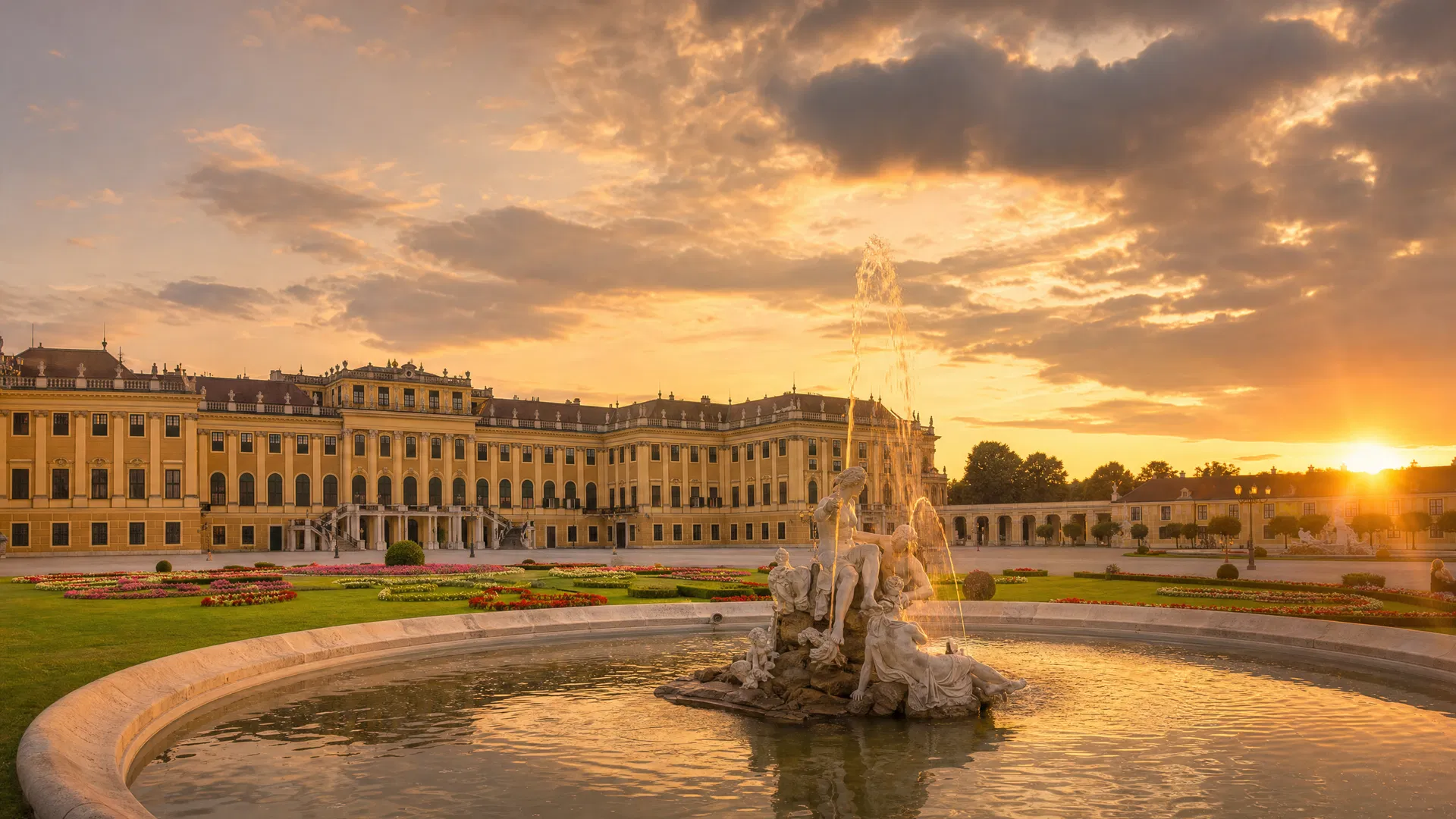
Schönbrunn Palace is the defining image of Vienna — a 1,441-room baroque palace that served as the summer residence of the Habsburg emperors, set in 1.2 square kilometers of formal gardens that include a maze, a palm house, a zoo (the oldest in the world, established in 1752), and the Gloriette — a neoclassical colonnade at the top of the hill behind the palace that offers the finest panoramic view of Vienna available anywhere. The palace itself is extraordinary: the Imperial Apartments, the Great Gallery where Mozart performed as a child, the Mirror Room where the six-year-old prodigy reportedly proposed to the young Marie Antoinette — all of it is open to visitors, and all of it is worth the time.
The Hofburg Palace in the center of the city is even larger — a complex of buildings that was expanded by successive Habsburg rulers over six centuries and now covers 240,000 square meters. It contains the Imperial Apartments, the Imperial Silver Collection, the Sisi Museum (dedicated to Empress Elisabeth, the most romanticized figure in Habsburg history), the Spanish Riding School (where the famous Lipizzaner horses have been trained since the 16th century), and the Imperial Crypt, where 149 members of the Habsburg dynasty are buried in elaborate sarcophagi. The Hofburg is not a single attraction — it's an entire district, and it rewards multiple visits.
Belvedere Palace is the third of Vienna's great palaces, built in the early 18th century as the summer residence of Prince Eugene of Savoy. The Upper Belvedere houses the most important collection of Austrian art in the world, including Gustav Klimt's The Kiss — arguably the most famous painting in Austria and one of the most reproduced images in art history. The gardens between the Upper and Lower Belvedere, with their fountains and sculptural groups and the palace facades reflected in the long rectangular pool, are among the most beautiful formal gardens in Europe.
For first-time visitors who want to experience all three palaces alongside the Ringstrasse and the city's essential neighborhoods, our 4-Day Vienna City Break: Your Ultimate Guide to Imperial Grandeur is the definitive starting point — a logical, unhurried sequence that covers the essential city without feeling rushed.
The Coffee Houses: Vienna's Living Rooms
The Viennese Kaffeehaus is not a café in the modern sense. It is a social institution — a place where you can sit for hours over a single coffee, reading the newspapers (provided on wooden holders), writing letters, playing chess, or simply watching the world go by, and no one will ever ask you to leave or order something else. The tradition dates to the 17th century, when coffee houses first appeared in Vienna following the Ottoman siege of 1683 (legend has it that the retreating Ottoman army left behind sacks of coffee beans, which the Viennese promptly turned into a cultural institution). UNESCO recognized the Viennese coffee house culture as an Intangible Cultural Heritage in 2011.
The coffee itself comes in a bewildering variety of forms. A Melange is the classic — espresso with steamed milk and milk foam, served with a glass of water. A Kleiner Brauner is a small espresso with a splash of cream. A Einspänner is a strong black coffee topped with whipped cream, served in a glass. An Eiskaffee is cold coffee with vanilla ice cream and whipped cream. The menu at most coffee houses runs to a dozen or more varieties, and ordering the wrong one is considered a minor social transgression.
The great coffee houses each have their own character. Café Central, in a former palace near the Hofburg, is the most architecturally spectacular — a soaring vaulted hall with marble columns and arched windows where Sigmund Freud, Leon Trotsky, and Adolf Hitler all reportedly sat at various points in the early 20th century. Café Hawelka, in the first district, is the most bohemian — a dark, smoke-stained room that has been run by the same family since 1939 and has barely changed since. Café Landtmann, on the Ringstrasse, is the most prestigious — Freud's regular haunt, still frequented by politicians and theater people after performances at the Burgtheater across the street. Café Sacher, in the Hotel Sacher behind the Staatsoper, is the most famous — home of the original Sachertorte, the dense chocolate cake with apricot jam that is Vienna's most iconic dessert and the subject of a decade-long legal dispute between the Hotel Sacher and the Demel bakery over who had the right to call their version "the original."
For travelers who want to experience Vienna's coffee house culture alongside its food scene — the schnitzel, the goulash, the Heuriger wine taverns in the vineyard villages on the city's outskirts — our Vienna Food Guide: 4 Days of Schnitzel, Coffee Houses & Heuriger Wine covers the full culinary landscape of the city.
The Music: Vienna's Eternal Obsession
Vienna's relationship with music is not a tourist attraction. It is a fundamental aspect of the city's identity, woven into its social fabric in a way that has no parallel anywhere else in the world. This is the city where Haydn, Mozart, Beethoven, Schubert, Brahms, Bruckner, Mahler, and Strauss all lived and worked. Where the Vienna Philharmonic — founded in 1842 and still considered by many to be the finest orchestra in the world — performs in the Musikverein's Golden Hall, a room with acoustics so perfect that it has been the benchmark for concert hall design for 150 years. Where the Staatsoper performs 50 different operas in a single season, with a repertoire and a roster of singers that no other opera house in the world can match.
The good news for visitors is that Vienna's musical life is remarkably accessible. Standing room tickets at the Staatsoper cost €4–10 and are available at the box office 80 minutes before each performance — one of the great cultural bargains in the world. The Vienna Philharmonic performs free open-air concerts in the Schönbrunn Palace gardens every summer. The Musikverein offers student and last-minute tickets at significant discounts. And the city's churches — particularly the Augustinerkirche, the Peterskirche, and the Stephansdom — host free or low-cost concerts of sacred music throughout the year.
For travelers who want to experience Vienna's musical life properly — from the Staatsoper to the Musikverein to the smaller concert venues where the city's next generation of musicians performs — our Solo Vienna: 3-Day Imperial Palaces, Coffee Houses & Classical Music Itinerary includes a full evening at the Staatsoper and a morning at the Musikverein, with practical advice on getting tickets and what to expect.
The Museums: Vienna's Extraordinary Collections
Vienna has more world-class museums per square kilometer than almost any city on earth, and the collections are extraordinary in a way that reflects the Habsburg Empire's centuries of acquisition, patronage, and conquest.
The Kunsthistorisches Museum is the crown jewel — a collection of European paintings, sculptures, and decorative arts that rivals the Louvre and the Prado. The Bruegel collection alone (the largest in the world) would justify a visit. The Vermeer, the Raphael, the Cellini salt cellar, the Egyptian and Near Eastern antiquities — the museum is so rich that it requires multiple visits to do it justice, and the building itself, designed by Gottfried Semper and Karl von Hasenauer, is as beautiful as anything in it.
The Belvedere, as mentioned, houses Klimt's The Kiss alongside the finest collection of Austrian Secession art in the world — Klimt, Schiele, Kokoschka, and their contemporaries, who at the turn of the 20th century produced some of the most psychologically intense and visually extraordinary art in European history.
The Leopold Museum in the MuseumsQuartier has the world's largest collection of Egon Schiele — an artist whose raw, contorted figures and unflinching psychological honesty make him one of the most powerful painters of the 20th century and one of the most difficult to look at for extended periods. The MuseumsQuartier complex itself — a former imperial stable converted into one of the largest museum districts in the world — also contains the MUMOK (Museum of Modern Art), the Kunsthalle Wien, and a courtyard that in summer becomes one of the best outdoor gathering spaces in the city.
Vienna for Every Type of Traveler
For couples, Vienna is one of the most romantic cities in Europe — and not in the obvious, postcard way. It's romantic in the way that a city is romantic when it has been designed for pleasure: the candlelit wine cellars, the opera evenings, the horse-drawn carriages (Fiaker) that clip-clop through the first district, the Prater at dusk when the old wooden Ferris wheel turns slowly against the sky. Our Vienna for Two: A 5-Day Romantic Itinerary for Couples covers the full romantic landscape of the city, from Schönbrunn at sunrise to a private wine tasting in a Heuriger in Grinzing. For a shorter trip with a cultural focus, our Vienna for Couples: A Romantic 5-Day Itinerary weaves the Staatsoper, the Belvedere, and the coffee houses into a five-day experience built for two.
For solo travelers, Vienna is one of the most rewarding solo destinations in Europe. The coffee house culture — where sitting alone is not just acceptable but traditional — makes it a city where solitude feels like a choice rather than a circumstance. The museums are best experienced alone, at your own pace, without the compromises of group travel. The classical music scene is perfectly suited to solo attendance. Our Solo Vienna: 3-Day Imperial Palaces, Coffee Houses & Classical Music Itinerary is built specifically for the independent traveler who wants to experience the city's depth without the constraints of a group itinerary.
For families, Vienna is better than its imperial reputation suggests. The Schönbrunn Zoo — the oldest in the world — is genuinely excellent and can absorb an entire day. The Prater's Wurstelprater amusement park, with its historic wooden Ferris wheel and old-fashioned rides, is one of the most charming family attractions in Europe. The Natural History Museum has a spectacular collection of dinosaur skeletons and meteorites that children find irresistible. Our Vienna with Kids: A 3-Day Family Adventure to Prater, Schönbrunn & More covers the city from a family perspective, with practical advice on managing the palaces and museums with children of different ages.
For budget travelers, Vienna is more affordable than its imperial grandeur suggests — particularly if you know where to look. The city's museums offer free admission on specific days. The Staatsoper's standing room tickets cost less than a glass of wine. The Naschmarkt — Vienna's famous open-air market — is one of the best places in the city to eat cheaply and well. Our Vienna on a Budget: 4-Day Imperial Palaces & Coffee Culture for €65/Day proves that experiencing the full depth of Vienna — the palaces, the museums, the coffee houses, the music — doesn't require a large budget.
The Naschmarkt: Vienna's Culinary Heart
The Naschmarkt — a 1.5-kilometer-long open-air market that runs along the Wienzeile in the fourth and sixth districts — is one of the great food markets of Europe. Established in the 16th century and operating continuously since, it stretches from the Karlsplatz U-Bahn station to the Kettenbrückengasse station and contains over 100 stalls selling everything from Viennese sausages and Austrian cheeses to Turkish spices, Persian dried fruits, Japanese sushi, and Lebanese mezze.
The market is at its best on Saturday mornings, when the regular food stalls are joined by a large flea market that extends along the adjacent street. The combination of fresh produce, prepared food, antiques, vintage clothing, and the general chaos of a market that has been in continuous operation for 500 years creates an atmosphere that is entirely its own. Eat a Käsekrainer (a cheese-filled sausage, the Viennese street food of choice) standing at one of the sausage stands, drink a glass of Grüner Veltliner from one of the wine stalls, and spend the morning wandering.
The Vienna-Budapest Connection
No guide to Vienna is complete without acknowledging the city's relationship with Budapest — its twin capital, its historical partner, its complement in almost every way. Vienna and Budapest are separated by 243 kilometers and connected by a train that takes 2 hours 40 minutes, and they are different enough from each other that visiting both in a single trip is one of the most rewarding travel experiences in Central Europe.
Vienna is grand and formal, its architecture confident and imperial, its pace unhurried and deliberate. Budapest is romantic and slightly melancholy, its architecture a mix of Habsburg grandeur and Hungarian exuberance, its pace more urgent and its energy more electric. Vienna's coffee houses are quiet and contemplative; Budapest's ruin bars are loud and anarchic. Vienna's thermal baths are elegant and classical; Budapest's are enormous and social. Vienna's food is refined and traditional; Budapest's is hearty and unpretentious.
Together, they form one of the great city-pair itineraries in the world. Fly into Vienna, spend four or five days, take the train to Budapest, spend four or five days, fly home. Or reverse the order. Either way, you leave with a richer understanding of Central Europe — its history, its culture, its contradictions — than you could get from either city alone. Read our Budapest destination guide to plan the perfect companion trip.
The Heuriger: Vienna's Wine Villages
One of Vienna's most distinctive features is the fact that it is the only major capital city in the world with significant wine production within its city limits. The hills on the northern and western edges of the city — Grinzing, Neustift am Walde, Sievering, Nussdorf, Gumpoldskirchen — are covered in vineyards that produce Grüner Veltliner and Riesling of genuine quality, and the Heuriger (wine taverns) that operate in these villages are one of the most authentic and enjoyable Viennese experiences available.
A Heuriger is a wine tavern that is legally permitted to sell only wine produced on its own estate, along with cold food (bread, cheese, cured meats, spreads). The tradition dates to a decree by Emperor Joseph II in 1784, and the best Heurigen still operate in the same way: wooden tables in a garden or courtyard, jugs of young wine poured from large barrels, a buffet of cold food, and the particular atmosphere of a place that has been doing the same thing for 240 years. Take the D tram from the Ringstrasse to Nussdorf or the 38A bus to Grinzing on a warm evening, find a Heuriger with a pine branch hung over the door (the traditional sign that new wine is available), and settle in for the evening.
Practical Vienna: What You Need to Know Before You Go
Getting there: Vienna International Airport (VIE) is connected to the city center by the City Airport Train (CAT), which takes 16 minutes and costs €12 one-way, and by the S-Bahn commuter rail, which takes 25 minutes and costs €4. Taxis to the center cost €35–45.
Getting around: Vienna's public transport system — U-Bahn (subway), trams, and buses — is one of the finest in Europe. A 24-hour pass costs €8; a 72-hour pass costs €17.10. The historic first district is entirely walkable, and the Ringstrasse is best experienced on foot. The Vienna City Bike system (Citybike Wien) is free for the first hour and is an excellent way to explore the outer districts.
When to go: Vienna is a year-round destination. Spring (April–May) and autumn (September–October) are the ideal seasons — mild temperatures, lower crowds, and the city's cultural season in full swing. Summer is warm and lively, with outdoor concerts in the Schönbrunn gardens and the Rathausplatz film festival. Winter is magical — the Christmas markets that appear throughout the city in December are among the finest in Europe, and the Viennese Ball season (January–February) transforms the city's grand halls into something from another century.
Money: Austria uses the Euro. Vienna is more expensive than Budapest but significantly cheaper than London, Paris, or Zurich. Budget €80–120 per day for a comfortable mid-range experience including accommodation, food, and museum entry. The city's free and low-cost attractions — the Ringstrasse walk, the coffee house culture, the Naschmarkt, the parks — mean that a tight budget is entirely workable.
Language: German is the official language, but English is widely spoken in the tourist areas, hotels, and restaurants. Learning a few words — Bitte (please), Danke (thank you), Entschuldigung (excuse me) — is appreciated and opens doors.
The Feeling That Stays With You
Vienna leaves a particular residue. It's not the residue of excitement or novelty — it's something quieter and more durable. It's the memory of sitting in a coffee house at 10am with nowhere to be, the newspaper on its wooden holder, the Melange cooling in its glass, the sound of the city muffled by the heavy curtains. It's the memory of standing in the Golden Hall of the Musikverein while the Vienna Philharmonic played Brahms and understanding, for the first time, what a concert hall is supposed to feel like. It's the memory of Klimt's The Kiss seen in person for the first time — smaller than you expected, more intimate, more alive.
Vienna is a city that teaches you to slow down. Not because it's slow — it isn't — but because it has arranged itself in such a way that rushing feels like a waste. The coffee houses won't let you rush. The museums won't let you rush. The Ringstrasse, walked at dusk with the buildings glowing gold, won't let you rush. The city insists, gently but firmly, that you take your time.
Take your time. It's worth it.
Plan Your Vienna Trip
Ready to experience everything Vienna has to offer? Build your perfect itinerary with Ask Leif — personalized to your travel style, budget, and the experiences that matter most to you.
- 4-Day Vienna City Break: Your Ultimate Guide to Imperial Grandeur
- Vienna for Two: A 5-Day Romantic Itinerary for Couples
- Vienna for Couples: A Romantic 5-Day Itinerary
- Solo Vienna: 3-Day Imperial Palaces, Coffee Houses & Classical Music Itinerary
- Vienna with Kids: A 3-Day Family Adventure to Prater, Schönbrunn & More
- Vienna on a Budget: 4-Day Imperial Palaces & Coffee Culture for €65/Day
- Vienna Food Guide: 4 Days of Schnitzel, Coffee Houses & Heuriger Wine