Budapest Doesn't Ease You In. It Pulls You Under.
Destination: Budapest, Hungary
Category: Destination Guides
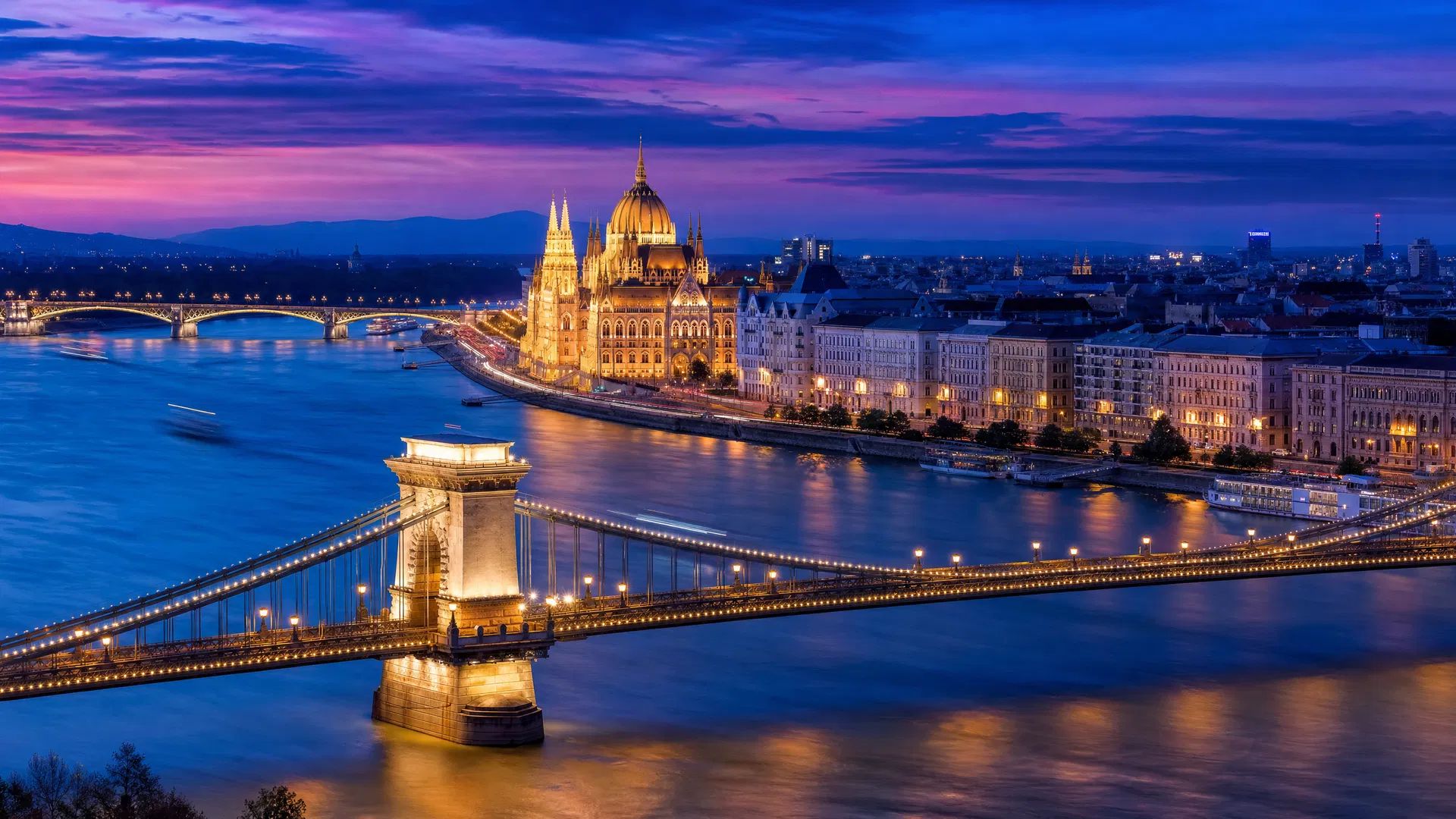
The first thing you notice about Budapest is the scale of it. Not the size — you know it's a capital city, you've seen the maps — but the scale of the ambition that built it. The Parliament building on the Danube's east bank is not just large; it is operatically, almost absurdly large, a neo-Gothic cathedral to democratic aspiration that stretches for 268 meters along the riverbank and took seventeen years to build. The Chain Bridge connecting Buda and Pest was, when it opened in 1849, one of the longest suspension bridges in the world. The Great Market Hall, built in 1897, is a cathedral of commerce with soaring iron arches and a tiled roof that looks like it belongs on a Hungarian church. The thermal bath complexes — Széchenyi, Gellért, Rudas — are not spas in any modern sense; they are palaces built around hot springs, with domed ceilings and marble columns and the kind of architectural confidence that says: we are not just here to wash. We are here to live.
Budapest was built to be one of the great cities of Europe. For a brief, extraordinary period at the turn of the 20th century, it was. The Austro-Hungarian Empire made Budapest its co-capital alongside Vienna, and the city responded with a building boom that produced the Parliament, the Opera House, the grand boulevards of Andrássy Avenue, and the first underground railway on the European continent. By 1900, Budapest was the sixth-largest city in Europe, a metropolis of nearly a million people, and the cultural capital of a civilization that stretched from the Adriatic to the Carpathians.
Then came the 20th century, which was not kind to Budapest. Two world wars. Soviet occupation. The 1956 uprising, crushed by tanks. Decades of communism that left the grand buildings slowly decaying while the political system they represented was dismantled. The fall of the Iron Curtain in 1989. The transition to democracy and capitalism that was exhilarating and chaotic in equal measure.
What you get, when you visit Budapest today, is a city that carries all of that history in its bones — the imperial grandeur, the communist-era decay, the post-1989 energy — and has somehow synthesized it into something that feels entirely its own. The ruin bars of the Jewish Quarter, built in the shells of abandoned buildings, are the most visible expression of this synthesis: they are simultaneously a response to poverty (we can't afford to renovate, so we'll decorate with found objects), a celebration of impermanence, and one of the most creative nightlife scenes in the world. The thermal baths are Ottoman-era infrastructure that has been in continuous use for 500 years. The street food — lángos, chimney cake, goulash from a bread bowl — is peasant food elevated to civic pride.
Budapest is a city that has been through everything and come out the other side with its character intact. That is a rare and precious thing. And it is the reason that visitors who come for a long weekend often find themselves extending their stay, then returning the following year, then telling everyone they know that Budapest is the most underrated city in Europe.
Buda and Pest: Two Cities, One Identity
The Danube River that runs through the heart of Budapest is not just a geographical feature — it is a cultural divide that shapes the entire character of the city. Buda, on the western bank, is hilly, residential, and ancient. Pest, on the eastern bank, is flat, urban, and relentlessly alive. The two cities were officially merged in 1873, but they have never quite become the same place.
Buda is where you go for history and perspective. The Castle District, perched on a limestone plateau above the river, contains the Royal Palace (now the Budapest History Museum and the Hungarian National Gallery), the Matthias Church (a Gothic masterpiece with a Zsolnay-tiled roof that looks like it was designed by a jeweler), and Fisherman's Bastion — a neo-Romanesque terrace built in 1902 that offers the most photographed view in Budapest: the Parliament building across the river, the Chain Bridge below, and the Danube stretching away in both directions. The view from Fisherman's Bastion at sunrise, when the Parliament's dome catches the early light and the city below is still quiet, is one of those travel experiences that stays with you for years.
Pest is where Budapest lives. The Great Boulevard (Nagykörút) and the smaller ring roads that circle the city center contain the Parliament, the Jewish Quarter, the ruin bars, the Great Market Hall, the Opera House, and the dense, layered street life of a European capital that has been continuously inhabited for two thousand years. Andrássy Avenue, the grand boulevard that runs from the city center to Heroes' Square, is lined with neo-Renaissance palaces that now house embassies, luxury hotels, and the State Opera House — one of the most beautiful opera houses in the world, with an interior that makes the Vienna State Opera look restrained.
The bridges that connect Buda and Pest are themselves worth attention. The Chain Bridge (Széchenyi Lánchíd) is the most famous — a symbol of Hungarian national identity and one of the most elegant suspension bridges ever built. The Liberty Bridge (Szabadság híd), with its green ironwork and mythological turul birds at each corner, is arguably more beautiful. Walking across either bridge at dusk, with the Parliament lit up on one side and the Castle on the other, is one of those experiences that makes you understand why people fall in love with Budapest.
The Thermal Baths: Budapest's Most Essential Experience
Budapest sits on a geological fault line that produces 120 thermal springs within the city limits, and the city has been building baths around them since the Romans established Aquincum here in the 1st century AD. The Ottoman occupation of the 16th and 17th centuries added a new layer of bath culture — the Turks were enthusiastic bathers — and the late 19th century added the grand spa palaces that define Budapest's bath scene today.
Széchenyi Thermal Bath in City Park is the most famous and the most fun. Built in 1913 in a neo-Baroque palace, Széchenyi has 18 pools at temperatures ranging from 27 to 40 degrees Celsius, including three outdoor pools where you can soak in 38-degree water while chess players push pieces across floating boards and the steam rises into the winter air. On weekend evenings, Széchenyi hosts "sparties" — spa parties with DJs and light shows — that have become one of Budapest's signature nightlife experiences. But the daytime experience is equally compelling: there is something profoundly civilized about soaking in a 113-year-old palace while the city goes about its business outside.
Gellért Thermal Bath, attached to the art nouveau Gellért Hotel on the Buda side of the river, is the most architecturally spectacular of Budapest's baths. The main pool, with its mosaic tiles, arched windows, and Roman columns, looks like a set from a Wes Anderson film about ancient Rome. The outdoor wave pool on the roof is a Budapest institution. Gellért is more expensive than Széchenyi and more tourist-oriented, but the architecture alone justifies the visit.
Rudas Thermal Bath is the oldest and most atmospheric. Built by the Ottomans in 1566, Rudas has a central octagonal pool under a domed ceiling with star-shaped skylights — a design that has barely changed in 450 years. On weekends, Rudas opens its rooftop pool at night, with views over the Danube and the lit-up Parliament that are simply extraordinary. Rudas is where Budapest locals actually go, which means it feels less like a tourist attraction and more like a genuine piece of living history.
For travelers who want to experience Budapest's bath culture as part of a broader culinary and nightlife adventure, our Budapest Food & Nightlife Guide includes a full day dedicated to the thermal bath circuit alongside the city's best restaurants and ruin bars.
The Ruin Bars: Where Budapest Invented a New Kind of Nightlife
In the early 2000s, a group of young Hungarians started throwing parties in the abandoned buildings of the Jewish Quarter — buildings that had been empty since the Second World War, their owners dead or dispersed, their interiors slowly decaying. They filled these spaces with mismatched furniture salvaged from flea markets, hung art on the crumbling walls, installed bars in the kitchens, and opened their doors to anyone who wanted to come. The result was something that had never existed before: the ruin bar.
Szimpla Kert is the original and still the best. Located in a former factory on Kazinczy Street, Szimpla is a labyrinth of interconnected rooms, courtyards, and rooftop terraces, each decorated in a different style — one room is a converted Trabant car, another is a garden of hanging plants, another is a gallery of Hungarian folk art. On weekend nights, Szimpla is packed with a mix of locals and tourists, all drawn by the atmosphere that is impossible to replicate: the feeling of being inside a living artwork that is also a bar that is also a community center that is also, somehow, one of the most fun places in Europe to spend an evening.
But Szimpla is not alone. Instant and Fogas Ház are larger, more club-oriented ruin bars with multiple dance floors and a more intense nightlife vibe. Ellátó Kert is smaller and more local, with a garden courtyard that fills up on warm evenings. Mazel Tov is a ruin bar that has evolved into a full restaurant, serving Israeli-Hungarian fusion food in a courtyard draped with hanging plants and fairy lights. The Jewish Quarter as a whole has become one of the most vibrant nightlife districts in Central Europe, a transformation that is simultaneously a celebration of the neighborhood's cultural heritage and a complex reckoning with its history.
The Jewish Quarter's history is inseparable from its present. The Great Synagogue on Dohány Street — the largest synagogue in Europe and the second-largest in the world — is a reminder that this neighborhood was once the center of a thriving Jewish community that was largely destroyed in the Holocaust. The Raoul Wallenberg Memorial Park behind the synagogue contains a weeping willow sculpture whose leaves are inscribed with the names of Hungarian Jewish victims. Walking through the ruin bars at night and then standing in the memorial garden the next morning is one of those experiences that makes you understand what it means for a city to carry its history.
Hungarian Food: Goulash, Lángos, and the Great Market Hall
Hungarian cuisine is one of the great underappreciated food traditions of Europe — a cuisine built on paprika, pork fat, and slow cooking, with influences from Ottoman, German, and Jewish culinary traditions that have been absorbed and transformed over centuries.
Goulash (gulyás) is the dish that everyone knows, but the version most people have encountered outside Hungary — a thick beef stew — is not quite the original. Traditional Hungarian gulyás is a soup, not a stew, built on a broth of beef, onions, and sweet paprika, with potatoes and csipetke (tiny pinched pasta) added near the end. It is warming, deeply savory, and best eaten from a bread bowl at a market stall in November. The best gulyás in Budapest is a matter of fierce local debate, but the stalls at the Great Market Hall and the restaurants around the Jewish Quarter are reliable starting points.
Lángos is the street food that Hungarians are most passionate about — a deep-fried flatbread topped with sour cream and grated cheese, or garlic butter, or both, or (in more adventurous preparations) smoked salmon or Nutella. It is the kind of food that is impossible to eat elegantly, that is best consumed standing up at a market stall, and that is so good that you will think about it for weeks afterward. The lángos vendors at the Great Market Hall are the most famous, but you'll find them at every market and festival in the city.
Chimney cake (kürtőskalács) is a spiral pastry cooked on a rotating spit over an open fire, caramelized on the outside and soft on the inside, rolled in sugar and cinnamon or ground walnuts. It is the most photogenic street food in Budapest and also one of the most delicious. The vendors on the Castle Hill and in the Christmas markets are the most visible, but the best chimney cakes come from the bakeries in the Jewish Quarter.
The Great Market Hall (Központi Vásárcsarnok) is the essential Budapest food experience. Built in 1897 in a massive iron-and-tile hall, the market has three floors: the ground floor is for fresh produce, meat, fish, and paprika (buy the sweet and hot varieties in the fabric bags — they make excellent gifts); the first floor is for Hungarian crafts, embroidery, and tourist souvenirs; and the basement is for pickles, sausages, and the kind of preserved foods that have sustained Hungarian winters for centuries. Come on a weekday morning when the market is at its most local and least touristy, and spend an hour just walking the stalls.
For travelers who want to build their Budapest trip around food — from the Great Market Hall to the ruin bar restaurants to the fine dining scene that has emerged in the past decade — our Budapest Food & Wine Guide covers four days of culinary exploration that includes Tokaj wine tasting, a cooking class in traditional Hungarian cuisine, and the best restaurants in the Jewish Quarter.
Budapest for Every Type of Traveler
For couples: Budapest is one of the most romantic cities in Europe — a city of candlelit wine bars, thermal baths at sunset, and long dinners in converted palaces. A weekend in Budapest for couples means a morning at Gellért, an afternoon on Fisherman's Bastion, dinner in the Jewish Quarter, and a nightcap at a rooftop bar overlooking the Danube. Our Budapest Couples Guide builds a five-day itinerary around the city's most intimate experiences — from private thermal bath sessions to wine tasting in the Tokaj region to the most romantic restaurants in the city.
For solo travelers: Budapest is one of the safest and most welcoming cities in Europe for solo travel. The ruin bar scene is inherently social — you will meet people at Szimpla. The thermal baths are communal by design. The city's compact center is entirely walkable. Our Budapest Solo Travel Guide covers three days of the city's highlights with specific recommendations for solo-friendly restaurants, bars, and experiences.
For families: Budapest with children is more rewarding than most people expect. The Budapest Zoo and Botanical Garden in City Park (next to Széchenyi) is one of the oldest and most beautiful zoos in Europe. The Castle Labyrinth under Buda Castle is a genuinely thrilling underground adventure for older children. The Danube river cruises are excellent for all ages. Our Budapest Family Guide covers three days of kid-friendly Budapest — from the thermal baths (children love the outdoor pools at Széchenyi) to the Castle District to the interactive exhibits at the Hungarian Natural History Museum.
For budget travelers: Budapest remains one of the most affordable capital cities in Europe. A meal at a traditional étkezde (Hungarian canteen) costs under $10. A day at Széchenyi costs around $20. The ruin bars serve excellent local beer for $2 a glass. Our Budapest Budget Guide shows how to experience the best of the city for under $35 a day — thermal baths, market food, ruin bars, and the city's extraordinary free architecture.
For city break travelers: Budapest is one of Europe's premier city break destinations — compact enough to cover the highlights in a long weekend, deep enough to reward a week. Our Budapest City Break Guide builds a four-day itinerary that covers both Buda and Pest, the essential thermal baths, the Jewish Quarter, the Parliament, and the best restaurants and bars — the ideal framework for a first visit.
Practical Budapest: When to Go, How to Get Around, What to Know
When to visit: Budapest is a year-round destination, but the sweet spots are May-June and September-October, when the weather is warm enough for outdoor terraces and the tourist crowds are manageable. July and August are peak season — hot, crowded, and expensive by Budapest standards. December is magical — the Christmas markets on Vörösmarty Square and around the Basilica are among the best in Europe, and the thermal baths are at their most atmospheric when steam rises into cold winter air. January and February are quiet and cold but offer the best prices and the most authentic experience of the city.
Getting around: Budapest has an excellent public transport system — metro, tram, and bus — that covers the entire city. The metro is particularly useful: Line 1 (the yellow line, the oldest metro in continental Europe) runs along Andrássy Avenue from the city center to City Park. Line 2 connects Buda and Pest via the river. A 24-hour or 72-hour travel card is the most economical option for visitors. The city center is also very walkable — you can cover most of the Jewish Quarter, the Parliament area, and the Grand Boulevard on foot.
Where to stay: The 5th and 7th districts (the city center and the Jewish Quarter) put you within walking distance of everything. The 7th district in particular — the ruin bar neighborhood — is the most atmospheric place to stay, with dozens of excellent boutique hotels in converted apartment buildings. For a splurge, the Four Seasons Gresham Palace on the Danube embankment is one of the most beautiful hotels in Europe, an art nouveau masterpiece that was restored to its original glory in 2004.
The currency: Hungary uses the Hungarian Forint (HUF), not the Euro. This is important to know because it means Budapest is significantly cheaper than most Western European capitals — and it means you should use ATMs rather than exchange bureaus, which typically offer poor rates.
Why Budapest Stays With You
There is a particular quality to Budapest that is hard to articulate but easy to feel: a sense that the city is simultaneously ancient and alive, that the weight of its history is not a burden but a foundation, that the people who live here have figured out how to carry the past without being crushed by it.
The ruin bars are the most visible expression of this quality, but it runs through everything — the thermal baths that have been in continuous use for 500 years, the market hall that has been feeding the city for 130 years, the bridges that have been rebuilt after every war and are still standing. Budapest is a city that has been destroyed and rebuilt so many times that its resilience has become part of its character.
Visitors who come expecting a party city (which it is) or a cheap city break (which it also is) often leave with something they didn't expect: a genuine attachment to a place that feels like it has something to say. The Parliament building, the Great Synagogue, the thermal baths, the ruin bars — they are all, in their different ways, expressions of the same impulse: the desire to build something beautiful and lasting in the face of everything that would destroy it.
Budapest doesn't ease you in. It pulls you under. And most people, once they've been pulled, find that they don't want to come back up.
Ready to plan your Budapest trip? Our Budapest City Break Guide is the best place to start — four days covering both Buda and Pest, the essential thermal baths, and the Jewish Quarter. For a deeper dive into the food scene, the Budapest Food & Wine Guide and Budapest Food & Nightlife Guide cover the culinary landscape from the Great Market Hall to the finest restaurants. Planning a romantic trip? The Budapest Couples Guide builds five days around the city's most intimate experiences. Traveling solo? The Budapest Solo Travel Guide has you covered. Bringing the family? The Budapest Family Guide makes it easy. And if you're watching your budget, the Budapest Budget Guide shows how to experience it all for under $35 a day.