The City That Sits on the Equator, Under a Volcano, at the Edge of the Cloud Forest — and Still Gets Overlooked
Destination: Quito, Ecuador
Category: Destination Guides
The City That Sits on the Equator, Under a Volcano, at the Edge of the Cloud Forest — and Still Gets Overlooked
Meta title: Quito, Ecuador: Colonial Capital at the Edge of the World Meta description: Quito has the Americas' best-preserved colonial center, sits on the equator at 2,850m, and is the gateway to the cloud forest and Galápagos. Here's why it's the destination, not the layover. Primary keyword: Quito Ecuador travel guide Destination: Quito, Ecuador Category: Destination Guides Tags: Quito, Ecuador, South America, colonial architecture, Galápagos, cloud forest, altitude
Every morning at 6:00am, the sun rises over Quito. Not approximately 6am. Not around sunrise. Exactly 6:00am, give or take a minute, every single day of the year, because Quito sits on the equator and the equator does not negotiate with the seasons. At 6:00pm, the sun sets. The days are always twelve hours long. The light at noon is vertical — it falls straight down, casting almost no shadow — and at altitude, at 2,850 meters above sea level, it has a quality that photographers describe as "equatorial high-altitude light" and that everyone else describes as "unlike anything I've seen anywhere else."
Most people who come to Quito are on their way to the Galápagos. They land at Mariscal Sucre International Airport, spend a night in a hotel near the Mariscal Sucre neighborhood, and fly out the next morning on a LATAM or Avianca connection to Baltra or San Cristóbal. They see the airport, a taxi, a hotel, and a departure gate. They do not see Quito.
This is a significant mistake. Not because the Galápagos aren't worth it — they are, emphatically — but because Quito is one of the most extraordinary cities in the Western Hemisphere, and treating it as a transit hub is the travel equivalent of flying through Paris and not leaving the airport. The thesis of this post is simple: Quito is the destination, not the layover. It has the best-preserved colonial center in the Americas — a UNESCO World Heritage Site since 1978, the first city in the world to receive that designation — a food culture that is only now beginning to get the international attention it deserves, a creative neighborhood that most travel content has never heard of, and a geography so extreme and so beautiful that the city feels, at every moment, like it exists at the edge of what's physically possible for a human settlement.
The Galápagos will be there when you get back. Give Quito three days first.
What It Means to Live at 2,850 Meters on the Equator
The altitude hits you before the beauty does. You step off the plane and walk to the taxi stand and feel, somewhere around the third minute, a slight tightening in your chest and a faint buzzing behind your eyes. This is not a problem. This is your body adjusting to the fact that there is 28% less oxygen in the air than at sea level, and it will pass within 24 to 48 hours if you drink water, avoid alcohol on the first night, and don't try to run up stairs.
What the altitude gives you, once you've adjusted, is extraordinary. The air is cool — Quito's average temperature is 14°C year-round, because the equatorial sun is balanced by the altitude, and the result is a city that is perpetually in a state of mild spring. You can wear a light jacket in the morning, a t-shirt at noon, and a light jacket again in the evening. You never need a heavy coat. You never need shorts. The climate is, by the standards of any other equatorial city, absurd in its pleasantness.
The light is the other thing. At 2,850 meters on the equator, the sun is closer and the atmosphere is thinner, and the quality of the light — particularly in the early morning and late afternoon — is unlike anything at lower elevations. The colonial churches of the Old Town glow in the late afternoon in a way that makes them look like they're lit from within. The Pichincha volcano, which rises to 4,784 meters directly west of the city, turns pink at sunset in a way that stops traffic. Photographers who come to Quito for the Galápagos connection and spend a day in the Old Town often extend their stay by two or three days because the light is doing something they've never seen before and they can't stop pointing their cameras at it.
The Old Town That Time Forgot to Ruin
Quito's Centro Histórico — the Old Town — is the reason UNESCO came here first. It covers 375 hectares of the city center and contains more than 40 churches, 17 plazas, and hundreds of colonial-era buildings that have survived earthquakes, political upheaval, and the 20th century with their facades largely intact. Walking through it is the closest thing to time travel that a city can offer.
The Plaza Grande — officially the Plaza de la Independencia — is the center of everything. It's a large square surrounded by the Presidential Palace, the Metropolitan Cathedral, the Archbishop's Palace, and the City Hall, and it has been the center of Quito's civic life since the city was founded in 1534. On weekday mornings, it's full of office workers eating breakfast at the cafés under the arcades. On weekends, it's full of families and street vendors and, occasionally, a military band playing in front of the Presidential Palace. The palace itself is open for tours on certain days, and the tours are worth taking: the interior has murals by the Ecuadorian artist Oswaldo Guayasamín that are among the most powerful political paintings in Latin America.
The Church of La Compañía de Jesús is the building that most photographs of Quito's Old Town are actually photographs of, though many people don't know its name. It's a Jesuit church completed in 1765, and its facade is the most elaborate piece of baroque architecture in the Americas — seven tons of gold leaf on the interior walls, a facade so densely carved that it looks like stone lace. The interior is overwhelming in the way that only things built to overwhelm can be: every surface covered, every inch of wall and ceiling and column carved and gilded and painted, the whole effect designed to make a 16th-century Andean convert feel the physical presence of God. It works, even on secular 21st-century visitors who don't believe in anything.
The Monastery of San Francisco is older — construction began in 1535, one year after the city's founding — and larger, occupying an entire city block. Its main church is one of the finest examples of Mudéjar architecture in the Americas, a style that blends Spanish Gothic and Islamic geometric patterns in a way that reflects the cultural complexity of colonial-era building. The monastery's museum contains one of the best collections of Quito School religious art in the world — the Quito School being the 17th and 18th-century tradition of painting and sculpture that developed in this city and produced work that is now in museums from Madrid to New York.
What most visitors miss in the Old Town: the rooftops. Several of the colonial buildings have been converted into restaurants and cafés with rooftop terraces, and the view from these terraces — looking out over the red-tiled roofs of the colonial center, with the Pichincha volcano rising directly behind and the newer city spreading north below — is the best view of Quito available without taking the Teleférico. The Casa Gangotena, a boutique hotel on the Plaza San Francisco, has a rooftop bar that opens at 5pm and serves the best pisco sour in the city. Get there at 5:30pm, order the pisco sour, and watch the light change on Pichincha until the volcano turns pink and then purple and then disappears into the dark. This is not in any guidebook. It should be.
The Mercado Central and the Food That Quito Doesn't Advertise
Ecuadorian food has a marketing problem. It doesn't have a Gastón Acurio. It doesn't have a Virgilio Martínez. It doesn't have a single chef who has become the international face of a national cuisine. What it has instead is a food culture that is deeply local, deeply seasonal, and deeply tied to the extraordinary biodiversity of a country that contains the Amazon, the Andes, the Pacific coast, and the Galápagos in an area the size of Nevada.
The Mercado Central in Quito's Old Town is the place to start understanding this. It's a covered market that has been operating since the 19th century, and on a Saturday morning it is one of the most intense sensory experiences available in South America. The produce section alone is worth the trip: Ecuador grows more than 4,000 varieties of potato (the potato is native to the Andes), and the market sells perhaps 30 of them, in colors ranging from white to purple to black, in sizes ranging from a marble to a fist. There are chirimoyas — custard apples — the size of softballs. There are tree tomatoes (tomate de árbol) that taste like a cross between a tomato and a passion fruit. There are naranjillas, a fruit that exists almost nowhere outside Ecuador and that makes a juice so sour and so fragrant that it tastes like nothing else in the world.
The food stalls in the market's central hall serve caldo de patas — a broth made from cow's feet, hominy corn, and peanuts, seasoned with cumin and cilantro — which is the traditional hangover cure and altitude sickness remedy in Quito, consumed in large quantities on Saturday and Sunday mornings by people who were out late the night before and by people who just arrived from sea level and need something warm and dense and restorative. It tastes like the Andes. It tastes like the specific combination of altitude and cold mornings and a food culture that has been solving the problem of how to feed people at 2,850 meters for centuries.
The llapingacho is the other thing to eat in Quito and not skip. It's a potato cake — mashed potato mixed with cheese, formed into a patty, and fried until the outside is crisp and the inside is molten — served with a peanut sauce and a fried egg and a slice of avocado. It is simple food, the kind of thing that a Quito grandmother makes on a Sunday morning, and it is extraordinary. The best version in the city is at a small restaurant near the Mercado Central called El Maple, which has been serving traditional Ecuadorian food since 1985 and has no English menu and no Instagram account and a line out the door every weekend morning.
The hornado is the Sunday food of Quito: a whole roasted pig, slow-cooked overnight in a wood-fired oven, served with llapingachos and mote (hominy corn) and a salad of pickled onions and tomatoes. The best hornado in the city is not in a restaurant — it's at the Mercado Iñaquito, a neighborhood market in the north of the city, where a family called the Morochos has been roasting pigs since 1962 and where the line starts forming at 9am and the pig is usually gone by noon.
La Floresta: The Neighborhood That Quito's Tourism Board Forgot
La Floresta is Quito's creative neighborhood, and it is almost entirely absent from English-language travel content. It sits in the north of the city, between the Mariscal Sucre tourist district and the upscale Gonzáles Suárez neighborhood, and it has been quietly becoming one of the most interesting urban neighborhoods in South America for the past decade.
The neighborhood's main street is Avenida Isabel La Católica, and on a weekday afternoon it is full of the things that make a neighborhood worth living in: independent bookshops with handwritten signs in the windows, craft beer bars serving Ecuadorian microbrews alongside Argentinian and Chilean imports, galleries showing work by Quito's emerging artists, and restaurants serving food that is neither traditional Ecuadorian nor international fusion but something in between — the kind of cooking that happens when young chefs who have trained in Europe or New York come home and start cooking with the ingredients they grew up eating.
The Café Mosaico, on the hill above La Floresta, is the most famous café in Quito that most visitors have never heard of. It's a terrace café with a view of the Old Town and the Pichincha volcano, and it serves breakfast until 3pm and has a wine list that is better than anything in the Mariscal Sucre tourist district. The walk up to it — 20 minutes from the bottom of the hill, through a residential neighborhood of painted concrete houses and gardens full of bougainvillea — is the walk that shows you what Quito looks like when it's not performing for tourists.
The Teleférico and the View That Changes Everything
The Teleférico — Quito's cable car — runs from the western edge of the city at 2,950 meters to a station on the flank of Pichincha volcano at 4,050 meters. The ride takes eight minutes. The view from the top is one of the great urban panoramas on earth.
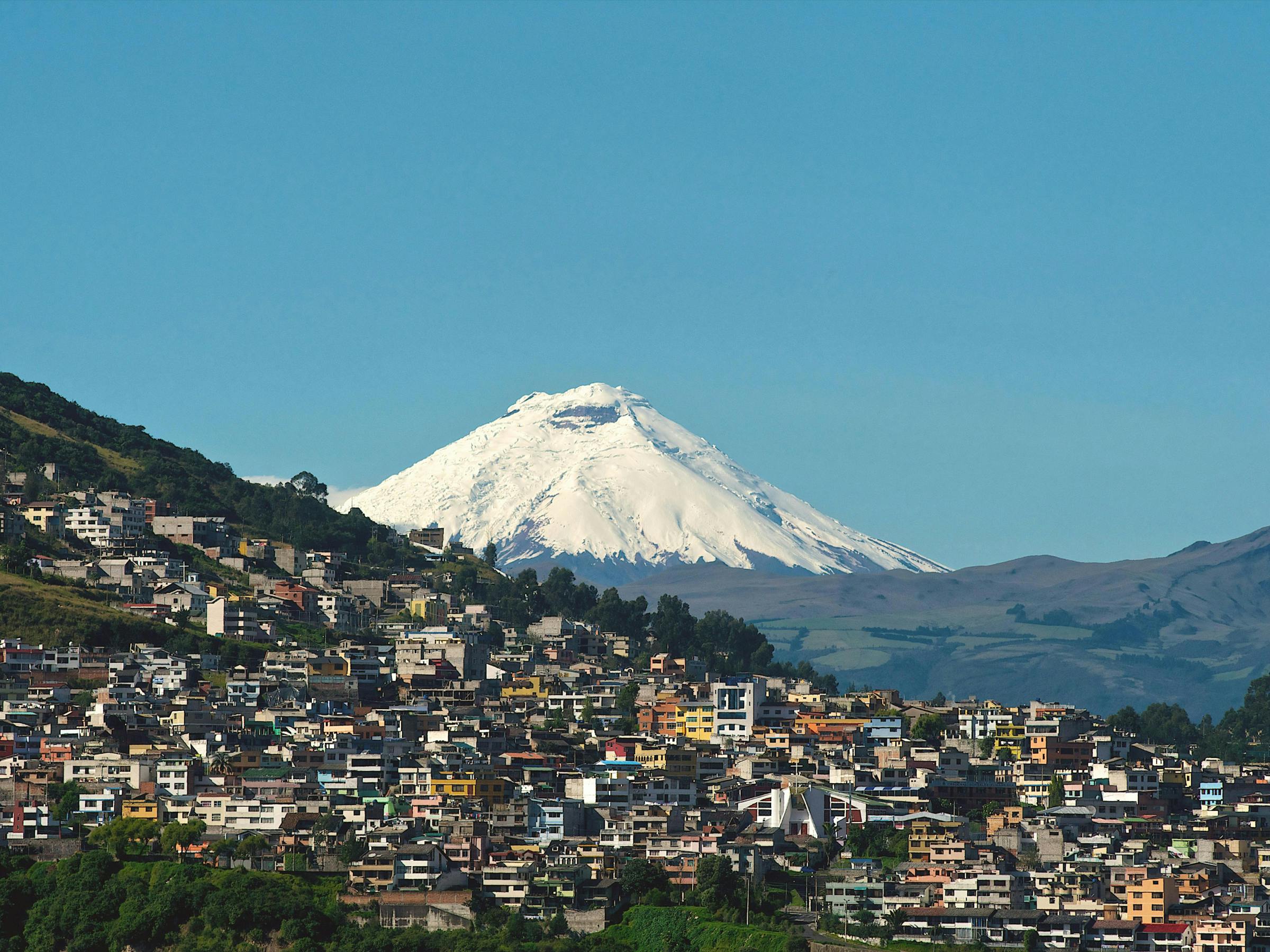
From 4,050 meters, you can see the entire city of Quito spread out below you — 2.7 million people in a valley that runs north-south between two mountain ranges, the colonial center a dense cluster of red roofs and white church towers in the south, the modern city a grid of glass and concrete spreading north. On a clear day, you can see the summit of Cotopaxi — the world's highest active volcano, at 5,897 meters — 50 kilometers to the south. You can see the Antisana volcano to the east. You can see, if the clouds cooperate, the Pacific Ocean to the west, 100 kilometers away.
The altitude at the top station requires acclimatization. If you've only been in Quito for a day, the jump from 2,850 to 4,050 meters will make you feel the altitude in a way that the city itself doesn't. Drink water before you go. Take the walk from the station slowly. The trail from the cable car station to the summit of Rucu Pichincha — a 4,698-meter peak accessible by a 3-hour hike from the top station — is one of the best day hikes in Ecuador, but it requires a guide and proper acclimatization. The view from the cable car station alone is worth the trip.
The Galápagos Gateway — and Why That's Not the Point
Quito is the primary gateway to the Galápagos Islands, and this fact has defined how the city is perceived by international travelers in a way that is both accurate and limiting. Yes, most flights to the Galápagos depart from Quito. Yes, the Galápagos are extraordinary. Yes, you should go.
But the Galápagos connection has caused most travel content to treat Quito as a transit hub rather than a destination, and this has created a situation where one of the most remarkable cities in the Americas is consistently underwritten, undervisited, and undervalued. The 7-Day Galápagos Islands Adventure Guide covers the islands in the depth they deserve — the wildlife, the snorkeling, the islands to prioritize, the logistics of getting between them. What it doesn't cover is what to do with the three days before your Galápagos flight, which is where this post comes in.
The answer is: spend them in Quito. Spend the first day adjusting to the altitude and walking the Old Town. Spend the second day in La Floresta and the Mercado Central and the Teleférico. Spend the third day on a day trip to the Middle of the World monument (the actual equatorial line, 22 kilometers north of the city, where you can stand with one foot in each hemisphere) or to the Mindo cloud forest (90 minutes west, at 1,250 meters, where the altitude drops and the temperature rises and the biodiversity explodes into something that makes the Andes seem almost restrained). Then fly to the Galápagos with the knowledge that you've seen two of the most extraordinary places on earth in one trip.
The 3-Day Quito Itinerary is the framework for those three days. The Quito Food & Culture Guide goes deeper into the markets, the restaurants, and the food culture. The Romantic Quito Couples Guide covers the rooftop bars, the boutique hotels in the Old Town, and the sunset views from Casa Gangotena. And the Quito Budget Guide proves that this city — unlike most UNESCO World Heritage destinations — is genuinely affordable, with excellent food and accommodation available at prices that make most European cities look extortionate.
The Middle of the World
The Mitad del Mundo — the Middle of the World monument — sits 22 kilometers north of Quito, at the point where French geodesic mission of 1736 determined the equator to cross. There is a large yellow line painted on the ground, a monument, a museum, and approximately 400 souvenir shops selling miniature Galápagos tortoises and Ecuador football shirts.
There is also, 200 meters north of the official monument, a smaller museum called the Intiñan Solar Museum, which sits on the actual GPS-confirmed equatorial line (the French mission was slightly off, as it turns out) and which runs a series of demonstrations that are either genuinely fascinating or mildly hokey depending on your tolerance for tourist science. The water-draining-in-different-directions demonstration is the famous one, and it is, in fact, real: water drains clockwise in the Southern Hemisphere, counterclockwise in the Northern Hemisphere, and straight down on the equatorial line. You can watch this happen three times in three minutes by walking ten steps north, ten steps south, and standing still.
The more interesting thing about the Mitad del Mundo is what it represents: the fact that Quito is the only capital city in the world that sits on the equator. Not near the equator. On it. The equatorial line runs through the northern suburbs of the city, 22 kilometers from the Plaza Grande. This is not a coincidence — the city was founded here because the Inca and pre-Inca peoples who lived in this valley understood the equator's significance for agriculture, astronomy, and calendar-keeping, and built their settlements accordingly. The Mitad del Mundo monument is a tourist attraction. The equator is a fact of geography that has shaped this city for 3,000 years.
Mindo: The Cloud Forest at the Edge of the Andes
Mindo sits 90 minutes west of Quito, at 1,250 meters, in a valley where the Andes descend toward the Pacific and the altitude drops fast enough that the vegetation changes completely within 30 kilometers. The cloud forest here — named for the mist that rolls in from the Pacific and hangs in the tree canopy — is one of the most biodiverse ecosystems on earth. Ecuador has more bird species per square kilometer than any other country on the planet, and Mindo is the reason: the valley is on the migration route between the Pacific coast and the Andes, and more than 500 species of bird have been recorded here, including 30 species of hummingbird that visit the feeders at the lodges on the valley floor.
The drive from Quito to Mindo is itself worth making. The road descends from the Andean plateau through a series of ecosystems — páramo grassland, cloud forest, subtropical forest — in a sequence that compresses what would normally take days of travel into 90 minutes. The temperature rises from Quito's 14°C to Mindo's 18°C, the air gets thicker and wetter, and by the time you reach the valley floor you are in a different world: green in a way that Quito, with its high-altitude dryness, is not, loud with birds and water, warm enough to swim in the rivers that run through the valley.
The activities in Mindo are the activities of a cloud forest: birdwatching at dawn (the best time, when the hummingbirds are most active and the tanagers and toucans are moving through the canopy), tubing on the Rio Mindo (a gentle float through the forest on an inner tube, cold and clear and completely unlike any other river experience available within two hours of a major city), and the chocolate tour at one of the small cacao farms in the valley, where you can follow the process from raw cacao pod to finished chocolate in an afternoon. The cacao grown in the Mindo valley is arriba cacao — a variety native to Ecuador that produces chocolate with a floral, fruity flavor that is considered among the finest in the world. Most visitors to Quito who make the trip to Mindo extend their Quito stay by a day specifically to fit it in. It is that good.
Planning Your Quito Trip
Quito rewards three days minimum. One day for the Old Town — the Plaza Grande, La Compañía, San Francisco, the Mercado Central. One day for the Teleférico, La Floresta, and the Café Mosaico. One day for a day trip — the Mitad del Mundo, the Mindo cloud forest, or the Cotopaxi volcano (a 90-minute drive south, with guided hikes to the glacier at 4,800 meters available for acclimatized visitors).
The AskLeif itinerary generator can build a Quito trip around your specific interests — food, architecture, adventure, or some combination of all three. The 3-Day Quito Itinerary is the starting point. The Quito Food & Culture Guide is the next step if the markets and restaurants are what's pulling you. And if you're combining Quito with the Galápagos — which you should — the 7-Day Galápagos Islands Adventure Guide handles the islands while this post handles the city.
The City That Earns the Detour
There is a version of a Quito trip that goes like this: you land, you're tired from the flight, you're slightly breathless from the altitude, you look at the taxi queue and the grey sky and the concrete sprawl of the modern city visible from the airport road, and you think: I'll come back properly next time.
Don't do that. Get in the taxi, go to the Old Town, check into the hotel, drink a glass of water, and walk to the Plaza Grande. Stand there in the late afternoon light and look at the cathedral and the Presidential Palace and the mountains rising behind the city to the west and the east, and understand that you are standing at 2,850 meters on the equator in a city that has been continuously inhabited for 3,000 years and that has the best-preserved colonial center in the Americas and that the sun will set in exactly twelve hours from when it rose this morning because that is what the equator does, every day, without exception.
Then go find the llapingachos. Then find the pisco sour at Casa Gangotena. Then watch the light change on Pichincha until the volcano disappears into the dark.
The Galápagos will be there tomorrow. Quito is here now.