The Bund Was Not Built by the British Government. It Was Built by Opium Merchants. That's the Whole City.
Destination: Shanghai, China
Category: destination
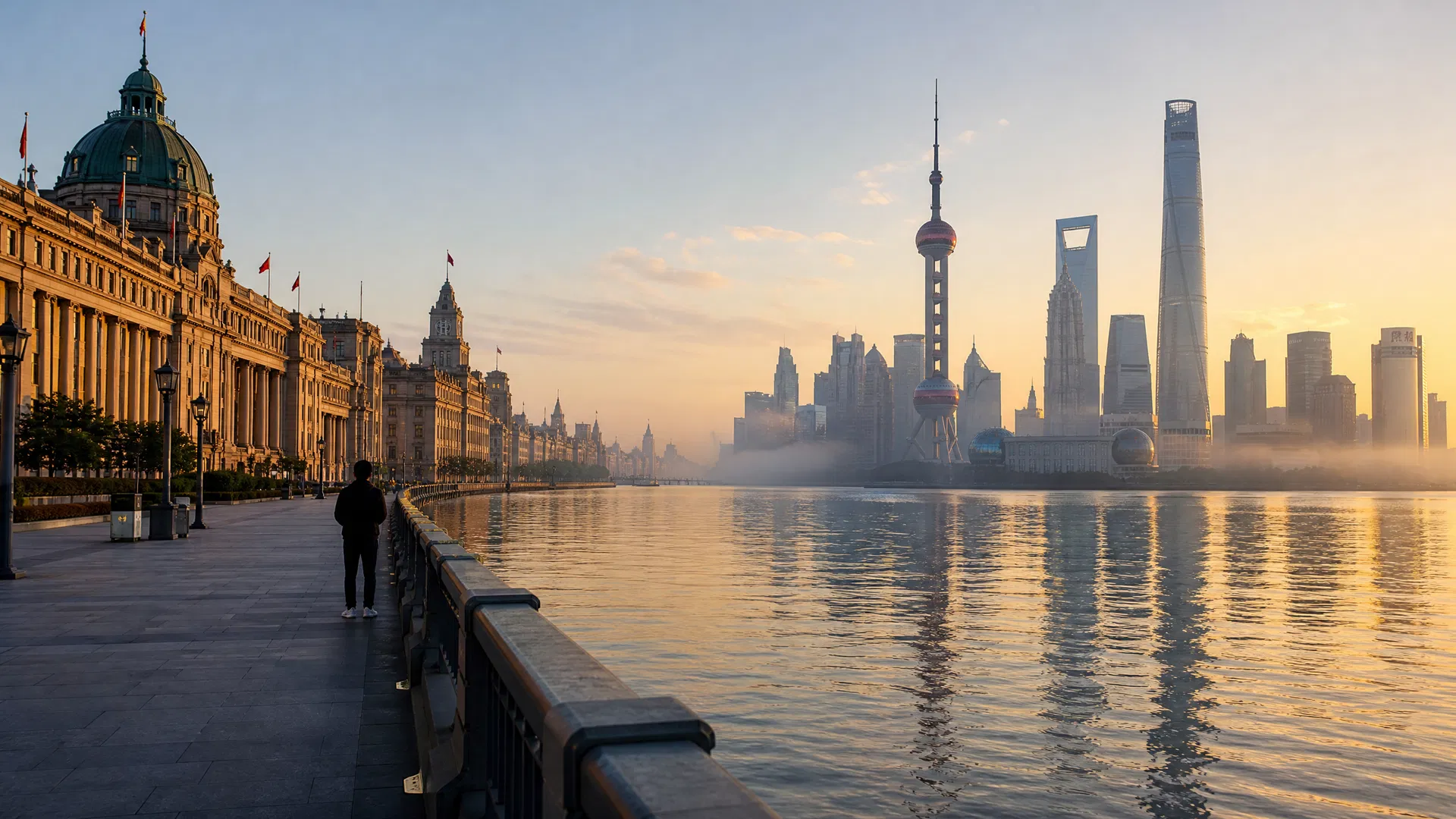
At six in the morning, before the tour groups arrive and before the selfie sticks come out, the Bund is briefly, impossibly, both things at once.
On your left: twenty-two neoclassical buildings in various states of grandeur, their stone facades the color of old bone in the early light. Corinthian columns, arched windows, copper domes gone green. They look like they belong in London or Paris or Vienna, and in a sense they do — they were designed by British architects, financed by British trading houses, and built to announce to the world that this stretch of the Huangpu River belonged, for the moment, to commerce.
On your right: Pudong. The Oriental Pearl Tower, the Shanghai Tower (the second-tallest building on earth), the Jin Mao Tower, the World Financial Center. Glass and steel reaching into the morning haze, a skyline that didn't exist in 1990 and that now defines the visual vocabulary of the twenty-first-century city. It looks like the future that every other city is still trying to build.
The river runs between them. And if you stand on the Bund at six in the morning and look at both banks simultaneously, you are looking at the whole argument of Shanghai in a single frame.
Most travel writing about Shanghai describes this view and calls it a contrast. It is not a contrast. It is a continuity. The neoclassical buildings and the glass towers are the same city at different moments in its development — a city that has always been built by whoever had the most money and the most ambition, regardless of where they came from or what they were selling.
What they were selling, in the beginning, was opium.
The Bund: What Paid for This
The word "bund" is not English. It comes from the Hindi and Urdu word for embankment — band — and it was introduced to Shanghai by the trading houses that set up operations along the Huangpu River in the 1840s following the First Opium War. The most prominent of those houses was Jardine, Matheson & Co., founded in Canton in 1832 by William Jardine and James Matheson, whose primary business was the importation of opium from British India into China.
Jardine Matheson is still in business. It is now a diversified conglomerate headquartered in Hong Kong with interests in retail, property, and infrastructure. Its original fortune was built on a trade that the Chinese government had banned, that the British government had gone to war to protect, and that would eventually addict an estimated 12 million Chinese people by the end of the nineteenth century.
The building at No. 27 on the Bund — the one with the distinctive green dome — was Jardine Matheson's headquarters. It is now a luxury retail complex.
Victor Sassoon, whose family name is on the Peace Hotel at No. 20 (the green-steepled building that anchors the northern end of the Bund), was a Baghdadi Jewish businessman from a family that had made its initial fortune in the opium trade between India and China before pivoting to real estate. Sassoon built the Cathay Hotel — now the Peace Hotel — in 1929, and it was for a time the most glamorous hotel in Asia. Noel Coward wrote Private Lives in a suite there in 1930. The green copper steeple is still the most recognizable silhouette on the Bund.
The building at No. 1 — originally the McBain Building, later the Asia Building — was built by another trading house. No. 3 was the Union Insurance Company of Canton. No. 6 was the Russell & Co. building, and Russell & Co. was, for much of the nineteenth century, the largest American trading house in China, whose primary business was also opium.
This is what the Bund is. It is a monument to one of the most profitable and most destructive commercial enterprises in human history, rendered in neoclassical stone and preserved by the Chinese government as a protected architectural heritage site. It is also genuinely, undeniably beautiful. Both of those things are true simultaneously, and the city of Shanghai has never pretended otherwise.
That is the first thing that makes Shanghai different from every other city you will visit.
The Shikumen: The Building That Exists Nowhere Else
Between 1842 and 1949 — the period from the First Opium War to the founding of the People's Republic — approximately seventy percent of all Shanghainese lived in a building type called the shikumen longtang. The phrase translates roughly as "stone gate alleyway," and the building it describes is a structure that exists nowhere else on earth.
The shikumen was invented because the concession-era city needed to house a rapidly growing population in a small area. The solution was to take the traditional Chinese courtyard house — a single-story structure organized around an open central courtyard — and compress it vertically using the structural logic of the Western townhouse. The result was a two- or three-story brick building with a small courtyard at the front, a stone arch at the entrance to the lane, and a density that allowed hundreds of families to live in a space that would have housed dozens in a traditional Chinese neighborhood.
The stone arch at the entrance to each lane is the shikumen — the stone gate — and it is the element that gives the building type its name. Walk through one of these arches and you step from the commercial street into a different world: narrower, quieter, with laundry strung between windows and the smell of cooking coming from open doors.
Most of these lanes have been demolished. The ones that remain have mostly been renovated — Xintiandi, in the former French Concession, is the most famous example, a shikumen complex that was gutted and rebuilt as an upscale shopping and dining district in the early 2000s. The brick walls are original. Everything inside them is not.
For the authentic version, walk to Jing'An Villa at 1025 Nanjing Xi Lu. It is still predominantly residential. Laundry still hangs between the upper windows above the cafes that have colonized the ground floor. The bohemian crowd that has moved in has not yet displaced the residents who have lived here for decades. This is what Xintiandi was before it was renovated.
For the version that has never been renovated at all, find Yuyangli at Lane 567, Huaihai Middle Road. It is a fully residential shikumen longtang with no commercial stores, protected as a national historical site. The stone arch at the entrance is original. The lanes inside are quiet. Nobody is selling anything. This is what seventy percent of Shanghai looked like for a hundred years.
The Shanghai 4-day itinerary covers the most accessible shikumen neighborhoods in detail — but the ones worth finding are the ones that don't appear on any itinerary.
The Jewish Refugees: The City That Said Yes
In 1938, following Kristallnacht, Jewish refugees from Germany and Austria began arriving in Shanghai. They came because Shanghai was one of the only ports in the world that did not require a visa for entry — a consequence of the city's unusual status as a place governed by multiple competing authorities, none of which had the bureaucratic coherence to enforce a unified immigration policy.
Between 1933 and 1941, approximately eighteen thousand to twenty thousand Jewish refugees from Europe settled in Shanghai, primarily in the Hongkew district (now Hongkou) north of Suzhou Creek. They established synagogues, newspapers, schools, and cafes. They created a community that was, by all accounts, remarkably self-sufficient and culturally alive, even as the conditions of their displacement were desperate.
The Ohel Moshe Synagogue, built in 1927 by Russian Jewish immigrants and used by the European refugees during the war years, is now the Shanghai Jewish Refugees Museum at 62 Changyang Road. It is one of the most quietly devastating museums in Asia — not because of what it shows, but because of what it implies. The city that was built on the opium trade became, in the 1930s and 1940s, the city that accepted people when no other city would.
This is the specific moral inversion that makes Shanghai unlike any other city. The same commercial pragmatism that allowed opium merchants to build their fortunes here — the refusal to ask too many questions about where the money came from or what it was doing — also meant that when Jewish refugees arrived with nothing, the city let them in. The Bund and the Ohel Moshe Synagogue are two miles apart. They are the same argument.
For context on China's other great imperial capital — the city that was built by emperors rather than merchants — the Beijing 5-day itinerary covers the Forbidden City, the Temple of Heaven, and the hutong alleyways that are Beijing's version of the shikumen longtang.
The Food: The Argument Across the Street
On Huanghe Road, a short walk from People's Park, two of the best dumpling institutions in Shanghai face each other across the street. The distance between them is approximately fifteen meters. The argument between them has been running for decades.
At No. 90: Jia Jia Tang Bao. The xiaolongbao — the soup dumpling — that most travel writing treats as Shanghai's defining food. Thin-skinned, gelatin-rich, pork-filled, served in bamboo steamers. The broth inside has sweetness from young ginger. The crab-and-pork version costs a premium and is, by most accounts, the best version in the city. The line starts before the doors open.
At No. 97: Yang's Fry-Dumpling (杨's生煎). The sheng jian bao — the fried soup dumpling — that is the actual local breakfast and that lives in the shadow of its more famous steamed counterpart. The dough is rolled with oil rather than flour, which gives it a different texture. The buns are three times the size of a xiaolongbao. They are cooked in large cast iron pans with just enough water to steam them through; as the water evaporates, the bottoms fry until golden and crisp. They are finished with a sprinkle of black sesame seeds and scallions. You order at the window, take your clamshell container, and eat standing outside, leaning over the gutter to catch the juice that runs down your chin when you bite through the fried bottom.
The xiaolongbao is what tourists come to Shanghai to eat. The sheng jian bao is what Shanghainese eat for breakfast. Both are extraordinary. The fact that they exist fifteen meters apart, in institutions that have been serving them for generations, is the food version of the Bund argument: two things that seem like they should be in competition are actually the same city at different registers.
Anfu Lu and the City That Keeps Becoming Itself
The French Concession is the part of Shanghai that every travel guide describes as "tree-lined" and "atmospheric," and it is both of those things, but the description misses what makes it interesting. The French Concession is interesting because it is the part of the city where the colonial infrastructure — the curved roads, the European-style apartment buildings, the plane trees planted by French administrators — has been colonized by a contemporary Shanghai culture that has no particular interest in the colonial history it is living inside.
Anfu Lu is the street that illustrates this most clearly. It became a destination without trying to — a concentration of cafes, independent shops, and the kind of people-watching that requires no particular agenda. The cafes have open-air seating. The plane trees provide shade. The fashion is extraordinary.
At the end of the road, next to the Brandy Melville that announced the street's arrival as a destination, is Deja Vu (多抓鱼) — a used bookstore on the ground floor and a vintage clothing store on the floor above. The English literature section is small but well-curated. The design and photography volumes are excellent. The building it occupies is a former shikumen structure. The bookstore does not mention this.
Two blocks east on Wukang Road, the Wukang Mansion — a 1924 French Renaissance apartment building designed by Hungarian architect László Hudec — has become the most photographed building in Shanghai. Hudec designed more than fifty buildings in Shanghai between 1918 and 1947, and the Wukang Mansion is the most recognizable of them: a curved, cream-colored building that occupies the triangular intersection of Wukang Road and Hunan Road, its ground floor now entirely occupied by cafes and boutiques. The building is a private residence. The people who live in the upper floors have watched their street become a destination and have, by all accounts, adapted.
The Communist Party of China was founded in the former French Concession, at Lane 76 Xingye Road, in July 1921. The building is now a museum. It is a ten-minute walk from Xintiandi and a five-minute walk from the best sheng jian bao in the city. The French Concession has always been the part of Shanghai where the most consequential things happen in the most ordinary-looking buildings, and that has not changed.
This is the contemporary Shanghai that has grown up alongside the opium merchants and the Jewish refugees and the revolutionary history. The city has never been interested in resolving its contradictions. It has always been more interested in getting on with things.
Practical Information
When to go: April through May and September through October are the best months — mild temperatures, lower humidity than the summer, and the plane trees in the French Concession at their most photogenic. July and August are hot, humid, and typhoon season. January and February are cold but the city is quieter.
Getting around: The Shanghai Metro is one of the best urban transit systems in the world — clean, fast, inexpensive, and with English signage throughout. A single journey costs 3-10 RMB depending on distance. The Metro connects all major neighborhoods and both airports. Taxis are inexpensive but require either a Chinese phone number for the Didi app or a willingness to negotiate with drivers who may not speak English.
Payments: Cash is increasingly difficult to use in Shanghai. Alipay and WeChat Pay are the dominant payment systems, and many vendors — including street food stalls — do not accept cash. International visitors can now add foreign credit cards to Alipay, which is the most practical solution.
Day trips: Suzhou is 30 minutes from Shanghai by high-speed rail and contains some of the finest classical Chinese gardens in existence — the Humble Administrator's Garden and the Master of the Nets Garden in particular. Wuzhen is a preserved ancient water town approximately two hours from Shanghai; the morning mist over the canals and the lights reflected in the water at sunset are among the most beautiful things in the Jiangnan region.
Where to stay: The Former French Concession (Xuhui and Jing'An districts) puts you within walking distance of Anfu Lu, the shikumen longtangs, and the best food. The Bund area is convenient for the waterfront but more expensive and more tourist-oriented.
For a structured four-day plan covering the Bund, the French Concession, Pudong, and the best food stops, the Shanghai city and culture guide provides a day-by-day framework. For the broader China context — the country's other great historical cities — the Xi'an terracotta warriors guide, the Beijing culture and history itinerary, and the Chengdu pandas and food guide cover the destinations most commonly combined with Shanghai. For those continuing south, the Hong Kong 4-day itinerary and the Hong Kong food guide cover the city that is, in some ways, Shanghai's closest cultural counterpart.
The City That Never Resolved Its Contradictions
There is a version of Shanghai's history that tries to resolve its contradictions — that frames the opium trade as a historical injustice that has been overcome, or that frames the Jewish refugee community as evidence of the city's essential generosity, or that frames the Communist Party's founding in the French Concession as the moment when Shanghai's colonial history was finally corrected.
None of these framings are wrong, exactly. But none of them are Shanghai, either.
Shanghai is the city that built the most beautiful architecture in China with money from the most destructive trade in modern history. It is the city that accepted refugees when no other city would, not because of a principled commitment to human rights but because it was too commercially pragmatic to turn away anyone who might contribute to the economy. It is the city that was renamed, reorganized, and ideologically transformed in 1949 and that spent the next forty years being one of the most politically constrained cities in China — and that then, in 1990, began building Pudong from scratch and became, within a generation, the financial capital of the world's second-largest economy.
The Iron Pillar in Delhi has stood through five civilizations and remained itself. Shanghai has been through five civilizations and remained itself by becoming each of them in turn.
Stand on the Bund at six in the morning, before the tourists arrive. Look left at the buildings that opium paid for. Look right at the towers that ambition built. The river runs between them. The city is both banks simultaneously.
That is not a contrast. That is the whole argument.
Shanghai does not ask you to make peace with its history. It asks you to stand in it, look at both banks simultaneously, and understand that the city you are visiting was built by people who were not, for the most part, trying to build something beautiful or something just or something lasting. They were trying to make money. The beauty and the injustice and the longevity are all consequences of that ambition, and they are all still present, and they are all, in the end, the same city.
That is what makes Shanghai the most interesting city in Asia. Not the skyline. Not the food. Not the architecture. The fact that it has never pretended to be anything other than what it is.
Planning a trip to Shanghai? The Shanghai 4-day city and culture itinerary covers the Bund, the French Concession, Pudong, and the best food stops with a day-by-day framework. For the broader China circuit, combine with Xi'an, Beijing, and Chengdu — or continue south to Hong Kong.