Eat Your Way Through Osaka: Japan's Greatest Food City Has No Equal
Destination: Osaka, Japan
Category: Destination Guides
Every traveler who has spent real time in Japan has an opinion about Osaka, and the opinion is almost always the same: it's the one they didn't expect to love most. They came for Tokyo's scale and Kyoto's temples, and somewhere between a plate of takoyaki at a Dotonbori street stall and a conversation with a stranger in a standing bar who insisted on buying them a second round of sake, they realized that Osaka had done something the other cities hadn't. It had made them feel welcome. Not politely tolerated. Not efficiently processed through a world-class tourist infrastructure. Actually, genuinely, warmly welcome — in the way that a city can only manage when its people have decided that life is too short for unnecessary formality.
Osaka is Japan's third-largest city and its most misunderstood. The travel industry has spent decades positioning it as a day trip from Kyoto or a cheaper alternative to Tokyo, which is like describing New Orleans as a day trip from Baton Rouge. Osaka is not an alternative to anywhere. It is its own thing entirely — a city with a 1,500-year history as Japan's commercial and culinary capital, a dialect that sounds like the country's id speaking out loud, a comedy tradition that produced Japan's most beloved entertainers, and a food culture so serious that the city's unofficial motto is kuidaore: eat until you drop. Osaka doesn't need to be compared to Tokyo to be understood. It needs to be eaten.
The city was a strategic trading port for over a millennium before Tokyo was anything more than a swamp. Osaka Castle was completed in 1597 — nearly a century before Edo (modern Tokyo) became Japan's political center. The merchants who built their fortunes along the Dotonbori canal developed a culture of hospitality and pleasure-seeking that was the direct opposite of the samurai austerity that defined the capital. Where Tokyo learned to be restrained, Osaka learned to be generous. Where Tokyo perfected the art of the formal greeting, Osaka perfected the art of the meal. The difference is still visible today in everything from how strangers interact on the street to how much food arrives at your table when you order one dish.
The Kansai region — the area around Osaka, Kyoto, and Kobe — is the birthplace of Japanese cuisine as the world knows it. Soy sauce in its modern form was developed here. Dashi, the fundamental broth that underlies almost all Japanese cooking, was refined here. The instant noodle was invented in Osaka in 1958 by Momofuku Ando, who is celebrated in the city with a museum dedicated to his contribution to humanity. Takoyaki — the octopus balls that have become one of Japan's most iconic street foods — was invented in Osaka in 1935. Okonomiyaki, the savory pancake that is essentially a meal in itself, has its Osaka variation (mixed together, not layered like the Hiroshima version) that locals will defend with the passion of a constitutional argument. The Kansai style of cooking — lighter broths, more delicate seasoning, an emphasis on the natural flavor of ingredients — is the foundation on which the entire edifice of Japanese cuisine was built. To eat in Osaka is to eat at the source.
Dotonbori: The Neon Heart of the City
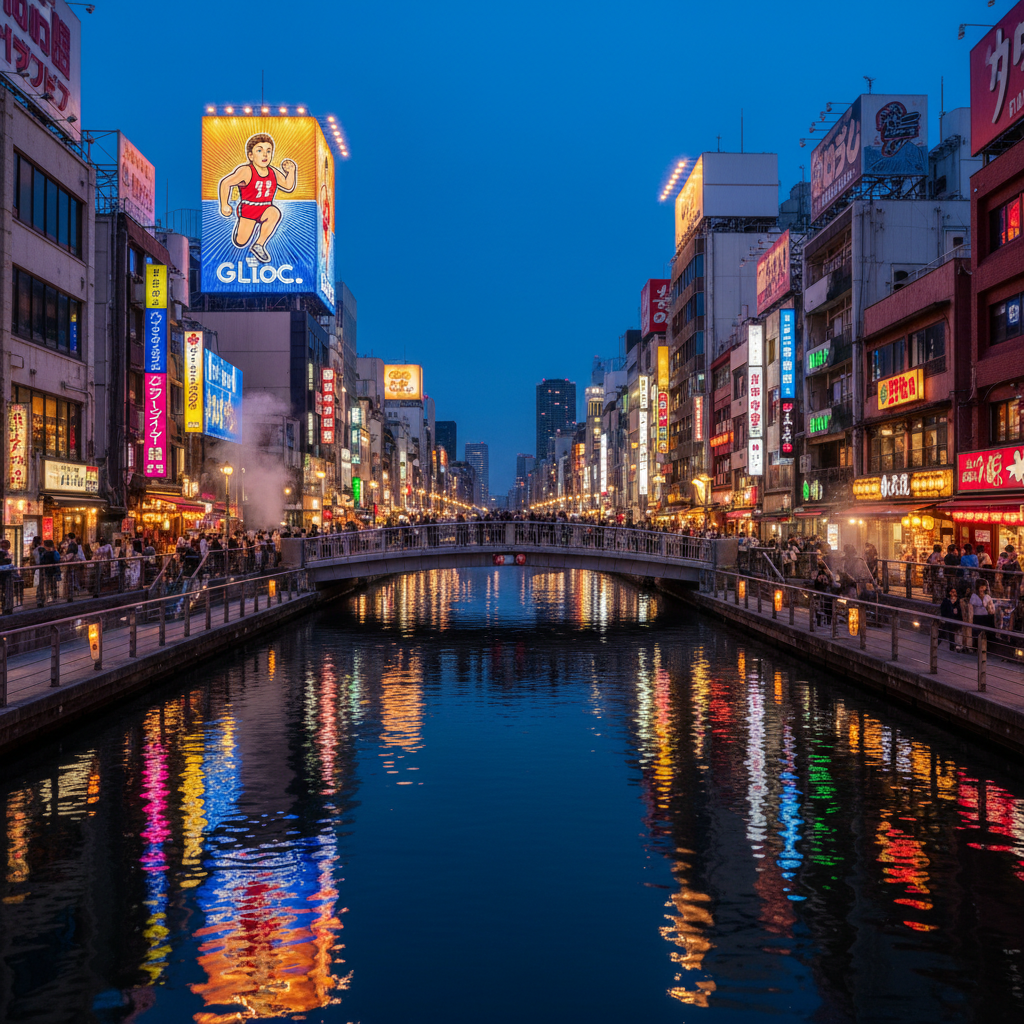
There is no more electrically alive stretch of urban real estate in Japan than the Dotonbori canal district at night. The neon signs — the giant mechanical crab of Kani Doraku, the running man of Glico, the dragon of Kinryu Ramen — reflect off the canal water in a riot of color that makes Times Square look tasteful. The covered shopping arcade of Shinsaibashi-suji runs perpendicular, a kilometer of shops that has been selling everything from silk kimonos to the latest streetwear since the Edo period. The narrow alleys behind the main drag — Hozenji Yokocho, with its moss-covered stone lanterns and tiny restaurants that seat eight people — feel like they exist in a different century entirely.
Dotonbori is where you eat. The takoyaki vendors operate with the focused intensity of surgeons, filling the round molds with batter, placing a piece of octopus in each, and flipping them with metal picks in a motion so practiced it looks choreographed. The okonomiyaki restaurants let you cook your own on the griddle built into the table, or they'll cook it for you if you're not confident — either way, the result is a savory, eggy, sauce-drenched pancake topped with bonito flakes that wave in the heat like they're alive. The ramen shops along the canal have lines that form before they open. The kushikatsu restaurants in the Shinsekai neighborhood to the south have a rule posted on the wall in multiple languages: no double-dipping in the communal sauce. This rule is enforced with the seriousness of a municipal ordinance.
The best way to experience Dotonbori is to arrive in the late afternoon, when the light is still good enough to see the architecture, and stay until midnight, when the neon is at full intensity and the streets are at their most alive. Walk the canal. Eat at every stall that has a line. Get lost in the covered arcades. Find Hozenji Yokocho and stand in front of the moss-covered Fudo Myoo statue that locals splash with water for good luck, and watch the city move around you. Dotonbori is not a tourist attraction. It's the city's living room, and you're invited in.
Shinsekai: The Neighborhood That Time Forgot (and Then Remembered)
Shinsekai — "New World" — was built in 1912 as Osaka's vision of a cosmopolitan future, modeled on Paris in the north and Coney Island in the south. The Paris part didn't survive the war. The Coney Island part evolved into something stranger and more interesting: a neighborhood of pachinko parlors, retro restaurants, and kushikatsu shops that became the spiritual home of Osaka's working-class culture. For decades it was considered rough, unfashionable, the part of the city that the tourist guides skipped. Then the tourists started coming precisely because it was rough and unfashionable, and now it occupies that sweet spot of being genuinely old and genuinely itself while also being genuinely welcoming.
The Tsutenkaku Tower, Shinsekai's 103-meter landmark, was built in 1956 as a replacement for the original 1912 version destroyed in the war. It's not the most impressive tower in Japan, but it has a quality that Osaka's more famous landmarks sometimes lack: character. The neighborhood around it is where you eat kushikatsu — breaded and deep-fried skewers of everything from beef and pork to asparagus, cheese, and quail eggs — at restaurants that have been doing this for 80 years and have no plans to change. The sauce is sweet and savory and the rule about not double-dipping is, again, serious. Order a beer. Order more skewers. Watch the neighborhood go about its business. Shinsekai is the Osaka that existed before anyone decided it needed to be curated.
Osaka Castle and the City's Samurai Past
Osaka Castle was built by Toyotomi Hideyoshi, the warlord who unified Japan in the late 16th century, as a monument to his power and a statement of Osaka's centrality to the nation. The original castle was destroyed and rebuilt multiple times — the current main tower dates from 1931, with a modern interior that houses a museum of the castle's history — but the stone walls and moats that surround it are original, and they are extraordinary. The massive stone blocks, some weighing hundreds of tons, were transported from quarries across Japan and assembled without mortar into walls that have survived earthquakes, wars, and four centuries of Osaka weather.
The castle park that surrounds it is one of the great urban parks in Japan — 106 hectares of gardens, plum groves, and open space that fills with cherry blossom viewers in spring and firefly watchers in summer. The view from the castle tower's eighth floor observation deck takes in the entire city, with the Ikoma Mountains to the east and Osaka Bay to the west, and gives you a sense of the scale of what Hideyoshi was trying to build. The museum inside is genuinely excellent, with artifacts from the castle's history and a recreation of Hideyoshi's golden tea room that makes the man's personality vividly clear: he had extraordinary taste and absolutely no sense of restraint.
The Day Trips That Make Osaka the Perfect Base
One of Osaka's most underappreciated qualities is its position at the center of the Kansai region, which means that some of Japan's most extraordinary destinations are within 30 minutes by train. Kyoto is 15 minutes away by Shinkansen (or 30 minutes by the cheaper Hankyu line), and the combination of Osaka's energy and Kyoto's temples makes for a trip that covers more of Japan's essential character than almost any other itinerary. Nara, with its 1,200 deer that roam freely through the park around the Todai-ji temple complex, is 45 minutes away. Kobe, with its harbor, its Chinatown, and its beef — the real Kobe beef, from cattle raised in Hyogo Prefecture and served in restaurants that have been doing this for generations — is 30 minutes away. Hiroshima is 90 minutes by Shinkansen, and the Peace Memorial Museum is one of the most important experiences available to any traveler in Japan.
This positioning means that Osaka works as a base for the entire Kansai region in a way that Kyoto, for all its beauty, doesn't quite manage. Kyoto is extraordinary but it closes early, its accommodation is expensive, and its restaurant scene — while excellent — is more formal and more expensive than Osaka's. Osaka stays open. Osaka is affordable. Osaka has standing bars that serve excellent sake for ¥300 a glass and izakayas where the food is better than restaurants that cost three times as much. Use Osaka as your base. Take the trains to Kyoto and Nara and Kobe. Come back to Osaka for dinner. This is the correct way to experience the Kansai region.
Osaka's Comedy Soul: Manzai and the Art of Being Funny
Osaka is the birthplace of manzai, the rapid-fire two-person comedy format that has been Japan's dominant form of stand-up comedy for over a thousand years. The form — one straight man, one fool, trading jokes at machine-gun speed in thick Osaka dialect — is so embedded in the city's culture that Osaka-ben (the Osaka dialect) is considered inherently funnier than standard Japanese. Osaka people are known throughout Japan for their directness, their willingness to make strangers laugh, and their deeply held belief that a good meal and a good joke are the two most important things a person can offer another person.
This manifests in ways that travelers notice immediately. The taxi drivers who do comedy routines for their passengers. The market vendors who turn the sales pitch into performance art. The strangers in bars who will argue with you about the best takoyaki in the city with the passion of a sports fan and the knowledge of a food critic. Osaka people are not performing warmth for tourists. They are simply, constitutionally, the way they are — and the way they are is more fun than almost anywhere else in Japan.
The Food Deep Dive: Beyond Takoyaki
The night market food is the entry point, but Osaka's food culture goes much deeper. The city has its own ramen style — lighter and cleaner than Sapporo's miso-heavy version or Fukuoka's tonkotsu — and its own take on sushi: oshizushi, pressed sushi made in wooden molds, which predates the hand-rolled nigiri style that most of the world thinks of as "sushi" by several centuries. The kappo restaurants of Kitashinchi — counter-style omakase dining where the chef cooks in front of you and the menu is whatever is best that day — represent some of the finest dining in Japan at prices that are significantly lower than equivalent experiences in Tokyo.
The Kuromon Ichiba market, known as "Osaka's Kitchen," has been supplying the city's restaurants and home cooks for nearly 200 years. The 170 stalls sell everything from live seafood to Wagyu beef to the pickled vegetables and dried goods that form the backbone of Osaka cooking. It's also one of the best places in the city to eat — the vendors sell prepared food alongside raw ingredients, and a walk through the market at lunchtime involves being offered samples of grilled scallops, fresh oysters, and marbled beef skewers by vendors who know that the best advertisement is the food itself.
Planning Your Osaka Trip
Osaka's climate is similar to Tokyo's but slightly warmer and more humid. Spring (March–May) is the best time to visit, with cherry blossoms in the castle park and comfortable temperatures. Autumn (October–November) is equally excellent, with the maple leaves turning in the parks and the food culture at its most active. Summer is hot and humid but the city's festival calendar is packed — the Tenjin Matsuri in late July is one of Japan's three great festivals, with boat processions on the river and fireworks over the castle. Winter is cold but manageable, and the city's indoor food culture means you'll spend most of your time warm and eating anyway.
The Osaka Amazing Pass covers unlimited rides on the subway and entry to 40 attractions, including Osaka Castle, the Umeda Sky Building observation deck, and the Osaka Museum of History. It pays for itself within a single day of active sightseeing. The subway system is comprehensive and easy to navigate; the IC card (ICOCA) works on all trains and buses throughout the Kansai region, making day trips seamless.
Budget travelers will find Osaka one of the most affordable major cities in Japan — a full day of eating at market stalls, izakayas, and standing bars can be done for ¥3,000–4,000 (roughly $20–27 USD). Mid-range travelers spending ¥8,000–12,000 per day will eat at excellent restaurants, visit the major attractions, and have money left for the standing sake bars that are one of the city's great pleasures.
The Osaka Itinerary Guides
We've built a complete set of Osaka itinerary guides to help you plan every kind of trip — whether you're coming for the food, the history, the day trips, or all three.
For first-time visitors and food lovers, our Osaka Food Lover's Guide: 4 Days of Takoyaki, Kushikatsu & Kansai Cuisine maps out the city's food geography from the morning fish market to the late-night standing bars, with specific recommendations for the dishes and vendors that represent Osaka's culinary identity at its best.
Solo travelers will find Osaka one of the most welcoming cities in Japan for independent exploration. Our Solo in Osaka: 4 Days of Street Food, Standing Bars & Spontaneous Conversations covers the solo-friendly izakayas, the standing ramen bars where you'll inevitably end up talking to your neighbors, and the day trip circuit that works perfectly without a group.
For families, our Osaka with Kids: 4-Day Family Itinerary covers Universal Studios Japan, the Osaka Aquarium Kaiyukan (one of the largest in the world), Osaka Castle, and the street food circuit that works for all ages.
Budget-conscious travelers should start with our Osaka on a Budget: 4-Day Itinerary, which proves that Japan's most affordable major city can be done extraordinarily well without spending like a tourist.
For those who want to combine Osaka with the broader Kansai region, our 5 Days in Osaka: Food, Culture & the Kansai Kitchen and the 7-Day Osaka & Kyoto Combo Guide use Osaka as the hub for day trips to Kyoto, Nara, and Kobe while keeping the evenings in Osaka where they belong.
Why Osaka Wins
There's a running argument among Japan travelers about which city is "better" — Tokyo or Osaka — that misses the point entirely. Tokyo is one of the greatest cities on earth. Osaka is one of the most lovable. These are different things, and both can be true simultaneously. Tokyo will make you feel like you're at the center of the world. Osaka will make you feel like you're at the center of a very good meal, surrounded by people who are genuinely glad you're there.
The travelers who love Osaka most are the ones who came expecting a consolation prize and left understanding that they'd found the real thing. The city that invented the philosophy of eating until you drop. The city where strangers in bars will argue passionately about the correct way to make dashi and then buy you a drink to prove there are no hard feelings. The city where the castle was built a century before Tokyo was relevant, and the food culture was established a millennium before anyone started writing restaurant reviews.
Osaka doesn't apologize for being the best city in Japan. It's too busy cooking dinner.