Bombay Was Renamed Mumbai in 1995. The City Didn't Notice.
Destination: Mumbai
Category: Destination
The Name That Has Never Settled
The Bombay/Mumbai tension is not a simple colonial-name-versus-indigenous-name argument, though that is how it is usually framed. It is more specific and more interesting than that. The name "Bombay" itself is not English — it is a Portuguese corruption of "Bom Bahia," meaning Good Bay, which the Portuguese applied when they arrived in 1534 and found a natural harbor that would eventually become the most commercially productive port in Asia. The name "Mumbai" derives from Mumbadevi, the Koli goddess, which makes it older than the Portuguese, older than the British, older than the city that was built on land reclaimed from the sea between the seven original islands.
So the rename in 1995 was not a restoration of an indigenous name over a colonial one. It was the replacement of one foreign name with a different, older, more local name — and the city's residents, depending on their age, language, and politics, use both with complete fluency and no apparent contradiction. Older residents and the English-speaking middle class say Bombay in casual conversation. Official documents say Mumbai. Restaurant menus say Mumbai in the header and Bombay in the description of the dish. The Irani cafe on Sprott Road that has been serving bun maska since 1923 still has "Britannia & Co., Bombay" painted on its facade, and no one has suggested changing it, because the cafe has outlasted every government that has had an opinion about what the city should be called.
The airport code is BOM. That is the only name that the international aviation system, which does not have opinions about politics, has assigned to this city. When you book a flight to Mumbai, your boarding pass says BOM. When your luggage arrives at the carousel, the tag says BOM. The city's identity, in the language of global logistics, is still Bombay.
Dharavi: The Economy That Runs on 15 Square Meters
Every Mumbai travel guide mentions Dharavi. Most of them describe it as Asia's largest slum and suggest a tour. That framing is both accurate and almost entirely wrong about what Dharavi actually is.
Dharavi is a 2.1 square kilometer neighborhood in the center of Mumbai that houses approximately one million people and generates an estimated $1 billion in annual economic output. That is not a typo. One billion dollars, from 2.1 square kilometers, from workshops that average 15 square meters in floor space. The economic density of Dharavi — output per unit of land area — is among the highest of any urban neighborhood on earth.
The specific engine of this economy is recycling. Dharavi processes approximately 60 percent of Mumbai's plastic waste. The recycling supply chain that runs through its lanes is not informal — it is a sophisticated multi-tier system with collectors, sorters, processors, and manufacturers, each operating in specialized workshops that have been refining their processes for decades. Plastic arrives in Dharavi as waste and leaves as pellets, which are sold to manufacturers across India and exported to markets in Southeast Asia and the Middle East. The workshops that do this work are small, hot, and extraordinarily efficient.
The recycling economy is one layer. The other layers include leather goods (Dharavi has a leather district that exports to Europe and the United States), pottery (the Kumbharwada district, where Gujarati potters have been working since the 1930s, produces clay pots that are sold across Mumbai), embroidery and garment work (the workshops that do finishing work for Mumbai's fashion industry are here), and food production (the bakeries in Dharavi produce bread and biscuits sold across the city).
The argument that every other Mumbai travel post misses is this: Dharavi is not a story about poverty. It is a story about what happens when a city's most entrepreneurial people are given no access to capital, no access to formal real estate, and no access to the institutional infrastructure that other businesses take for granted — and build a billion-dollar economy anyway. The 15-square-meter workshop is not a constraint that limits ambition. It is the unit of production that the ambition has adapted to.
The Mumbai 4-day itinerary includes a responsible visit to Dharavi through Reality Tours, which was founded in 2006 with a commitment to return 80 percent of tour profits to community development projects within Dharavi itself. The tour does not enter homes. It walks through the industrial districts, the recycling lanes, the pottery quarter. It is, deliberately, a tour of the economy, not the living conditions.
The Lunch System That Has No App
At 10:30am every weekday morning, approximately 5,000 men in white kurtas and Gandhi caps begin collecting tiffin boxes from homes across Mumbai's suburbs. By 12:30pm, those tiffin boxes — containing home-cooked lunches prepared by wives, mothers, and domestic workers — will have been delivered to offices in the city's commercial districts. By 2:30pm, the empty boxes will be on their way back. The entire operation involves no GPS, no smartphones, no real-time tracking software, and no centralized logistics platform. It runs on a color-coded system of symbols painted on the lid of each tiffin box that encodes the pickup location, the delivery building, the floor number, and the return address.
The dabbawalas — the name means "one who carries a box" — have been operating this system since 1890, when Mahadeo Havaji Bachche started the service for British colonial officers who wanted home-cooked Indian food delivered to their offices. The system has survived independence, partition, the 1995 rename, two World Wars, the 1993 Bombay bombings, the 2008 Mumbai attacks, and the COVID-19 pandemic (during which the dabbawalas pivoted to delivering essential goods and medicines). It has never been disrupted by a software update.
In 2010, a Harvard Business School study certified the dabbawala system at Six Sigma accuracy — fewer than 3.4 errors per million deliveries. FedEx has studied it. Prince Charles visited in 2003 and was reportedly impressed enough to invite the dabbawalas to his wedding. The system handles 200,000 lunches per day. The average dabbawala earns approximately ₹8,000 to ₹12,000 per month and is a shareholder in the cooperative that runs the operation.
The dabbawalas are not a heritage attraction. They are a functioning logistics network that processes more daily transactions than many mid-sized courier companies. They are also, in the specific way that Mumbai has of making things work through human ingenuity rather than institutional infrastructure, a perfect illustration of the city's character. The system was invented in Bombay. It operates in Mumbai. It answers to neither name. It answers to the tiffin box.
The Cafes That Outlasted Every Government
Kyani & Co. has been at the corner of Jer Mahal Estate, near Dhobi Talao, since 1904. The founders were Khodadad and Khodamorad Shokriye, brothers from Iran who were part of the Zoroastrian community that fled Persia to escape religious persecution and settled first in Gujarat, then in Bombay. The Irani community — Zoroastrian immigrants from Iran, distinct from the older Parsi community that had arrived centuries earlier — opened cafes across Bombay in the late 19th and early 20th centuries, and those cafes became the city's first genuinely democratic public spaces. Anyone could sit. Anyone could order. The bun maska — a soft white bun split and spread with an amount of butter that would concern a cardiologist — cost the same regardless of who was eating it.
Kyani & Co. is now 122 years old. The current proprietor, Farokh Shokriye, is the fourth generation of the family to run it. The menu has not changed in living memory. The marble-topped tables have not changed. The bentwood chairs have not changed. The glass display case with the mawa cake and the shrewsbury biscuits has not changed. The price of a bun maska and chai has changed, but not by much. The cafe opens at 6:30am and closes at 9pm, and in those hours it serves construction workers, lawyers, film directors, students, and tourists, all of whom receive the same bun maska and the same slightly impatient service.
Britannia & Co., in Ballard Estate, is the other essential Irani cafe. It was opened in 1923 by Rashid Kohinoor, and was run until his death in 2022 at the age of 97 by his son Boman Kohinoor, who became as famous as the cafe itself. Boman Kohinoor was known for two things: his berry pulao — a rice dish made with Iranian barberries, not Indian berries, that he sourced from Iran and that has no equivalent anywhere else in Mumbai — and his habit of proposing to Queen Elizabeth II in every interview he gave. He proposed approximately thirty times over sixty years. She never responded. He never stopped. The cafe still serves the berry pulao. It is still made with Iranian barberries. It is still the best argument for eating lunch in Ballard Estate that exists.
The Mumbai couples guide includes both Kyani & Co. and Britannia & Co. as essential stops, because the Irani cafe experience — the specific combination of democratic seating, unchanged menus, and the feeling of sitting in a room that has absorbed a century of the city's conversations — is one of the things that Mumbai does that no other city does in quite the same way.
Marine Drive at 5am
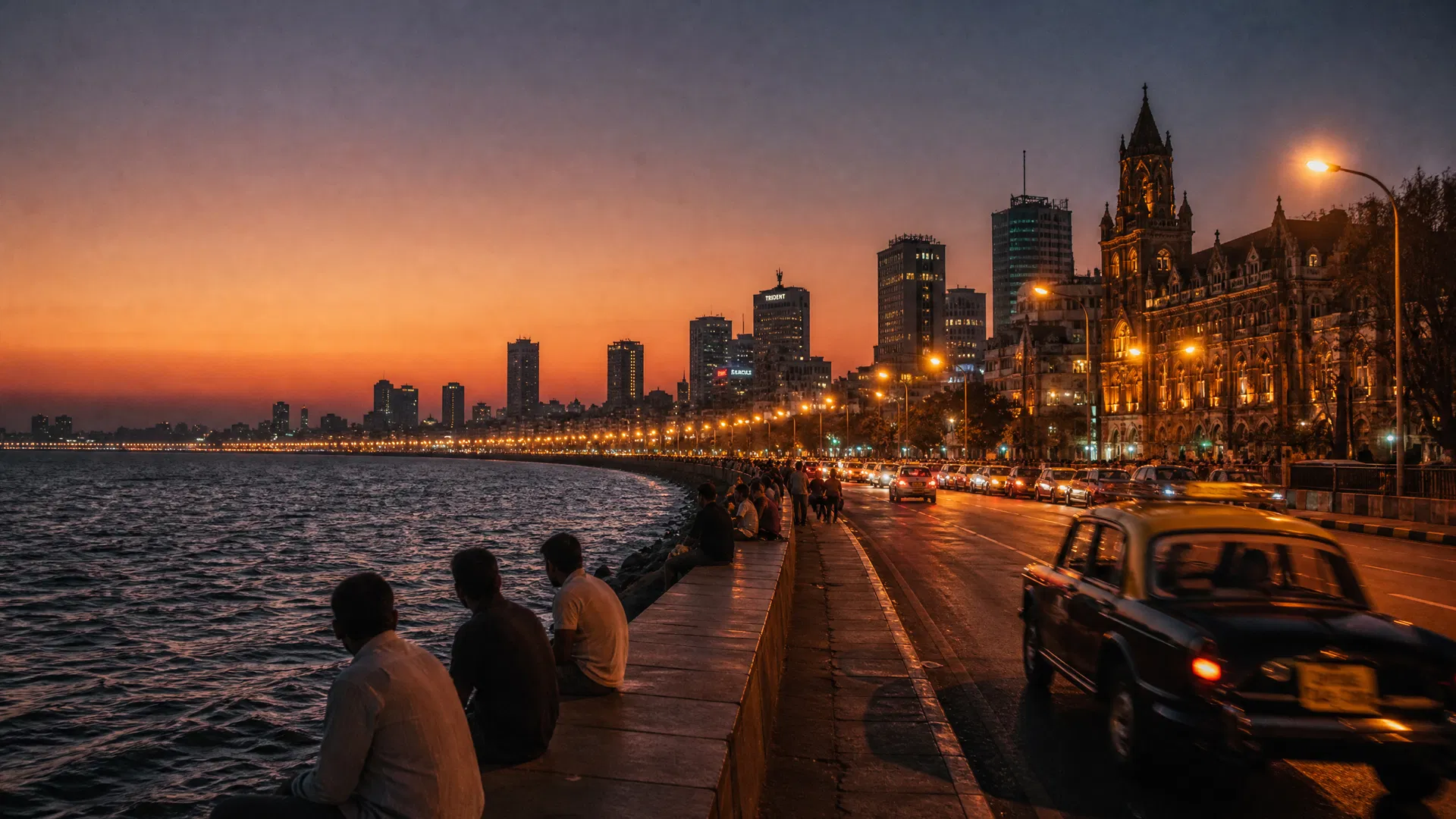
The Queen's Necklace is what the British called Marine Drive, because at night the streetlights along the 3.6-kilometer arc of reclaimed seafront look, from the hills above, like a string of pearls. The name has stuck the way all the British names have stuck in Mumbai — not because anyone is particularly attached to the colonial association, but because the city is too busy to rename everything, and the name is accurate, and accuracy is what Mumbai respects.
At 5am, Marine Drive is the city's breathing room. The sea wall is populated by people who have come to be alone in a city of 12.5 million, which is a specific kind of aloneness that only very large cities can provide — the aloneness of being surrounded by people who are also alone, who have also come to watch the Arabian Sea in the dark before the city starts again. There are walkers and runners and people sitting on the sea wall with their feet dangling over the water. There are fishermen. There are couples. There are people who have been awake all night and are watching the sunrise as a form of punctuation.
The specific quality of Marine Drive at 5am is that it is the only moment in Mumbai when the city's pace drops to something close to stillness. By 7am it will be busy. By 9am it will be loud. But at 5am, with the sea breeze coming in from the Arabian Sea and the city's skyline going from black to grey to orange behind you, Marine Drive is the city at its most honest — not performing, not producing, not becoming. Just being.
This is the experience that no travel guide can manufacture and no itinerary can guarantee. It requires only getting up early enough and walking to the sea wall before the city remembers what it is.
Crawford Market and the Friezes That Rudyard Kipling's Father Made
Crawford Market — officially Mahatma Jyotirao Phule Market since 1999, though no one calls it that — was designed by William Emerson and opened in 1869. The stone friezes above the main entrance, depicting Indian agricultural life, were designed by Lockwood Kipling: the father of Rudyard, who was born in Bombay in 1865 and spent his first six years here before being sent to England for his education. The friezes are still there. The market is still there. The name change in 1999 did not take, in the way that name changes in Mumbai tend not to take.
Crawford Market is a covered Victorian market selling fruits, vegetables, meat, poultry, and dry goods. It is not a tourist market. It is the wholesale and retail market that supplies a significant portion of South Mumbai's food supply, and it operates with the specific efficiency of a place that has been doing the same thing for 155 years. The spice section alone — sacks of turmeric, coriander, cumin, dried chilies, cardamom, and a dozen varieties of rice — is worth the visit as a sensory experience that no spice shop in any other context can replicate.
The specific competitive gap detail: the friezes above the entrance are among the finest examples of Victorian-era Indian architectural sculpture in the city, and they are almost never mentioned in travel content about Crawford Market, which focuses on the produce and the chaos and misses the fact that the building itself is a collaboration between a British architect and the father of the writer who would go on to write The Jungle Book, which was set not in India's jungles but in the specific imagination of a man who spent his first years in Bombay and never fully left it.
When to Go, How to Move, Where to Stay
When to go: November through February is the canonical answer, and it is correct. The monsoon (June through September) is dramatic and beautiful and also genuinely difficult — the flooding that accompanies heavy rainfall can make entire neighborhoods impassable, and the humidity is total. October and March are shoulder months: warmer and wetter than the ideal window, but manageable. November through February offers temperatures between 18°C and 32°C, low humidity, and the specific quality of light that makes Mumbai's Victorian Gothic architecture look exactly as it was designed to look.
How to move: The Mumbai local train is the correct answer for almost every journey. The network covers the city's north-south axis comprehensively, runs from approximately 4am to 1am, and costs between ₹10 and ₹50 for most journeys. The Ladies' Compartment — the first compartment of every train, reserved for women — has existed since 1891 and is one of the city's most important social institutions. For east-west journeys and shorter distances, the black-and-yellow taxis (metered, reliable, and an experience in themselves) and auto-rickshaws (available north of Bandra) are the practical options. The Metro is expanding and useful for specific corridors. Avoid driving.
Where to stay: South Mumbai (Colaba, Fort, Marine Drive) for proximity to the Victorian Gothic district, Crawford Market, and the Irani cafes. Bandra West for proximity to the restaurant and cafe culture that has made it Mumbai's most visited neighborhood. Lower Parel for the converted mill district, which contains some of the city's best restaurants and the Phoenix Mills shopping complex. Each area is a different city.
Planning Your Mumbai Trip
Mumbai is most naturally a gateway to the rest of India. The city's international airport connects directly to every major Indian destination, and the train network — the long-distance trains, not the local — connects Mumbai to Goa (8 hours south), Rajasthan (12-16 hours north), and the rest of the subcontinent.
For the city itself, four days is the minimum for a meaningful visit. Two days in South Mumbai — the Victorian Gothic district, Crawford Market, the Irani cafes, Marine Drive — and two days in the northern neighborhoods — Dharavi, Bandra, Versova — gives a city that is not a single place but a collection of cities that happen to share a coastline.
The Mumbai 4-day guide covers the essential South Mumbai circuit in detail. For travelers continuing south, the Goa 5-day couples guide is the natural next stop — eight hours by overnight train, a completely different pace. For travelers heading north and east, the Rajasthan Golden Triangle — Jaipur, Agra, Delhi — is the canonical India itinerary, and Mumbai is its western entry point. For travelers seeking the spiritual counterpoint to Mumbai's commercial intensity, Varanasi is the argument: the oldest continuously inhabited city in the world, on the Ganges, where the relationship between life and death is conducted in public in a way that no other city on earth manages. And for travelers who want to end a Mumbai trip in complete contrast, the Kerala backwaters — houseboat, coconut palms, the specific silence of the backwater canals — is the decompression that Mumbai makes necessary.
What the City Does to People Who Stay
There is a specific thing that happens to people who live in Mumbai for long enough. They stop being from wherever they were from and start being from Mumbai. Not Mumbaikars in the official sense — not Maharashtrian, not Marathi-speaking, not born here. Mumbaikars in the sense that the city has processed them through its particular combination of density, ambition, shared suffering, and democratic indifference, and what has come out the other side is someone who moves differently, thinks differently, and has a specific tolerance for chaos that people from other cities find either admirable or alarming.
The Reddit comment that captures this most precisely was written by someone who grew up in Goa and moved to Mumbai: "The city traumatises everyone but the richest so we all band together and look out for each other like siblings with shit parents." This is not a complaint. It is an explanation of why Mumbai produces the specific kind of solidarity that it does — not the solidarity of shared identity, but the solidarity of shared difficulty, which is the more durable kind.
Bombay was renamed Mumbai in 1995. The airport code is still BOM. The train station everyone calls VT is officially named after a Maratha king. The Irani cafe in Ballard Estate still has "Bombay" on its sign and still serves the berry pulao with Iranian barberries and still has the photograph of Boman Kohinoor on the wall, the man who proposed to Queen Elizabeth II thirty times and never received a reply and never stopped proposing.
The city has been named and renamed by every empire that has passed through it. It has responded to every renaming by continuing to be exactly what it already was: the city that absorbs everyone who arrives, processes them through its particular intensity, and produces Mumbaikars — people who are defined not by where they came from but by the fact that they stayed.
That is the only identity that has ever stuck.