The Rambla, the Mate, and the Mercado: Why Montevideo Is South America's Most Liveable City
Destination: Montevideo, Uruguay
Category: destination
There is a moment that happens to almost every traveler who arrives in Montevideo for the first time. You step off the ferry from Buenos Aires — or land at Carrasco International, bags still spinning on the carousel — and you look around expecting the frenzy of a capital city. The honking, the crowds, the relentless velocity of a place trying to prove something. Instead, you find a city that is almost aggressively calm. A city where the pace of life is measured not in minutes but in the slow, deliberate ritual of preparing a gourd of maté, filling it with hot water, and watching the river.
That moment of quiet surprise is the beginning of one of South America's most underrated love affairs.
Montevideo is the capital of Uruguay, a country so small and so frequently overlooked that it barely registers on most travelers' South American itineraries. Most people fly into Buenos Aires, spend a week in Patagonia, and call it a continent. The ones who make the 50-minute ferry crossing or the short flight across the Río de la Plata are the ones who come back with a different kind of story — quieter, warmer, harder to explain. The kind of story that starts with "you've probably never heard of it" and ends with "I'm already planning to go back."
This is that story. And this is your guide to getting it right.
Why Montevideo Hits Different
Every major city in South America has a brand. Buenos Aires is passion and beef and European grandeur. Rio is carnival and beaches and beautiful chaos. Santiago is modern and efficient and slightly corporate. Montevideo has no brand. It doesn't want one.
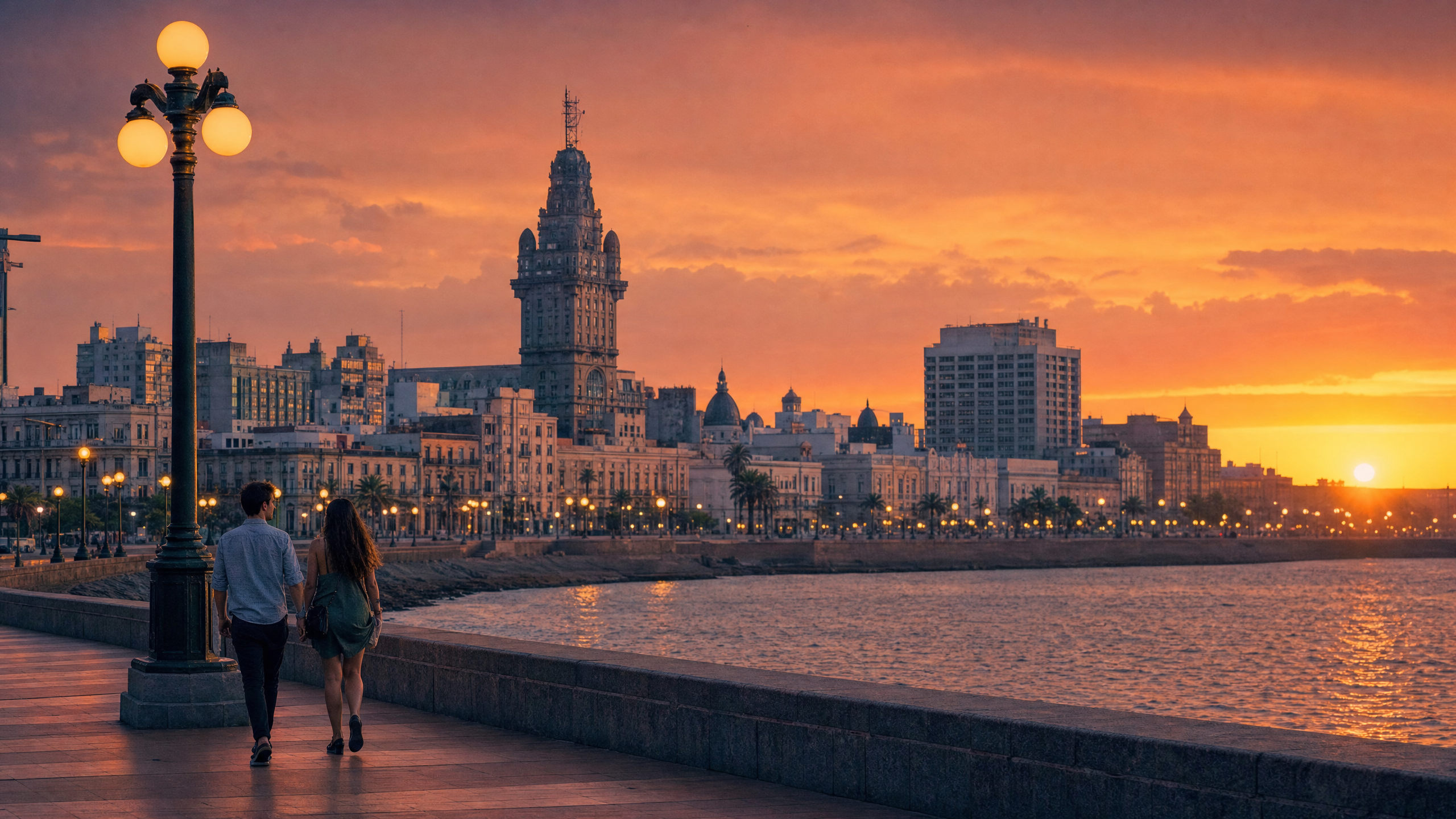
What it has instead is something rarer: authenticity without performance. The city of 1.3 million people — nearly half of Uruguay's entire population — is genuinely, quietly itself. The streets of Ciudad Vieja are lined with art deco facades that nobody has bothered to Instagram-optimize. The Rambla, the 22-kilometer waterfront promenade that wraps the entire southern edge of the city, is packed every evening not with tourists but with locals — joggers, dog walkers, couples sharing a thermos of maté, old men fishing with the patience of people who have nowhere better to be.
Uruguay itself sets the tone. It was the first country in Latin America to legalize same-sex marriage, the first in the world to fully legalize recreational marijuana at the state level, and it consistently ranks as one of the least corrupt and most democratic nations in the hemisphere. Its people — called Orientales, a reference to their position east of the Uruguay River — have a reputation for being warm without being performative, proud without being loud. The national drink is not a cocktail designed for tourists. It is maté, a bitter, grassy infusion shared from a communal gourd, passed between friends as a gesture of trust and belonging. When a Uruguayan offers you their maté, they are not being polite. They are letting you in.
The city reflects all of this. Montevideo is a place where the best meal you will eat might be at a table with a view of a rusted iron grill, where the most memorable music you will hear might be a group of candombe drummers rounding a corner in Barrio Sur on a Sunday afternoon, where the most beautiful sunset you will see will be from a bench on the Rambla, free of charge, with no queue.
The Neighborhoods: A City in Chapters
Montevideo is not a city you understand all at once. It reveals itself in neighborhoods, each one a different chapter of the same long, unhurried story.
Ciudad Vieja is where you start. The old city sits on a small peninsula jutting into the Río de la Plata, and its streets are a gorgeous, slightly crumbling museum of early 20th-century architecture. Art deco buildings stand next to neoclassical facades stand next to the kind of weathered colonial structures that look like they survived a revolution — because many of them did. Calle Sarandí, the main pedestrian artery, is lined with cafes, galleries, and small shops selling leather goods, gaucho knives, and handmade ceramics. On weekends, Plaza Matriz fills with a flea market where you can find genuine antiques — silver mate gourds, vintage prints, old gaucho paraphernalia — alongside the kind of artisan crafts that make excellent gifts.
The crown jewel of Ciudad Vieja is Mercado del Puerto, a 19th-century iron market hall that has been repurposed as the city's great temple of meat. On weekend lunchtimes, the parrilla grills inside the market are lit before noon, and the smoke that billows through the iron-and-glass roof is visible from blocks away. This is where you eat asado — not the Argentine version, which Uruguayans will tell you with a straight face is a pale imitation, but the Uruguayan original: whole cuts of beef cooked low and slow over wood embers, served with chimichurri and crusty bread and a glass of tannat, the country's signature red wine. The atmosphere is loud, convivial, and completely unself-conscious. Locals and tourists eat side by side at communal tables, and the only rule is that you order more than you think you need.
Barrio Sur and Palermo are where Montevideo's African-Uruguayan heritage lives and breathes. These adjacent neighborhoods, just east of Ciudad Vieja, are the birthplace of candombe — the UNESCO-recognized drumming tradition that arrived with enslaved Africans in the 18th century and evolved into something entirely its own. On Sunday evenings, the llamadas (drum processions) begin without announcement: a group of drummers appears at the end of a street, the deep, syncopated rhythm of the chico, repique, and piano drums building into something that you feel in your chest before you hear it with your ears. The processions move through the neighborhood, gathering spectators and dancers, and if you are lucky enough to be standing on the right corner at the right time, it is one of the most viscerally alive experiences available anywhere in South America.
Cordón is the neighborhood that locals actually live in — a dense, leafy grid of apartment buildings, corner cafes, and independent bookshops that sits between Ciudad Vieja and the more residential neighborhoods to the east. This is where you find Café Brasilero, one of the oldest continuously operating cafes in South America, its dark wood interior unchanged since the 1870s, its walls covered in photographs of the writers, artists, and intellectuals who have been regulars for generations. Order a cortado and a medialuna and sit for as long as you like. Nobody will rush you.
Pocitos is where Montevideo goes to the beach. The neighborhood's crescent of white sand on the Río de la Plata is not the Caribbean — the water is brown-grey and the waves are gentle — but on a summer afternoon, the beach is packed with families, teenagers, and the kind of effortless social energy that makes you realize why Montevideo consistently ranks as one of the most liveable cities in Latin America. The Rambla here is at its most animated: food trucks, cyclists, inline skaters, and the ever-present maté drinkers occupying every available bench.
The Food: A Quiet Culinary Revolution
Uruguayan food has long been dismissed as a simpler, less glamorous version of Argentine cuisine. This is both unfair and increasingly untrue.
The foundation is still meat — Uruguay has more cattle per capita than almost any country on earth, and the quality of the beef is extraordinary. But the food culture in Montevideo has evolved far beyond the parrilla. The city now has a thriving restaurant scene that draws on its multicultural heritage — Spanish, Italian, African, indigenous Guaraní — while embracing a new generation of chefs who trained abroad and came home with something to prove.
The chivito is the dish that defines Montevideo's street food identity. This is not a delicate sandwich. It is a monument: a thick beef tenderloin steak layered with ham, bacon, mozzarella, fried egg, olives, tomato, lettuce, and mayonnaise, served on a soft roll that barely contains it. Every neighborhood has its own version, every local has their preferred spot, and the debate over who makes the best chivito in the city is conducted with the same seriousness that Neapolitans bring to the question of pizza.
Jacinto, in Ciudad Vieja, is the restaurant that most clearly represents where Montevideo's food scene is going. Chef Lucía Soria — who trained under the legendary Francis Mallmann — runs a small, beautiful space where the menu changes with the seasons and the cooking is rooted in local ingredients but informed by a global sensibility. Her alfajores (shortbread cookies sandwiched with dulce de leche) are among the best in the city, and the lunch menu is one of the great bargains in South American dining.
For something more traditional, La Otra in the port area serves the kind of asado that makes you understand why Uruguayans are so possessive about their grilling culture. The cuts are different from what you find in Argentina — tira de asado (short ribs), vacío (flank), mollejas (sweetbreads) — and the technique is slower, more patient, more focused on the quality of the fire than the speed of the cook.
The city's tannat wine deserves its own paragraph. Tannat is a grape variety that originated in the Basque region of France and arrived in Uruguay in the 19th century, where it found a climate and soil that suited it better than its homeland. Uruguayan tannat is darker, more structured, and more complex than its French cousin, and the best bottles — from producers like Bouza, Garzón, and Pisano — rival anything produced in Argentina or Chile at a fraction of the price. A wine tour to the Canelones region, just 30 minutes from Montevideo, is one of the most rewarding half-day excursions available from the city.
The Rambla: The Soul of the City
No single feature defines Montevideo more completely than the Rambla. This 22-kilometer promenade runs along the entire southern edge of the city, from the old port in the west to the beach suburb of Carrasco in the east, and it is the place where the city comes to be itself.
The Rambla is not a tourist attraction. It has no entrance fee, no opening hours, no Instagram-optimized viewpoints. It is simply a wide sidewalk along the water, and it is in constant use from dawn to midnight. Runners and cyclists claim it in the early morning. Families with children take it over on weekend afternoons. Couples walk it at sunset. Old men fish from the rocks below it at all hours. The maté thermos is omnipresent — tucked under an arm, balanced on a knee, passed between friends with the easy intimacy of people who have been doing this their whole lives.
Walking the Rambla at sunset, with the wide brown river catching the last light and the silhouettes of distant ships on the horizon, is one of those travel experiences that resists description. It is not dramatic. It is not Instagram-worthy in any conventional sense. It is simply, profoundly, quietly beautiful — and it is completely free.
Day Trip: Colonia del Sacramento
No visit to Montevideo is complete without a day trip to Colonia del Sacramento, a UNESCO World Heritage Site 180 kilometers west of the capital that is, by almost universal agreement, one of the most beautiful small towns in South America.
Founded by the Portuguese in 1680 and fought over by Spain and Portugal for more than a century, Colonia's historic quarter is a perfectly preserved colonial maze of cobblestone streets, whitewashed walls, and bougainvillea-draped doorways. The streets are so narrow and so unchanged that you half expect a Portuguese soldier to come around the corner. The lighthouse at the tip of the peninsula offers views across the Río de la Plata toward Buenos Aires — on a clear day, you can see the Argentine coast shimmering on the horizon.
The town is small enough to walk in an afternoon, but the quality of its restaurants and the pace of its afternoons make it worth an overnight stay if your schedule allows. The ferry from Montevideo takes about two and a half hours (or 45 minutes on the fast ferry), and the crossing itself — across the widest river estuary in the world — is an experience in its own right.
Music, Carnival, and the Culture of Celebration
Montevideo's cultural life is anchored in music, and the city's musical traditions are more diverse and more deeply rooted than most visitors expect.
Candombe is the heartbeat. This Afro-Uruguayan drumming tradition, born in the enslaved communities of Barrio Sur and Palermo in the 18th century, has evolved into a living cultural practice that permeates the city. The drums — three sizes, each with a distinct role in the rhythm — are played in processions called llamadas that move through the streets of the old neighborhoods on Sunday evenings and during the Carnival season. Candombe was recognized by UNESCO as Intangible Cultural Heritage of Humanity in 2009, but in Montevideo it is not a museum piece. It is alive, it is loud, and it will find you whether you look for it or not.
Carnival in Montevideo is the longest carnival in the world — 40 days, running from late January through early March — and it is almost entirely unknown outside Uruguay. While Rio's carnival dominates the global imagination, Montevideo's version is more intimate, more community-rooted, and in many ways more interesting. The murga — a theatrical, satirical musical tradition unique to Uruguay — is the centerpiece: troupes of performers in elaborate costumes deliver sharp political commentary through song, dance, and comedy in outdoor theaters called tablados set up throughout the city. The murga tradition is fiercely democratic; the best troupes are judged not by spectacle but by the quality of their writing and the sharpness of their wit.
Tango is also part of the picture, though Uruguay and Argentina have been arguing about its origins for over a century. What is not disputed is that Montevideo has its own tango tradition, its own milonga culture, and its own way of dancing — slightly more restrained than the Buenos Aires style, some say, though Uruguayans would dispute even that. Free tango classes are held at Plaza Liber Seregni most weekday evenings, and the milongas (tango dance halls) in the old city are open to beginners.
Practical Matters: Getting Here, Getting Around, Getting the Most Out of It
Getting to Montevideo is straightforward from Buenos Aires: the Buquebus ferry runs multiple times daily from Puerto Madero, and the crossing takes between one and three hours depending on the service. Flying is also an option — Carrasco International Airport is modern, efficient, and well-connected to the rest of South America. From further afield, most international flights connect through Buenos Aires or São Paulo.
Getting around the city is easy. Montevideo is compact enough that Ciudad Vieja, Cordón, and Pocitos are all walkable from each other, and the city's bus network is reliable and inexpensive. Taxis and ride-hailing apps are available throughout the city.
When to go depends on what you want. The Southern Hemisphere summer (December through February) brings warm weather, beach culture, and the Carnival season — this is the most vibrant time to visit, though also the most crowded. The shoulder seasons (March–May and September–November) offer mild weather, fewer tourists, and the particular pleasure of having the Rambla almost to yourself on a cool autumn morning. Winter (June–August) is mild by most standards — temperatures rarely drop below 10°C — and the city takes on a quieter, more introspective character that some travelers find deeply appealing.
The currency is the Uruguayan peso, and while Uruguay is more expensive than its neighbors Peru or Bolivia, it is significantly cheaper than Buenos Aires (which has become expensive for international visitors). A full lunch at a good restaurant in Ciudad Vieja — three courses, wine included — rarely costs more than $20 USD per person.
Safety is not a significant concern in the tourist areas of Montevideo. Uruguay consistently ranks as one of the safest countries in South America, and the city center, Pocitos, and Cordón are all considered safe for solo travelers, including women traveling alone.
Plan Your Montevideo Trip with Ask Leif
Montevideo rewards the traveler who comes without a rigid agenda and leaves room for the unexpected — the Sunday candombe procession that appears from nowhere, the conversation with a local at a parrilla that turns into a three-hour lunch, the sunset on the Rambla that makes you forget you had somewhere else to be.
But even the most spontaneous trip benefits from a solid foundation, and that is where Ask Leif comes in. Our Montevideo guides cover every angle of the city — from budget-conscious itineraries that show you how to experience the best of Uruguay on €50 a day, to romantic escapes designed for couples who want to slow down and actually be somewhere together.
Ready to start planning? Explore our full collection of Montevideo itineraries:
- Montevideo on a Budget: 3-Day Itinerary for €50/Day — Everything you need to experience the best of the city without breaking the bank, including free Rambla walks, the Mercado del Puerto, and the best cheap eats in Cordón.
- Montevideo for Couples: A Romantic 3-Day Itinerary — Sunset walks on the Rambla, wine from the Canelones region, and the kind of slow, unhurried days that remind you why you travel with someone you love.
- 3 Days in Montevideo: The Ultimate General Itinerary — The complete first-timer's guide to the city, covering all the essential neighborhoods, food experiences, and cultural highlights.
- Montevideo Family Fun: 4-Day Itinerary with Rambla Cycling & Colonia Day Trip — A thoughtfully paced family itinerary that balances the city's cultural highlights with the kind of outdoor, active experiences that keep kids genuinely engaged.
- Montevideo Food & Culture: 4-Day Asado, Chivito & Tannat Wine Guide — For the traveler who plans their trip around what they're going to eat: a deep dive into Uruguay's extraordinary food culture, from the parrillas of Mercado del Puerto to the wine cellars of Canelones.
The Thing About Montevideo
There is a reason that Montevideo consistently tops lists of the most liveable cities in Latin America. It is not the most dramatic city on the continent. It does not have the mountains of Santiago or the beaches of Rio or the electric social energy of Buenos Aires. What it has is something harder to manufacture and impossible to fake: a genuine quality of life, a city that functions well and feels good, a population that has figured out how to be happy without making a show of it.
The maté culture is the key to understanding all of this. The ritual of preparing and sharing maté — filling the gourd, adding the herb, pouring the hot water, passing it to the person next to you — is not about the drink. It is about the pause. It is about the decision to stop, to sit, to be present with the people around you. Montevideo is a city built around that pause. The Rambla is a 22-kilometer pause. The Mercado del Puerto on a Saturday afternoon is a pause. The candombe drums on a Sunday evening are a pause — a reminder that some things are worth stopping for.
You will leave Montevideo with fewer photographs than you took in Buenos Aires and more memories than you expected. You will find yourself thinking about it on the plane home — not about any single landmark or meal or experience, but about the feeling of the whole place. The way the light falls on the Río de la Plata at dusk. The smell of wood smoke from the parrillas. The sound of drums from a street you cannot see.
That is what Montevideo does to you. And that is exactly why you should go.