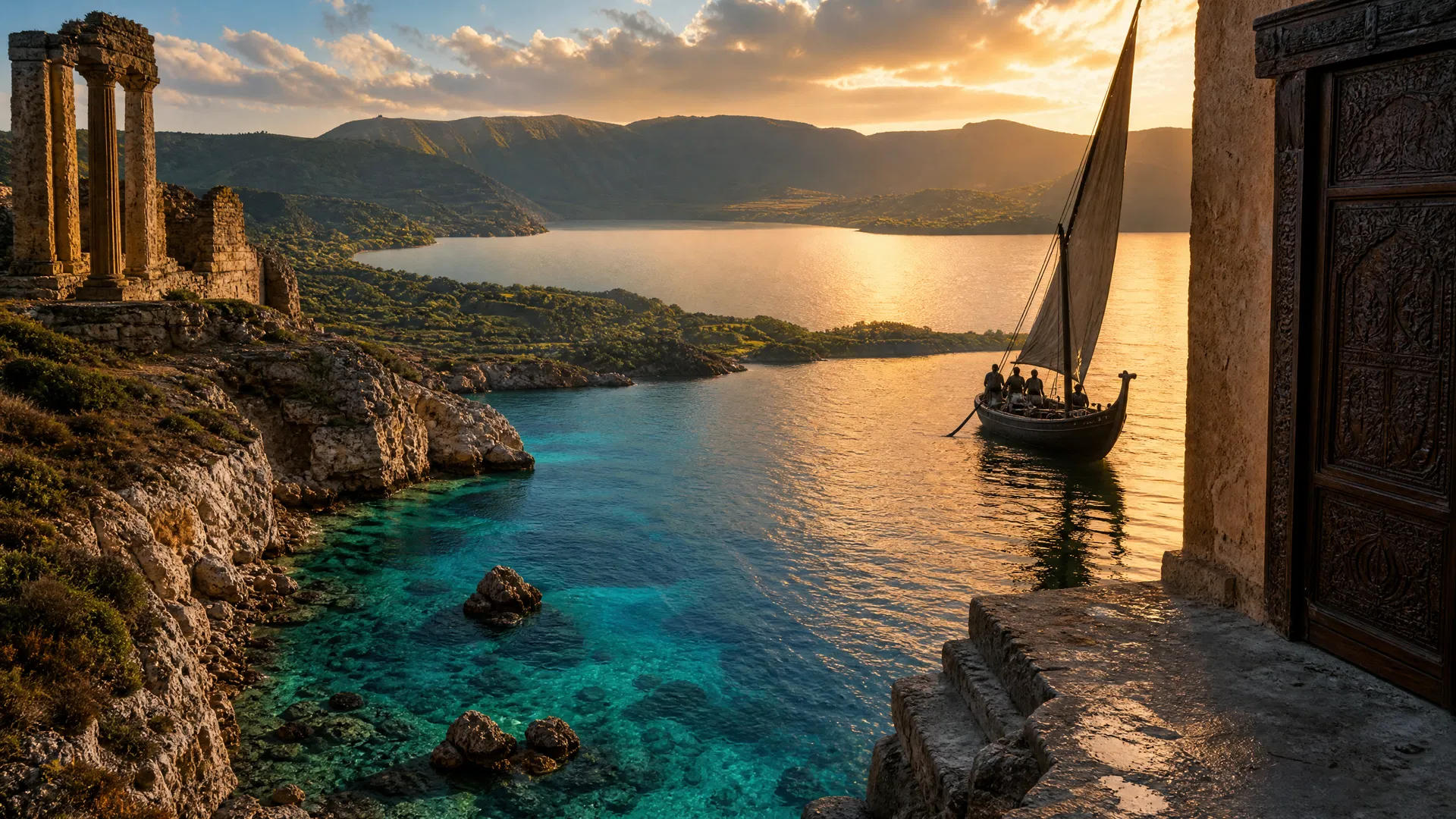
The Maldives Is Perfect. These Islands Are Interesting.
Destination: Global
Category: Destinations
The Maldives is not overrated, and neither are the islands in this post. That's the first thing to say, because this post is sometimes read as an argument against the Maldives, and it isn't. The Maldives is genuinely perfect at what it does: it takes a coral atoll in the Indian Ocean, builds an overwater bungalow on it, and delivers the most controlled, most beautiful, most expensive version of the beach vacation that exists. The water is the color that water is supposed to be. The service is the service that service is supposed to be. If you want the ideal version of an island resort experience, the Maldives is the correct answer.
But perfect and interesting are different qualities. And depending on what you're actually looking for, one matters more than the other.
The Maldives has no pre-resort history. No indigenous civilization. No archaeological sites. No cuisine that predates the resort economy. It was a chain of fishing villages before the tourism industry arrived, and the tourism industry has now so thoroughly replaced the fishing village economy that the two barely coexist. This is not a criticism — it's a description. The Maldives was built to be a resort destination, and it is the best resort destination in the world.
The six islands in this post were not built to be resort destinations. They were built — by geology, by history, by the specific accidents of trade and conquest and isolation — to be places. Each of them has beaches that compete with the Maldives on water clarity and color. Each of them has something the Maldives specifically cannot have: a reason for existing that predates the first tourist. The question this post is answering is not "where can I find cheaper Maldives?" It is "where can I find something the Maldives cannot give me?" The answer is six places. Here is why each one belongs on this list and not another.
Sardinia: The Mediterranean That Tourism Hasn't Finished
Sardinia is the second-largest island in the Mediterranean and one of the least understood. Most travelers who have heard of it think of the Costa Smeralda — the northeastern coast where the Aga Khan built a private resort enclave in the 1960s that became the preferred destination of European royalty and oligarchs and that now charges prices that make the Maldives look accessible. That Sardinia exists. It is not the Sardinia that belongs on this list.
The Sardinia that belongs on this list is the interior — the Barbagia, a mountainous region in the center of the island that has maintained cultural continuity from the Bronze Age to the present day. The Nuragic civilization built approximately 7,000 stone towers across the island between 1800 and 500 BC — conical structures of stacked basalt that served as fortresses, temples, and meeting points for a culture that has no confirmed connection to any other known civilization. The best-preserved complex is Nuraghe Su Nuraxi near Barumini, a UNESCO World Heritage Site dating to 1500 BC, roughly contemporary with Mycenae and the height of the Egyptian New Kingdom. Most visitors to Sardinia never reach it because it's 80 kilometers from the coast and requires a deliberate decision to go inland rather than stay on the beach.
The beach argument for Sardinia is also legitimate. Cala Goloritzé, on the eastern coast near Baunei, is accessible only by boat or by a 90-minute descent from the plateau above — a white limestone arch rising from water so clear that the coral is visible at 15 meters. Forbes has ranked it among the ten most beautiful beaches in the world. It appears on no resort map because there is no resort near it.
The Barbagia villages of Orgosolo are covered in political murals dating to the 1960s — a tradition of public art that began as protest against the Italian state and that has accumulated over 60 years into one of the most significant bodies of political mural work in Europe. The village also sits in the region with the highest concentration of centenarians in the world after Okinawa, a demographic anomaly that epidemiologists have linked in part to the Cannonau wine — a high-altitude Grenache that produces antioxidant concentrations significantly above the European average.
The Sardinia 7-day family guide covers the logistics of moving between the coast and the interior, which is the essential Sardinian decision. The island rewards the traveler who makes it.
Sri Lanka: The Island That Contains Everything
Where Sardinia rewards the traveler who goes inland, Sri Lanka rewards the traveler who stays long enough to understand that the concept of choosing a type of trip is unnecessary here. Sri Lanka is approximately the size of Ireland and contains within it more compressed geographic and cultural diversity than any island destination in the world — ancient Buddhist temples, colonial-era hill stations, leopard-dense national parks, spice plantations, surf beaches, whale watching, and a tea culture that rivals Darjeeling, all within a four-hour drive of each other.
The Maldives offers one register at exceptional depth. Sri Lanka offers twelve registers simultaneously. The traveler who has two weeks and wants to understand what a place is — rather than simply experience what a resort provides — will find Sri Lanka more rewarding than anywhere else in the Indian Ocean.
Sigiriya is the proof. In the 5th century, King Kassapa built a palace-fortress on a volcanic plug 200 meters above the surrounding jungle — a structure so improbable that it was dismissed as legend until archaeologists confirmed its existence in the 19th century. The climb is more physically demanding than most visitors expect. The frescoes of the Cloud Maidens, painted on the rock face at the midpoint of the ascent, have survived 1,500 years of monsoons and humidity. The view from the summit — jungle in every direction, the ancient city of Polonnaruwa visible in the distance — is the view that justifies the climb.
Yala National Park has the highest leopard density of any protected area in the world. The critical detail is timing: the 6am game drive, not the afternoon drive. Leopards are crepuscular — most active at dawn — and the morning light in the dry zone of southern Sri Lanka produces a quality of visibility that the afternoon heat haze eliminates. Most tour operators offer both. Most tourists take the afternoon drive because it's more convenient. The morning drive is the one that produces the photographs.
The Ella train journey — the most scenic railway route in Asia by multiple independent rankings — runs through tea country between Kandy and Ella, a six-hour journey through landscapes that change from lowland jungle to high-altitude plantation. The authentic version of this journey is third class, in the carriages that locals use, with the doors open and the tea fields at arm's length. The first-class observation car produces a different experience — comfortable, air-conditioned, photographically identical — but the third-class carriage is the one that produces the memory.
The Sri Lanka 7-day adventure couples guide and the Colombo 4-day guide cover the logistics of the island's two distinct travel modes: the fast-paced cultural circuit and the slower coastal experience. Both are worth understanding before you go.
The Azores: The Islands That the Atlantic Made
If Sri Lanka is the island that contains everything, the Azores are the islands that contain something no other place on earth contains: a human civilization built from scratch on volcanic rock in the middle of the Atlantic Ocean, 1,500 kilometers from mainland Portugal and 3,900 kilometers from the American East Coast, with no prior history and 600 years to develop in relative isolation.
The Azores were uninhabited when the Portuguese arrived in 1427. Everything on them — the culture, the architecture, the cuisine, the landscape — was invented on volcanic islands with no indigenous tradition to draw from. The result is the most geologically dramatic landscape in the Atlantic, a whale watching destination that rivals anywhere on earth, and a hydrangea-lined road culture that exists because the volcanic soil produces flowers in a profusion that no gardener planned and no resort could replicate.
São Miguel is the largest island and the most visited, and the Sete Cidades — twin lakes in a volcanic caldera, one green and one blue, separated by a bridge — is the image that appears on every Azores travel piece. The Azorean legend explains the colors: a princess and a shepherd fell in love, were separated by her father, and wept until their tears filled the caldera, his green eyes producing one lake and her blue eyes producing the other. The scientific explanation involves different algae concentrations responding to different light angles. Both explanations are correct in the ways that matter.
The whale watching on Faial and Pico is not a resort activity. The Azores sit at the intersection of three tectonic plates and the deep-water trench that results produces a year-round concentration of sperm whales — the only whale species that can be reliably found in the Azores in every month of the year. Blue whales pass through in spring. Fin whales in summer. The vigia system — shore-based lookouts on clifftop stations, a practice inherited from the whaling era — still operates today, with spotters using the same clifftop positions to radio boat captains when a whale surfaces. The Azores was a whaling center for 200 years. It is now one of the world's leading whale watching destinations, and the transition from hunting to watching happened within living memory.
The Pico Island wine is produced in UNESCO-listed lava field vineyards — the currais system, low stone walls built to protect individual vines from Atlantic wind, one of the most unusual wine landscapes on earth. The wine is a Verdelho, dry and mineral, tasting of salt and stone and the specific Atlantic air that the vines absorb.
The Azores 5-day adventure guide covers the island-hopping logistics that make the Azores work as a trip — the ferry connections between islands, the specific timing for whale watching season, and the caldeira hike on Faial that produces the most dramatic volcanic landscape accessible by foot in the Atlantic.
Zanzibar: The Island Where Three Worlds Converge
The Azores were built from nothing. Zanzibar was built from everything — East African, Arab, and Portuguese layers accumulated over 600 years of trade, conquest, and cultural collision that produced a culture, an architecture, and a cuisine with no equivalent anywhere else on earth.
Stone Town, the old city on the western coast, is a UNESCO World Heritage Site and the most intact Swahili trading port architecture in the world. The streets are too narrow for cars. Arab merchant houses with carved wooden doors sit alongside Indian trader shops and Portuguese fort remnants on lanes so tight that two people must turn sideways to pass each other. The carved door culture is a language in itself: each door was carved to communicate the owner's status, religion, and origin. Indian brass studs indicate Hindu merchant ownership. A pointed Omani arch indicates Arab Muslim ownership. The oldest confirmed surviving door in Stone Town, on Mkunazini Street, dates to the 18th century and still stands in its original frame.
The Darajani Market begins at 6am when the dhow fishermen bring their overnight catch in from the Indian Ocean. The fish auction — conducted in Swahili, Arabic, and occasionally Hindi — is the most concentrated version of what Zanzibar is: a place where three worlds meet and conduct business in the language that serves the moment. The octopus preparation that follows — grilled on charcoal with coconut milk and tamarind — appears in no mainland Tanzanian cuisine. It is specific to Zanzibar, a product of the specific intersection of Indian Ocean fishing culture and Arab spice trade.
The spice tour to the interior farms near Kizimbani is the experience that explains why Zanzibar was the wealthiest territory in East Africa in the 19th century. The clove monopoly — established by Omani Sultan Seyyid Said, who moved his court from Muscat to Zanzibar in 1840 — made the island the world's largest clove producer and the center of a spice trade that shaped the global economy. The farms still grow cloves, nutmeg, vanilla, and cinnamon. The smell of a working spice plantation in the Zanzibar interior is the smell of the specific history that made this island matter.
The dhow sailing at sunset from Stone Town harbor passes the site of the old slave market — abolished in 1873 under British pressure, the last operating slave market in the world at the time of its closure. The sunset from a lateen-rigged dhow that has been sailing these waters for 1,000 years carries a moral weight that the Maldives sunset specifically cannot have. That weight is not a reason to avoid Zanzibar. It is a reason to go.
The Zanzibar 5-day couples guide and the Zanzibar 5-day honeymoon guide cover both the Stone Town immersion and the beach experience on the northern and eastern coasts — the two registers that make Zanzibar work as a complete trip rather than a single-note destination.
Corsica: The Island That Refused to Be Civilized
Where Zanzibar is the product of too much history, Corsica is the product of a history that never fully resolved. It is a French island that has never fully accepted being French. It has its own language — Corsican, closer to Italian than French — its own political independence movement, its own cuisine that has almost nothing to do with mainland French cooking, and a landscape so dramatically mountainous that 40% of the island is protected wilderness.
The GR20 — the most difficult long-distance hiking trail in Europe — runs 180 kilometers across the island's mountain spine. Monte Cinto rises to 2,706 meters. The beach at Palombaggia, on the southern coast, is visible from the summit on a clear day. The specific quality of Corsica that no other Mediterranean island possesses is this vertical compression: you can swim in water the color of the Maldives in the morning and stand in alpine terrain in the afternoon, and the distance between those two experiences is 40 kilometers.
The maquis is the smell of Corsica. The dense scrubland of lavender, rosemary, rockrose, and myrtle that covers the island's interior produces a specific fragrance that Napoleon Bonaparte — born in Ajaccio in 1769 — reportedly said he could recognize with his eyes closed from a ship at sea. The maquis is not a garden. It is a wild thing, and the interior of Corsica smells of it constantly.
The charcuterie culture is the cuisine argument for Corsica. Lonzu, coppa, and figatellu are produced from pigs that roam free in the chestnut forests of the interior — an AOC designation that protects Corsican charcuterie from mainland imitations. The figatellu, a liver sausage grilled over chestnut wood, is the specific Corsican food that mainland French cuisine has never successfully replicated and that no restaurant outside the island produces correctly.
Bonifacio, on the southern tip, is built on white limestone cliffs 70 meters above the Strait of Bonifacio — the narrow channel between Corsica and Sardinia. The cliffs are hollow underneath, eroded by centuries of wave action into a system of caves and grottos that are accessible by boat from below. The citadel above has been continuously occupied since the 9th century. The view from the ramparts, looking south toward Sardinia across water that is simultaneously turquoise and dangerous, is the view that explains why Corsica has been fought over by Genoa, France, and its own independence movement for 800 years.
The Corsica 5-day adventure couples guide covers the essential Corsican decision: coast or mountains, or the specific routing that gives you both.
Palawan: The Last Frontier
Corsica refuses to be civilized. Palawan refuses to be finished. The westernmost province of the Philippines is a 450-kilometer-long island that the Philippine government itself has called the country's last ecological frontier — a designation that acknowledges both what Palawan still has and what the rest of the Philippines has already lost.
The Puerto Princesa Underground River is a navigable river that flows through a cave system for 8.2 kilometers before emerging into the South China Sea — a UNESCO World Heritage Site and one of the New Seven Wonders of Nature. The banca boat experience navigating into the cave — past a colony of millions of swiftlets and bats on the cave ceiling, through chambers large enough to contain a cathedral — is the experience that most travel content describes correctly but that most travelers book incorrectly. The first departure, before 8am, avoids the peak tour boat congestion. The cave is the same cave at any hour. The experience is not.
El Nido contains 45 islands and islets in a protected bay with limestone karst cliffs rising from water so clear that the coral is visible at 15 meters. The four standard island hopping routes are labeled A, B, C, and D. Tour C is the least popular — longer boat journey, more exposed to open water — and the most rewarding: Helicopter Island, Matinloc Shrine, and a lagoon accessible only through a crack in a cliff face at low tide, a passage so narrow that the boat cannot follow and the swimmer must go alone.
Coron contains more than 50 dive sites, including seven Japanese warships sunk by American aircraft in a single day in September 1944. The Okikawa Maru sits at 10 to 35 meters depth, its engine room colonized by coral and fish over 80 years. The thermocline at 15 meters produces a visibility difference between the upper and lower sections of the wreck — warm, slightly murky water above; cold, crystalline water below — that divers describe as entering a different ocean. The wrecks are not a curiosity. They are one of the great dive destinations in the world.
Culion Island, accessible by ferry from Coron, was the largest leper colony in the world during the American colonial period — a place where people were sent and never returned, an island that existed outside the normal geography of the Philippines for 50 years. The museum documents the specific history that most Philippines travel content deliberately avoids. The island is now a quiet community of descendants of the original patients, and the museum is the most honest account of American colonial medicine in Southeast Asia.
The Palawan 5-day adventure guide and the Palawan 5-day couples guide cover the logistics of moving between Puerto Princesa, El Nido, and Coron — three distinct experiences that require separate planning and that together constitute one of the great island trips in the world.
Why the Obvious Alternatives Don't Appear Here
This list excludes three islands that every competitor post includes. The exclusions are decisions, not omissions, and they deserve explanation.
Bali is not on this list because Bali is not an island alternative to the Maldives. It is a cultural and spiritual destination that happens to be on an island, and its actual value — the temple culture, the rice terrace landscape, the specific Balinese Hindu tradition that has survived 500 years of Islamic Indonesia — is inland, not coastal. Including Bali on an island alternatives list treats it as a beach destination when its beach is the least interesting thing about it. The Bali travel guide makes the case for Bali on its own terms.
The Seychelles is the closest genuine alternative to the Maldives in terms of resort infrastructure and water quality. It is also nearly as expensive and offers only marginally more cultural depth. A traveler choosing between the Maldives and the Seychelles is making a preference decision, not a values decision. This post is for travelers making a values decision.
Fiji is the correct alternative to the Maldives for travelers who want resort infrastructure in the Pacific. It belongs on a different list — best islands for families, best islands for honeymooners — where its specific combination of resort quality and cultural accessibility makes it the right answer. On this list, it would be the weakest entry because its cultural depth, while genuine, does not match Sardinia, Zanzibar, or the Azores.
How to Choose Between These Six
These six islands are not interchangeable. They are answers to different questions, and the right choice depends on what you're actually asking.
If you want the Maldives water with a civilization alongside it, Sardinia is the answer. The beaches compete directly. The Nuragic towers, the Barbagia villages, and the Cannonau wine are the things the Maldives cannot offer.
If you want the most compressed diversity available in a single island trip, Sri Lanka is the answer. Two weeks is the minimum. One week is enough to understand why two weeks isn't.
If you want geological drama and the specific experience of a place built from nothing in the middle of an ocean, the Azores is the answer. The whale watching alone justifies the trip. The volcanic landscape is the bonus.
If you want cultural depth and the specific weight of a place that was the center of the world for 600 years, Zanzibar is the answer. Stone Town is the most intact version of the Swahili trading world that still exists. The beaches are excellent. The history is irreplaceable.
If you want the Mediterranean without the resort infrastructure, Corsica is the answer. The GR20 is for serious hikers. The maquis, the charcuterie, and the limestone cliffs at Bonifacio are for everyone else.
If you want ecological intact wilderness and one of the great dive destinations in the world, Palawan is the answer. The Underground River, El Nido, and Coron are three separate trips that happen to be on the same island.
Leif's itinerary generator is built for exactly this kind of decision: a category of travel with multiple right answers and the need to match the right answer to the specific traveler. Tell Leif which dimension matters most — the water, the history, the geology, the wildlife, the cuisine — and it will build the trip that matches the answer.
The Argument
The Maldives is perfect. It will remain perfect. Nothing in this post changes that.
What this post argues is that perfect is not the only standard worth applying to an island trip. The islands in this post are interesting in the way that a place is interesting when it has been shaped by forces larger than tourism — by geology that took millions of years, by civilizations that built in stone and left the stone standing, by trade routes that connected three continents, by landscapes that refused to be domesticated.
Sardinia has 7,000 Nuragic towers and water the color of the Maldives. Sri Lanka contains everything. The Azores were built from scratch on volcanic rock in the middle of the Atlantic. Zanzibar is where three worlds converged and left their marks on every door. Corsica refused to be finished. Palawan is still becoming what it will be.
The Maldives is the answer to one question. These islands are the answer to six different questions that are, in the end, more interesting to ask.