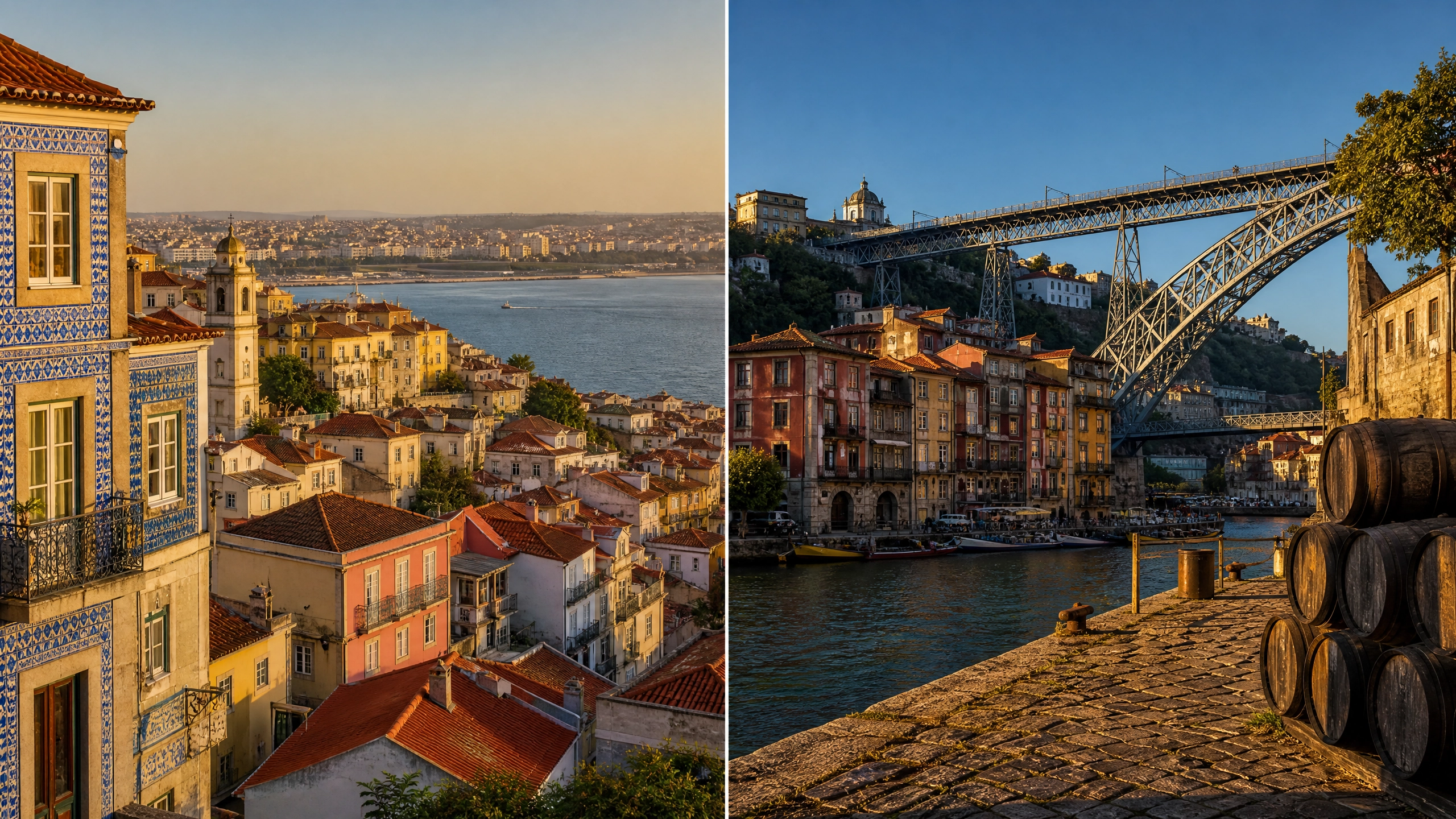
Lisbon vs Porto: One City Wants to Impress You. The Other Doesn't Care.
Destination: Lisbon & Porto, Portugal
Category: Destination Guides
There is a moment, somewhere in your second hour in Porto, when you realize the city has not once tried to sell you anything. No panoramic viewpoint with a ticket booth. No curated "authentic experience" with a QR code. No neighborhood that has been renamed to make it easier for tourists to find. The city simply exists, in the way that very old things exist — indifferent to whether you understand it, confident that you will eventually.
Lisbon is different. Lisbon has been watching the world watch it for decades, and it has learned to perform. Not dishonestly — Lisbon is not fake — but consciously. It knows which angles are beautiful. It has placed the miradouros where the light falls correctly. It has turned its grief into a music form and put that music form in restaurants where you can order wine and feel something manageable. Lisbon is a city that wants you to love it, and it has gotten very good at making that happen.
This is not a competition. That is the first thing to understand about Lisbon versus Porto, and it is the thing that every comparison post on the internet gets wrong. These two cities are not fighting for your attention. They are not different-sized versions of the same experience. They are two different answers to the same question: what is Portugal?
Lisbon is the answer Portugal gave after 1755, when an earthquake and the fires and the tsunami that followed it destroyed most of the city in a single morning and forced the country to decide what to build in its place. The Marquis of Pombal rebuilt Lisbon on a rational grid — wide avenues, uniform facades, earthquake-proof construction, a city designed for the future. Porto was never destroyed. Porto never had to decide what to become. Porto simply continued being what it had always been.
That is the thesis. Everything else follows from it.
How the Earthquake Explains Everything
On the morning of November 1, 1755 — All Saints' Day, when most of Lisbon's population was in church — an earthquake estimated at magnitude 8.5 to 9.0 struck the city. The churches collapsed first. Then fires broke out across the rubble. Then, forty minutes after the initial quake, a tsunami rolled in from the Tagus estuary. By the time it was over, between 30,000 and 40,000 people were dead and the city that had been the center of one of the world's great maritime empires was largely gone.
The Marquis of Pombal, the king's chief minister, is supposed to have responded to the disaster with the instruction: "Bury the dead and feed the living." Then he rebuilt the city. The Pombaline downtown — the Baixa — is what he built: a perfectly rational grid of streets, numbered buildings, standardized facades, a city that could be evacuated efficiently if it happened again. It is beautiful in the way that well-designed things are beautiful. It is also, unmistakably, a city built by someone who had just watched the old one disappear.
Porto, 300 kilometers north, felt the earthquake but was not destroyed by it. The medieval street grid of the Ribeira district — the narrow alleys climbing the hillside above the Douro, the buildings stacked so close together that neighbors can shake hands from opposite windows — survived because it was never in the earthquake's path. When you walk through Porto's historic center today, you are walking through streets that have been there since the twelfth century. When you walk through Lisbon's Baixa, you are walking through a city that was designed in the 1750s and built in the decades that followed.
This is why they feel so different. Not because one is bigger or one is cheaper or one has better food. Because one of them was rebuilt from scratch by a rationalist bureaucrat who was trying to make it better, and the other one just kept going.
What Lisbon Does to You
Lisbon works on you slowly and then all at once. You arrive thinking you understand it — the hills, the trams, the azulejo tiles, the fado — and then somewhere around your second or third day you realize that what you've been seeing is the surface, and the surface is genuinely extraordinary, and you haven't gotten anywhere near what's underneath it.
The surface: Alfama, the oldest neighborhood in the city, which survived the earthquake because it sits on bedrock while the Baixa sat on river sediment that liquefied. The narrow streets climbing toward the São Jorge Castle. The Miradouro da Graça at sunset, when the light turns the Tagus the color of old copper and the city spreads out below you in layers. The Number 28 tram, which is genuinely useful for getting around and not merely a tourist attraction, though it has become both. The pastéis de nata at Pastéis de Belém, which are different from every other pastel de nata in the country because of a recipe that has been kept secret since 1837 and which you can taste the difference in immediately.
The underneath: Mouraria, which is where Lisbon's soul actually lives. Mouraria is the Moorish quarter — the neighborhood that the Moors retreated to after the Christian reconquest of Lisbon in 1147, and which has been the city's most genuinely multicultural neighborhood ever since. Today it is Cape Verdean and Bangladeshi and Chinese and Portuguese, all layered on top of each other in streets so narrow that the buildings block the sun by mid-morning. The fado houses in Mouraria are not the ones on TripAdvisor. They are the ones where the singer is someone's grandmother and the audience is mostly people who live on the street. Largo da Mouraria on a weekday afternoon, when the old men are playing cards and the smell of grilled fish is coming from somewhere you can't identify — this is Lisbon without the performance.
The food in Lisbon is excellent and has gotten better every year for a decade. Belcanto, José Avillez's flagship in Chiado, holds two Michelin stars and serves a tasting menu that is genuinely one of the best meals you can eat in Europe. But the more important food fact about Lisbon is that the petiscos culture — small plates, shared, with wine, at a marble counter — is alive and extraordinary in Príncipe Real and in Mouraria at prices that make the Michelin economics feel irrelevant. Three euros for a plate of amêijoas à bulhão pato (clams in garlic and white wine) at a counter in Mouraria. Seven euros for a plate of pataniscas de bacalhau (cod fritters) that you will think about for weeks.
The Time Out Market at Cais do Sodré is excellent. It is also not where Lisbon eats. It is where Lisbon goes when it wants to show visitors what it can do. The distinction matters.
For a full five days in Lisbon — the right amount of time to get past the surface — the 5-Day Lisbon Travel Guide maps the city in the order that makes sense: Alfama first, then Belém, then Mouraria, then Príncipe Real, then a day trip to Sintra before you leave. That sequence is not arbitrary. It is the sequence that takes you from the postcard to the real thing.
What Porto Does to You
Porto does not try. This is the most important thing about it and the thing that is hardest to explain to someone who hasn't been there.
The Ribeira waterfront — the row of colored houses climbing the hillside above the Douro, the Dom Luís I bridge framing everything, the wine cellars of Vila Nova de Gaia visible across the river — is one of the most visually striking urban landscapes in Europe. Porto knows this. It does not do anything about it. There are no viewing platforms with ticket booths. There is no curated experience. There is the waterfront, and there are the restaurants along it (most of which are tourist traps — more on this shortly), and there are the boats, and there is the bridge, and Porto simply lets it be what it is.
The city is small enough to walk entirely — though "walk" understates the cardiovascular commitment required, because Porto is built on hills that are steeper than they appear on maps and the cobblestones are polished to a near-frictionless shine by centuries of feet. The historic center is a UNESCO World Heritage site, which means the medieval street grid is protected from the kind of development that has transformed other European city centers. The buildings are old in the way that Porto is old — not restored and presented, but genuinely aged, with azulejo tiles that are cracked and faded and beautiful precisely because no one has replaced them.
The wine is the obvious thing. Porto sits at the mouth of the Douro Valley, which is where port wine comes from, and the wine cellars of Vila Nova de Gaia — Taylor's, Graham's, Sandeman, Ramos Pinto — are across the bridge from the historic center and offer tastings that range from tourist-accessible to genuinely educational. The Yeatman Hotel in Gaia holds two Michelin stars and has a wine programme anchored in Douro and port wines that is among the most serious in the Iberian Peninsula. The rooftop bar is accessible without dinner — cocktails run €8 to €14 — and the view across the river to Porto from that terrace is the best view of the city you will find anywhere.
But the thing Porto does to you that no wine cellar explains is the feeling of being in a place that is still primarily for the people who live there. Bonfim, the neighborhood east of the historic center, was named one of Europe's coolest neighborhoods by The Guardian, which is the kind of recognition that usually destroys a neighborhood. Bonfim has absorbed it without changing. It is flat — unusual in Porto — and residential, and the streets around Rua de Costa Cabral have a specialty coffee scene that is genuinely exceptional: Combi Coffee Roasters, housed in a converted garage, roasts its own beans on-site and produces what many Porto residents consider the best flat white in the city. Von&vonnie, a few blocks away, is a microroastery operating on what its founders describe as "hedonistic and ethical" sourcing principles — smaller, more intimate, focused entirely on the craft of the bean. And then there is Fiasco, which is four things at once: a high-end cocktail bar, a curated vinyl shop, a café, and an underground art gallery, all in a space bathed in cinematic red light with a double-sided velvet sofa designed, as the owners put it, for "seeing and being seen." The signature cocktail is a cachaça-based Euphorbia Two Step. It is one of the best bars in Portugal and it is in a residential neighborhood in Porto that most visitors never find.
For four days in Porto — the right amount of time to get past the Ribeira and into the neighborhoods — the Porto City Break: A 4-Day Urban Adventure covers the city in the sequence that matters: the historic center and wine cellars first, then Bonfim and Cedofeita, then a day in Matosinhos, then the Douro Valley before you leave.
The Food Question, Answered Honestly
Every comparison post on the internet declares a winner in the food category. Most of them give it to Porto, usually on the strength of the francesinha. This is correct but incomplete.
The francesinha is a layered meat sandwich — ham, linguiça, fresh sausage, steak — drowned in a spiced beer-and-tomato sauce and topped with a fried egg. It sounds wrong. It is extraordinary. The version at Lado B on Rua de Costa Cabral 1026 in Bonfim is the most discussed in the city among Porto residents, which is a more reliable recommendation than the versions that appear in every travel article (Brasão Aliados is fine; Lado B is better). Order it for lunch. Have something light for dinner. Your cardiovascular system will appreciate the sequencing.
Porto's real food advantage is not the francesinha. It is the fish. Matosinhos, 25 minutes north of the historic center on metro line A, is where Porto residents actually go to eat seafood. Rua Heróis de França is lined with grilled fish restaurants — simple rooms with open charcoal grills visible from the street, fish priced by weight, white wine by the carafe, chips fried in clean oil. This is not a tourist experience. It is a neighborhood that has been doing the same thing for a century and sees no reason to change. The francesinha is Porto's signature dish. Matosinhos is Porto's actual food culture.
For the full Porto food picture — the francesinha, the petiscos, the Douro wine, and the Matosinhos detour — the Porto Food Guide: 4 Days of Francesinha, Port Wine & Bacalhau covers every meal worth planning.
Lisbon's food advantage is different. It is breadth. The city has 18 Michelin-starred restaurants, including Belcanto and Alma with two stars each. The petiscos culture in Mouraria and Príncipe Real is extraordinary at the low end. The Time Out Market, whatever its limitations as a "local" experience, genuinely aggregates some of the best food in the city into one building. And the bacalhau — salt cod, prepared in what Portuguese food culture claims are 365 different ways — is better in Lisbon than anywhere else in the country, which is a strong claim and a defensible one.
The Lisbon Foodie's Paradise: A 4-Day Culinary Journey builds the itinerary around the food rather than the sights, which is the correct priority order for a city where the food is this good.
One practical note that appears in no travel article but in every Reddit thread about Porto: the couvert. When you sit down at a Porto restaurant, bread, olives, and sometimes cheese will arrive at your table unordered. They are not free. They will appear on your bill. If you don't want them, say "Não pedimos, obrigado" — "We didn't order these, thank you" — and they will be removed without offense. This is not a scam. It is a custom. Knowing it before you arrive is the difference between a pleasant dinner and a confused argument at the end of it.
The Neighborhoods Nobody Writes About
The neighborhoods that appear in every Lisbon article: Alfama, Belém, Chiado, Bairro Alto. The neighborhoods that appear in every Porto article: Ribeira, Vila Nova de Gaia, the Bolhão market area. These are all worth visiting. They are also where everyone goes.
In Lisbon: Mouraria has been mentioned. The other neighborhood worth knowing is Intendente, which sits just above Mouraria and has been undergoing a quiet transformation for the past decade — not the aggressive gentrification that has hit Alfama and Chiado, but a slower shift in which the old hardware stores and fabric shops are being joined by natural wine bars and small restaurants without displacing the community that was already there. The Largo do Intendente square on a Sunday morning, when the market is running and the café tables are full and the light is coming in at the angle that makes Lisbon look like a city that has been painted rather than built — this is the Lisbon that doesn't appear in the travel magazines.
In Porto: Bonfim has been covered. The other neighborhood is Cedofeita, which is Porto's gallery district — Rua de Miguel Bombarda is lined with independent art galleries, vintage shops, and design studios, and the café culture that has grown up around it is excellent. The prato do dia culture — a complete lunch (soup, main course, bread, a drink, sometimes dessert) for €8 to €12 at a counter with a handwritten menu in the window — is strongest in Cedofeita. These restaurants rarely have names that appear anywhere online. They are found by walking Rua de Cedofeita around noon and following the smell.
The Fontaínhas viewpoint in Bonfim deserves its own mention. It is the best viewpoint in Porto for watching the São João festival fireworks on the night of June 23rd — but the week before the festival, when the city is setting up and the crowds haven't arrived, is when to go. Grilled sardines and pork belly at a plastic table with a view of the Douro river, without a tourist in sight. That is the experience.
Day Trips: Two Different Versions of "Away"
From Lisbon, the day trip is Sintra. The train from Rossio station takes 40 minutes and costs €2.35 each way, and it deposits you in a town of palaces and castles stacked into green hills in a way that looks like a fairytale that has been running for so long it has become real. The Pena National Palace — a nineteenth-century Romanticist confection in yellow and red perched at the top of the Serra de Sintra — is the most photographed building in Portugal and worth every photograph. The queue for the palace itself can run two hours on summer weekends. Go on a weekday. Go in October. Go at 9am when the gates open. The palace in the morning light, before the tour groups arrive, is one of the best experiences available within an hour of any European capital.
From Porto, the day trip is the Douro Valley. The valley is 100 kilometers east of the city — an hour by car, longer by train — and it is a UNESCO World Heritage landscape of terraced vineyards climbing hillsides above the Douro river, wine estates that have been producing port since the seventeenth century, and a quality of light in the late afternoon that makes the terraces look like they were arranged by someone with an unreasonable eye for composition. The river cruise from Pinhão, the small town at the heart of the valley, takes you through the terraces at water level. The wine tasting at Quinta do Crasto, which produces some of the best unfortified Douro reds in the country, is €15 and includes three wines and a view that justifies the drive on its own.
One more Porto day trip worth knowing: Casa de Chá da Boa Nova in Leça da Palmeira, 30 minutes north of the city, is a one-Michelin-star restaurant designed by Álvaro Siza Vieira and built directly into the Atlantic coastline rocks. The building is as much the point as the food — a masterpiece of Portuguese modernist architecture that makes the meal feel like it is happening inside a wave. Advance booking is essential; dinner runs €80 to €120 without wine.
The 10-Day Portugal Road Trip: Lisbon, Porto & Algarve builds the Sintra and Douro Valley days into a full Portugal itinerary that connects both cities with the south coast — the right framework if you have ten days and want to understand what the country actually is rather than what its two most famous cities are.
When to Go
Both cities are year-round destinations, but the honest answer is that they are different cities in different seasons.
Lisbon in summer (June through August) is hot — regularly above 35°C — and crowded. The Alfama trams run so full that locals don't use them. The Sintra queues are brutal. The light is extraordinary. If you go in summer, go early and go late: the city before 9am and after 8pm is a different place from the city between noon and 6pm.
Porto in summer is cooler than Lisbon by 5 to 8 degrees — the Atlantic influence is stronger this far north — and the São João festival on June 23rd is the best single night in Portugal. The city fills with people hitting strangers on the head with plastic hammers (a tradition that has replaced the original custom of hitting strangers with garlic, which was considered less festive), releasing paper lanterns over the Douro, and eating grilled sardines in every street. It is completely insane and completely wonderful and worth planning a trip around.
Spring (April to June) and autumn (September to October) are the right answer for both cities. Crowds are manageable, prices are lower, the light is better than summer, and the weather is warm enough to eat outside without planning around it.
Winter in Lisbon is mild — rarely below 10°C — and the city is at its most local. Porto in winter is cooler and wetter, but the wine cellars are warm and the francesinha tastes better in the cold.
Getting There and Getting Around
Lisbon's airport (LIS) is Portugal's main international hub with direct flights from most major US cities — New York, Boston, Washington, Chicago, Miami, San Francisco — on TAP Air Portugal, Delta, and United. Porto's airport (OPO) has some direct transatlantic service from Newark on TAP but most US travelers connect through Lisbon or another European hub.
The high-speed Alfa Pendular train between Lisbon and Porto takes approximately three hours and costs €25 to €40 depending on how far in advance you book. It is scenic, comfortable, and the correct way to travel between the cities if you are doing both.
Within Lisbon, the metro is excellent and covers most of the city. The trams are useful for Alfama and Belém but crowded in summer. Taxis and Uber are cheap by Western European standards — a cross-city ride rarely exceeds €12. Within Porto, the city is small enough to walk most of it, though the hills require honest assessment of your fitness level. The metro connects the airport to the center and runs to Matosinhos on line A.
For Lisbon on a budget — the metro passes, the cheap lunch counters, the free miradouros — the Lisbon on a Shoestring: 5-Day Budget Guide covers the city without the expenses that most travel articles assume are unavoidable. For Porto on a budget, the Porto on a Budget: 4-Day Guide does the same — including the specific neighborhoods where the prato do dia runs €8 rather than €15.
Planning Your Portugal Trip
The question most people arrive at after reading a comparison post is: can I do both? The answer is yes, and the answer is that you should.
The cities are three hours apart by train. A Portugal trip that spends four nights in Lisbon and three nights in Porto — or three and three, with a night in Sintra between them — gives you enough time in each city to get past the surface without feeling rushed. The 7-Day Lisbon & Porto City Escape is built around exactly this structure: Lisbon first (the earthquake city, the performance, the miradouros and the Mouraria and the pastéis de nata), then Porto (the medieval city, the indifference, the francesinha and the Douro and the Bonfim coffee shops). The sequence matters. Lisbon first means you arrive in Porto already knowing what Portugal decided to become, which makes it easier to understand what Porto decided to remain.
If you have ten days and want to go further south, the Algarve adds a third version of Portugal — the coastal one, the one that has been dealing with northern European tourism since the 1960s and has developed a complicated relationship with its own beauty because of it. The 10-Day Portugal Road Trip: Lisbon, Porto & Algarve connects all three regions if you have the time.
The AskLeif itinerary generator builds the specific day-by-day plan once you know which version of Portugal you're going for. The guides above give you the structure. The generator fills in the hours.
Which Portugal Do You Need Right Now
Here is the honest version of the comparison that every other post avoids making.
If you need to be impressed — if you want a city that will perform for you, that will show you its best angles and its most beautiful light and its most accessible version of its own culture — go to Lisbon. Lisbon is very good at this. It has been practicing for decades. You will leave having been genuinely moved by a city that knows how to move people.
If you need to be left alone — if you want a city that will let you find things rather than showing them to you, that will give you the experience of discovering something rather than the experience of being guided to it — go to Porto. Porto is not performing. It is simply there, in the way that it has always been there, and if you pay attention it will show you something that Lisbon cannot: what a city looks like when it has never had to decide what to become.
The best version of a Portugal trip contains both. Four days in Lisbon, three days in Porto, one morning in Sintra, one afternoon in Matosinhos, one evening at the Fontaínhas viewpoint in Bonfim watching the Douro go dark. That is not a trip to two cities. That is a trip to one country, seen from both ends.
The One Thing Both Cities Agree On
There is a moment in both Lisbon and Porto — different moments, different streets, different times of day — when the city stops being a destination and becomes a place. In Lisbon it happens in Mouraria, usually in the late afternoon, when the light is going and the fado is starting somewhere nearby and you realize you have been walking for three hours and have no idea where you are and are not concerned about it. In Porto it happens in Bonfim, usually in the morning, at a counter in Combi Coffee Roasters with a flat white and the sound of beans being roasted in the back and no one trying to sell you anything.
Both cities are trying to tell you the same thing. They are just saying it in different languages.
One city wants to impress you. The other doesn't care. Go to both. Listen to both. The country they're describing is the same one.