How to Plan a Trip to Taiwan on a Budget: The Real Numbers
Destination: Taiwan
Category: budget
There's a reason Taiwan keeps showing up on every "most underrated destination in Asia" list. It's not because the island is undiscovered — it's because the people who've been there can't quite believe how good it was, and they keep telling everyone they know.
The food is extraordinary. The landscapes are dramatic. The people are genuinely among the warmest you'll encounter anywhere in the world. And the cost? Taiwan is one of the most affordable destinations in East Asia for Western travelers, full stop. A well-planned 4-day trip can run you less than $500 all-in — including flights from some US cities, if you're strategic about when you book.
This is the real breakdown. No vague estimates, no "it depends" hedging. Real numbers, real context, and the honest truth about where you can save and where you shouldn't.
The Real Cost of 4 Days in Taiwan
Before we get into the day-by-day, here's the honest budget picture for a solo traveler spending 4 days in and around Taipei:
| Category | Budget Traveler | Mid-Range |
|---|---|---|
| Accommodation (per night) | $15–25 (hostel/guesthouse) | $50–90 (3-star hotel) |
| Food (per day) | $15–20 (night markets + local spots) | $35–55 (mix of local + restaurants) |
| Transport (total) | $20–30 (MRT + day trips) | $40–60 (MRT + occasional taxi) |
| Activities (total) | $10–20 (most things are free or cheap) | $30–50 |
| 4-Day Total (excl. flights) | $130–200 | $300–450 |
Flights from the US West Coast to Taipei (TPE) typically run $600–900 round-trip if you book 6–8 weeks out. From the East Coast, budget $800–1,100. These numbers move significantly based on season — January through March and September through November are the sweet spots for both weather and airfare.
The bottom line: a 4-day Taiwan trip, flights included, is genuinely achievable for $700–900 per person if you plan it right. That's less than a long weekend in New York.
Where to Stay: The Honest Options
Taipei has excellent accommodation at every price point, but the best value is concentrated in a few neighborhoods.
Zhongzheng District (around Taipei Main Station) is the practical choice for budget travelers — central, well-connected to the MRT, and home to dozens of clean, well-run hostels and guesthouses in the $15–25/night range. It's not the most atmospheric neighborhood, but you'll spend most of your time elsewhere.
Ximending is where younger travelers tend to gravitate — a pedestrian shopping district that feels like Tokyo's Harajuku, with good hostel options and a lively street food scene right outside the door. Expect to pay $20–35/night for a decent private room.
Da'an District is the upscale option — quieter, leafier, close to the best coffee shops and restaurants. Budget hotels here run $50–80/night; it's worth the upgrade if you're traveling as a couple.
One thing worth knowing: Taiwan's guesthouses and smaller hotels often don't appear on the major booking platforms. Ask Leif can surface options that the big sites miss, including family-run places that offer breakfast and local tips you won't find in any guidebook.
Day 1: Taipei — The City That Feeds You
Land at Taoyuan International Airport (TPE), take the Airport MRT directly to Taipei Main Station (NT$160, about $5), and you're in the city in 35 minutes. No taxi required, no confusion.
Spend your first afternoon getting oriented in Zhongzheng District — the National Chiang Kai-shek Memorial Hall is free to enter and genuinely impressive, with a changing of the guard ceremony that draws crowds for good reason. Walk north to Zhongshan District for the afternoon, where the covered arcades and independent shops feel like a different city from the tourist trail.
The evening belongs to Shilin Night Market — the largest and most famous night market in Taipei, and one of the great food experiences in Asia. The stall food here is the real deal: oyster vermicelli, stinky tofu (try it, seriously), scallion pancakes, and the legendary Shilin fried chicken cutlet, which is roughly the size of your face. Budget NT$200–300 ($6–9) and you'll eat until you can't move.
Day 1 food budget: NT$300–400 ($9–12) if you eat exclusively at night markets and local spots.
Day 2: Jiufen and the Northeast Coast
This is the day that makes people fall in love with Taiwan.
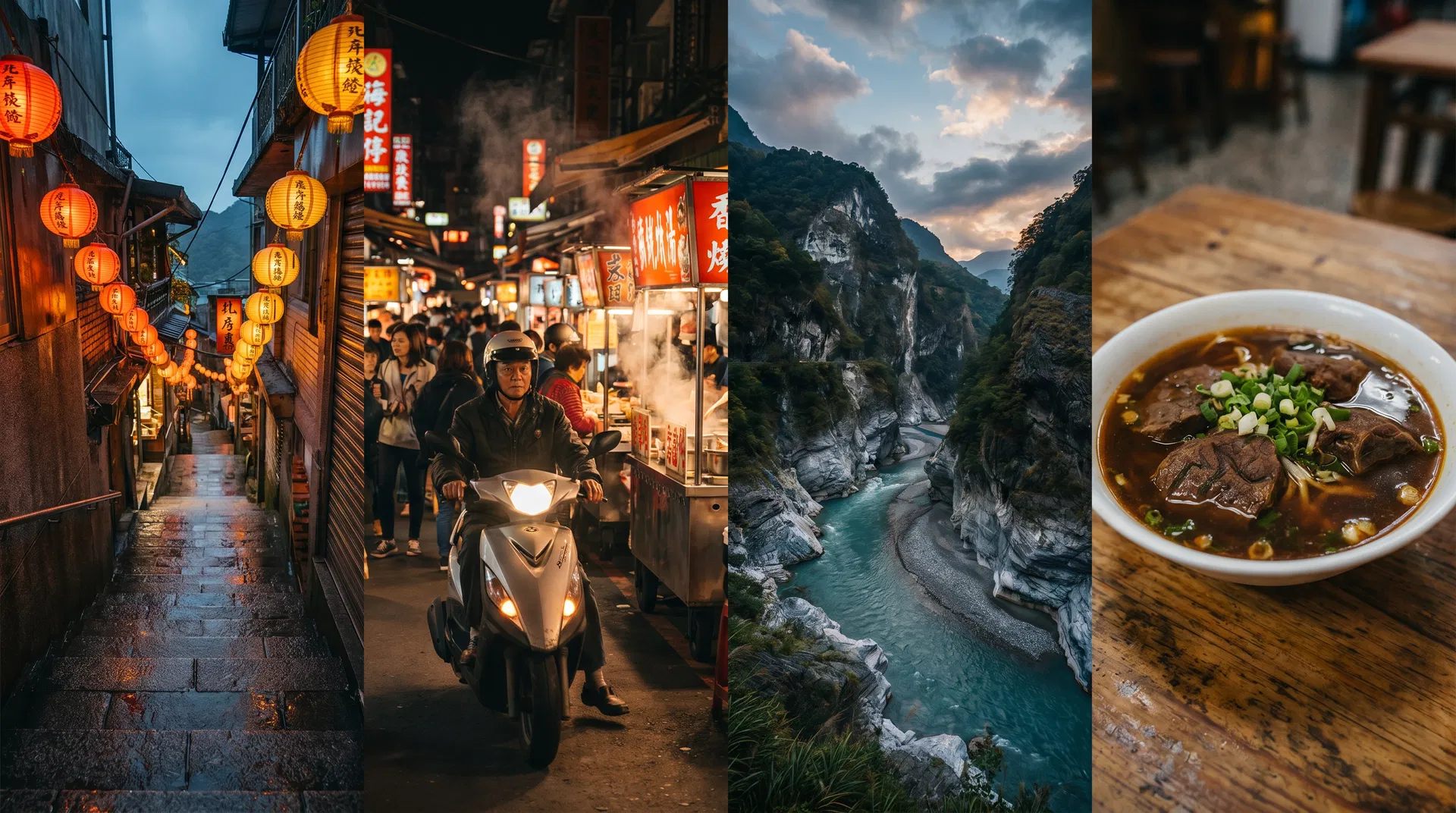
Jiufen is a hillside mining town about 45 minutes from Taipei by bus (NT$90 each way, about $3). The old street — a narrow, lantern-hung alley that climbs the hillside past tea houses, dumpling shops, and vendors selling taro balls — is one of the most atmospheric places in Asia. It's often compared to the setting of Studio Ghibli's Spirited Away, and the comparison isn't wrong.
Go in the late afternoon, when the light turns golden and the lanterns start to glow. Find a tea house with a view of the harbor — the ones on the upper levels of the old street are the best, and a pot of tea with taro balls runs NT$150–200 ($4–6) per person. Stay until dark, when the lanterns reflect off the water below and the whole town looks like something from a dream.
The bus back to Taipei runs until late. Total cost for the day: NT$400–600 ($12–18) including transport, food, and tea.
Pro tip: Combine Jiufen with a stop at Yehliu Geopark on the way back — bizarre mushroom-shaped rock formations on a coastal headland that look like they belong on another planet. Entry is NT$80 ($2.50).
Day 3: Taroko Gorge — Taiwan's Greatest Natural Wonder
This is the day that requires the most logistics but delivers the most reward.
Taroko Gorge is a marble canyon on Taiwan's east coast — sheer cliffs dropping hundreds of meters to a turquoise river, with hiking trails carved into the rock face and Buddhist temples tucked into the cliff walls. It's one of the most dramatic natural landscapes in Asia, and it's a 2.5-hour train ride from Taipei (NT$440 each way, about $14, on the Puyuma Express).
The key trails are free to walk: Shakadang Trail (a flat, 4km riverside path carved into the canyon wall), Swallow Grotto (where the gorge narrows to almost nothing and the rock overhead is close enough to touch), and the Eternal Spring Shrine (a temple built into a waterfall). You don't need a guide, you don't need a tour, and you don't need to spend anything beyond the train ticket and whatever you eat.
The town of Hualien, at the mouth of the gorge, has excellent food — the beef noodle soup here is considered among the best in Taiwan, and a bowl runs NT$120–180 ($3.50–5.50). Take the evening train back to Taipei.
Day 3 total cost: NT$1,200–1,500 ($35–45) including round-trip train, food, and incidentals. This is the most expensive day of the trip and still costs less than a dinner out in most major US cities.
Plan your Taipei base: Taipei 4-Day Budget Guide →
Day 4: Taipei Deep Dive — The Neighborhoods Nobody Tells You About
Your last day is for the Taipei that doesn't make the highlight reels.
Start at Dihua Street in the Dadaocheng neighborhood — a 19th-century trading street lined with baroque shophouses selling dried goods, traditional medicine, and some of the best preserved architecture in the city. The morning market here is a working neighborhood market, not a tourist attraction, and the breakfast options (congee, rice noodles, sesame flatbreads) are exceptional and cheap.
Walk south to the Longshan Temple in Wanhua — one of the oldest and most active temples in Taipei, where the incense smoke is thick and the devotion is genuine. It's free to enter and one of the most atmospheric places in the city.
Spend the afternoon in Da'an District, where the coffee culture is serious and the independent bookshops are worth browsing. The Yongkang Street area has the best beef noodle soup restaurants in the city (the famous ones have lines, but they move fast), and the bubble tea here is the real thing — not the chain versions, but the original shops that invented the drink.
End at Raohe Street Night Market for your final evening — smaller and less touristy than Shilin, with a famous pepper pork bun stall at the entrance that has a line every night for good reason. The bun costs NT$55 ($1.70) and is worth every cent.
Plan your Taipei experience: Taipei Foodie Adventure → | Taipei for Couples → | Solo Taipei →
The Money-Saving Rules That Actually Work
Eat where the locals eat. This sounds obvious, but it bears repeating: the best food in Taiwan is almost always the cheapest. Night markets, local noodle shops, and breakfast stalls run by families who've been doing the same thing for decades will consistently outperform any restaurant with an English menu. A full meal at a local spot costs NT$80–150 ($2.50–4.50). A meal at a tourist-facing restaurant costs three times that and is rarely better.
Use the MRT for everything within Taipei. The Taipei Metro is clean, fast, cheap, and covers virtually every tourist destination in the city. A single-journey ticket costs NT$20–65 ($0.60–2) depending on distance. Buy an EasyCard (NT$100 deposit, refundable) and you get a 20% discount on all MRT rides. Taxis are cheap by Western standards but unnecessary for most of the city.
Book trains early for Taroko. The Puyuma Express to Hualien sells out, especially on weekends. Book at least a week in advance through the Taiwan Railways Administration website. The booking interface is in English and the process is straightforward.
Stay in Zhongzheng or Ximending. These neighborhoods have the best hostel and budget hotel options and put you within walking distance of the MRT, which means you're never more than 20 minutes from anywhere in the city.
Go in shoulder season. March through May and September through November are the sweet spots — warm enough for the east coast, cool enough for hiking, and significantly cheaper for flights than the peak summer months. July and August are hot, humid, and expensive.
What People Get Wrong About Taiwan Travel
The most common mistake is treating Taiwan as a quick add-on to a Japan or Southeast Asia trip. It deserves its own dedicated visit — not because it's difficult to navigate (it's one of the easiest countries in Asia for first-time visitors), but because it rewards depth. The neighborhoods, the day trips, the food culture — these things reveal themselves over days, not hours.
The second mistake is underestimating the east coast. Most visitors spend their entire trip in Taipei and miss the fact that Taroko Gorge, the Hualien coast, and the Rift Valley are among the most spectacular landscapes in Asia. The train journey alone — the Puyuma Express hugging the Pacific coast — is worth the trip.
The third mistake is not talking to anyone. Taiwanese people are genuinely curious about foreign visitors and will go out of their way to help, recommend, and share. The best restaurant tips, the best hidden spots, the best local knowledge — all of it comes from conversations, not guidebooks.
Build Your Taiwan Itinerary
Taiwan is one of those destinations where the planning matters as much as the trip itself — not because it's complicated, but because the right sequence of neighborhoods, day trips, and food stops makes the difference between a good trip and a great one.
Taipei Family Adventure → | Taipei for Couples: Hot Springs & Mountain Villages →
If you want a personalized day-by-day itinerary built around your travel dates, budget, and travel style — one that accounts for the trains you need to book, the neighborhoods that match your vibe, and the food experiences you actually care about — Leif can build it for you in about 60 seconds.
Created by the Ask Leif Team — Reviewed by Shane