Saigon Never Agreed to Be Renamed. That's the Whole Story.
Destination: Ho Chi Minh City
Category: guides
Saigon Never Agreed to Be Renamed. That's the Whole Story.
The first thing that happens when you land at Tân Sơn Nhất International Airport is that you look for the sign. It says Ho Chi Minh City. It has said Ho Chi Minh City since 1976, when the North Vietnamese government renamed the captured southern capital in honor of their late revolutionary leader. The sign is official. The sign is correct. The sign is, in the most technical sense, the name of the place you have just arrived in.
Then you get into a taxi. The driver asks where you're going. You tell him your hotel address, somewhere in District 1. He nods, pulls into traffic, and says: "Saigon very busy tonight." Not Ho Chi Minh City. Saigon. He has been saying Saigon his entire life, his parents said Saigon before him, and his children will almost certainly say Saigon after him. The official name exists in documents, on airport signs, on government letterhead, and in the mouths of people who want to signal their political alignment. Everyone else — the taxi drivers, the banh mi vendors, the café owners, the young entrepreneurs building tech startups in converted shophouses — says Saigon.
This is not a small thing. It is the entire thing. A city of nine million people has been quietly, daily, stubbornly refusing to accept its official name for fifty years. That refusal is not nostalgia. It is not politics, exactly. It is something more fundamental: an identity so strong that it survived being renamed, and continues to express itself in every domain of city life — in the food, in the pace, in the architecture, in the way the city relates to its own history. Understanding why the people of this city still say Saigon is understanding what this city actually is.
The Name on the Sign and the Name in the Street
The city was renamed Ho Chi Minh City on July 2, 1976, one year after North Vietnamese Army tanks broke through the gates of the Presidential Palace on April 30, 1975. The renaming was the final symbolic act of reunification — the North had been calling the city Ho Chi Minh City in their official communications since 1946, and the formal name change was, in their framing, simply bringing the map into alignment with the political reality.
The southern residents saw it differently. Saigon had been Saigon — in various spellings and pronunciations — since at least the seventeenth century, when Vietnamese refugees fleeing the Trịnh–Nguyễn civil war settled in the Khmer city of Prey Nôkôr and began calling it by a name derived from the dense forest that surrounded it. The name predated French colonization by two centuries. It was not a colonial imposition. It was the city's own name, given by its own people, and the act of changing it felt to many southerners less like reunification and more like erasure.
So they kept saying Saigon. Not loudly, not as protest — just as the ordinary, daily act of calling the place where they lived by the name they had always called it. Today, the shopping center in the heart of District 1 is called Saigon Centre. The main railway station is Sài Gòn Station. The river that runs through the city is the Saigon River. The river cruise companies call themselves Saigon River Cruise. The airport's IATA code — the three-letter identifier assigned by international aviation authorities and printed on every boarding pass, every baggage tag, every flight booking in the world — is SGN: Saigon. The city's own residents, when they speak casually, say Saigon. The official name is Ho Chi Minh City. The city's name is Saigon. Both are true. The tension between them is the story.
The Reunification Palace Hasn't Changed Since 1975
The building that ended the war is still standing exactly as it was on the morning it ended. The Reunification Palace — called the Independence Palace before 1975 — sits in a wide green compound in District 3, and the rooms inside it have not been meaningfully altered since the moment Tank 843, a Soviet-made T-54B, broke through the side gate on April 30, 1975. The tank stalled after crashing through. Tank 390 followed and made it all the way to the front steps. Both tanks are still on the grounds, parked where history left them.
Inside, the palace is a time capsule of the South Vietnamese government's final days. The president's bedroom is preserved with its original furniture. The war room in the basement still has the original maps on the walls, the original telephones on the desks — the kind of rotary phones that were state-of-the-art in 1975 — and the original communications equipment that was still operational when the North Vietnamese Army arrived. The rooms feel less like a museum and more like a crime scene that was never cleaned up, which is perhaps the most honest way to present a building where a government ceased to exist.
What the palace does that no exhibit could replicate is make the end of the war feel immediate. You stand in the war room and look at the telephones and understand, in a way that no documentary can convey, that people were using those telephones to coordinate a defense that was already lost. The palace is the most honest building in the city. It doesn't editorialize. It just shows you what was there.
The name of the palace itself is part of the same tension. It was the Independence Palace when it housed the South Vietnamese government. It became the Reunification Palace after 1975. Two names, two histories, one building. The city has been living inside that same duality ever since.
The War Remnants Museum Is Not What You Think It Will Be
Most visitors expect the War Remnants Museum to be difficult. They have been told it is difficult. They arrive prepared for difficulty, which means they arrive with a certain emotional armor in place — the armor of someone who knows they are about to see something hard and has decided to be mature about it.
The armor doesn't help. The museum, housed in a former US Information Service building in District 3, is not difficult in the way you expect. The photographs in the Agent Orange exhibit — the third-generation birth defects, the children who were born into consequences they had no part in creating — are not difficult in the way that a war film is difficult. They are difficult in the way that facts are difficult when the facts are unbearable. There is no narrative distance. There is no score. There is just the evidence.
What the museum does that most war museums don't is present the war from the perspective of the people who were bombed. This sounds obvious, but it is not. Most war museums in the world present the war from the perspective of the people who did the fighting. The War Remnants Museum presents it from the perspective of the people who were underneath the bombs. The effect is disorienting for Western visitors in a way that is, ultimately, useful. You leave understanding something about the war that you did not understand before, and that understanding changes how you see the rest of the city.
The museum is also, in its own way, part of the name argument. It was called the Exhibition House for US and Puppet Crimes until 1993, when it was renamed the War Remnants Museum — a softening of the original title that reflected Vietnam's warming relationship with the United States and the opening of the economy. The name changed. The photographs did not. For solo travelers who want to understand what they're walking through, the Ho Chi Minh City solo travel guide builds a four-day itinerary that sequences the War Remnants Museum and the Reunification Palace on the same day — the right order, the right pacing, the right emotional architecture for what these two places do to you in combination.
The Hẻm Behind the Street Is Where the City Actually Lives
The streets of District 1 are what tourists see. The hẻm — the alleyways that run behind and between and through every block in the city — are where the city actually happens. Every major street in Saigon has a network of hẻm running off it, and inside those alleys is a parallel city: smaller, quieter, cheaper, more honest. Plastic stools. Folding tables. Women cooking over gas burners set up on the pavement at five in the morning, serving bowls of soup to construction workers who will be on-site by six.
The hẻm are not a secret. They appear in travel guides. But they are consistently described as a place to find "authentic" food, which misses the point. The hẻm are not authentic because they haven't been touched by tourism. They are authentic because they are functional. The food exists because the people who live and work in those alleys need to eat, and the women who cook it have been cooking it for decades, and the recipes are calibrated to the preferences of the people who eat there every day, not to the preferences of people who are visiting once. That calibration is what you taste.
Hẻm 18A off Nguyễn Thị Minh Khai Street in District 3 is a good example of what this looks like in practice: a single alley that contains a vegetarian restaurant, a bún bò Bảo Trâm stall serving a complex crab noodle soup, a fruit stand, and a woman who sells bánh cuốn — steamed rice crepes filled with wood ear mushrooms and ground pork — from a cart that appears at 6:30 AM and is gone by 8:30. You cannot find her on Google Maps. You find her by being in the alley at the right time.
The food in the hẻm is also where the name argument plays out at its most granular. The stall signs say whatever they say. The vendors call the neighborhood Saigon. The menus, if there are menus, might say Ho Chi Minh City in the header and Saigon in the dish descriptions. The city's identity is not resolved at the governmental level. It is negotiated, every day, in ten thousand small transactions. For a full map of where to eat — from the hẻm stalls to the sit-down restaurants that the city's food culture is actually built around — the Ho Chi Minh City food guide covers four days of eating in a way that goes well past the obvious.
Chợ Lớn: The City That Was Already a City Before Saigon Was
District 5 is not where most tourists go. This is a mistake. Chợ Lớn — literally "big market," the name for the Chinese district that occupies Districts 5 and 6 — was a separate city before it was absorbed into Saigon, and it has the bones to prove it. The streets are narrower. The signage is in Vietnamese and Cantonese. The temples are older than anything in District 1. The Ba Thiên Hậu Pagoda, built by Cantonese immigrants in 1760, predates the French colonial period by nearly a century and is still an active place of worship, not a tourist attraction that happens to have incense.
The history of Chợ Lớn is the history of Chinese migration to southern Vietnam — waves of Cantonese, Teochew, and Hakka merchants who arrived over three centuries and built a commercial district so successful that it became the rice capital of Southeast Asia. The market that Quách Đàm, a Chinese merchant, built with his own money in the 1920s is now called Chợ Bình Tây, and it is still the wholesale hub for the surrounding neighborhoods. Unlike Bến Thành Market — which is where tourists go and where prices are calibrated accordingly — Chợ Bình Tây is where the city's restaurant owners and market vendors come to buy in bulk. The vendors speak Cantonese to each other and Vietnamese to customers, and the prices are what prices are when the buyer is local.
The food in Chợ Lớn is also distinct from the food in the rest of the city in ways that matter. Bánh tiêu — fried hollow bread, a Chinese-Vietnamese hybrid that doesn't exist in quite the same form anywhere else — is sold from carts near the market entrance. The dim sum restaurants on Châu Văn Liêm Street open at five in the morning and are full of elderly men reading newspapers by six. The soup stalls serve hủ tiếu with a Teochew broth that is different from the Cambodian-influenced version you get in the rest of the city. Chợ Lớn is the part of Saigon that was already a city before Saigon was a city, and it has been quietly maintaining that identity for three hundred years. For couples who want to spend a day in this part of the city, the Ho Chi Minh City couples guide builds a three-day itinerary that includes a morning in Chợ Lớn alongside the rest of what makes this city worth sharing with someone.
The Breakfast That Isn't Pho
Everyone knows about pho. Pho is the Vietnamese dish that the world knows. But pho is a northern dish — it originated in Nam Định Province and was carried south by migrants in the twentieth century. In Saigon, the breakfast of choice is not pho. It is hủ tiếu Nam Vang.
Hủ tiếu Nam Vang is a noodle soup with a history as complicated as the city itself. Nam Vang is the Vietnamese name for Phnom Penh, and the dish arrived in Saigon with Cambodian-Chinese migrants who brought their noodle soup tradition with them and adapted it to the ingredients available in southern Vietnam. The result is a broth made from pork bones and dried shrimp, lighter and sweeter than pho, served with thin rice noodles, sliced pork, a whole shrimp, quail eggs, and a small piece of liver. It can be ordered wet — in the broth — or dry, with the broth on the side and the noodles dressed with lard and fish sauce. The dry version is the local preference.
The stall on Cao Thắng Street in District 3, which opens at eleven and closes when the pot is empty — usually by two in the afternoon — is one of the better-known versions, but the dish is everywhere in the city's hẻm. It is the dish that Saigon made its own from someone else's recipe, which is, in a way, the story of the city: absorbing influences, adapting them, making them specifically and irreversibly local.
Pho exists in Saigon. But the dish that the city's residents eat for breakfast, the dish that the hẻm vendors have been serving since before the war, the dish that is specifically and irreversibly southern Vietnamese — that is hủ tiếu Nam Vang. It does not appear in the top five Google results for "Ho Chi Minh City food." It appears in the city itself, at plastic tables, at six in the morning, served by women who have been making the same broth for thirty years.
Cà Phê Sữa Đá and the Saigon Pace
The coffee culture of Saigon is not the coffee culture of Hanoi, and the difference matters. Hanoi has egg coffee — cà phê trứng — a Hanoi invention, a Hanoi identity marker, a Hanoi thing. Saigon has cà phê sữa đá: Vietnamese iced coffee with condensed milk, brewed through a slow-drip phin filter, poured over ice, drunk on a plastic stool on a pavement that is already busy at five-thirty in the morning.
The difference is not just the recipe. It is the pace. Hanoi coffee culture is contemplative. You sit with your egg coffee in a narrow shophouse and look at the street. Saigon coffee culture is operational. You drink your cà phê sữa đá because you need to be somewhere in twenty minutes and the coffee is the fuel that gets you there. The city contributes twenty-three percent of Vietnam's entire GDP from less than one percent of its land area. That density is not accidental. It is the product of a city that has been running at this pace for decades, and the coffee is part of the infrastructure.
The Cafe Apartment building on Nguyễn Huệ Street — a 1960s residential tower that has been entirely converted into cafés, nine floors of them, each one a different aesthetic, each one accessible by a single narrow staircase — is the most visible expression of what happens when Saigon's coffee culture meets its vertical village architecture. The building is genuinely extraordinary: you walk in expecting a single café and find an entire ecosystem, each floor a different world, the views from the upper floors looking out over the walking street below toward the Saigon River. It is also, inevitably, now on every tourist itinerary. The best version of the Cafe Apartment experience is to arrive before nine in the morning on a weekday, when the tourists have not yet arrived and the building is being used by the people who actually work in it.
For travelers who want to experience the city's coffee culture without the tourist markup, the Ho Chi Minh City budget guide maps out a four-day itinerary built around the city's twenty-dollar-a-day floor — which is achievable, and which includes cà phê sữa đá at street stalls where the coffee costs thirty cents and the plastic stool is included.
When to Go, How Long to Stay
Saigon has two seasons: wet and dry. The dry season runs from November through April. The wet season runs from May through October. The distinction matters less than it sounds, because the wet season rain in Saigon is not the kind of rain that ruins a day. It arrives in the afternoon, usually between two and four, falls hard for forty-five minutes, and stops. The streets flood briefly, drain quickly, and the city continues. The temperature barely changes. If you are going to Saigon in July and you are worried about the rain, stop worrying. Bring a light rain jacket for the afternoon and spend the morning outside.
The dry season is more comfortable for walking, particularly November through January, when the humidity drops to something approaching manageable. February and March are the best months: cool enough to walk the city for hours, dry enough to eat outside without watching the sky. April is the hottest month of the year and the end of the dry season, but it is also when the city celebrates the anniversary of April 30, 1975 — the day the tanks came through the gates — with a public holiday that is officially called Reunification Day and colloquially called Liberation Day, depending on who you ask.
Four days is the minimum to understand the city. Three days is enough to see the landmarks. Four days is enough to find the hẻm behind the landmarks, to eat in Chợ Lớn, to spend a morning at the War Remnants Museum and an afternoon recovering from it. Five days is enough to take a day trip to the Mekong Delta.
Getting Around a City That Never Stops Moving
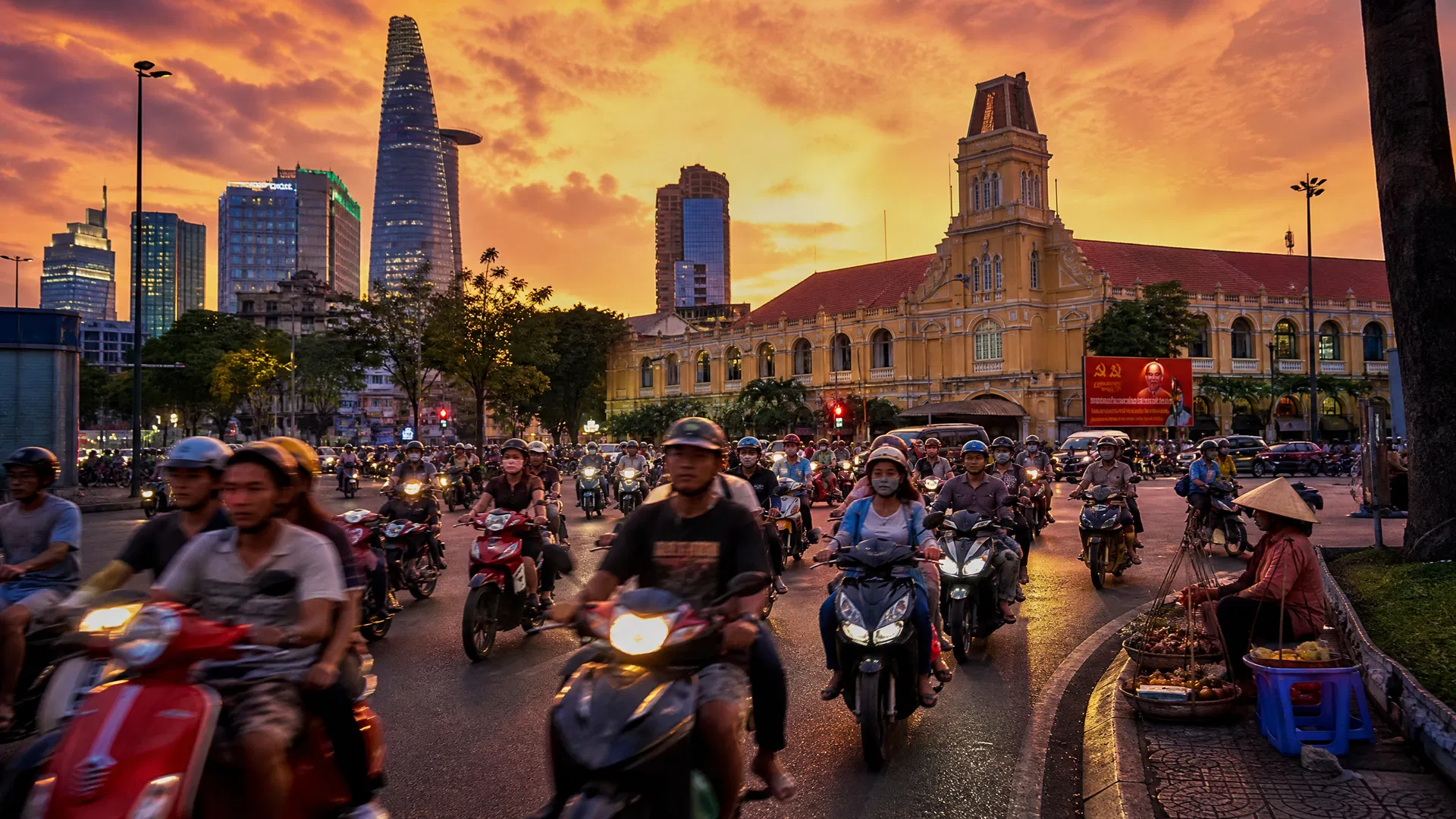
The motorbike is the unit of measurement in Saigon. The city has approximately four million registered motorbikes, and the traffic they create is not chaos — it is a system with its own logic, its own etiquette, its own physics. The rule for crossing the street is to walk slowly and steadily, never to stop, never to run. The motorbikes will flow around you. This sounds terrifying and is, in fact, fine. The drivers are skilled. They have been navigating pedestrians for their entire lives.
Grab — the Southeast Asian equivalent of Uber — operates throughout the city and is the most reliable way to get from one district to another. The app works in English, the prices are fixed before you confirm the ride, and the drivers know the city. GrabBike, the motorbike taxi option, is faster and cheaper than GrabCar and is the local preference for short trips. The metro system — Line 1, which opened in 2024 after a decade of construction — runs from Bến Thành Station in District 1 to Suối Tiên in the northeast, and is useful for reaching the airport and the eastern districts, though it does not yet cover most of the city's tourist areas.
Walking is possible in District 1 and District 3, where the major landmarks are clustered within reasonable distance of each other. Walking is not possible in the outer districts, where the distances are too large and the footpaths too inconsistent. The city is not built for pedestrians in the way that European cities are built for pedestrians. It is built for motorbikes, and the best way to experience it is to accept that and move accordingly.
Planning Your Trip to Saigon
The question most people ask before going to Saigon is whether to combine it with the rest of Vietnam. The answer is yes, but with a specific caveat: Saigon is not a gateway to Vietnam. It is a destination. Treating it as a starting point for a northern itinerary — two days in Saigon, then fly to Hanoi, then Hạ Long Bay — means leaving before you have understood what you came for.
The better structure is to give Saigon four days at the start or end of a longer trip, and to treat those four days as their own thing. The War Remnants Museum and the Reunification Palace on day one. Chợ Lớn and the hẻm on day two. The Cafe Apartment and Nguyễn Huệ walking street on day three. The Mekong Delta on day four — a full-day trip that takes you ninety minutes south of the city into a landscape of floating markets, river villages, and coconut candy factories that is as different from Saigon as it is possible to be while still being in the same country. The Mekong Delta adventure guide covers the delta in depth for those who want to extend beyond a day trip.
For the broader question of how Saigon fits into a Vietnam itinerary — whether to go north to south or south to north, how to sequence Hội An and Đà Nẵng and Hà Nội — the Vietnam 5-day country guide provides the structural framework. And for families traveling with children, the Ho Chi Minh City family guide builds an itinerary that makes the history accessible without being overwhelming, and finds the parts of the city that work for every age.
This is where the AskLeif itinerary generator earns its keep. Saigon is a city that rewards specificity — the right neighborhood, the right time of day, the right sequence of experiences — and building a trip around a generic "top ten things to do" list means missing the city that exists behind the list. The generator builds itineraries around how you actually travel: your pace, your interests, your tolerance for heat and crowds and early mornings. The difference between a Saigon trip that feels like a checklist and one that feels like a city is usually a matter of sequencing, and sequencing is what the tool does.
What the Name Tells You
The name argument is not going to be resolved. The official name is Ho Chi Minh City. The city's name is Saigon. Both are true and will remain true, and the tension between them is not a problem to be solved but a fact to be understood.
What the name tells you is that this is a city with a strong enough identity to survive being renamed. That identity is not nostalgia — it is not a longing for the South Vietnamese government or the pre-1975 order. It is something more durable: a sense of place, a way of being in the world, a specific relationship between the people who live here and the city they live in. The Saigonese are not southerners in the way that people from the American South are southerners — defined by loss, by a mythology of what was taken. They are southerners in the sense that they are from a specific place with a specific character, and that character has survived everything that has been thrown at it.
The city is the economic engine of a country of ninety-seven million people. It generates twenty-three percent of Vietnam's GDP. It is the place where the country's startups are founded, where its fashion industry operates, where its film industry is based, where its food culture is most diverse and most alive. It is the place where young Vietnamese come when they want to build something. That energy — the energy that the broad Vietnam post calls "an energy that has no name" — has a name. It's called Saigon.
The taxi driver who says "Saigon very busy tonight" is not making a political statement. He is just saying where he lives. But in a city where the official name and the real name have been in disagreement for fifty years, every casual use of the old name is a small act of continuity — a thread connecting the city that exists now to the city that existed before the tanks came through the gates. The thread has not broken. It will not break. The sign at the airport says Ho Chi Minh City. The city says Saigon. That gap, that small persistent disagreement between the official version and the lived version, is what you come here to understand. And you will not understand it until you have been here, until you have sat on a plastic stool at five-thirty in the morning with a glass of cà phê sữa đá in your hand, listening to the motorbikes, and heard someone say the name.