The Mountains That Were Ancient When Rome Was Young: A Real Guide to the Great Smoky Mountains
Destination: Great Smoky Mountains, Tennessee/North Carolina, USA
Category: National Parks
The Mountains That Were Ancient When Rome Was Young: A Real Guide to the Great Smoky Mountains
The Great Smoky Mountains are older than the Atlantic Ocean.
Let that sit for a moment. The Appalachians — the range that the Smokies anchor — began forming roughly 480 million years ago, when the continents that would become North America and Africa collided with a force that pushed the earth's crust skyward into peaks that once rivaled the Himalayas. The Atlantic Ocean, by contrast, is about 180 million years old. The Smokies were already ancient, already worn down by hundreds of millions of years of rain and wind and ice, before the ocean that separates the Old World from the New had even opened.
This is the first thing to understand about the Great Smoky Mountains National Park: the scale of time here is genuinely different from almost anywhere else you will ever stand. The rocks underfoot are among the oldest exposed on the surface of the earth. The forests that cover them — temperate rainforests receiving up to 85 inches of precipitation per year in the highest elevations — are among the most biologically diverse in the temperate world. There are more tree species in the Smokies than in all of northern Europe. There are more species of salamander here than anywhere else on earth. On a single ridge in spring, you can count more wildflower species than in entire national parks in the American West.
And yet most people who visit the Great Smoky Mountains National Park — which receives more visitors annually than Yellowstone and Grand Canyon combined, making it the most visited national park in the United States — spend the majority of their time in Gatlinburg, Tennessee, eating at chain restaurants and riding go-karts.
This guide is for the other kind of visitor.
What the Smokies Actually Are
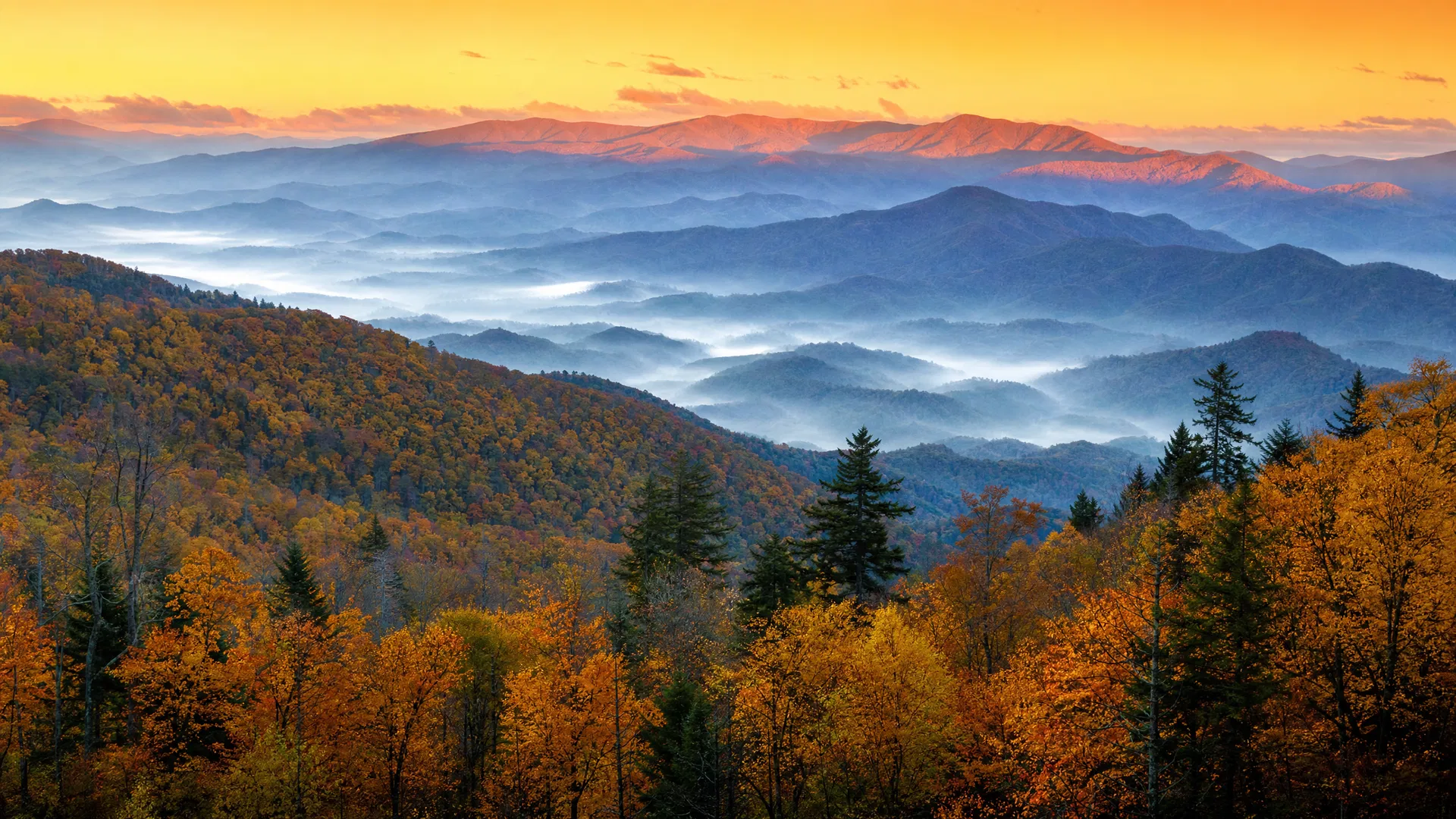
The Great Smoky Mountains National Park straddles the border between Tennessee and North Carolina, covering 522,000 acres of some of the most ecologically complex terrain in North America. The "smoke" in the name is real — it is not pollution or haze, but the volatile organic compounds released by the trees themselves, which react with sunlight to create the characteristic blue-grey mist that hangs in the valleys and hollows at dawn and dusk. The Cherokee, who lived in these mountains for thousands of years before European contact, called them Shaconage — "place of blue smoke."
The park rises from around 900 feet at its lowest elevations to 6,643 feet at Clingmans Dome, the highest point in the Appalachians. This elevation gradient creates a series of distinct ecological zones, from the cove hardwood forests of the lower valleys — where tulip poplars grow to 150 feet and the spring wildflower bloom is one of the most spectacular natural events in the eastern United States — to the spruce-fir forests of the high ridges, which feel more like Canada than Tennessee, with their mossy boulders and fog-shrouded silence.
The park is also a UNESCO World Heritage Site and an International Biosphere Reserve, designations that reflect its status as one of the most important protected ecosystems in the world. It is home to approximately 1,500 species of flowering plants, 100 species of trees, 240 species of birds, 66 species of mammals, 50 species of fish, and 80 species of reptiles and amphibians. The salamander count alone — 30 species — makes the Smokies the "Salamander Capital of the World," a title that sounds modest until you understand that most of the world's salamander diversity is concentrated in the southern Appalachians and that these animals are among the most sensitive indicators of ecosystem health on earth.
The Cherokee: The Mountains' First Stewards
Before there was a national park, before there were European settlers, before there was a United States, the Cherokee people had been living in these mountains for at least a thousand years. Their territory, Tsalagi Ayvwiya — "the Principal People's land" — covered much of the southern Appalachians, and the Smokies were at its heart.
The Cherokee relationship with the mountains was not the romantic abstraction that gets applied to it in tourist literature. It was practical, detailed, and deeply knowledgeable. The Cherokee knew which plants cured which ailments, which streams held which fish at which seasons, which ridges were safe to cross in winter and which were not. They built towns in the river valleys — Chota, Echota, Kituwah — and maintained a network of trails through the mountains that the first European explorers followed because they were the only routes that worked.
The Trail of Tears — the forced removal of the Cherokee from their homeland in 1838 — is one of the most consequential and least-taught events in American history. Approximately 4,000 Cherokee died on the march west to what is now Oklahoma. But a group of Cherokee, led by a man named Tsali and sheltered by a white settler named William Holland Thomas, refused to leave and hid in the mountains. Their descendants are the Eastern Band of Cherokee Indians, who today live on the Qualla Boundary — a 57,000-acre tract of land adjacent to the national park — and operate the Museum of the Cherokee Indian in Cherokee, North Carolina.
The Museum of the Cherokee Indian is one of the most important museums in the American South. Its collection covers 12,000 years of Cherokee history and culture, from the Paleo-Indian period through the present day. The exhibits on the Trail of Tears are among the most honest and devastating accounts of American ethnic cleansing available in any public institution. This museum is not optional. It is essential.
The Appalachian Settlers: A Culture That Shaped America
After the Cherokee, the mountains were settled by waves of European immigrants — primarily Scots-Irish, English, and German — who arrived in the late eighteenth and early nineteenth centuries and built a culture that was shaped by the isolation and self-sufficiency that mountain life demanded.
Appalachian culture is one of the most misunderstood and misrepresented in America. The caricature — poverty, ignorance, insularity — is a distortion that serves the interests of those who want to dismiss the region. The reality is a culture of extraordinary resourcefulness, musical creativity, and community solidarity that gave America bluegrass music, old-time fiddle traditions, a distinctive approach to woodworking and quilting, and a tradition of storytelling that is among the richest in the English-speaking world.
The national park preserves more than 90 historic structures — log cabins, barns, grist mills, churches — that document the lives of the mountain settlers who were displaced when the park was created in the 1930s. Cades Cove, a broad valley on the Tennessee side of the park, is the most complete example: a working nineteenth-century landscape of fields, orchards, and homesteads that has been preserved largely intact. The Cable Mill, still operating, grinds corn into meal. The Methodist church, built in 1902, still holds occasional services. White-tailed deer graze in the fields at dusk, and black bears emerge from the tree line in the morning.
The Oconaluftee Visitor Center on the North Carolina side has the Mountain Farm Museum, an outdoor collection of historic structures that gives a visceral sense of what mountain farming life actually looked like. The Mingus Mill, a turbine-powered grist mill built in 1886, is one of the best-preserved examples of Appalachian industrial ingenuity in existence.
The Trails: Where the Park Reveals Itself
The Great Smoky Mountains National Park has 800 miles of trails, ranging from paved accessible paths to multi-day backcountry routes that require permits and serious preparation. The trails are the only way to actually experience what the park is — the road system, while scenic, gives you a windshield view of a landscape that demands to be walked.
Alum Cave Trail is the single best introduction to the Smokies for a first-time visitor. The 4.4-mile round trip to Alum Cave Bluffs — a massive overhanging arch of black slate that the Cherokee used as a shelter — passes through old-growth forest, crosses log bridges over Alum Cave Creek, and climbs through a series of geological features that tell the story of the mountains' formation. The bluffs themselves are extraordinary: a 100-foot overhang of dark rock streaked with minerals, dripping with moisture, covered in mosses and ferns. Continue past the bluffs another 2.5 miles to the summit of Mount LeConte — at 6,593 feet, the third-highest peak in the park — and you have done one of the great day hikes in the eastern United States.
Ramsey Cascades Trail leads to the highest waterfall in the park — a 100-foot cascade that drops over a series of massive boulders in one of the most dramatic settings in the Smokies. The 8-mile round trip passes through old-growth cove hardwood forest with trees that are genuinely staggering in their size: tulip poplars and yellow birches with trunks six feet in diameter, their canopies closing over the trail like a cathedral ceiling. This is what the forest looked like before European settlement. Almost none of it survives outside the national park.
Chimney Tops Trail was one of the most popular in the park before the 2016 wildfire that burned the summit. The trail has been rebuilt and the summit reopened, and the views from the rocky twin peaks — 360 degrees of ridgelines and valleys, with Gatlinburg visible far below — are among the best accessible from a day hike in the park.
The Appalachian Trail runs along the Tennessee-North Carolina border through the park for 71 miles, including the summit of Clingmans Dome. The 5-mile stretch from Newfound Gap to Charlies Bunion — a rocky outcropping with sheer drops and views that extend to multiple states on clear days — is one of the most spectacular sections of the entire 2,190-mile trail.
Clingmans Dome deserves special mention. The observation tower at the summit is reached by a half-mile paved trail from the parking area — steep enough to be a genuine workout, but accessible to most visitors. On clear days, the views extend 100 miles in every direction. More often, the summit is in the clouds, which is its own experience: standing above the treeline in the fog, surrounded by the ghostly forms of Fraser firs killed by the balsam woolly adelgid, with the wind coming in from the west and the temperature dropping twenty degrees below the valley floor. This is the Smokies at their most elemental.
The Wildlife: What You Will Actually See
The Smokies have one of the healthiest black bear populations in the eastern United States — approximately 1,900 bears in the park, which works out to roughly one bear per 275 acres. You will almost certainly see one if you spend more than two days in the park. The protocol is simple and non-negotiable: stay at least 50 yards away, never approach, never feed, never leave food unattended. Bears that become food-conditioned are euthanized. The bears that survive are the ones that remain wild.
The elk herd in the Cataloochee Valley on the North Carolina side is one of the great wildlife spectacles in the eastern United States. Elk were extirpated from the Appalachians in the nineteenth century; the current herd descends from animals reintroduced from Elk Island National Park in Canada in 2001. The rut in October — when the bulls bugle and spar in the valley meadows at dawn and dusk — draws wildlife photographers from across the country. Cataloochee is remote enough (a winding 11-mile gravel road from the nearest highway) that it remains uncrowded even during peak season.
White-tailed deer are everywhere in Cades Cove, particularly at dawn and dusk. Wild turkeys are common throughout the park. River otters, reintroduced in the 1990s, are now established in the park's streams. The synchronous firefly display at Elkmont Campground in late May and early June — when thousands of Photinus carolinus fireflies flash in unison, creating a light show that has no parallel in the natural world — is one of the most extraordinary natural events in North America. The National Park Service runs a lottery for the viewing shuttle; apply months in advance.
The Tennessee Side vs. The North Carolina Side
Most visitors enter the park from the Tennessee side, through Gatlinburg. This is understandable — Gatlinburg is the largest gateway town and has the most lodging — but it means that the North Carolina side, which is quieter, less commercial, and in many ways more beautiful, goes largely unvisited.
The North Carolina entrance at Cherokee leads directly to the Oconaluftee Valley, where the Mountain Farm Museum and the Oconaluftee River Trail offer some of the most accessible and rewarding experiences in the park. The Blue Ridge Parkway begins at Cherokee and runs 469 miles northeast to Shenandoah National Park in Virginia — one of the great scenic drives in America, and a natural extension of any Smokies trip.
Maggie Valley, just east of Cherokee, is a small mountain town that has preserved more of the old Appalachian character than Gatlinburg. Waynesville, further east, is a genuine small city with a thriving arts scene, excellent restaurants, and a historic downtown that has not been converted entirely into tourist infrastructure. Asheville, 60 miles east on I-40, is one of the most interesting small cities in the American South — the Biltmore Estate, the River Arts District, the food scene that has made it one of the top culinary destinations in the Southeast. The Ask Leif guides cover the Great Smoky Mountains from multiple angles, including the 7-day first-timer's guide, the 5-day hiking and waterfalls guide, the 4-day family adventure, the 5-day family road trip, and the 7-day Appalachian loop that takes in Cades Cove, the Blue Ridge Parkway, and the Tail of the Dragon.
The Seasons: When to Go and Why It Matters
The Smokies are a year-round destination, and each season offers something that the others cannot.
Spring (mid-March through May) is the wildflower season, and it is the best-kept secret in the park. The wildflower bloom begins in the lower elevations in mid-March with hepatica and bloodroot, moves up the mountains through April with trillium, wild geranium, and phacelia, and reaches the high ridges in May with flame azalea — a shrub that turns entire mountainsides orange and red. The Smokies have more wildflower species than almost any other area of comparable size in North America, and the spring bloom is genuinely one of the great natural spectacles of the eastern United States. Crowds are moderate in early spring; the park fills up for spring break in late March and April.
Summer (June through August) is peak season — the park receives 60% of its annual visitors in these three months. The waterfalls are at their most dramatic from spring snowmelt and summer thunderstorms. The high-elevation trails are cool even when the valleys are hot. The firefly display at Elkmont happens in late May and early June. The downside is crowds: Cades Cove can have bumper-to-bumper traffic on summer weekends, and parking at popular trailheads fills by 9 AM. The solution is to start early — on the trail by 7 AM — or to visit the less-traveled areas of the park.
Fall (mid-September through November) is the most popular season for a reason. The foliage in the Smokies is among the best in the eastern United States — the diversity of tree species means that the color change is more varied and more prolonged than in New England, moving from the high ridges down to the valleys over a period of six weeks. Peak color at the higher elevations is typically mid-October; the lower valleys peak in late October and early November. The elk rut in Cataloochee Valley happens in October. The crowds are significant, particularly on fall weekends, but the experience justifies it.
Winter (December through February) is the Smokies' secret season. The park is quieter, the air is clear, and the bare trees open up views that are invisible in summer. Snow on the high ridges is common from December through March, and the park occasionally closes Newfound Gap Road due to ice. But the winter hiker who gets to Alum Cave Bluffs on a cold clear morning, with frost on the rocks and the valley below filled with mist, has the park largely to themselves. This is the Smokies at their most honest.
Where to Stay: Beyond the Chain Hotels
Gatlinburg and Pigeon Forge have hundreds of hotels, from budget chains to luxury resorts. But the most memorable Smokies accommodation is the cabin — and the Smokies cabin rental market is one of the most developed in the country, with options ranging from one-bedroom retreats to multi-family compounds with hot tubs, game rooms, and mountain views.
The best cabin areas are in the hills above Gatlinburg (closer to the park entrance, quieter than Pigeon Forge), around Wears Valley on the western side of the park (less commercial, more rural), and in the Maggie Valley/Cherokee area on the North Carolina side. Book well in advance for fall foliage season — October cabins in prime locations sell out six months ahead.
LeConte Lodge, accessible only by trail (the shortest route is 5 miles), is the only lodging inside the park. It has been operating since 1926 and offers a genuine wilderness experience: no electricity, no running hot water, kerosene lamps, and meals served family-style in the main lodge. The views from the summit of Mount LeConte at sunrise are among the best in the eastern United States. Reservations open in October for the following year and sell out within hours.
The Practical Intelligence
The park is free. The Great Smoky Mountains is one of only two national parks (along with Grand Canyon's South Rim) that does not charge an entrance fee. This is a legacy of the original land donation agreements and has been maintained despite periodic attempts to change it. It is one of the reasons the park receives 12 million visitors per year.
Newfound Gap Road is the only road that crosses the park from Tennessee to North Carolina, and it is one of the great scenic drives in the eastern United States. The 31-mile route climbs from Gatlinburg at 1,400 feet to Newfound Gap at 5,046 feet, passing through every ecological zone in the park. Stop at every overlook. The views are different at every elevation.
Cell service is limited inside the park. Download offline maps before you go. The NPS app has downloadable park maps that work without service.
The Roaring Fork Motor Nature Trail is a one-way loop road off Cherokee Orchard Road in Gatlinburg that passes through old-growth forest and by several historic homesteads. It is one of the most scenic drives in the park and is far less crowded than Cades Cove.
Parking is the constraint. The park has been implementing a parking reservation system at the most popular trailheads. Check the NPS website before your visit for current requirements. The alternative is to arrive before 8 AM, when parking is almost always available.
The Sugarlands Visitor Center at the Tennessee entrance is the best starting point for first-time visitors. The exhibits on the park's ecology and history are genuinely excellent, and the rangers are among the most knowledgeable in the national park system.
Why the Smokies Reward the Traveler Who Pays Attention
The Great Smoky Mountains are easy to visit badly. You can drive through on Newfound Gap Road, stop at the overlooks, eat at a chain restaurant in Gatlinburg, and go home having seen the mountains from the outside. Millions of people do exactly this every year.
The traveler who pays attention — who gets up before dawn to watch the mist rise from the valleys, who walks the Alum Cave Trail slowly enough to notice the wildflowers in the rock crevices, who drives the 11-mile gravel road to Cataloochee and stands in the meadow at dusk while the elk bugle in the trees — that traveler experiences something that is genuinely difficult to find anywhere else in the United States.
These are mountains that have been here for nearly half a billion years. They have seen the continents drift, the ocean open, the ice ages come and go. They sheltered the Cherokee for a thousand years and the Appalachian settlers for two hundred. They hold more biological diversity than almost anywhere in the temperate world. They are, in the most literal sense, one of the oldest and most complex places on earth.
The Smokies do not announce themselves. They do not have the dramatic vertical relief of the Rockies or the stark grandeur of the desert Southwest. They are soft and green and layered, their ridges folding into each other like the pages of a book. Their beauty is the kind that accumulates — that you understand more deeply the longer you stay and the more carefully you look.
Plan your Smoky Mountains trip with Ask Leif. Whether you want a complete 7-day first-timer's experience, a focused hiking and waterfalls adventure, a family-friendly 4-day itinerary, or the full Appalachian loop road trip, the mountains have more depth than any single visit can exhaust. That is not a problem. That is the entire point.