The European Cities That Don't Just Tolerate October. They Require It.
Destination: Europe
Category: destination-guide
There is a version of European travel that most people have done, or dreamed of doing, that goes roughly like this: summer, somewhere famous, crowds that make the famous thing feel like a chore. You waited forty-five minutes to board a tram designed to carry twenty people. You walked the walls of a medieval city surrounded by ten thousand other people who had the same idea. You stood in a viewpoint queue long enough to watch the light change twice. The city was beautiful. You were not sure you were actually in it.
October is the answer most travel writers reach for at this point, and they are not wrong to reach for it. But the way they frame it — fewer crowds, lower prices, shoulder season savings — misses what is actually happening in the best cases. Fewer crowds is a reduction. What October does to certain European cities is not a reduction. It is a transformation.
The thesis of this post is specific: most European cities are merely less crowded in October. These six are genuinely different. The distinction matters because it changes how you plan, what you prioritize, and what you actually experience when you arrive. A city that is merely less crowded in October is still the same city, just quieter. A city that is transformed by October is a different city entirely — one that was waiting for the season to change before it could be fully itself. These six cities don't just tolerate October. They require it.
Lisbon: Where October Belongs to the City Again
The thing that makes Lisbon extraordinary in October is not the absence of summer tourists. It is the presence of something that summer tourists make impossible: the city's own atmosphere.
Lisbon is a city built around saudade — the Portuguese concept of longing for something beautiful that has passed or may never fully arrive. It is in the fado music, in the azulejos (the blue-and-white painted tiles that cover entire building facades), in the way the city sits at the edge of the Atlantic looking out toward a former empire. Saudade is not a tourist attraction. It is a mood. And moods require conditions. In July, when forty thousand cruise ship passengers are competing for the same viewpoints and the Tram 28 queue stretches around the block, the conditions for saudade do not exist. The city is performing. In October, it stops.
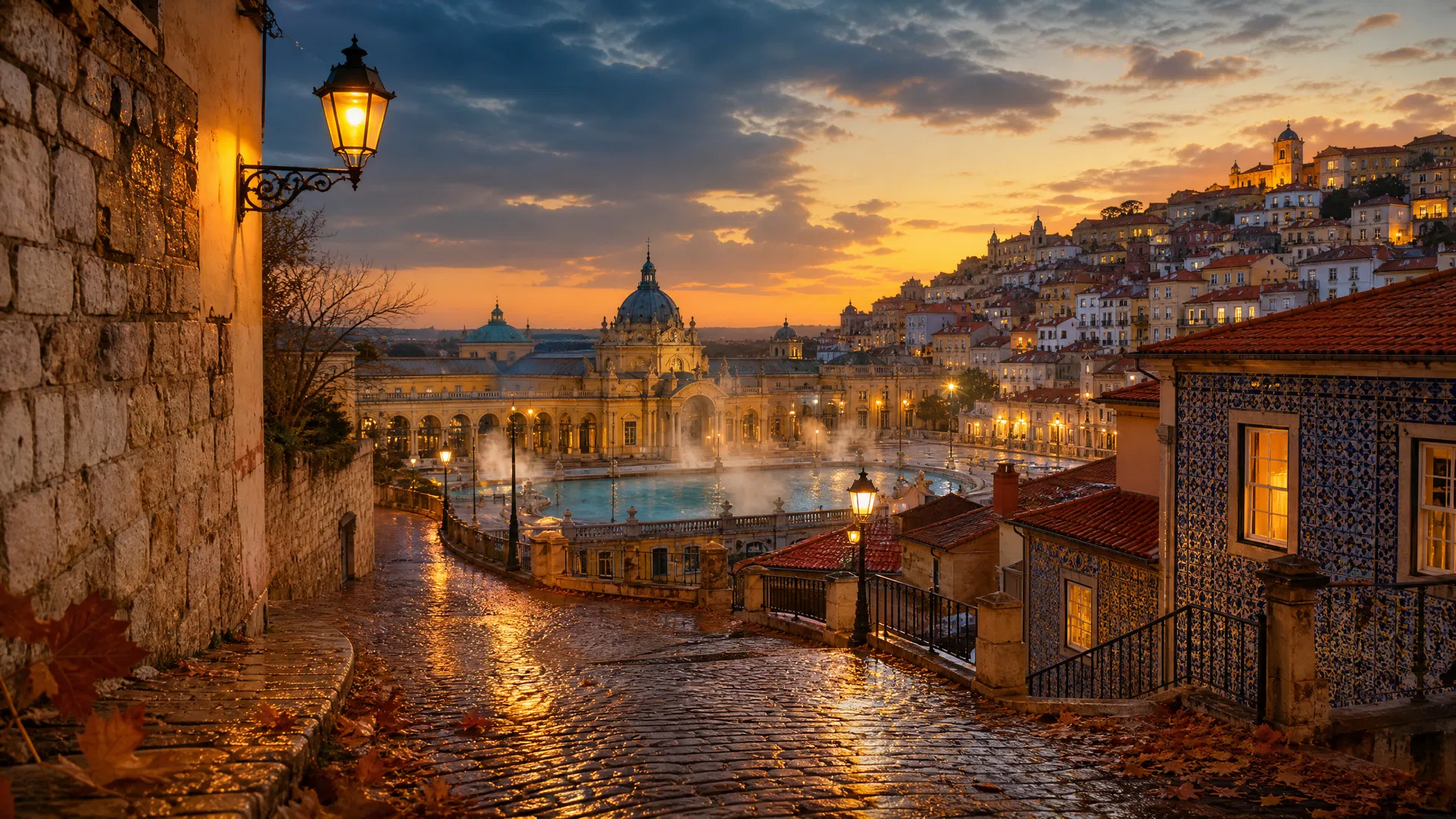
The light changes first. Summer in Lisbon is harsh Mediterranean white — overhead, bleaching, relentless. October brings what the Portuguese call luz de outubro, October light: lower-angled, golden, softer. It hits the azulejos differently. The tiles that look washed out in August glow amber and cobalt in October. The Alfama neighborhood — the old Moorish quarter that climbs the hillside above the Tagus — becomes a different place when the light comes from the side rather than directly above. The shadows are longer. The colors are richer. The city looks the way it looks in the photographs that made you want to go.
From late September, the castanheiros appear — the roasted chestnut vendors who set up their charcoal drums at Rossio, Baixa, Chiado, and along Avenida da Liberdade. This is not a tourist attraction. It is a seasonal marker, the way the first wood smoke of autumn signals a change in the air. You buy a paper cone of chestnuts for three euros and eat them while walking, and the smell of charcoal and autumn follows you through the streets. It is one of those experiences that is impossible to replicate in any other month because it only exists in this one.
The fado houses of Alfama are worth a separate note. In summer, they are full of tourists who have been told to go to a fado house. In October, the audience shifts. Mesa de Frades — housed in an 18th-century chapel on Rua dos Remédios, its walls covered in azulejos — fills with people who came specifically for the music rather than because it was on a list. The acoustics of a chapel built for resonance, the low light, the voice of a fadista singing about longing in a city that understands longing: this is the experience the city was built to provide. October is when it is available.
The miradouros — the viewpoints that look out over the city and the river — are walkable again. Portas do Sol, Santa Luzia, Graça: in summer, these are queued. In October, you can stand at the railing for as long as you want and watch the Tagus go silver in the afternoon light. The city does not feel emptied. It feels returned to itself.
Explore Lisbon with the 5-Day Lisbon Travel Guide or go deeper into the food culture with the Lisbon Food Guide.
Porto: When the Wine World Comes to You
Where Lisbon rewards the slow traveler who wants to absorb a city's atmosphere, Porto in October rewards a different kind of attention: the kind that follows a supply chain from hillside to cellar to glass and wants to understand every step.
October is the tail end of the vindima — the Portuguese word for the grape harvest, which runs from mid-September through mid-October in the Douro Valley, ninety minutes east of Porto by train. The harvest is finishing when October begins, which means the quintas (wine estates) are at their most alive: the grapes are in, the fermentation is beginning, and the estates are still buzzing with the energy of the season's central event. This is the window when the Douro Valley is not a scenic wine region. It is a working one.
Quinta da Pacheca, near Régua, runs full-day harvest programs that include grape stomping in authentic granite lagares — the ancient stone troughs that have been used for this purpose for centuries. Quinta da Roêda, the Croft estate, offers stomping alongside the workers who actually do it for a living. Quinta do Crasto, which produces some of the Douro's most respected wines, opens its wine tourism programs during harvest season in a way that is, as one wine writer put it, "a completely different experience from any other time of year." The difference is not just the activity. It is the context. You are not visiting a winery. You are visiting a winery at the moment when it is most fully itself.
Back in Porto, the wine lodge culture of Vila Nova de Gaia — the city's southern bank, where the great Port wine houses have aged their wines in riverside lodges for centuries — operates at its most authentic in October. Graham's Lodge, built in 1890, offers guided visits through its museum, lodge, and bottle cellar that feel genuinely unhurried when the summer crowds have gone. Taylor's, with its terrace looking back across the Douro toward Porto's skyline, is the kind of place where October light and a glass of twenty-year tawny Port create an experience that is not available in any other season. The people who come to Porto in October came for the wine. The people who came in August came for the photographs. The difference in the rooms is palpable.
The city itself — the Ribeira waterfront, the Livraria Lello bookshop, the São Bento train station with its 20,000 azulejo tiles depicting Portuguese history — is navigable in October in a way it simply is not in summer. But the wine is the point. Porto in October is the argument for planning a trip around what a place produces rather than what it looks like.
Plan your Porto visit with the Porto Food & Wine Guide or combine both cities with the 7-Day Lisbon & Porto Itinerary.
Budapest: The Steam Rises When the Air Gets Cold
The thermal bath cities of Europe — and there are not many of them — have a specific relationship with autumn that cities built around beaches or mountains do not. A beach city in October is a beach city without its central attraction. A thermal bath city in October is a thermal bath city at its absolute peak.
Budapest sits on top of more than 120 natural thermal springs, and the city has been building elaborate structures around them for centuries. The Széchenyi Baths, in City Park, are the most famous: a neo-baroque complex of fifteen indoor pools and three grand outdoor pools, built in 1913, that looks like a palace that decided to become a spa. In summer, the outdoor pools are full of tourists taking photographs and attending the weekend "sparty" events — spa parties with DJs and floating rubber rings that are, by all accounts, exactly as chaotic as they sound. The baths are worth visiting in summer. They are transcendent in October.
The physics of the experience change when the air temperature drops. The outdoor pools are fed by thermal springs that maintain a temperature of around 38°C regardless of the season. In October, when the air temperature in Budapest falls to 10 or 12 degrees, the contrast between the water and the air produces something that photographs cannot fully capture: a dense, rolling steam that rises off the surface and drifts through the neo-baroque arches and columns of the surrounding architecture. The building goes amber in the autumn light. The steam catches the morning sun. The people in the water are locals — the tourists who came for the sparty are gone, and the Budapestians who would never share their baths with a stag party are back.
This is the distinction that the thermal bath experience in October makes explicit: summer Budapest is a city performing its thermal culture for visitors. October Budapest is a city actually living it. The Lukács Baths, a quieter historic spa on the Buda side of the river, captures this even more clearly — an Instagram post from October 2025 described it as a place where "the city slows down and the water feels like a gentle embrace," which is not how anyone describes Széchenyi during a July sparty.
Beyond the baths, October strips away the layer of Budapest that exists purely for tourism and reveals the city underneath. The ruin bars of the Jewish Quarter — Szimpla Kert, Instant, Fogas Ház — are less performative in October. The Great Market Hall on Vámház körút, with its three floors of Hungarian produce and paprika and Tokaji wine, is a market rather than a tourist attraction. The Danube promenade, with its view of the Parliament building lit gold at night, is walkable without the summer crush.
Start planning with the Budapest 4-Day City Itinerary or go deep on the food and wine scene with the Budapest Food & Wine Guide.
Bologna: The Most Expensive Ingredient in the World, and the City That Deserves It
Bologna is already the best food city in Italy. This is not a controversial claim among people who have eaten seriously in Italy. The city that invented ragù, mortadella, tortellini, and tortelloni — that gave its name to a sauce that the rest of the world has been misrepresenting for a century — operates at a level of culinary seriousness that makes other Italian food cities look like they are trying. In October, it adds the most expensive ingredient in the world to everything, and the result is something that has no equivalent anywhere else on the continent.
The white truffle (tartufo bianco) season in Emilia-Romagna opens in October and runs through December. The white truffle is not like other luxury ingredients. It cannot be cultivated. It grows in specific oak and hazelnut forests in the Apennine hills, found by trained dogs following a scent that no human nose can reliably detect, and it must be used within days of being found. Its flavor — earthy, garlicky, intensely aromatic, unlike anything else — is so volatile that it dissipates in heat, which is why it is shaved raw over warm pasta rather than cooked into a sauce. It costs, depending on the season and the size of the specimen, between two and four thousand euros per kilogram. A restaurant in Bologna in October will shave it over your tagliatelle at the table, and the experience of watching that happen — the smell that rises from the plate, the way a dish you have eaten a hundred times becomes something you have never eaten before — is one of the specific pleasures that October in Emilia-Romagna provides and no other month can replicate.
The Quadrilateri — Bologna's covered market district, a labyrinth of medieval streets lined with food vendors — transforms in October. The vendors who drive down from the Apennine hills arrive with their finds: fresh truffles, porcini mushrooms, chestnuts, the last of the season's figs. The restaurants around the Quadrilateri pivot their menus entirely. I Portici, the Michelin-starred restaurant on Via dell'Indipendenza, builds its October tasting menu around the Emilia-Romagna seasonal calendar in a way that makes the same restaurant in July feel like a different establishment.
Forty kilometers southwest of Bologna, in the village of Savigno in the Apennine foothills, the Tartófla festival runs on specific weekends in late October and into November. In 2026, the dates are October 24–25 and 31, and November 1, 7–8, and 14–15. The festival takes place in Piazza XV Agosto and fills the streets of the medieval village center with truffle hunters, food vendors, and tasting routes through local farmhouses and restaurants. UNESCO recognized the traditional practice of truffle hunting and extraction as an intangible cultural heritage of humanity, and the Tartófla festival is where that recognition becomes tangible: you can listen to truffle hunters describe their methods, meet the dogs that do the actual finding, and eat dishes that exist only because someone walked into a forest at dawn and came back with something irreplaceable.
Bologna is the argument for October in Italy that nobody makes because everyone is talking about Rome and Florence. The Bologna Food Lover's Guide is the place to start planning.
Dubrovnik: The City the City Is Actually Trying to Be
Dubrovnik in July is a cautionary tale about what happens when a place becomes too famous for its own infrastructure. The city's medieval walls were built to protect a population of around eight thousand people. On a peak summer day, ten thousand cruise ship passengers disembark before noon and join the independent tourists already on those walls. The limestone streets of the Old Town — polished to a mirror shine by centuries of foot traffic — become a slow-moving crowd. The restaurants fill with people who have ninety minutes before their ship departs. The city is beautiful. It is also, in July, barely a city at all.
October changes this in a way that is not simply a matter of degree. The cruise ships continue through October but with significantly reduced frequency — the Dubrovnik crowd calendar describes October as "comfortable," a word that would not appear anywhere in a July entry. The independent tourist numbers drop sharply after the school half-term. The walls become walkable at a human pace. The Old Town becomes a place where you can sit at a restaurant table for two hours without feeling the pressure of the turnover behind you.
The Adriatic is still swimmable in October. The sea temperature holds at 19 to 22 degrees Celsius through the first half of the month — warm enough for swimming, cool enough to make it feel like an achievement rather than a relief from the heat. The beaches and coves around Dubrovnik that are impossible to access in summer without arriving at dawn are accessible in October at any hour. The sea is clearer in October than in summer, when the heat and the boat traffic stir up the water.
But the specific reason Dubrovnik belongs on this list — the reason October is not just less crowded but genuinely different — is what the October light does to the limestone. The walls of Dubrovnik are built from a white limestone quarried from the nearby island of Korčula that has a specific optical property: it reflects light differently depending on the angle of the sun. In summer, the overhead sun bleaches the limestone to a flat white. In October, the lower angle of the sun hits the walls from the side, and they glow amber and gold in the late afternoon. The city that looks like a film set in July looks like a painting in October. This is the Dubrovnik that people who love Dubrovnik are actually talking about when they say they love it.
Plan your visit with the Dubrovnik 4-Day City & Culture Guide or extend your stay with the 6-Day Dubrovnik Guide.
Edinburgh: The City That Returns to Itself
Edinburgh's identity is built on atmosphere in a way that few other cities can claim. The grey volcanic stone of the Old Town, the castle on its basalt crag, the haar — the cold sea fog that rolls in from the North Sea and turns the city into something out of a Robert Louis Stevenson novel — the sense of history pressing in from every direction: these are not decorative features. They are what Edinburgh is. And they are available, in their fullest form, only when the conditions are right.
The conditions are not right in August. The Edinburgh Festival Fringe — the largest arts festival in the world — descends on the city every August and transforms it into something that Edinburgh residents describe, with varying degrees of affection, as barely recognizable. The city centre is packed to the point where, as one local described it in a recent Reddit thread, "supermarkets [are] stripped bare like we were in an apocalypse." The streets of the Old Town become a slow-moving crowd of performers, tourists, and flyerers. The city is extraordinary in August. It is also, in August, not quite Edinburgh.
October is the first month when Edinburgh fully returns to itself. The Fringe is over. The summer tourists have gone. The students who arrived in September have settled into their routines and are no longer disorienting the city. The haar returns — the cold sea fog that locals know as a familiar weather mood, cool and damp and low, drifting inland from the Firth of Forth and wrapping the castle in cloud. Arthur's Seat, the ancient volcano that rises above the city, turns the color of rust as the bracken dies back. The walk to the summit in October — through heather and dying fern, with the city spread below in autumn light — is a different experience from the same walk in June, when the grass is green and the sky is blue and it could be anywhere.
The whisky makes sense in October in a way it does not in summer. This is not a metaphor. Scotch whisky — smoky, peaty, warming — is a drink designed for cold weather, and drinking it in Edinburgh in October, in a bar on the Royal Mile or in the tasting room at the Holyrood Distillery on the edge of the Old Town, is an experience that connects the drink to its context in a way that a July afternoon does not. The Scotch Whisky Experience, next to Edinburgh Castle, runs its whisky tasting tours year-round, but October is when the experience feels earned rather than touristic. In October 2025, the National Whisky Festival held its debut Edinburgh edition at The Biscuit Factory in Leith — an event that drew serious whisky people rather than the festival-adjacent crowd that dominates the city in August.
The Royal Mile, Victoria Street, and Dean Village — the three most photographed streets in Edinburgh — are walkable in October without the Fringe crowds. The closes (the narrow alleyways that cut between the main streets of the Old Town) are quiet. The city feels like the city it is trying to be: ancient, atmospheric, slightly forbidding, and entirely itself.
Plan your Edinburgh trip with the 5-Day Edinburgh Travel Guide or focus on the food and whisky culture with the Edinburgh Food & Whisky Guide.
Planning Your October Trip: How to Choose, What to Expect, and How to Combine
The six cities on this list are not interchangeable. Each one is the best answer to a specific version of October travel, and choosing between them requires knowing which version you are looking for.
If you want atmosphere and slow travel: Lisbon. The city rewards extended stays — three days minimum to absorb the rhythm of the Alfama, the miradouros, the fado houses. Budget travelers will find October prices significantly lower than summer, with good guesthouses in the historic center available for under €80 per night. The weather is reliably mild: 18 to 22 degrees, with occasional rain that makes the azulejos glisten rather than ruining the day.
If you want a specific experience tied to a season: Porto or Bologna. The Douro Valley harvest and the truffle season are events with specific windows. For Porto, the first two weeks of October are the harvest window — after mid-October, the quintas are winding down. For Bologna, the Tartófla festival runs on specific weekends from late October into November; check the exact dates (tartufosavigno.com) before booking. Both cities reward three to four days, and both are excellent bases for day trips — Porto to the Douro Valley (90 minutes by train), Bologna to Savigno and the Apennine hills (40 minutes by car).
If you want a city that is genuinely transformed rather than just quieter: Budapest or Dubrovnik. Budapest's thermal bath experience in October is the most specific and unreplicable item on this list — the steam-into-cold-air phenomenon at Széchenyi is not available in any other season. Budget four days minimum to do the baths properly alongside the city's other offerings. Dubrovnik rewards two to three days in October — enough time to walk the walls twice (once at dawn, once at dusk), swim in the Adriatic, and eat at the restaurants that have time for you. The sea temperature holds through mid-October; after that, swimming becomes a matter of personal conviction.
If you want the city at its most itself: Edinburgh. October is the one window between the Fringe and the Christmas markets when Edinburgh belongs to its residents. Budget three to four days, bring layers, and plan at least one evening in a whisky bar and one morning hike up Arthur's Seat. The haar is not guaranteed — Edinburgh's weather is famously unpredictable — but if it arrives, it is the city at its most atmospheric.
Combining destinations: The Portugal combination (Lisbon and Porto) is the most natural pairing on this list, and the 7-Day Lisbon & Porto Itinerary covers it in detail. Bologna and Dubrovnik are both accessible from major European hubs and can be combined with a week between them. Edinburgh stands alone — it is not easily combined with the Mediterranean cities on this list, but it is the strongest single-destination argument for October travel in northern Europe.
Budget ranges across the group: Lisbon and Porto are the most affordable (€80–150/night for good accommodation, €30–50/day for food and transport). Budapest is similarly priced. Bologna is slightly more expensive, particularly if you are eating seriously — a truffle dinner at I Portici will cost €100–150 per person. Dubrovnik is the most expensive of the six, even in October, though prices drop significantly from summer peaks. Edinburgh falls in the mid-range: accommodation in the Old Town runs £100–180/night, and a serious whisky evening adds up.
Use AskLeif's itinerary generator to build a personalized October trip to any of these cities — the Budapest Food & Wine Guide and the Porto 4-Day Itinerary are good starting points for the more food-focused destinations.
The Argument That October Makes
There is a version of this post that lists six cities and says: go in October, it is less crowded, you will save money. That post exists in approximately four hundred versions across the internet, and it is not wrong. October is less crowded. You will save money.
But the version of October travel that this post is arguing for is different. It is the version where you go to Lisbon and stand at a miradouro eating roasted chestnuts from a paper cone while the October light turns the Tagus silver, and you understand that this is not the same city you would have visited in July. It is the version where you stand in the outdoor pool at Széchenyi at ten in the morning in October, the water at 38 degrees and the air at twelve, steam rising around the neo-baroque columns, and you think: this is what this place is actually for. It is the version where you sit in a restaurant in Bologna in October and watch a waiter shave white truffle over your tagliatelle at the table, and the smell that rises from the plate is unlike anything you have eaten before and will not be available again until next October.
These are not experiences that are merely better in October because the crowds are smaller. They are experiences that only exist in October — that require the specific conditions of the season to be what they are. The cities on this list are not waiting for summer to end so they can be visited. They are waiting for October to arrive so they can be themselves.
That is the distinction. That is why these six and not the other forty.