The European Cities That Stopped Competing with Paris and Won
Destination: Europe
Category: Travel Guides
There is a specific kind of travel conversation that happens between people who have done Paris, Rome, Barcelona, and Amsterdam. It usually starts with someone asking where to go next, and it usually ends in one of two places: either a list of cities that are essentially the same conversation at a lower volume — Budapest, Edinburgh, Dubrovnik, Vienna — or a kind of paralysis, a sense that the obvious choices have been exhausted and the next tier is somehow lesser.
That paralysis is based on a false premise.
The cities on this list did not fail to become Paris. They were not trying to. Paris spent centuries accumulating the attention of the world, and the cities on this list spent those same centuries becoming something more specific, more particular, more themselves. Bologna did not lose the competition for Italy's culinary capital — it invented the cuisine that the rest of Italy is still interpreting. Ghent did not lose the competition for Belgium's medieval showcase — it simply refused to become a museum piece while Bruges accepted the role. San Sebastián did not lose the competition for Spain's food city — it quietly accumulated more Michelin stars per capita than anywhere else on earth and then went back to making pintxos.
The thesis of this post is not that these cities are underrated. Underrated implies they are lesser versions of something more famous. The thesis is that they stopped competing with the obvious choices and won — that the specific qualities that kept them out of the first tier of European tourism are exactly the qualities that make them worth the trip. The traveler who has done the obvious is not descending to a consolation tier. They are finally ready for the real thing.
Bologna: What Italian Food Actually Is
Every traveler who has been to Rome and Florence has eaten Italian food. Almost none of them have eaten Italian food. Bologna is where the cuisine that the rest of the world calls Italian was invented — ragù, mortadella, tortellini, tagliatelle al ragù, the specific technique of hand-rolling pasta until it is thin enough to read through — and eating in Bologna after eating in Rome is the experience of understanding that you were eating a regional interpretation of a national cuisine rather than the cuisine itself.
The city's nickname is La Grassa — the fat one — and it is not a criticism. It is a statement of values. Bologna has been the gastronomic capital of Italy for so long that the claim is no longer contested; it is simply accepted, the way you accept that a river runs downhill. The Quadrilateri market district, the warren of streets between Via Rizzoli and Piazza Maggiore, is where the city's food culture is most concentrated: the salumerias with their hanging mortadellas, the pasta shops where women have been rolling sfoglia by hand since before the unification of Italy, the wine bars that open at noon and close when the last person leaves.
The specific address that most visitors to Bologna never find is the Archiginnasio, the original building of the oldest university in the Western world — founded in 1088, predating Oxford by a century. The building is on Via dell'Archiginnasio, a five-minute walk from Piazza Maggiore, and most people walk past it without entering. On the upper floor is the Anatomical Theatre, a baroque room built in 1637 where medical students once watched dissections performed on cadavers beneath a carved wooden canopy supported by figures of the flayed. The theatre was partially destroyed by Allied bombing in 1944 and meticulously reconstructed from the original pieces. It is one of the most extraordinary rooms in Italy and it appears in almost no travel content about Bologna.
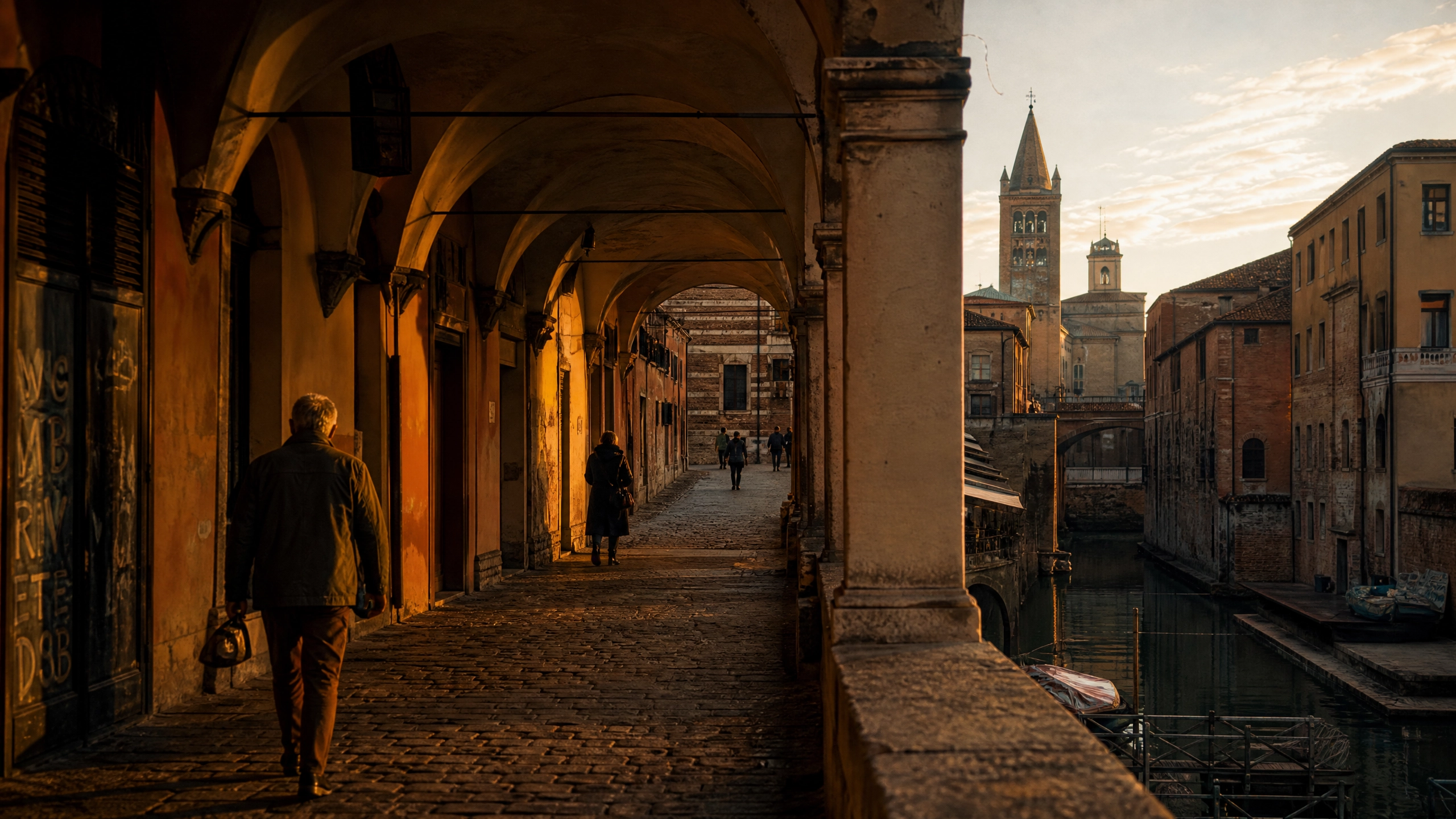
The portici — the 40 kilometers of covered arcades that run through the city and that UNESCO designated a World Heritage Site in 2021 — are not a tourist attraction. They are infrastructure. Bologna built them in the twelfth century to accommodate a growing university population, and they have been in continuous use ever since. Walking Bologna in the rain is a different experience than walking any other Italian city in the rain: you are never wet. The arcades create a city that is entirely walkable in any weather, a city that has been thinking about pedestrian comfort for nine hundred years.
For the full culinary geography — from the Quadrilateri to the specific osterie that have served the same menu since the 1970s — the Bologna food guide maps the city's eating in the order and context that makes it legible rather than overwhelming.
Ghent: What Medieval Europe Actually Looked Like
Where Bologna rewards the traveler who wants to understand what a cuisine is before it became famous, Ghent rewards the traveler who wants to understand what medieval Europe actually looked like before it became a postcard.
Bruges gets all the attention because Bruges is perfectly preserved and therefore perfectly legible to a tourist's eye. The canals, the belfry, the guild houses — it is beautiful and it is also, in a specific way, finished. Bruges resolved itself into a heritage site sometime in the late twentieth century and has been maintaining that resolution ever since. Ghent is also medieval, also canal-crossed, also Flemish — and it is still a living city. The Gravensteen castle rises from the center of a working neighborhood. The Graslei harbor's guild houses are the backdrop for a street that students use to get between lectures. The Friday market at the Vrijdagmarkt has been happening since the Middle Ages, and the vendors selling vegetables and second-hand clothing on a Friday morning are not performing for anyone.
The reason to go to Ghent specifically, the reason that makes it irreplaceable rather than just pleasant, is in St. Bavo's Cathedral. The Ghent Altarpiece — The Adoration of the Mystic Lamb, completed by Jan and Hubert van Eyck in 1432 — is one of the most important paintings in the history of Western art. It was stolen by Napoleon, stolen again by the Nazis, recovered by the Monuments Men, and has been the subject of more theft attempts than any other artwork in history. The panels were recently returned after a multi-year restoration that is the most technically sophisticated conservation project in Belgian history, and the current installation in the cathedral's Vijdkapel allows closer viewing than has been possible for decades. You can stand close enough to see the individual brushstrokes in the lamb's wool.
The Dok Noord neighborhood — a former industrial port on the northern edge of the city center — is being converted into Ghent's creative district and is almost entirely absent from existing travel content. The warehouses along the canal have been occupied by design studios, independent restaurants, and a weekend market that draws the city's younger residents rather than its tourists. It is the neighborhood that shows you what Ghent is becoming rather than what it has been.
Ghent's jenever culture — the city's specific tradition of grain-based gin, distinct from Dutch jenever and from London dry gin — is best experienced at the brown cafés along Vrijdagmarkt and Groentenmarkt. Order a young jenever (jonge) if you want something clean; an old jenever (oude) if you want something that tastes like the nineteenth century. The correct accompaniment is a Ghent-brewed beer, and the correct bar for this combination is one where the average age of the clientele is over fifty and the music is not audible.
The Ghent couples guide, solo guide, and family guide cover the city from three different angles — each one routes the same medieval core through a different set of priorities.
San Sebastián: What Eating Seriously Means
Where Ghent rewards the traveler who wants to understand what a place looked like before it became famous, San Sebastián rewards the traveler who wants to understand what it means to take food seriously as a civic value rather than a lifestyle choice.
Every traveler who has been to Barcelona has eaten well. San Sebastián makes Barcelona's food scene look like a warm-up. The city has more Michelin stars per capita than anywhere else on earth — including Tokyo, including Paris — and the pintxos culture of the Parte Vieja makes the question of where to eat lunch a genuinely difficult decision that rewards an entire afternoon of research and grazing. But the Michelin stars are almost beside the point. The point is the pintxos bars, and the specific culture around them, and what that culture reveals about how a city can organize itself around the act of eating well.
The distinction that most visitors miss is the difference between the tourist-facing bars on Calle Fermín Calbetón and the bars that locals actually use on Calle 31 de Agosto, one street over. The tourist bars are good. The local bars are the reason to be in San Sebastián. The difference is visible in the clientele, in the quality of the anchovies, and in whether the person behind the bar knows your name by your third visit.
Bar Nestor on Calle Pescadería is the specific address that requires planning before you arrive. The bar serves exactly two things: a tortilla de patatas and a tomato salad dressed with olive oil and salt. Nestor makes one tortilla per service — lunch and dinner — and the queue for a slice forms an hour before it comes out of the oven. The tortilla is runny in the center in the way that Basque tortilla is supposed to be, and it is one of the most argued-about dishes in a city that argues about food the way other cities argue about football. Arrive early, put your name on the list, and come back when they call you.
The Gros neighborhood, on the eastern side of the Urumea River, is where the city actually lives when it is not performing for visitors. The bars are cheaper, the pintxos are less elaborate, and the morning surf culture at Zurriola beach — the break that faces the open Atlantic rather than the protected bay of La Concha — gives the neighborhood a different energy than the Parte Vieja. La Concha beach is beautiful and it is also, by 10am in summer, full. The correct time to swim at La Concha is before 8am, when the locals swim before the tourists arrive and the beach has a morning character that the afternoon version doesn't.
The San Sebastián food guide and couples guide both route the city through its eating — the food guide with the depth of a four-day culinary itinerary, the couples guide with the specific rhythm of a city that is best experienced slowly and together.
Ljubljana: What a Small Capital Does Right
Where San Sebastián makes the case that a city can organize itself entirely around the act of eating, Ljubljana makes the case that a city can be extraordinary without being large, famous, or exhausting.
Ljubljana is the capital of Slovenia — a country that most European travelers have never visited — and it is the most walkable city in Europe. That is a specific and defensible claim. The Ljubljanica River runs through the center, the castle sits on a hill above it, the Triple Bridge connects the old town to the new, and the entire city is so compact that you can walk from the train station to the castle in twenty minutes and cover its essential character in a long afternoon. The scale is the point. Ljubljana is the argument that not every great European city needs to be large, famous, or exhausting.
The architectural language of the city is almost entirely the work of one man: Jože Plečnik, the Slovenian architect who studied under Otto Wagner in Vienna and then returned to Ljubljana in the 1920s to redesign the city in a style that is neither Art Nouveau nor modernist but something specific to him and to this place. The Triple Bridge, the Central Market along the Ljubljanica, the National and University Library, the covered market colonnade — all Plečnik, all unmistakable, all part of a coherent vision for what a small capital should look like. Walking Ljubljana is walking through one architect's argument about civic space, and the argument is convincing.
The Saturday morning market along the Ljubljanica — the open-air section of Plečnik's Central Market — is where the city's character is most visible. Local farmers sell produce, honey, and dried mushrooms. The flower stalls are permanent. The fish market in the covered colonnade opens at 7am and closes when the fish is gone. This is not a tourist market. It is the market where Ljubljana buys its food, and it has been in this location, in this form, since Plečnik designed it in the 1940s.
Metelkova, fifteen minutes' walk from the city center, is the experience that no other European capital offers. The former Yugoslav military barracks was squatted by artists and activists in 1993 when the Slovenian army vacated it, and it has been operating as an autonomous cultural center ever since. The complex contains bars, galleries, music venues, and a hostel, all in buildings that have been painted, sculpted, and altered by the artists who have occupied them for thirty years. It is chaotic and specific and entirely unlike anything you will find in Vienna or Budapest or any of the other Central European capitals that get more attention than Ljubljana.
The Ljubljana couples guide and family guide both approach the city from the Plečnik architecture outward — the correct sequence for a city whose built environment is its most specific quality.
Porto: The City Lisbon Overshadowed
Where Ljubljana makes the case for the small capital that gets everything right, Porto makes the case for the city that has been misrepresented by its own country's more famous alternative.
Every traveler who has been to Lisbon thinks they have been to Portugal. Porto is the argument that they have been to one version of it. The two cities are as different from each other as Barcelona and Madrid — different in character, different in pace, different in what they value and what they show. Lisbon is horizontal and melancholic, a city that spreads across seven hills and looks out at the Tagus with the specific sadness of a maritime empire that peaked in the sixteenth century. Porto is vertical and stubborn. The city climbs the hillside above the Douro in a way that makes every walk either a climb or a descent, and the effort is part of the experience. Porto does not make things easy for you, and it does not apologize for this.
The wine lodge culture of Vila Nova de Gaia — the riverside quarter directly across from the city center, connected by the Luís I Bridge — is the most specific and unreplicable cultural experience in Portugal that isn't a fado house. The lodges where Port wine has been aging in barrels since the eighteenth century are open for visits, and the difference between them is worth knowing before you arrive. Graham's Lodge is the choice for the museum and the historic cellar — the collection of vintage Ports going back to the 1880s, the explanation of the wine-making process, the tasting in a room that smells of oak and time. Taylor's Lodge is the choice for the terrace at sunset, a view across the Douro to Porto's hillside that is one of the best views in Europe, with a glass of tawny Port that costs less than a coffee in London.
The Mercado do Bolhão, Porto's central market, reopened in 2022 after a six-year restoration that returned it to its original 1914 iron-and-glass structure. The market had been deteriorating for decades — the iron rusting, the vendors leaving, the building becoming a monument to what it had been rather than what it was. The restoration brought the vendors back, and the market is now what it was designed to be: a covered arcade where fish, produce, flowers, and prepared food are sold on two levels around a central courtyard. Go on a weekday morning before 10am.
Rua das Flores — the pedestrian street that runs between the Palácio da Bolsa and the Praça Almeida Garrett — is where Porto actually shops, as opposed to the tourist-facing Ribeira waterfront. The street has independent bookshops, tile shops, wine bars, and the kind of hardware store that has been selling the same things in the same location for forty years. Livraria Lello, the bookshop that inspired J.K. Rowling and now charges €5 entry (deductible from any purchase), is on a side street off Rua das Flores. The correct time to visit is immediately when it opens at 9am, before the Harry Potter tourist crowds arrive.
Porto's guide cluster is the deepest on this list. The Porto city break guide, food guide, budget guide, solo guide, couples guide, and family guide cover the city from every angle — and the Lisbon & Porto 7-day itinerary sequences both cities together for travelers who want to understand the contrast rather than choose between them.
Tbilisi: The Edge of Europe's Known World
Where Porto rewards the traveler who wants to understand what a country looks like when you go beyond its most famous city, Tbilisi rewards the traveler who wants to understand what Europe looks like at its eastern edge — where the continent becomes something else entirely.
Tbilisi is the furthest east that most European itineraries reach, and it is the city that makes a well-traveled European visitor feel, for the first time in years, that they are somewhere genuinely new. The old town's carved wooden balconies lean over streets that are too narrow for cars. The sulfur baths of Abanotubani — the neighborhood named for its natural hot springs, which have been in use since the fifth century — are built into the hillside below the Narikala fortress, their domed rooftops visible from the castle walls above. Georgian Orthodox churches coexist with mosques and synagogues on the same street, a spatial arrangement that is the product of a specific history rather than a design decision. Tbilisi is the city at the intersection of Europe, Asia, and the Middle East, and it wears that intersection in its architecture, its food, its wine, and its face.
The sulfur bath experience requires a decision before you arrive: public bath or private room. The public baths are cheaper and more social — you share the pool with strangers, which is the Georgian way, and the experience is communal in a way that private rooms are not. The private rooms are more comfortable and allow you to control the temperature and the duration. The specific bath houses worth visiting are Chreli-Abano on Grishashvili Street for the private room experience, and the Royal Bath (Orbeliani) on Abanotubani Square for the exterior — the blue-tiled facade is the most photographed building in Tbilisi. The bath houses that cater exclusively to tourists are identifiable by the English-language signs and the prices quoted in euros.
The Dry Bridge flea market, held on weekends along the bridge and the park below it, is the largest outdoor antiques and curiosities market in the Caucasus. Soviet-era cameras, Orthodox icons, hand-painted oil portraits of Georgian heroes, military medals, carpets, and objects whose provenance is entirely unclear are sold by vendors who have occupied the same spots for decades. The market is not curated. It is not organized. It is the accumulated material culture of a country that has been at the intersection of empires for two thousand years, and it is one of the most interesting places to spend a morning in Europe.
Georgia's natural wine culture — the country claims 8,000 years of continuous wine production, and the amber wines made in qvevri (clay vessels buried in the earth) are unlike anything produced in France or Italy — is most concentrated at Vino Underground on Galaktion Tabidze Street in the old town. The bar opened in 2013 and has been the specific address where Georgia's natural wine revival is most legible to a visitor: the wine list is organized by grape variety and region, the staff can explain the difference between a Rkatsiteli made in qvevri and one made in stainless steel, and the courtyard in summer is one of the better places to spend an evening in any European city.
The Narikala fortress at dusk, when the tour groups have left and the city spreads below in the specific golden light of the Caucasus, is the view that makes the trip irreversible. You understand, standing there, that you have reached the edge of something — that the Europe you know ends here and something older and more complicated begins.
The Tbilisi food & wine guide and couples guide both approach the city through its most specific qualities — the food guide through the qvevri wine culture and the khinkali dumplings and the specific restaurants where the city's culinary identity is most concentrated, the couples guide through the old town's architecture and the sulfur baths and the evening rhythm of a city that stays up late.
The Cities That Didn't Make This List — and Why
Every competitor post on this topic defaults to the same second-tier list: Dubrovnik, Edinburgh, Budapest, Vienna, Copenhagen. These are excellent cities. They are also exactly what every other "beyond the obvious" European travel post recommends, which means they have become the new obvious. A traveler who has done Paris and Rome has almost certainly already researched Budapest and Edinburgh. They appear on every list. They have their own guidebooks, their own Instagram hashtags, their own tourist infrastructure that has grown to match their reputation.
Dubrovnik is extraordinary and it is also, in July and August, one of the most overcrowded places in Europe — the city walls that make it famous are now a queue rather than a walk, and the cruise ship arrivals have changed the character of the old town in ways that are visible and documented. Edinburgh is one of the great cities of the British Isles and it is also, for a traveler who has done London, a city that operates within a familiar cultural and linguistic framework. Budapest is beautiful and it is also, in the travel content ecosystem, thoroughly mapped — the ruin bars, the thermal baths, the Parliament building at night have been photographed and described so many times that arriving there feels like recognizing something rather than discovering it.
Vienna belongs in a separate category: it is one of the great cities of the world and it is not on this list because it is not a consolation prize for having done Paris — it is a destination that deserves its own trip, its own preparation, its own argument. Vienna is not the next tier. It is a different tier entirely, and conflating it with the cities on this list would be a disservice to both.
The cities on this list are here because they stopped competing with the obvious choices and became something more specific. Bologna stopped competing with Rome for Italy's culinary capital and became the place where the cuisine was invented. Ghent stopped competing with Bruges for Belgium's medieval showcase and became the city where medieval architecture is still inhabited rather than preserved. San Sebastián stopped competing with Barcelona for Spain's food city and accumulated more Michelin stars per capita than anywhere on earth. Ljubljana stopped competing with Vienna and Budapest for Central Europe's attention and became the most walkable capital on the continent. Porto stopped competing with Lisbon for Portugal's most famous city and became the city that shows you what Portugal looks like when it isn't performing for visitors. Tbilisi stopped competing with European capitals entirely and became the edge of the known world.
Planning Your Trip: How to Choose
These six cities are geographically spread across Europe and do not suggest a single routing. The correct approach is to choose based on what you are specifically looking for rather than trying to combine them all.
If food is the primary reason you travel: Bologna and San Sebastián are the two most important food cities in Europe that most travelers have never visited. Bologna for the cuisine that the rest of Italy is still interpreting; San Sebastián for the pintxos culture and the Michelin-starred restaurants and the specific experience of a city that has organized itself around eating well. Both reward at least four days. Both have guide coverage to plan the full culinary itinerary.
If you want to understand a place rather than collect it: Ghent and Ljubljana are the cities on this list that reward the traveler who wants depth over breadth. Ghent for the Van Eyck altarpiece and the medieval city that is still a living place; Ljubljana for the Plečnik architecture and the Metelkova cultural center and the Saturday market. Both are compact enough to feel fully explored in three days.
If you want somewhere genuinely new: Porto and Tbilisi are the cities that will recalibrate your sense of what European travel can be. Porto for the wine lodge culture and the vertical city and the market that just reopened; Tbilisi for the sulfur baths and the natural wine and the specific feeling of having reached the edge of something. Porto rewards three to four days; Tbilisi rewards at least five.
Budget range: Ljubljana and Ghent are the most affordable of the six — both are significantly cheaper than Amsterdam or Paris, and the cost of eating and drinking well is lower than in any comparable Western European city. San Sebastián is the most expensive, though the pintxos culture means that eating extraordinarily well is possible at bar prices. Bologna, Porto, and Tbilisi fall in the middle range, with Tbilisi being the most affordable city on the list by a significant margin — a full day of eating, drinking, and visiting the sulfur baths costs less than a single meal at a mid-range restaurant in London.
Plan Your Europe Trip with Leif
These guides were built for travelers who have already done the obvious and are ready for what comes next — not as a consolation tier, but as the layer of Europe that rewards the traveler who arrives without the expectations that famous cities impose. Use them to plan the specific trip rather than the general one.
- Bologna Food Lover's Guide: 4 Days of Culinary Bliss
- Ghent for Couples: A Romantic 3-Day Escape
- Ghent Solo Travel: 3-Day Itinerary for Independent Explorers
- Ghent with Kids: A 3-Day Family Adventure
- San Sebastián Foodie Paradise: A 4-Day Culinary Journey
- San Sebastián for Couples: A Romantic 4-Day Itinerary
- Romantic Ljubljana for Couples: A 3-Day Enchanting Escape
- Ljubljana Family Fun: A 3-Day Adventure for All Ages
- Porto City Break: A 4-Day Urban Adventure Guide
- Porto Food Guide: 4 Days of Francesinha, Port Wine & Bacalhau
- Porto on a Budget: 4-Day Guide
- Porto Solo Travel: A 3-Day Itinerary
- Porto for Two: A Romantic 3-Day Couples' Getaway
- Porto Family Fun: A 3-Day Adventure for All Ages
- 7-Day Lisbon & Porto City Escape
- Tbilisi Food & Wine: 4-Day Khinkali, Natural Wine & Mtsvadi Guide
- Tbilisi for Two: A Romantic 4-Day Couple's Escape
The Cities That Stopped Competing
The traveler who has done Paris and Rome and Barcelona and Amsterdam has not exhausted Europe. They have completed the introduction. The cities on this list are what comes after the introduction — the places that have been accumulating their specific qualities for centuries without needing the attention of the world to validate them.
Bologna has been making ragù since before France invented haute cuisine. Ghent has been living inside its medieval architecture since before Bruges decided to become a heritage site. San Sebastián has been taking food seriously since before the Michelin Guide existed. Ljubljana has been walking its compact, Plečnik-designed streets since before Central European tourism discovered Budapest. Porto has been aging Port wine in the lodges of Vila Nova de Gaia since before Lisbon became the city everyone wanted to visit. Tbilisi has been making wine in qvevri since before the Roman Empire.
These cities did not stop competing with Paris and win by accident. They won by becoming so specifically themselves that comparison became irrelevant. That is the trip. That is what comes next.